You’re wondering whether you need to learn Kyrgyz before you go. Here’s the plain answer, the kind you’d get from a friend who’s looked into it: no, you don’t, and if you’re going to memorize anything, a handful of Russian words will actually get you further than Kyrgyz will.
Russian is the practical lingua franca across Kyrgyzstan: nearly everyone in towns speaks it, it’s the language of transport, markets, and hotels, and a dozen Russian phrases plus a translation app will cover almost any situation. Kyrgyz is the national language and the mother tongue of most people, so a few Kyrgyz words are a lovely icebreaker, especially in villages, but you never strictly need them. English exists only in pockets. Let’s break down what to actually learn.
Why Russian usually wins
Kyrgyzstan is genuinely bilingual in practice. Kyrgyz is what families speak at home and what you’ll hear in the countryside; Russian is the language that greases daily transactions, particularly in Bishkek, where it’s often the default even among ethnic Kyrgyz. Marshrutka drivers, market vendors, taxi apps, guesthouse owners, pharmacists — overwhelmingly, the common tongue with a foreigner will be Russian.
So if you have any Russian at all, use it without hesitation. Nobody will be offended that you’re not speaking Kyrgyz; Russian is a completely normal, everyday choice. The one place the balance tips is rural and southern: in remote villages, in parts of the Osh region, and among older or very young people, Kyrgyz may be stronger than Russian, and a few Kyrgyz words go a long way. Even there, though, someone nearby usually speaks enough Russian to bridge a gap.
The phrases actually worth memorizing
Keep it small. You don’t need a phrasebook’s worth, you need the ten or so lines that come up constantly. Here they are in both languages, so you can pick whichever fits the moment. Kyrgyz greetings in particular land warmly; the rest you can lean on Russian for.
| Meaning | Kyrgyz | Russian |
|---|---|---|
| Hello | Salamatsyzby (formal) / Salam (casual) | Zdravstvuyte / Privet |
| Thank you | Rahmat | Spasibo |
| Yes / No | Ooba / Jok | Da / Net |
| Please / You’re welcome | Suranych / Arzybayt | Pozhaluysta |
| How much? | Kancha? | Skolko? |
| Where is…? | …kayda? | Gde…? |
| Goodbye | Jakshy kalyngyz | Do svidaniya |
| Delicious / Very good | Daamduu / Jakshy | Vkusno / Khorosho |
| I don’t understand | Tushunboy jatam | Ya ne ponimayu |
| Do you speak English? | Anglische suyloysuzbu? | Vy govorite po-angliyski? |
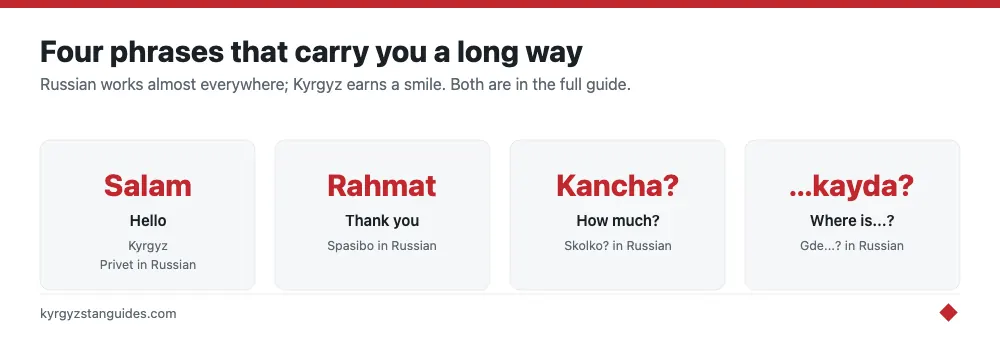
If you learn only three things, make them Salam, Rahmat, and Kancha? — hello, thank you, and how much. A cheerful “Rahmat” after a meal or a market purchase reliably earns a smile, because it signals you noticed Kyrgyz exists rather than defaulting to Russian for everything. That small courtesy is worth more than fluency. If those first words leave you curious about the language itself, our Kyrgyz proverbs guide gives a literal translation and the source collection for each saying.
A quick word on the Cyrillic alphabet
Both Kyrgyz and Russian are written in Cyrillic, and this is the single most useful thing you can prep before arriving. Signs, menus, marshrutka destination boards, and shop names are overwhelmingly in Cyrillic, with Latin transliteration inconsistent at best. You don’t need to speak a word to benefit from being able to sound out letters.
Spend an hour learning the Cyrillic alphabet and a surprising amount clicks into place: you’ll recognize that a marshrutka board reading “Каракол” is Karakol, that “кафе” is cafe, that “аптека” is pharmacy. Kyrgyz Cyrillic adds three letters Russian doesn’t have (Ң, Ө, and Ү) but they’re minor. The payoff for that one hour of study is out of all proportion to the effort, and it makes navigating far less stressful than any spoken phrase.
Apps that carry the load
Realistically, a translation app is your workhorse, and you should set it up before you fly. Google Translate handles Russian and Kyrgyz, download both language packs for offline use, because you’ll often be out of signal exactly when you need them, as covered in our Kyrgyzstan SIM card guide. The camera-translate feature is the star: point it at a Cyrillic menu or a bus schedule and it renders a usable English version instantly.
Yandex Translate is worth having as a backup, since it often handles Russian a touch more naturally and works well offline too. For actually learning a few words, a short Russian starter course on any language app before your trip beats trying to cram Kyrgyz grammar, which is a tricky Turkic language you won’t crack in a week. Keep expectations right: apps are for bridging, not for holding a conversation, and a friendly gesture plus a photo of a place name will solve most navigation problems.
Where you’ll find English
English is patchy but growing, and it clusters exactly where tourists go. You’ll find it among younger staff at the specialty cafes and hostels covered in our things to do in Bishkek guide, at trekking and tour agencies, in the community-based tourism (CBT) offices that arrange homestays and guides, and with professional mountain guides — who often speak solid English precisely because it’s their trade.
Outside that bubble, assume none. Marshrutka drivers, small-town shopkeepers, and rural guesthouse hosts generally won’t speak English, and that’s where your app, your Cyrillic reading, and a cheerful “Salam, Rahmat” do the heavy lifting. The good news is that Kyrgyz hospitality fills a lot of the gap, people are patient, gestures work, and a shared cup of tea communicates plenty. If you’re mapping out a first trip, our one-week Kyrgyzstan itinerary keeps you mostly on the routes where communication is easiest.
Bottom line: don’t stress about the language. Learn to read Cyrillic, load an offline translation app, memorize three Kyrgyz words for goodwill and a dozen Russian ones for function, and you’re fully equipped. The rest sorts itself out over tea.
Frequently Asked Questions
Do I need to speak Kyrgyz to travel in Kyrgyzstan?
No. Russian is the practical common language across the country and will cover almost every situation, from transport to markets to hotels. A few Kyrgyz words like “Salam” (hello) and “Rahmat” (thank you) are a warm gesture, especially in villages, but you never strictly need them. A translation app fills any remaining gaps.
Is English widely spoken in Kyrgyzstan?
Only in pockets. You’ll find English among younger hostel and cafe staff in Bishkek, at tour and trekking agencies, in community-based tourism offices, and with professional mountain guides. Outside those tourist-facing settings (marshrutka drivers, small shops, rural homestays) assume little to no English and rely on an offline translation app.
Should I learn the Cyrillic alphabet before I go?
Yes, and it’s the highest-value hour of prep you can do. Both Kyrgyz and Russian use Cyrillic, and most signs, menus, and marshrutka destination boards are written in it with little Latin transliteration. Being able to sound out letters lets you recognize place names and shop types without speaking a word.
Is Russian or Kyrgyz more useful for travellers?
Russian, clearly. It is the practical lingua franca: nearly everyone in towns speaks it, and it is the language of transport, markets and hotels. A dozen Russian phrases plus a translation app covers almost any situation.
Should I learn any Kyrgyz at all?
A few words, yes — not because you need them but because they land well. Kyrgyz is the national language and the mother tongue of most people, and a greeting in Kyrgyz is a genuine icebreaker, especially in villages.
Will I manage with just a translation app?
For most practical situations, yes, provided you have downloaded the Russian language pack for offline use. Signal disappears in the mountains, and an app that needs a connection is no use at the moment you actually need it.