Five hundred som, less than $6, buys you a month of mobile service with up to 50 GB of data in Kyrgyzstan. That single number should shape your whole connectivity plan: this is one of the cheapest countries on the planet per gigabyte, so there's no reason to ration maps, uploads, or video calls.
The short answer for 2026: get an O! SIM at an official office in Bishkek, passport in hand, for 300-500 KGS ($3.50-6) with 20-50+ GB included — and skip the airport kiosk, where the same thing costs two to three times more. Beeline and MegaCom sell near-identical packages; MegaCom has the edge in remote valleys, and all three go dead on high treks. The details, the eSIM math, and the honest coverage picture follow.
O!, Beeline or MegaCom: the three-minute decision
Kyrgyzstan has exactly three operators, and for a typical two-week loop through Bishkek, Issyk-Kul, and Karakol, any of them will do the job. The differences live at the margins: O! (run by locally focused Nur Telecom) has the fastest 4G in Bishkek and the most useful app; MegaCom (state-owned) traditionally reaches a little further into Naryn province and the southern valleys; Beeline is the veteran with solid city performance and the most walk-in shops.
| Operator | Tourist package (typical) | Coverage strength | Best for |
|---|---|---|---|
| O! | 300-500 KGS for 20-50 GB + calls | Excellent in cities, Chüy valley, Issyk-Kul north shore | Most travelers; best app (O! Dengi) |
| MegaCom | 300-500 KGS for 20-40 GB | Best rural reach: Naryn province, Suusamyr, parts of Song-Kul | Remote itineraries; drivers and guides carry it |
| Beeline | 300-550 KGS for 20-50 GB | Strong in Bishkek, Osh, Fergana-side towns | South-heavy trips; easiest to find shops |
One telling detail: guides on horse treks and jeep tours overwhelmingly carry MegaCom, which says everything about who wins outside the towns. Serious trekkers and photographers sometimes run both — O! as the daily driver, MegaCom in the second slot of a dual-SIM phone — for a combined outlay under $10. For everyone else, one SIM is plenty.
Buy it in town, not at the airport
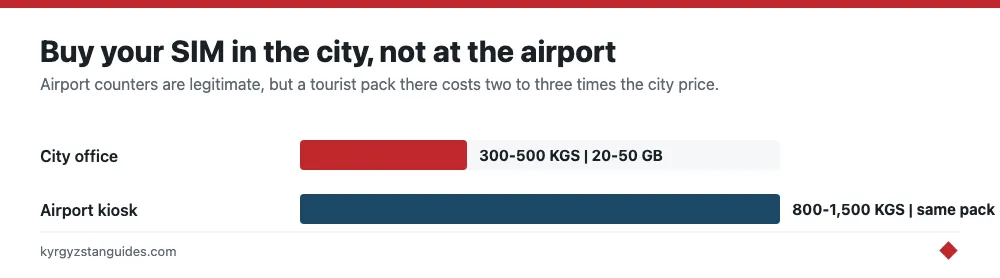
The O! and Beeline counters in Manas Airport arrivals are legitimate and open around the clock, but their “tourist packs” run 800-1,500 KGS for what costs 300-500 KGS in the city. If you land at 3 a.m, buy one without guilt, it is still only $10-17 — otherwise hold out for a proper office.
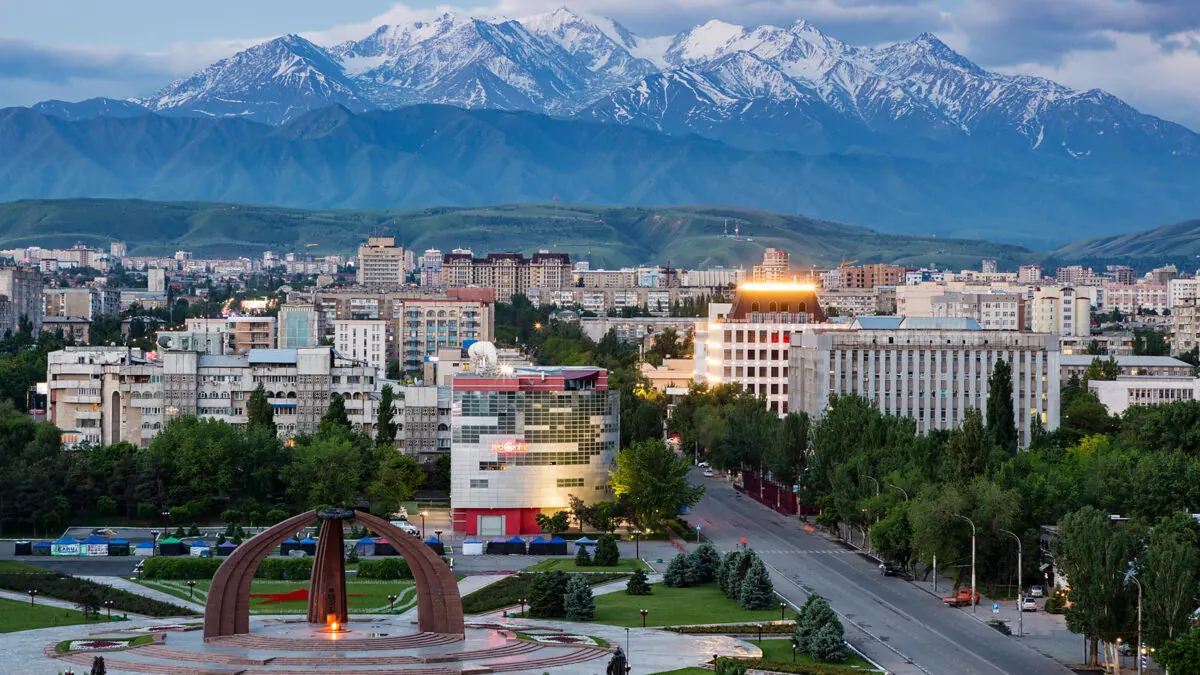
In Bishkek, official shops cluster along Chuy Avenue, around Ala-Too Square, and inside the Bishkek Park and Dordoi Plaza malls, with more near Osh Bazaar. Bring your passport. Registration is legally required. Staff scan it and activate the SIM on the spot in about ten minutes. What you shouldn't do is buy the pre-registered SIMs hawked at bazaar stalls: they're registered to strangers and get blocked in periodic purges. Every regional center has operator offices too, so buying on arrival in Karakol or Osh works just as well if Bishkek is only your transit point.
What packages actually cost
The traveler sweet spot is a 30-day bundle at 300-500 KGS ($3.50-6) with 20-50 GB, unlimited on-net calls, and enough off-net minutes to phone guesthouses and drivers. Heavier plans with 60-100 GB or unlimited social media run 500-700 KGS. Data-only SIMs exist, but the combo packages cost the same and you genuinely want a local number, yurt camps, CBT coordinators, and drivers all confirm bookings by phone or WhatsApp call, not email.
- Have the shop install the operator app and switch it to English or Russian before you leave
- Packages auto-renew if your balance covers it: top up the day before renewal or you fall onto brutal per-MB rates
- Hotspot tethering is allowed on standard packages, so one SIM can feed a laptop
- 4G is the norm in towns; 5G exists only in patches of central Bishkek in 2026
The eSIM math (it’s lopsided)
Travel eSIMs work fine in Kyrgyzstan — Airalo sells 1 GB for 7 days at around $4.50, and regional Central Asia eSIMs covering Kazakhstan and Uzbekistan too run $15-30 for a mere 3-5 GB. Set one against a local package and the comparison collapses: the travel eSIM costs 10-20 times more per gigabyte than the 300-500 KGS local deal. There is a third option most travelers miss: O! and Beeline will issue their normal cheap package as an eSIM at their main offices, same passport process, same price — the best of both worlds if your phone supports it.
Our verdict: install a 1 GB Airalo eSIM before you fly so you land connected and can order a Yandex Go taxi, then switch to the local SIM within a day or two. Skip the regional multi-country eSIMs unless you're hopping three borders in three weeks.
Staying months? Know the IMEI rule
Kyrgyzstan runs a phone IMEI registration system. Tourists get a grace period, so for stays under 30-60 days your foreign phone simply works on a locally registered SIM. Remote workers and overlanders staying longer may eventually need to register the handset itself. A small fee at operator offices or via the state portal. Or risk the device being blocked from local networks. The rules have shifted several times, so ask at the counter when you buy; staff handle it daily. Keep your SIM registration receipt, and note the same passport can register several SIMs. Stay-length rules on the visa side are covered in our Kyrgyzstan visa guide.
Mountain coverage, honestly
Excellent along roads and settlements, nonexistent exactly where you most want to send photos. All three networks blanket Bishkek, Osh, the Chüy valley, and the entire Issyk-Kul ring road including Cholpon-Ata and Karakol; you will hold 4G most of the way to Naryn. Then coverage follows the highways and dies within kilometers of leaving them.
- Song-Kul: a bar or two of MegaCom or O! on certain hillocks near the yurt camps: nothing reliable
- Ala-Kul trek: no signal from shortly past the Karakol Valley entrance until Altyn Arashan; a few camps now run Starlink
- Kel-Suu and the Naryn border zone: nothing at all. Your driver’s word is the communication system
- Jyrgalan and Arslanbob: decent in the village, gone on the trails
- Rule of thumb: above the last village, assume zero and plan accordingly
Before any multi-day route from our Kyrgyzstan trekking guide, download offline maps (Organic Maps), leave your route with your guesthouse, and set expectations at home. Yurt camps increasingly sell an hour of Starlink Wi-Fi for 100-200 KGS: welcome, never guaranteed.
Top-ups, Wi-Fi and the VPN question
Topping up is a solved problem anywhere with electricity: the blue-and-orange cash terminals in every shop and petrol station take notes against your number (1-3% fee), and the operator apps — O! Dengi, MegaPay, Beeline — take local cards. Foreign Visa and Mastercard work in the apps inconsistently, so most travelers just feed the terminals; 200 KGS keeps a light user going for weeks. Guesthouse and café Wi-Fi is everywhere in Bishkek, Karakol, and Osh, the capital’s specialty cafés manage 20-50 Mbps, and thin elsewhere. The internet itself is essentially open in 2026: WhatsApp, Instagram, and booking sites all work, though the government has periodically restricted individual platforms (TikTok most notably), and current regulations sit on the state portal gov.kg. A VPN is a sensible pre-trip install for open Wi-Fi security, not a daily necessity.
Frequently Asked Questions
Which SIM card is best for tourists in Kyrgyzstan?
O! is the best all-rounder in 2026: strong 4G in cities and along Issyk-Kul, tourist packages around 300-500 KGS ($3.50-6) for 20-50+ GB, and the useful O! Dengi wallet app. MegaCom is worth considering if your trip is heavy on Naryn province and remote valleys.
Do I need my passport to buy a SIM card in Kyrgyzstan?
Yes. Registration is mandatory, and every official O!, Beeline, and MegaCom shop will scan your passport before activating the SIM. The process takes about ten minutes. SIMs sold unregistered at bazaars can be cut off without warning, so buy from an official office.
Is there mobile signal at Song-Kul or on treks?
Mostly no. Song-Kul has patchy reception on a few hilltops (MegaCom tends to work best), and multi-day treks like Ala-Kul are dead zones between trailhead and finish. Download offline maps, tell your guesthouse your route, and treat any signal above 3,000 m as a bonus.
Last check before you leave the shop: package active, app installed, hotspot tested, and 200 KGS of spare balance on top. That is your entire connectivity admin for the month. Done for the price of a coffee back home.
How much does mobile data cost in Kyrgyzstan?
Very little. The traveller sweet spot is a 30-day bundle at 300–500 som, about $3.50–6, with 20–50 GB plus unlimited on-net calls. Heavier plans with 60–100 GB run 500–700 som. It is one of the cheapest countries in the world per gigabyte, so there is no reason to ration maps or video calls.
Is it worth buying a SIM at Manas Airport?
Only if you land in the middle of the night. The O! and Beeline counters in arrivals are legitimate and open around the clock, but their tourist packs run 800–1,500 som for what costs 300–500 som in a city office. At $10–17 it is not a disaster, just poor value.
Is a travel eSIM or a local SIM better in Kyrgyzstan?
A local SIM, by a wide margin — travel eSIMs cost ten to twenty times more per gigabyte. A good compromise is a 1 GB Airalo eSIM installed before flying so you land connected enough to order a taxi, then a local package within a day. O! and Beeline will also issue their normal cheap package as an eSIM at their main offices.
Do I need to register my phone in Kyrgyzstan?
Not for a short trip. Kyrgyzstan runs an IMEI registration system but tourists get a grace period, so for stays under roughly 30–60 days a foreign phone works normally on a locally registered SIM. Longer stays may require registering the handset for a small fee. The rules have shifted several times, so ask at the counter.