Song-Kul is the best night you'll spend in Kyrgyzstan, and it is not close. The lake sits at 3,016 m on open summer pasture (jailoo) in Naryn province, reachable only from June to mid-September, and you sleep in nomad yurts for about 1,200–1,800 KGS ($14–20) per person including dinner and breakfast. There are no hotels, no electricity grid, and no towns — just grass, horses, herders, and a horizon that goes on forever. That is the appeal.
Plenty of places in Kyrgyzstan have bigger mountains or bluer water. Nowhere else combines a living nomadic economy with somewhere you can actually stay, at a price this low, with logistics this manageable. This guide covers how the yurt stays really work, how to book through CBT, which shore to choose, the 2–3 day horse trek in, the road approaches, and what to realistically expect at 3,000 m.
What and Where Is Song-Kul?
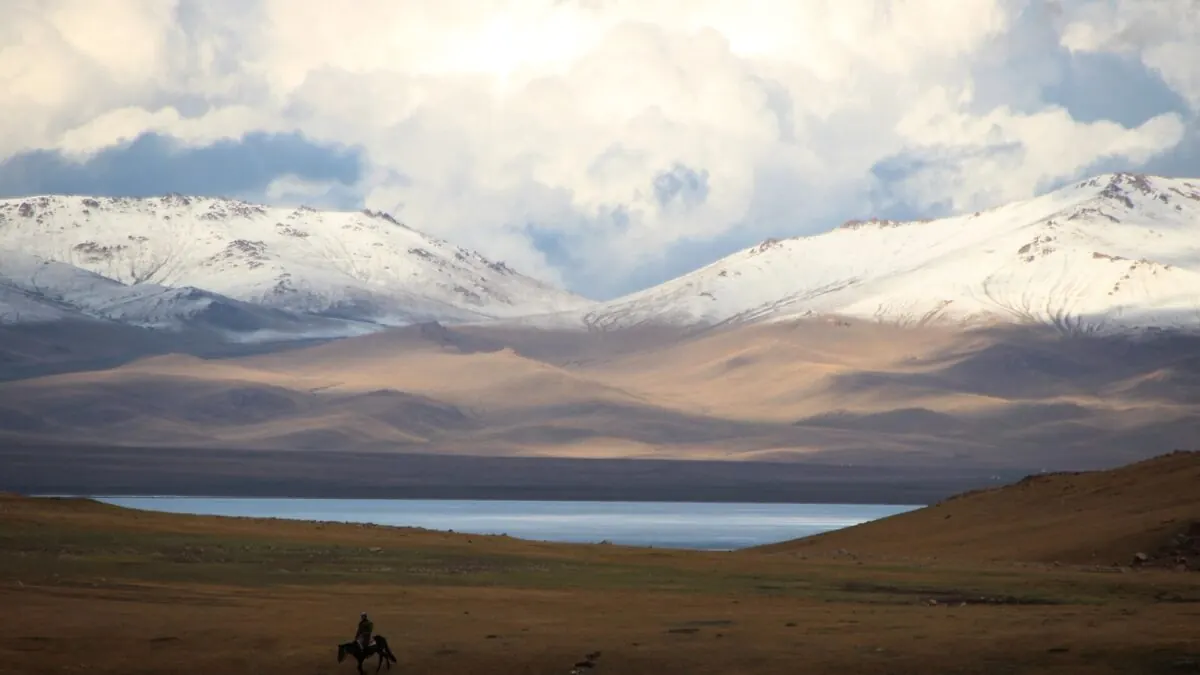
Song-Kul (also spelled Son-Kul or Song-Köl) sits in a treeless basin about 300 km southwest of Bishkek. It's Kyrgyzstan’s second-largest lake, 29 km long and 18 km wide, and the surrounding jailoo — high summer pasture — has been grazed by nomadic herders for centuries. From June to September, Kyrgyz families move up with their yurts, horses, sheep and yaks, and many host travelers as a side business. That last part matters: the camps aren't a folklore performance staged for tourists, but working households that happen to have spare beds. Sunset turns the whole basin gold; night brings some of the clearest star fields in Central Asia, with zero light pollution for fifty kilometers in any direction.
The Season Is Short. Respect It.
June to mid-September. The lake sits above 3,000 m, so the passes in are snowbound roughly eight months a year and the yurt camps pack up by late September. July and August are warmest (15–20°C days, 0–5°C nights) and busiest. Late June brings wildflowers and fewer people; early September brings golden grass, frosty mornings and the tail end of the season. Snow flurries are possible in any month — pack accordingly. Do not try to shoulder-season this one: an October visit means locked-up camps and a driver muttering about the pass. For the wider picture, read our guide to the best time to visit Kyrgyzstan.
What a Yurt Stay Is Actually Like
You sleep on thick felt mats and heavy blankets on the floor of a traditional yurt, usually shared with 2–5 other guests, warmed by a dung-fired stove that a host lights in the evening. Dinner is home cooking: fresh bread, jam, cream (kaymak), soup such as shorpo, and often plov or laghman, washed down with endless tea and — if you are game — kumis, fermented mare’s milk and the defining taste of the jailoo. Nobody pretends kumis is delicious; drink half a bowl, thank your host, and reach for the tea. The dishes you'll meet all week are covered in our Kyrgyz food guide.
A typical day has almost no schedule, which is the luxury. Breakfast around eight, then riding or shoreline walking; herders drive stock past the camps mid-morning and again at dusk, and watching a twelve-year-old control two hundred sheep from horseback never gets old. Afternoons bring wind and often a brief squall. Evenings are tea, dinner, cards, and the stars. Bring a book, and accept that your phone is now a camera.
Photographers should plan around the edges of the day. The flat midday light does the basin no favors, but the hour after sunrise — frost on the grass, smoke rising from stovepipes, horses being saddled — is as good as landscape mornings get, and the Milky Way shows up to the naked eye on any clear night. A small tripod weighs nothing in a car-based trip and belongs here more than anywhere else in the country.
How to Book: CBT Kochkor and CBT Naryn
The reliable route is Community Based Tourism (CBT), a network of local coordinators who place you with vetted host families. CBT Kochkor (on Pioneerskaya Street in Kochkor town) handles the northern shore; CBT Naryn covers the south. Walk in a day ahead, or email in advance in July–August. Expect 1,200–1,800 KGS ($14–20) per person per night including dinner and breakfast; lunch adds ~300 KGS. Independent yurt camps like those at Batai-Aral on the north shore take direct bookings too, at similar prices. No payment apps work up there — bring cash in som, in small notes.
North Shore or South Shore?
Most travelers end up on the northern shore around Batai-Aral without ever making a decision, because that's where the Kochkor logistics deliver you. It has the most camps, the easiest access over the Kalmak-Ashuu pass, and the most fellow travelers — sociable if you want company, mildly deflating if you imagined having the jailoo to yourself in August. The southern shore, reached from Naryn over the Moldo-Ashuu pass, has fewer camps, fewer visitors and the same lake. Verdict: first-timers on a loop through Kochkor should take the north shore and not overthink it; travelers routing via Naryn or craving quiet should ask CBT Naryn for a southern camp. The shoreline is 90 km around — nobody sees all of it, and no camp has a bad view.
What Song-Kul Costs in 2026
| Item | Price (KGS) | Price (USD) |
|---|---|---|
| Yurt stay per person (dinner + breakfast included) | 1,200–1,800 | $14–20 |
| Lunch at camp | ~300 | ~$3.50 |
| Horse hire per day | 1,000–1,500 | $11–17 |
| Horse guide per day (per group) | 1,800–2,500 | $20–28 |
| 2-day/1-night horse trek package (CBT, per person) | 7,000–9,500 | $80–110 |
| Shared taxi Bishkek to Kochkor | 400–500 | $4.50–6 |
| Private car Kochkor to Song-Kul (round trip or drop-off) | 4,000–6,000 | $45–68 |
Two nights at the lake with a horse day and shared transport comes to roughly $60–90 per person — details on stretching your som in our Kyrgyzstan travel budget breakdown. The single best value on that list is the horse: eleven dollars a day for the thing the place was built around.
The Horse Trek In: 2–3 Days from Kyzart
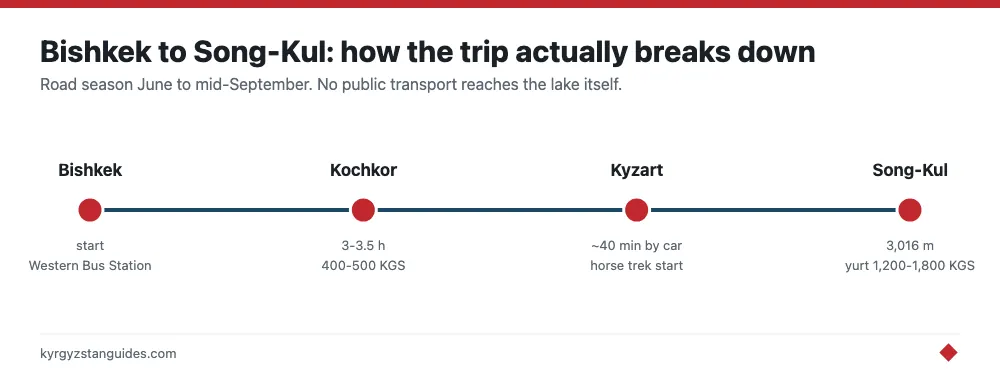
Arriving on horseback is the classic way in, and it changes the trip: instead of a bumpy drive delivering you to a camp, the lake appears below you after two days of riding through herders’ country, which is how it has been arrived at for a few hundred years. The most popular route starts at Kyzart village (about 40 minutes by car from Kochkor), climbs through the Kyzart pass area and working camps, and reaches the northern shore in two days, sleeping one night in a yurt en route at around 2,800 m. A three-day version loops further along the shore before descending.
CBT Kochkor and local operators like Shepherd’s Way run these treks with a horseman-guide, and no riding experience is needed — the horses are calm, sure-footed, and do this all summer. You ride 4–6 hours a day. Wear long trousers against the saddle, bring sunscreen for the back of your hands, and trust the horse on the steep bits; it has done this route more times than your guide has. Expect to be saddle-sore on day two and fine by day three. Committed walkers can trek the same route on foot in 2–3 days — our Kyrgyzstan trekking guide compares it with the country’s best hikes — but this is one place where the horse is the better tool.
Getting There by Road
There is no public transport to the lake itself. The standard approach: marshrutka or shared taxi from Bishkek’s main bus station on Alma-Atinskaya 1/1 to Kochkor (3–3.5 hours, 400–500 KGS), then a private 4×4 arranged through CBT or any driver in town for the final 2–2.5 hours over the Kalmak-Ashuu pass (3,446 m) to the north shore. From Naryn city, drivers reach the southern shore via the Moldo-Ashuu pass in about 2.5 hours. The roads are rough gravel switchbacks — spectacular, occasionally hair-raising, fine in a Delica or Land Cruiser, not fine in the rented sedan somebody attempts every summer. Coming from Kazarman or Jalal-Abad in the west, the Moldo-Ashuu approach also serves as a scenic link on a cross-country loop.
The 33 Parrots Pass Route
Drivers coming from the Kazarman road sometimes use the southern serpentine locals call “33 Parrots” (Teskey-Torpok), a stack of thirty-odd hairpin bends climbing the basin’s southwestern rim. It's the most dramatic road approach to Song-Kul and worth requesting in dry weather if you're circling toward Kazarman or Tash Rabat; after rain, stick to Kalmak-Ashuu.
Expect This, Not That
- No electricity grid: some camps run a solar panel for an evening bulb and phone charging; bring a power bank
- No showers: a basin of warmed water if you ask nicely; embrace two days of wet wipes
- Outhouse toilets: long-drop pits a short walk from the yurts — the headlamp belongs at 2 am
- Little or no phone signal: a weak spot of coverage near some camps at best; download offline maps first
- Cold nights: near freezing even in August; the blankets are heavy but bring a warm layer to sleep in
- No shops: carry cash, snacks, sunscreen and anything else you need from Kochkor
Families do fine here, for what it's worth — kids tend to remember the horses and the sheep long after the mountains blur together — but pack extra warm layers for small children and keep the first stay to two nights.
What to Pack for Two Nights
Everything comes up in the car with you, so this is less about weight than about not forgetting things Kochkor can't fix once you're on the jailoo:
- A warm sleep layer, thick socks and a hat — the stove dies overnight
- Headlamp for the outhouse run, plus a power bank per person
- Sunscreen and lip balm — the UV at 3,000 m burns through cloud
- Wet wipes and a small towel; hand sanitizer is worth the money
- Cash in small som notes for the stay, horses and any extras
- Snacks, a refillable bottle and purification tablets or a filter
- Long trousers if you plan to ride, sandals for around camp
- A book or a deck of cards — evenings are long and screenless
Three Mistakes to Avoid
First, booking a single night. The drive in and out eats most of two half-days, so one night means you experience Song-Kul mostly through a windshield. Second, arriving without enough cash — there's no ATM after Kochkor, and running short means cutting the horse day, which is the best thing here. Third, treating the camp like a hotel: hosts are herders first and innkeepers second, dinner happens when the animals are settled, and guests who roll with that rhythm consistently have a warmer, funnier, more generous stay than the ones checking their watches.
Tread Lightly
The jailoo is a working landscape, not a resort. Book through CBT or directly with host families so money stays with herders. Ask before photographing people, keep drones away from livestock, and pack out every scrap of rubbish — there's no collection service at 3,000 m. Ride established tracks rather than cutting across fragile turf, and go easy on water. Small camps of five yurts beat the larger tour-bus operations for both experience and impact. If you're unsure about travel logistics or etiquette generally, our is Kyrgyzstan safe guide covers the practical side.
Frequently Asked Questions
How many nights should you stay at Song-Kul?
Two nights is ideal. One night means arriving late afternoon and leaving after breakfast, which wastes the place. Two nights gives you a full day for riding or shoreline walking, plus a sunset and a starry night with margin for bad weather. Three nights suits riders doing the full horse trek loop.
Is Song-Kul cold at night?
Yes. Even in August, night temperatures at 3,016 m drop to 0–5°C, and frost is common by early September. Yurts are warm under thick blankets once the stove is lit, but bring a fleece, warm socks and a hat for the walk to the outhouse under the stars.
Do you need riding experience for the Song-Kul horse trek?
No. The horses used on the Kyzart–Song-Kul route are placid working animals that carry beginners all summer, and a horseman-guide accompanies every group. You'll be saddle-sore after 4–6 hours of riding, but genuine riding skill isn't required. Helmets are rare, so ask ahead if you want one.
Can you swim in Song-Kul?
You can wade and take a quick dip in July and August when the shallows warm to roughly 10–12°C, but it's bracing and the lake bottom is muddy in places. Most visitors settle for photographing the water rather than getting in it. There are no lifeguards or facilities.
Where Song-Kul Fits in a Trip
Song-Kul slots naturally into the middle of a northern loop: two nights at the lake between Bishkek and the Issyk-Kul side of the country, with Kochkor as the hinge. Our 10-day Kyrgyzstan itinerary shows exactly where it lands and what to cut if your dates are tight. However you route it, put Song-Kul in the first half of the trip — it's the experience everything afterwards gets measured against.
There is a slower way in: seven days on foot from Kyzyl-Oi through the Suusamyr valley, instead of the two-day jeep from Kochkor.
How much does a yurt stay at Song-Kul cost?
About 1,200–1,800 KGS ($14–20) per person per night including dinner and breakfast. You sleep on felt mats in a shared yurt warmed by a dung-fired stove, usually with 2–5 other guests. Book through CBT Kochkor for the northern shore or CBT Naryn for the south — walk in a day ahead, or email in advance for July and August.
When can you visit Song-Kul?
June to mid-September only. The lake sits at 3,016 m, the passes in are snowbound roughly eight months a year, and camps pack up by late September. July and August are warmest (15–20°C days, 0–5°C nights) and busiest; late June brings wildflowers, early September golden grass and frosty mornings. Snow flurries are possible in any month.