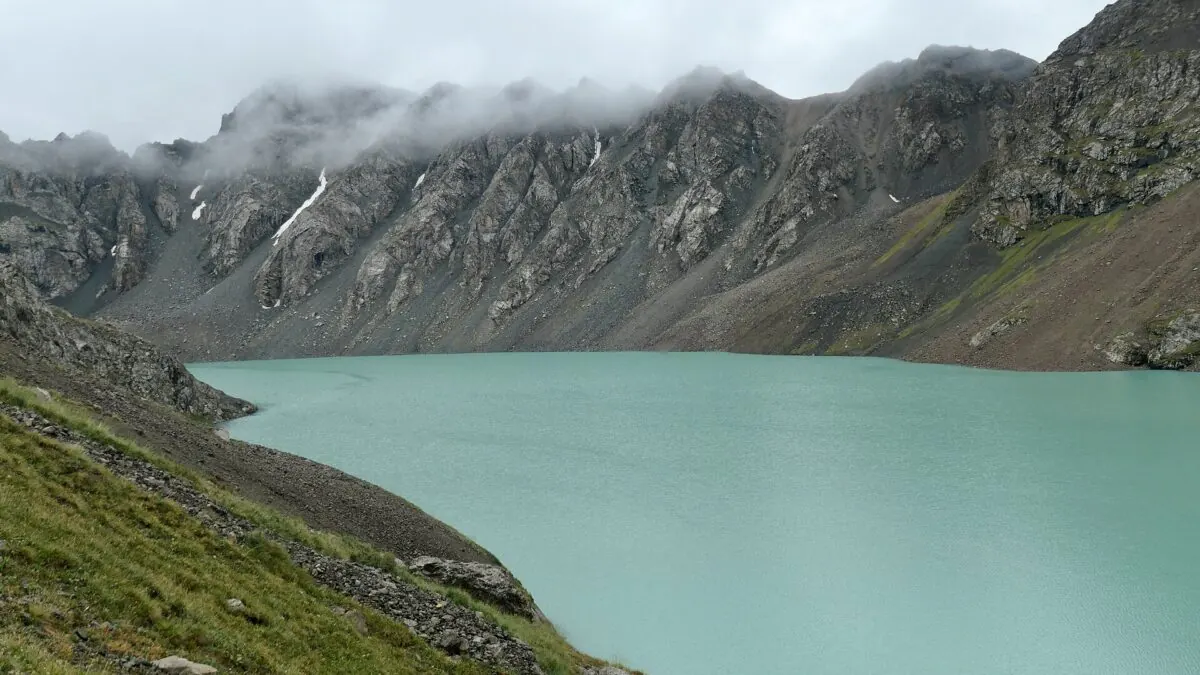
You haul yourself over the lip of the moraine at 3,500 m, catch your breath, and the water below is a shade of turquoise that looks faked. That is Ala-Kul: a glacial lake at 3,560 m in the Terskey Ala-Too range, reached on a 2–4 day trek from Karakol that crosses the 3,860 m Ala-Kul pass and finishes at the Altyn Arashan hot springs. The window is July to mid-September, the national park fee is around 500 KGS (~$6), and you can do it independently for under $50 or fully guided for $150–250.
This guide covers the classic route stage by stage, every realistic variation, honest difficulty notes, 2026 costs, gear and altitude strategy. If you're still planning the rest of your trip, start with our Karakol travel guide — the town is your base for everything here, from gear rental to the taxi to the trailhead.
Quick Facts
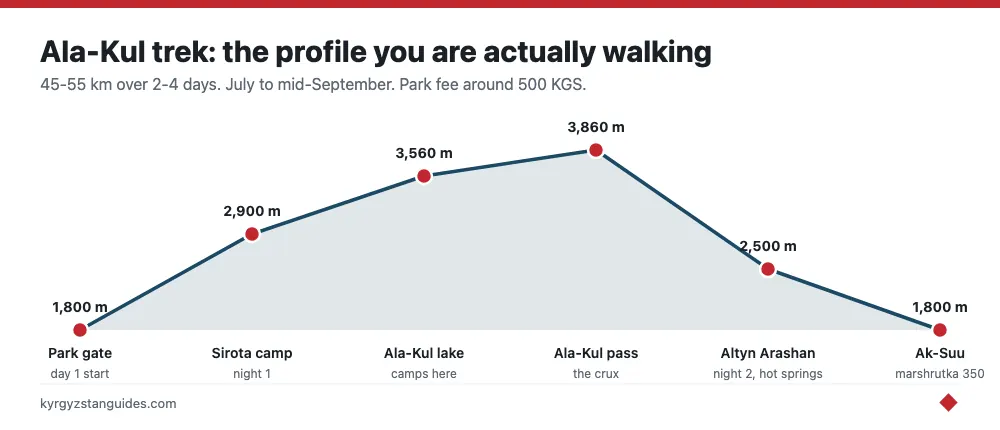
- Lake altitude: 3,560 m; the Ala-Kul pass tops out at 3,860 m
- Duration: 2–4 days (3 days is the sweet spot for most hikers)
- Distance: roughly 45–55 km depending on where transport drops you
- Start/finish: Karakol Valley (Karakol gorge) to Ak-Suu village via Altyn Arashan
- Season: July to mid-September; snow blocks the pass outside this window
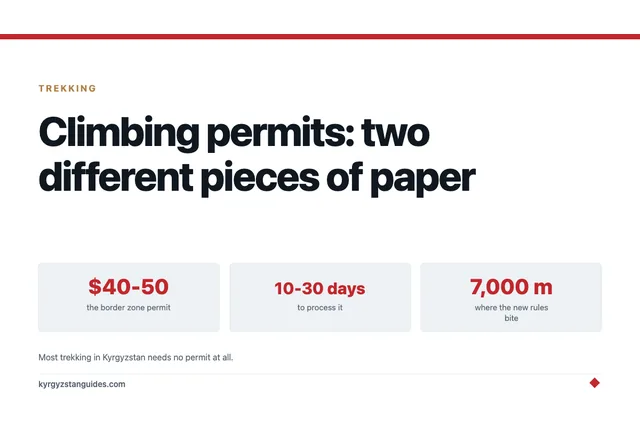
- Permits: none — just the Karakol National Park fee of ~500 KGS
Getting to the Trailhead
Everything starts in Karakol, which is a 6–7 hour marshrutka ride from Bishkek’s main bus station on Alma-Atinskaya 1/1 (500–600 KGS) or about five hours in a shared taxi (~1,000–1,200 KGS). Spend at least one night in town before you walk — both for acclimatization and because trek admin takes half a day: renting gear, buying trail food at the bazaar, withdrawing cash, and arranging the taxi to the start. On trek morning, a taxi covers the 30 minutes from town to the Karakol National Park gate in the Karakol gorge for 600–800 KGS; pay the ~500 KGS park fee at the barrier and keep the ticket, since it's occasionally checked upstream.
The Route, Stage by Stage
Almost everyone hikes the loop counter-clockwise: up the Karakol Valley, over the Ala-Kul pass, and down to Altyn Arashan. This direction spreads the altitude gain over two days and saves the hot springs for the end, which is exactly where you want them. The table below shows the standard three-day breakdown; the variations further down cover the two-day push and the four-day version.
| Stage | Distance / time | Sleep at |
|---|---|---|
| Day 1: Park gate to Sirota camp | 12–15 km, 5–6 hrs | Sirota, ~2,900 m (tents/yurts) |
| Day 2: Sirota over the pass to Altyn Arashan | 14–16 km, 8–10 hrs | Altyn Arashan, 2,500 m (guesthouses) |
| Day 2 alternative: Sirota to the lake camps | 5–6 km, 3–4 hrs | Lake camps, ~3,530 m (tents/yurts) |
| Day 3: Altyn Arashan to Ak-Suu village | 14 km, 3–4 hrs | — (marshrutka back to Karakol) |
Day 1: Karakol Valley to Sirota Camp
From the park gate at about 2,000 m, a dirt road follows the Karakol river through spruce forest — gentle walking, big valley walls, and the only stretch of the trek where you'll curse the distance rather than the gradient. After the bridge at Sirota (around 2,900 m), the trail leaves the road and climbs steeply through the trees to the Sirota camp meadow. Several operators run tent and yurt camps here in season with hot dinners, so you can hike up with a light pack and no stove. Sleeping at Sirota rather than pushing higher is the smart acclimatization move: it keeps your first night below 3,000 m and leaves the moraine climb for fresh morning legs.
Day 2: The Lake and the Pass
This is the big day, and starting by 07:00 matters — afternoon storms are near-daily up high. A steep 600 m climb over moraine brings you to the western shore of Ala-Kul by mid-morning. Give yourself twenty minutes here; the color shifts as the sun moves, and this is the view you came for. The trail then traverses above the northern shore — narrow in places, never technical — and grinds up scree to the pass at 3,860 m. The final 200 m are loose and steep; short steps, poles out, no shame in resting every few switchbacks.
From the top, the reward is a double panorama: the whole lake behind you, the green Keldike valley ahead. The descent is knee-punishing scree at first, then eases into meadows all the way down to the Altyn Arashan camps at 2,500 m, where hot spring pools (150–300 KGS) and guesthouse beds wait. Total: 8–10 hours. Many hikers split this day by sleeping in tents or rented yurts at the lake camps around 3,530 m — a cold night, but sunrise over the water is a fair trade.
If the weather turns before the pass, wait. Storms here are violent and short — an hour of hail, then sun — and the camps at the lake exist precisely so you can sit one out with tea instead of gambling on wet scree at 3,800 m. Crossing in poor visibility is the single most common way this trek goes wrong.
Day 3: Down to Ak-Suu
An easy walk down a 4×4 track beside the Arashan river to Ak-Suu village, where marshrutka 350 runs back to Karakol for about 50 KGS. If your knees have had enough, ex-Soviet military trucks and 4x4s drive the track for around 1,500–2,000 KGS per seat. There is no shame in the truck. There is some shame in skipping a final morning soak in the springs before you leave.
The Camps: What You Actually Get
None of this requires carrying a tent if you time it right. In July and August, seasonal camps run at Sirota, at the lake, and at Altyn Arashan: a mattress and blankets in a shared tent or yurt for 1,000–1,800 KGS, plus hot dinners of soup, pasta or plov and a bread-and-jam breakfast for another 500–800 KGS. Sirota and the lake camps work on a walk-in basis for individuals most of the season, though Karakol agencies can reserve ahead in the August rush — worth doing for the lake, which has the least capacity. Altyn Arashan is the roomiest stop, with several rustic guesthouses, proper beds and the hot pools. Standards are basic everywhere: long-drop toilets, no showers before Altyn Arashan, and solar-only charging. Outside July and August, camps thin out fast — carry a tent and stove in June or late September and treat any open camp as a bonus.
Variations Worth Considering
The 2-day push. Fit hikers go park gate to the lake camps in one long day, then over the pass and all the way out through Altyn Arashan the next. It saves a day and costs you acclimatization — expect a rough night at 3,530 m if you came straight from Bishkek. Only sensible if you have recent altitude in your legs.
The 4-day amble. Sleep at Sirota, then at the lake, then at Altyn Arashan. Three short-to-moderate days, the lake at both dusk and dawn, and a full lazy afternoon in the hot springs. If your schedule allows it, this is the version we would pick.
Clockwise from Altyn Arashan. Doable, but the climb from the Keldike side to the pass is a longer, steeper grind and you hit 3,860 m on day two with less acclimatization behind you. Choose this direction only if transport logistics force your hand.
No trek at all. A 4×4 from Karakol runs up the rough track to Altyn Arashan, where you can stay two nights, soak, and day-hike up the valley. You won't see the lake — there is no road to Ala-Kul — but you get the alpine scenery without the pass.
How Hard Is It, Really?
Moderate to hard, and harder than many blogs admit. The distances are reasonable, but you gain about 1,900 m over two days, the pass day is long, and the scree on both sides of the pass is loose enough that trekking poles stop being optional. Any reasonably fit hiker who has done a few full-day hikes will manage it; nobody needs ropes or glacier skills. But it's a genuine high-altitude trek: afternoon hail rolls through even in August, weather can close the pass for a day, and a twisted ankle at the lake is a long way from help. Skip it if you have knees that flare on steep descents — the drop off the pass is relentless — and pick something gentler from our Kyrgyzstan trekking guide instead.
Costs in 2026
Ala-Kul is one of the cheapest world-class treks anywhere. Realistic prices (1 USD ≈ 88 KGS):
| Item | Price (KGS) | Price (USD) |
|---|---|---|
| National park entry fee | ~500 | ~$6 |
| Taxi Karakol to park gate | 600–800 | $7–9 |
| Bed in yurt/tent camp (Sirota, lake, Altyn Arashan) | 1,000–1,800 | $12–20 |
| Dinner + breakfast at camps | 500–800 | $6–9 |
| Tent + mat + sleeping bag rental (Karakol, per day) | 500–700 | $6–8 |
| Guide (per day, per group) | 4,500–7,000 | $50–80 |
| Porter or pack horse (per day) | 2,600–4,400 | $30–50 |
| Hot springs at Altyn Arashan | 150–300 | $2–3.50 |
An independent trekker sleeping in camps and eating camp meals spends roughly 4,000–5,000 KGS ($45–57) for three days. A fully guided package from a Karakol agency with porter, meals and transfers runs $150–250 per person. Carry it all in small KGS notes — there are no card machines on the mountain, and camps rarely have change for a 5,000 note. See our Kyrgyzstan travel budget guide for how the trek fits into a longer trip.
Gear: What You Need, What You Can Rent
If you sleep in the camps, a 30–40 L pack covers it. Rental shops in Karakol — several on Gagarin Street and around the bazaar — rent everything else by the day, so there's no reason to fly across the world with a tent.
- Broken-in hiking boots with ankle support — the scree eats trail runners
- Trekking poles (rent for ~150 KGS/day if needed)
- Warm layers: it drops below freezing at the lake even in July
- Rain jacket and pack cover — afternoon storms are near-daily
- Sleeping bag rated to -5°C if camping; camp blankets are thin
- Sunscreen, sunglasses and a hat — UV at 3,800 m is brutal
- Water filter or purification tablets; streams are plentiful the whole way
- Headlamp, power bank, and cash in small notes
Food strategy: the camps at Sirota, the lake and Altyn Arashan all sell hot meals in season, so you only need trail snacks — the Karakol bazaar covers nuts, dried fruit and chocolate for a fraction of trailhead prices.
Altitude: How to Not Get Sick
The pass at 3,860 m is high enough for genuine altitude sickness, and most hikers arrive from Bishkek (800 m) or Karakol (1,770 m) with zero acclimatization. Three rules make the difference. First, spend at least one night in Karakol before starting, ideally with a day hike up Jeti-Oguz or the Karakol ski base area. Second, sleep at Sirota (2,900 m) rather than pushing to the lake on day one. Third, if you have a pounding headache or nausea at the lake, don't cross the pass — descend the way you came. Ibuprofen, slow pacing and 3–4 litres of water a day handle most mild symptoms; nothing but descent handles the serious ones.
Guide or No Guide?
The trail is well-trodden and clearly visible in season, and it's mapped accurately on Organic Maps and on the Trekking Union of Kyrgyzstan sheets, so confident hikers don't need a guide for navigation. Go independent if you have multi-day experience, rented or own gear, and flexibility to wait out weather. Go guided if you're new to altitude, hiking solo and want company on the pass, or simply want horses to carry your bag while you enjoy the views. Guides earn their fee early and late in the season, when snowfields linger on the pass and route-finding gets genuinely tricky — a June or late-September crossing without one is a poor idea unless you have snow experience.
When to Go
Mid-July to late August is peak: the pass is snow-free, every camp is open, and daytime temperatures at the lake reach 10–15°C. Early July and the first half of September are quieter and still doable, with colder nights and a real chance of fresh snow up high. June and October crossings happen, but they are a different sport. More seasonal detail in our best time to visit Kyrgyzstan guide — and if you want a completely different high-altitude night afterwards, pair the trek with a yurt stay at Song-Kul lake, which trades glacial drama for open pasture and horses.
Frequently Asked Questions
Can you do the Ala-Kul trek in 2 days?
Yes, fit hikers do it in two long days: park gate to the lake (sleeping in lakeside tents at 3,530 m), then over the pass and all the way down through Altyn Arashan to Ak-Suu. Expect 8–10 hours of hiking each day and a rougher night from the altitude.
Can you swim in Ala-Kul lake?
You can, briefly. Ala-Kul is glacial meltwater at roughly 4–8°C even in August, so most people manage a screaming ten-second dip. There are no facilities at the shore, so dry off fast — wind at 3,560 m chills you quickly. Locals consider a dip good luck.
Is there phone signal on the Ala-Kul trek?
Barely. You get patchy O! and Beeline signal in the lower Karakol Valley and again near Altyn Arashan, but nothing reliable at the lake or on the pass. Download offline maps before you leave Karakol and tell your guesthouse your planned return day.
If the crowds are the problem, the regional tourist board publishes seventeen quieter routes: see alternatives to the Ala-Kul trek.
Do I need a tent for the Ala-Kul trek?
Not in July and August, if you time it right. Seasonal camps run at Sirota, at the lake and at Altyn Arashan, offering a mattress and blankets in a shared tent or yurt for 1,000-1,800 som, with hot dinners and a bread-and-jam breakfast for another 500-800 som. Sirota and the lake camps take walk-ins for most of the season.
How much does the Ala-Kul trek cost?
Done independently, under $50 including the roughly 500 som park fee, camp beds and food; fully guided packages run $150-250. Getting there adds a 500-600 som marshrutka from Bishkek to Karakol and a 600-800 som taxi to the park gate.
What happens if the weather turns on the Ala-Kul pass?
Wait it out at the lake camps - that is what they are for. Storms up high are violent but short, often an hour of hail followed by sun, and crossing the 3,860 m pass in poor visibility on wet scree is the single most common way this trek goes wrong. Start the pass day by 07:00 to beat the near-daily afternoon storms.