The best time to visit Kyrgyzstan is mid-June to mid-September, when the high passes are snow-free, the yurt camps at Song-Kul and Tash Rabat are open, and valley temperatures sit at a comfortable 25–32°C. July and August are peak trekking months; early September buys nearly identical access with quieter trails and stable, clear weather. If we had to name one month, it would be September: the case for it is below.
Context matters, though, because Kyrgyzstan is 94% mountains and altitude rewrites the forecast. Bishkek (800 m) can hit 38°C in July while Ala-Kul lake (3,532 m) still has ice floating on it in late June. Skiers should come December to March for Karakol’s powder, and travelers watching their budget can save 20–30% on rooms in the May and October shoulders. Here is what each month of 2026 actually delivers.
The four seasons, compressed
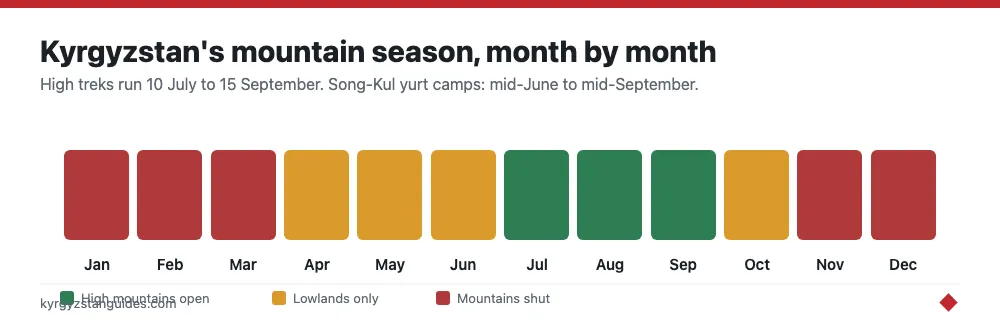
- Summer (mid-June–mid-September): the main season. Every trek, yurt stay, and mountain road open. Warm days, cold nights above 3,000 m. Downside: peak prices and the busiest trails, especially Ala-Kul in August.
- Autumn (mid-September–November): golden larch and walnut forests, Arslanbob is spectacular in October, crisp visibility, empty guesthouses. Downside: yurt camps close by late September and the high passes take first snow in October.
- Winter (December–March): skiing at Karakol Ski Base and backcountry touring in Jyrgalan. Bishkek turns smoggy and grey; the mountains are brilliant. Downside: Song-Kul and most trekking routes are unreachable.
- Spring (April–mid-June): green valleys, poppies, lambing season, the fewest tourists. Downside: April and May are the wettest months, and passes above 3,500 m usually hold snow until late June.
Month by month for 2026
| Month | Weather (Bishkek / mountains) | Best for | Verdict |
|---|---|---|---|
| January | -5°C / -15°C, snow | Skiing at Karakol, ski touring in Jyrgalan | Great for skiers only |
| February | -3°C / -12°C, reliable powder | Freeride skiing, winter yurt experiences | Best snow month |
| March | 8°C / -5°C, thaw begins | Late-season skiing, Nooruz festival (21 March) | Good, transitional |
| April | 15°C / 2°C, rain | Bishkek city breaks, low valleys | Wettest month, avoid trekking |
| May | 21°C / 8°C, showers | Green valleys, low-altitude hikes, horse festivals | Beautiful but limited access |
| June | 27°C / 12°C | Song-Kul opens (mid-June), lower treks | Very good from mid-month |
| July | 32°C / 16°C | All treks, Ala-Kul, Issyk-Kul beaches | Peak season |
| August | 31°C / 15°C | High passes, yurt stays, festivals | Peak season, busiest |
| September | 25°C / 10°C | Trekking with fewer crowds, clear skies | Our favorite month |
| October | 16°C / 2°C | Arslanbob walnut harvest, autumn colors | Good for culture, treks closing |
| November | 7°C / -6°C, first snow | Quiet city travel, eagle hunting demos | Off-season lull |
| December | -2°C / -12°C | Karakol ski season opens (~mid-December) | Good for skiers |
Two months stand out, and they answer different questions. July delivers the warmest high-mountain weather and everything open, at the cost of crowds and the highest prices of the year. Early September delivers 90% of the same access with noticeably quieter trails, stable anticyclonic weather, and Karakol guesthouses dropping from around $40 to $30 a night. Book July if warm nights at altitude matter to you; book September if solitude does.
And the worst time? April, without much competition. It's the wettest month, the ski season has collapsed, the trekking season hasn't started, and the mountains sit behind a curtain of valley rain. November runs it close — first snow without enough of it to ski, and the summer infrastructure packed away. If those are your only options, build the trip around Bishkek, Osh, and low-altitude culture rather than fighting the calendar.
Trekking windows
For high routes in the Terskey Ala-Too, Ala-Kul with its 3,860 m pass, Altyn Arashan, Jeti-Oguz to Telety, the reliable window is 10 July to 15 September. Before mid-July you can still meet snowfields on the Ala-Kul pass steep enough to want microspikes; after mid-September fresh snow can close it overnight. Our Ala-Kul trek guide walks the route day by day.
Lower valley treks are more forgiving. Jyrgalan’s day hikes, the Alamedin and Ala-Archa gorges near Bishkek, and Sary-Chelek open from late May or June and stay walkable into October. If you're planning a multi-trek trip, our Kyrgyzstan trekking guide ranks routes by month. One rule holds everywhere: mountain weather turns fast even in August, so pack for four seasons above 3,000 m regardless of what the calendar says.
Yurt stays run on the herders’ calendar
Song-Kul sits at 3,016 m, and its yurt camps operate roughly mid-June to mid-September: outside that window the herders and their animals simply aren't there, and no amount of booking enthusiasm changes it. July is the sweet spot: daytime highs of 15–20°C, foals and lambs everywhere, and kok-boru (horseback goat polo) matches organized between camps. Even in August, nights approach freezing; camps provide thick blankets, but bring a warm layer anyway. A night with dinner and breakfast runs 1,500–2,200 KGS ($17–25) through CBT offices. Routes in — including the Kalmak-Ashuu pass and the three-day horse trek from Kyzart — are in our Song-Kul lake guide.
The ski season
Karakol Ski Base, 7 km above the town, runs roughly mid-December to late March, with the most reliable powder in January and February. The top station sits at 3,040 m, there are about 20 km of marked pistes, and a full-day adult pass costs around 3,000–3,500 KGS ($34–40), a fraction of Alpine prices. The real draw is off-piste: the resort’s side bowls, plus the ski-touring and freeride scene in Jyrgalan an hour away, pull a growing backcountry crowd every winter. Where to stay and rent gear is covered in our Karakol travel guide.
Timing a trip around festivals
Kyrgyzstan created the World Nomad Games and hosted the first three editions at Cholpon-Ata. The event now rotates between countries, but smaller versions of the same spectacle run every summer: kok-boru tournaments, horse racing, and salburun eagle-hunting demonstrations, especially around Bokonbayevo on Issyk-Kul’s south shore and at Song-Kul’s jailoo camps in July and August. Ask any CBT office about upcoming horse games — they are usually announced only days ahead, which is either charming or maddening depending on your planning style.
In the cities, Nooruz (21 March) is the biggest cultural date of the year: Ala-Too Square fills with music, wrestling, and sumolok cooked in giant cauldrons. Independence Day (31 August) brings horse games to hippodromes around the country — a good anchor for a late-August trip. If a festival is the point of your visit, build slack into the schedule: dates slip, venues change, and the reward for flexibility is standing at the rail of a kok-boru pitch while the rest of the crowd arrives on horseback.
Are the shoulder seasons worth it?
Yes, with adjusted expectations. In late May and early June the lower valleys are at their greenest, wildflowers carpet the Suusamyr plateau, and you might have Jeti-Oguz’s red cliffs entirely to yourself. Guesthouses discount 20–30% and Issyk-Kul’s north shore is pleasantly quiet. The trade: Song-Kul camps are not open yet, high passes are snowbound, and showers are frequent.
October is the culture-and-color month. The world’s largest walnut forest at Arslanbob turns gold during the harvest, when whole villages move into the forest to collect nuts. One of Central Asia’s great slow-travel spectacles. Days are crisp (14–18°C in the south), nights cold. Build an October trip around cities, Issyk-Kul, and the south rather than high mountains; our 10-day Kyrgyzstan itinerary adapts well if you swap Ala-Kul for Arslanbob.
Match the month to the trip
A shortcut, if the table above is too much: trekkers and yurt sleepers book mid-July to mid-September; skiers book late January or February; photographers chasing color book early October for Arslanbob or late May for the green valleys; and travelers who mainly want cities, bazaars, and day trips can come almost any month except April. Families with school-holiday constraints shouldn't fear August, it's busy by Kyrgyz standards, which still means you'll often have a trail to yourself.
Packing by season
- Summer: sun hat and SPF50 (high-altitude sun is fierce), a real down jacket or warm fleece for nights above 3,000 m, rain shell, broken-in boots, water filter or purification tablets.
- Spring/autumn: waterproof jacket and pants, warm hat and gloves, layers for 25°C daily swings, gaiters if trekking from late September onward.
- Winter: genuine cold-weather gear (-15°C is standard in the mountains), thermal base layers, insulated boots; ski gear rents in Karakol for around 800–1,200 KGS ($9–14) per day.
- Year-round: cash in som (ATMs are scarce outside cities), a power bank, motion-sickness tablets for the mountain roads, and a headlamp for yurt camps with no electricity.
One scheduling note: seven of the nine days between 1 and 9 May are non-working, which is the longest holiday block of the Kyrgyz year and fills lakeside accommodation with domestic travellers. Our public holidays guide has the dates.
Frequently Asked Questions
What is the single best month to visit Kyrgyzstan?
Early September. Every trek and yurt camp is still open, the weather is stable and clear, trails are noticeably quieter than August, and accommodation prices start dropping. July is the alternative if you want the warmest high-altitude temperatures and full festival season.
What is the rainiest month in Kyrgyzstan?
April is the wettest month countrywide, with May close behind. Rain falls as heavy afternoon showers in the valleys and snow above 3,000 m. By late June precipitation drops sharply, and July–September are the driest, most stable months in the mountains.
Is winter a good time to visit Kyrgyzstan?
Only if you ski. Karakol Ski Base and Jyrgalan’s backcountry offer cheap, uncrowded powder from mid-December to March, with day passes around $34–40. Trekking routes and Song-Kul are inaccessible, and Bishkek suffers heavy winter smog, so non-skiers should wait for summer.
When is the best time to visit Issyk-Kul lake?
July and August for swimming, the water reaches 20–22°C and Cholpon-Ata’s beaches are lively. For hiking the southern shore around Bokonbayevo and Jeti-Oguz without crowds, June and September are better. The lake never freezes, so lakeside travel works year-round.
Can you visit Song-Kul in May?
Usually not. The passes to Song-Kul typically stay snowbound into early June, and the yurt camps only set up from mid-June when herders bring livestock to the summer pastures. In May, base yourself around Kochkor or Issyk-Kul’s south shore instead.
What is the worst month to visit Kyrgyzstan?
April, without much competition: it is the wettest month, the ski season has collapsed, the trekking season has not started, and the mountains sit behind a curtain of valley rain. November runs it close — first snow without enough to ski, and summer infrastructure packed away. If stuck with either, build the trip around Bishkek, Osh, and low-altitude culture.