At six on a Sunday morning, the eastern edge of Karakol smells of hay and diesel, and a man is checking a horse’s teeth before sealing the deal with a double handshake. That market is one reason to come. The other is what stands behind the town: the wall of the Terskey Ala-Too, with the trailheads for Ala-Kul, Altyn Arashan, and Jeti-Oguz all starting within 15 km of the center. Marshrutkas from Bishkek take 6-7 hours and cost 500-600 KGS (about $6-7); shared taxis do it in 5-6 hours for 1,000-1,300 KGS per seat.
Karakol sits at 1,750 m where the mountains meet the eastern end of Issyk-Kul, a former Russian garrison town of about 70,000 people that now functions as Kyrgyzstan’s adventure capital. Give it 2-3 days for the town and a day trip, or a full week if the treks are the point of your trip: which, for most people, they should be.
One Town, Three Trailheads
No other town in Central Asia packs this density of alpine access. The Karakol Valley, Altyn Arashan, and Jeti-Oguz gorges all begin practically at the edge of town, stacking 4,000-5,000 m peaks behind the last streets. Just as important, the infrastructure keeps pace: gear rental shops, the CBT Karakol office, and the Destination Karakol tourist office (destinationkarakol.com) can line up guides, pack horses, and yurt-camp beds within a day of you walking in. In winter the same valleys hold the country’s best ski area. Nowhere else in Kyrgyzstan lets you improvise this much, this fast.
Getting There Is the Boring Part
Marshrutkas leave Bishkek’s main bus station on Alma-Atinskaya 1/1 every 30-60 minutes from early morning until about 17:00 and run along Issyk-Kul’s north shore. There is no rail link and, as of 2026, no scheduled flights — it’s road or nothing. Two practical notes: shared taxis fill and leave from the same station, so arrive before 9 am for the shortest wait, and sit on the left side of the vehicle for lake views most of the way. If you have a spare half day, break the ride at Cholpon-Ata; our Issyk-Kul travel guide covers the lake stops worth making and the ones worth skipping.
The Town: Two Odd Buildings, One Loud Market
The Dungan Mosque is the building everyone photographs and almost nobody expects. Built 1907-1910 by Dungan (Chinese Muslim) refugees entirely without nails, it looks like a Buddhist temple in green, red, and yellow, because its Chinese master builder constructed it like one. Entry is by small donation (~100 KGS); women receive a headscarf at the gate.
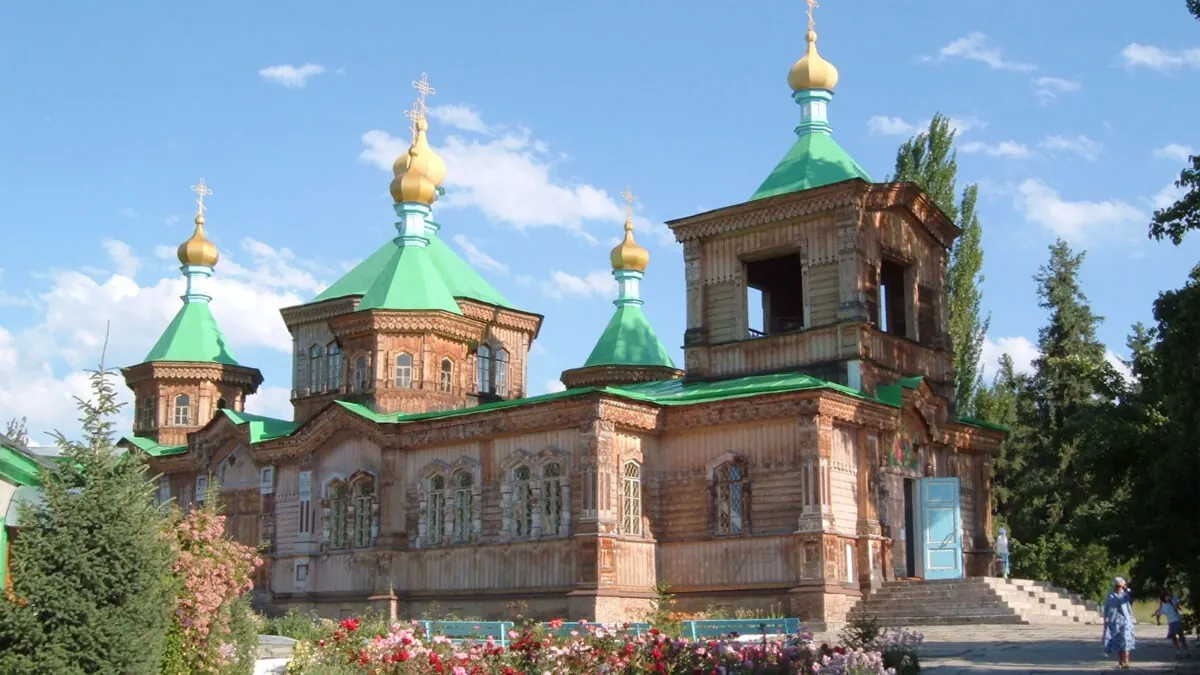
Holy Trinity Cathedral, a green-domed wooden Russian Orthodox church from 1895, survived the Soviet decades as a sports club and a coal store. It's free to visit and photogenic from every angle. Ten minutes apart, the mosque and cathedral tell you most of what you need to know about this town’s layered history.
The Sunday animal market is the event. Farmers trade sheep, horses, and cattle from trailer-side starting at first light, and by 9-10 am it is effectively over — set an alarm. It costs nothing to wander and nobody minds cameras. The horse section is the theater: buyers check teeth, argue, walk away, come back.
The Przhevalsky Memorial Museum is the quiet fourth stop. Nikolai Przhevalsky, the Russian explorer of wild-horse fame, died in Karakol in 1888 and is buried on a bluff above the lake 9 km north of town, next to a small museum of expedition maps and taxidermy. Entry runs about 150 KGS; pair it with a swim at the Mikhailovka inlet on a hot day.
Eat the Ashlan-Fu
Karakol’s signature dish is ashlan-fu: a cold, spicy, vinegary noodle soup with cubes of starch jelly, served for 80-120 KGS a bowl at “Ashlan-fu Alley” beside the small bazaar, where it comes with a fried piroshki. It sounds strange and it works, especially after a hot bus ride. The upgrade is a Dungan family dinner (around 900-1,200 KGS per person, booked through Destination Karakol) a table-bending spread of hand-pulled noodles served with the story of the Dungan migration from China. Our Kyrgyz food guide puts the dish in national context, but the short version is: this is the best food town in the country outside Bishkek, and arguably including it.
The Treks That Made Karakol Famous
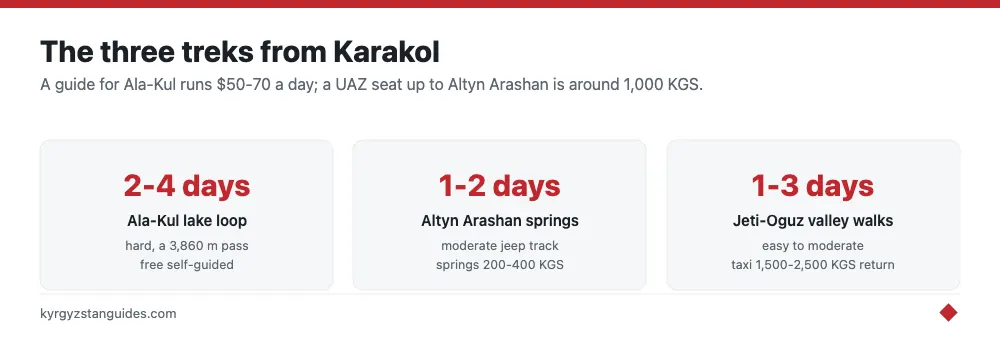
The big three all start practically in town. Ala-Kul is the headliner: a turquoise lake at 3,532 m reached over a 3,860 m pass, read our full Ala-Kul trek guide before committing, because the pass is no joke. Altyn Arashan is the mellow classic, a hot-springs valley at 2,435 m you can reach on foot, by horse, or bouncing up the track in a Soviet-era UAZ van. Jeti-Oguz offers the gentlest walking of the three, beneath red sandstone walls.
| Trek | Duration | Difficulty | Typical cost |
|---|---|---|---|
| Ala-Kul lake loop | 2-4 days | Hard (3,860 m pass) | Free self-guided; guide $50-70/day |
| Altyn Arashan hot springs | 1-2 days | Moderate (jeep track) | Springs 200-400 KGS; UAZ ride ~1,000 KGS/seat |
| Jeti-Oguz valley walks | 1-3 days | Easy-moderate | Taxi from Karakol 1,500-2,500 KGS return |
The season runs mid-June to mid-September, and the Ala-Kul pass holds snow into early July — check conditions with the gear shops before you commit to an early-season crossing, because they hear trail reports daily. Tents, sleeping bags, and stoves rent in town for $5-10 per item per day, so there's no need to haul equipment across the world for one trek; yurt camps at Ala-Kul and Sirota charge $15-25 with dinner, cash only, small notes. Tell your guesthouse your route, there is no mobile signal in the upper valleys, and that register is the closest thing to a rescue plan most hikers have here. If you have one spare day and solid legs, the walk up the Karakol Valley to the first bridge and back needs nothing but water, lunch, and the ~250 KGS national park entry. For how these routes stack up against the rest of the country, see our Kyrgyzstan trekking guide.
Winter: The Trip Almost Nobody Takes
From December to late March, Karakol Ski Base — 7 km from town, lifts between 2,300 and 3,450 m, delivers reliable powder at prices that read like typos: day passes 2,800-3,500 KGS ($32-40), full gear rental about 1,500 KGS, and empty midweek pistes with Issyk-Kul views from the top station. A taxi from town costs 400-500 KGS each way, freeride and touring operators run guided days into the side valleys, and guesthouses stay open all winter at summer prices. Aim for mid-January to late February: cold, stable, and dumping. A week alternating ski days with the Sunday market and long banya evenings is one of the best-value winter trips in Asia, and the lift lines will make you wonder where everyone is.
Day Trips Along the South Shore
Three stops chain together into one excellent driving day. Jeti-Oguz, 25 km west, is the postcard: the Seven Bulls ridge and the Broken Heart rock, with a walkable gorge and summer yurts behind them (half-day taxi 1,500-2,500 KGS). An hour further, Skazka (Fairy Tale) Canyon is a compact badlands of red and orange hoodoos you can scramble over freely. Entry about 100 KGS, best at golden hour. Barskoon gorge stacks waterfalls beneath fir forest and, improbably, two monuments to Yuri Gagarin, who vacationed here after his spaceflight. The full loop costs 3,500-4,500 KGS for the taxi, split between passengers. Skip it only if you are already trekking through Jeti-Oguz on foot, otherwise it's the best-spent day around the lake.
Where to Sleep, and a Three-Day Plan
Guesthouses are the local specialty: family-run places with enormous breakfasts at $25-40 a double (Matsunoki and Green Yard are long-standing favorites), hostel dorms at $8-12, simple hotels at $40-70. Book ahead for July-August and ski-season weekends. For dinner beyond ashlan-fu, Dastorkon does Kyrgyz classics in a garden setting (mains 250-450 KGS), Karakol Coffee pulls real espresso for post-trek cake, and the bazaar covers samsy and fruit. Cash matters here: ATMs (Optima, Demir) are reliable in the center, but guesthouses, yurt camps, and drivers all want som in hand.
The plan that works: day one, arrive, walk the mosque and cathedral, book a Dungan dinner for the evening. Day two, run the Jeti-Oguz–Skazka–Barskoon loop. Day three (if it’s a Sunday) hit the animal market at dawn, then stretch your legs up the Karakol Valley. Trekkers should bolt Ala-Kul or Altyn Arashan onto the front of that, while legs are freshest, then bracket the whole trip with a night in Bishkek on either end. Two days here feels short. A week doesn't.
Twelve kilometres north-west of town, Cape Koy-Sary has been a naval weapons testing site since 1943 and is still leased to Russia. It is closed and you cannot visit, but our page on torpedo testing on Issyk-Kul explains what is there and why the lake suits it.
One thing older guidance gets wrong. Bishkek’s Western Bus Station (Zapadnyi Avtovokzal) and the “Akzhol” mini-station both closed on 23 October 2024. Services moved to the municipal Bishkek Bus Station, which had opened that January: east-direction routes — Issyk-Kul, Karakol, Kochkor, Naryn — now leave from Alma-Atinskaya 1/1, and west-direction routes, including Osh and Talas, from Frunze 209. Any source still sending you to the Western Bus Station is out of date.
FAQ
How do I get to Karakol from Bishkek?
Marshrutkas take 6 to 7 hours and cost 500 to 600 som, about $6 to $7. Shared taxis do it in 5 to 6 hours for 1,000 to 1,300 som per seat. Note that Bishkek's Western Bus Station closed on 23 October 2024 and east-direction services now leave from Alma-Atinskaya 1/1.
How many days should I spend in Karakol?
Eat ashlyanfu at the bazaar before anything else. Two or three days for the town and a day trip, or a full week if the treks are the point of the trip — which for most people they should be.
What treks start from Karakol?
Ala-Kul, Altyn Arashan and Jeti-Oguz all have trailheads within 15 kilometres of the centre. The Karakol Valley, Altyn Arashan and Jeti-Oguz gorges begin practically at the edge of town, with 4,000 to 5,000 metre peaks stacked behind the last streets.
How high is Karakol and how big is it?
It sits at 1,750 metres where the mountains meet the eastern end of Issyk-Kul, a former Russian garrison town of about 70,000 people that now functions as Kyrgyzstan's adventure capital.
Where do I arrange guides and gear in Karakol?
Gear rental shops, the CBT Karakol office and the Destination Karakol tourist office can line up guides, pack horses and yurt-camp beds within a day of you walking in. No other town in Central Asia lets you improvise a mountain trip this fast.
Is Karakol worth visiting in winter?
Yes. The same valleys that carry the summer treks hold the country's best ski area, so the town works year-round rather than shutting down outside trekking season.
If the crowds are the problem, the regional tourist board publishes seventeen quieter routes: see alternatives to the Ala-Kul trek.
The same geothermal system surfaces lower down at Ak-Suu, a sanatorium village a 25-som marshrutka from Karakol.