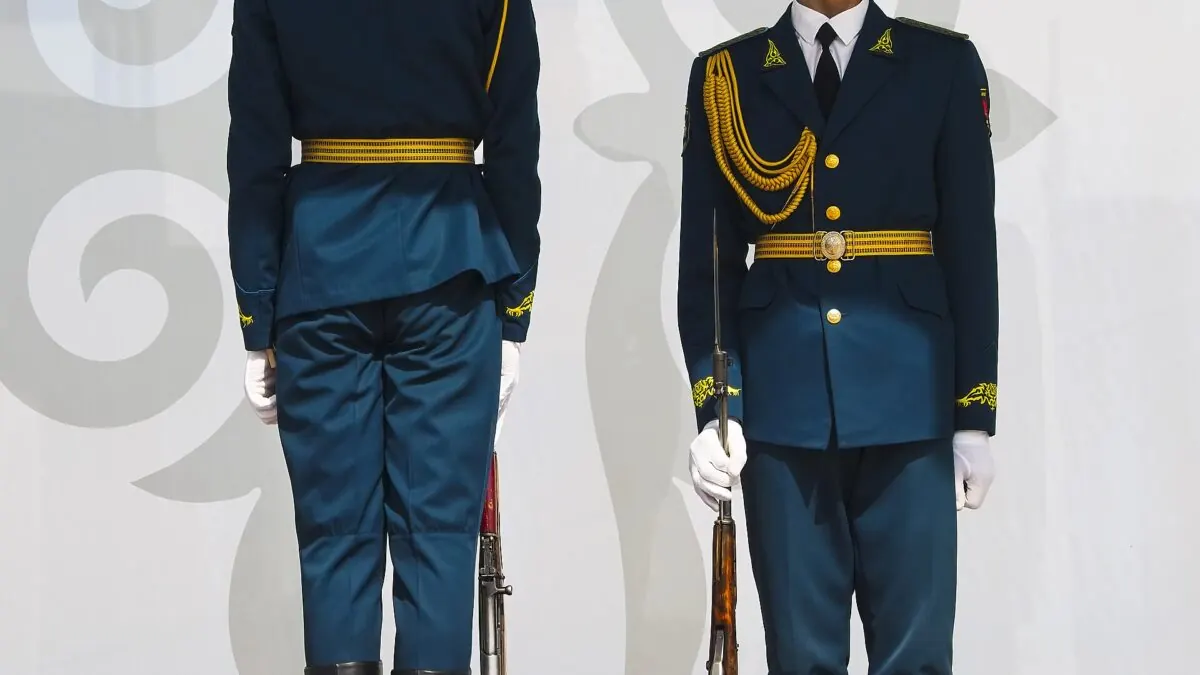
On the hour at Ala-Too Square, soldiers goose-step past a colossal flag while most of Bishkek walks by without a glance. That contrast — ceremony up front, easygoing city everywhere else — is Bishkek in one frame, and it deserves more than the single rushed night most travelers give it. The best things to do in Bishkek are the changing of the guard on Ala-Too Square, a morning grazing through Osh Bazaar, the renovated State History Museum, a proper Soviet banya, and day trips to Burana Tower and Ala-Archa National Park — all comfortably covered in two days on $30–50 per day. The capital is flat, green, walkable and cheap, with the best food and coffee in the country.
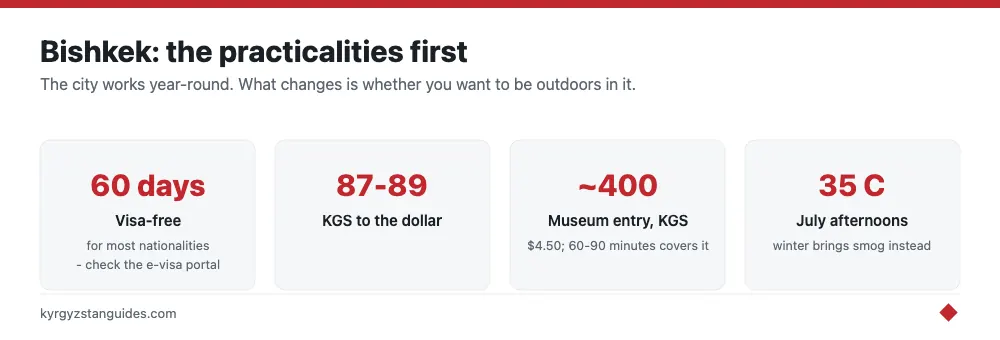
Practicalities first: 1 USD ≈ 87–89 KGS, most nationalities get 30 days within any 60-day period visa-free (check the official e-visa portal if yours doesn't), and the city runs on the 2GIS offline map app and Yandex Go taxis. Bishkek works year-round — July and August afternoons can hit 35°C, winter brings smog — and the seasonal trade-offs are in our guide to the best time to visit Kyrgyzstan. Here are the seventeen things actually worth your hours, numbered roughly in the order a first-timer should care about them.
The city center
1. Ala-Too Square and the changing of the guard
The ceremonial heart of the country: the Manas statue on horseback, the national flagpole, and fountains that fill with families on summer evenings. The goose-stepping changing of the guard happens on the hour and lasts about five minutes, which is exactly the right length. It costs nothing and anchors every walking route through the center. The tip: come ten minutes before the hour and stand on the flagpole side for an unobstructed view, then come back after dark at least once — the square is lit, full of teenagers and ice-cream carts, and far livelier than during office hours.
2. State History Museum
Right on the square and reopened after a long renovation, with three floors running from Scythian gold through nomadic life to the Soviet century. The building itself is half the exhibit — head upstairs for the preserved Soviet ceiling murals, a genuinely strange piece of ideological art that survived the refit. Entry is around 400 KGS ($4.50) and 60–90 minutes covers it well. Go in the late morning after the bazaar, when tour groups have moved on; captions are in Kyrgyz, Russian and English, so no guide is needed.
3. Panfilov Park
A scruffy, endearing Soviet fairground directly behind the White House, where the government quarter dissolves into candy floss and bumper cars. The creaking Ferris wheel costs 50–100 KGS and delivers a surprisingly good view over the government buildings and the mountains behind the city. Nothing here's polished and that's the charm — it feels like 1985 never ended. Ride the wheel near sunset when the Ala-Too range turns pink; the whole park takes half an hour unless you commit to the bumper cars, which you should.
4. Oak Park and Erkindik Boulevard
Bishkek’s oldest park doubles as an open-air sculpture gallery under oaks planted 130 years ago, and the shaded spine of Erkindik Boulevard running south from it is the nicest walk in the city. On weekends local painters hang canvases along the boulevard railings — prices are soft and small oils go for less than a restaurant dinner, making this a better souvenir stop than any gift shop. October is the boulevard’s show-off month, when the oaks go gold. Combine it with the Fine Arts Museum, two minutes away.
5. A Soviet architecture walk
Bishkek — formerly Frunze — is one of the best-preserved showcases of Soviet modernism anywhere, and it's all walkable. A self-guided two-hour loop takes in the flying-saucer State Circus, the Wedding Palace, the monumental National Library and the Philharmonic, with brutalist apartment friezes filling the gaps between headliners. Do it in the morning before the heat, phone loaded with 2GIS so the detours stay efficient. The circus is the prize: if a show is on (weekends, tickets from a few hundred som), the interior is even stranger than the exterior.
Markets and shopping
6. Osh Bazaar
The essential Bishkek experience: mountains of dried apricots, pyramids of spices, kurut (salty dried yogurt balls), horse sausage, and the tall white ak-kalpak felt hats stacked like wedding cakes. Vendors expect you to taste before buying, so arrive hungry and graze your way down the dried-fruit rows. Go before noon while produce is fresh and the aisles are navigable, and keep your phone in a front pocket — the crowds that make it atmospheric also make it the city’s one pickpocket zone. Read our Kyrgyz food guide first so you know your kurut from your kazy.
7. Dordoi Bazaar
One of the largest markets in Asia: kilometers of double-stacked shipping containers, the bottom one a shop and the top one a warehouse, selling everything from sneakers to car parts to wedding dresses. It sits 30–40 minutes north of the center by marshrutka and it's emphatically not a souvenir stop — go for the spectacle of raw commerce at continental scale. Wear closed shoes, bring small bills, and go on a weekday morning; weekend crowds turn the container canyons into slow-motion rivers. Skip it if markets stress you out — Osh Bazaar covers the greatest hits.
8. TsUM department store
The Soviet-era department store on Chuy Avenue is the most painless souvenir stop in the country. The top floor concentrates felt slippers, shyrdak rugs, ak-kalpak hats, honey and Manas-themed everything at near-fixed prices — roughly what you would pay at the bazaar after haggling, minus the haggling. It's also the sensible place to buy a local SIM or a phone cable from the electronics floors below. Do your souvenir run here on the last afternoon rather than hauling felt around the mountains for two weeks.
Culture, evenings and local rituals
9. Kyrgyz National Opera and Ballet Theatre
A full opera or ballet in a chandeliered Soviet-classical hall costs 300–1,000 KGS ($3.50–11), which makes it one of the world’s great cheap nights out. The season runs roughly September to June, and the repertoire mixes Russian classics with Kyrgyz national works — the latter are the more memorable choice if you get a vote. Check the poster boards outside the theatre for the week’s schedule and buy at the box office; dressing up is appreciated but a clean shirt clears the bar. Doors close on latecomers, so eat afterward, not before.
10. Gapar Aitiev Museum of Fine Arts
Strong on Soviet-era Kyrgyz painting — herders rendered in heroic socialist realism — alongside traditional felt textiles and contemporary work, and it's rarely busy enough to share a room in. Entry runs under 200 KGS, and an hour is plenty. It pairs naturally with Oak Park next door and fills the mid-afternoon lull when the parks are hot and dinner is far away. The felt-art rooms are the sleeper highlight: the shyrdak tradition you'll see sold flat at TsUM hangs here as serious art, which recalibrates your souvenir shopping.
11. Victory Square at dusk
The WWII memorial east of the center is a giant granite arc shaped like a yurt’s crown frame, with an eternal flame beneath it. It is quietly moving at dusk, when the light softens the stone and wedding parties arrive for photographs — a local tradition that turns a solemn monument into something warmer. There is nothing to pay and nothing to queue for; give it twenty minutes on the walk between the center and the eastern restaurants. Come on May 9 if your dates align — Victory Day fills the square with veterans, flowers and brass bands.
12. Craft beer and third-wave coffee
Bishkek has grown a real scene on both fronts. Save the Ales, a women-founded brewery, pours the country’s best IPA at 250–350 KGS a pint and fills with an easy mix of locals and NGO workers; Blonder Pub covers dependable lagers for the less hop-inclined. On the coffee side, Sierra and Adriano are the standbys, with flat whites at 220–280 KGS and reliable Wi-Fi — useful for booking mountain transport. The move: coffee planning session in the morning, Save the Ales as your last stop before an early night and an alpine start.
13. Zhirgal Banya
A brutalist concrete bathhouse that's both an architectural landmark and a fully functioning banya. Entry is around 500 KGS; pay a little more for a venik — the birch-branch beating that sounds like assault and feels like renewal. The etiquette is simple: strip, steam, plunge, repeat, and accept that a stranger may offer to thrash your back as a courtesy. Go on a cold day and the logic of Central Asian bathing culture explains itself better than any museum could. Bring flip-flops; rent the felt hat — it isn't a costume, it keeps your head from overheating.
14. Eat where locals eat
Faiza is the canteen every Bishkek local recommends, and they are right: beshbarmak, manty and laghman at 200–400 KGS a plate, served fast in a room full of families and office workers. Arrive before 13:00 or accept a queue — the lunch rush is real and the manty sell out. Navat dresses the same national classics in carved-wood teahouse surroundings for slightly more, and its tapchan platform seating makes it the better dinner venue. Between the two you cover the national menu in two meals for under $10 total, which is the correct introduction to Kyrgyz food economics.
Day trips
15. Burana Tower
An 11th-century minaret — all that remains of Balasagun, a Silk Road capital of the Karakhanids — standing alone in farmland 80 km east near Tokmok, ringed by a field of balbals, the carved stone grave markers that stare back at you across a millennium. Climb the dark internal staircase for steppe-and-mountain views; it's tight, steep and completely worth it. Entry is about 100 KGS. A round-trip taxi with waiting time costs 2,500–3,000 KGS, or do it for pocket change with a Tokmok marshrutka (~100 KGS) plus a short local taxi. Half a day, door to door.
16. Ala-Archa National Park
A genuine alpine gorge 40 km from downtown — glacier-fed river, spruce slopes, 4,000 m peaks — which is an absurd thing for a capital city to have as a suburb. Trails run from an easy riverside stroll to the sweaty half-day climb toward the Ak-Sai waterfall and Ratsek Hut at 3,300 m. Park entry is about 500 KGS per car; a taxi that waits a few hours runs 1,500–2,500 KGS, and sharing one from a hostel noticeboard is standard practice. Start early: morning light on the peaks is better and afternoon storms are a summer habit. It's the fastest possible answer to why people fly here to trek.
17. Chunkurchak Valley
A jailoo — summer pasture — valley 45 minutes from the city, with yurts, horse rides and picnic meadows in summer and a small ski base in winter. It is the low-commitment alternative when Ala-Archa’s trails feel too serious: gentler slopes, family-friendly, and you can be back in town for dinner without rushing. In July the wildflowers are ridiculous. Go on a weekday if you can; Bishkek families have the same idea on summer weekends and the road in is narrow. A taxi there and back with waiting time lands around 2,000 KGS — agree it before leaving.
How to sequence it
Bishkek rewards a little choreography, especially in summer. Bazaars and parks belong to the morning, before the heat and the crowds; museums earn their keep in the early afternoon when the streets are baking; the square, the opera and the beer bars own the evening. Two cautions save wasted walks: several museums close one day early in the week, so check opening hours in 2GIS before crossing town, and the opera box office keeps daytime hours — buy tickets in the morning for that night. If a heatwave or the winter smog rolls in, flip the plan inside out: banya, museums and cafes by day, the square after dark.
Where to stay
Base yourself between Ala-Too Square and Erkindik Boulevard and everything above except the day trips is walkable. Dorm beds run $8–12 — Interhouse and Apple Hostel are the backpacker hubs and the best places in the country to find trekking partners — while guesthouses and apart-hotels cost $25–40 and solid midrange hotels $50–80. The blocks around Osh Bazaar are cheaper and noisier; worth it only if your budget is the headline. Booking ahead matters in July and August and almost never otherwise.
Getting around
Download 2GIS (offline maps that include marshrutka routes) and Yandex Go before you land; between them they solve the city. Marshrutka minibuses cost about 20 KGS and go everywhere, eventually; Yandex rides cross town for 100–250 KGS. From Manas Airport, 23 km north-west, take express bus 153 for 122 KGS cashless or a Yandex/official taxi for 600–900 KGS. The center is a flat Soviet grid, so walking usually wins under 2 km. Full daily numbers — and where they quietly inflate — are in our Kyrgyzstan travel budget guide.
If you only have one day
Do it in this order: Osh Bazaar at 9:00 while the produce is fresh, then walk Chuy Avenue east to catch the changing of the guard on Ala-Too Square at the top of the hour, followed by the State History Museum before lunch. Eat at Faiza just ahead of the 13:00 rush, stroll it off through Oak Park and down Erkindik Boulevard, and spend the late afternoon on the Soviet architecture loop with a TsUM souvenir stop on the way back. Finish with laghman in a Navat tapchan booth and a pint at Save the Ales. If a second day materializes, give it to Ala-Archa with a banya afterward — then point yourself east toward Karakol or roll the whole thing into our 10-day Kyrgyzstan itinerary. Bishkek is the warm-up act, but it is a better one than it gets credit for.
Osh Bazaar deserves its own note: trading since 1983, around eight thousand traders, and scheduled to relocate out of the city. It is also the one place the UK Foreign Office names by name for pickpocketing.
Getting around the city changed in 2026: buses stopped taking cash on 1 July. A contactless Visa or Mastercard tapped on the validator works, or a Tulpar card from the driver for 60 som. Our guide to Bishkek bus routes has the detail.
FAQ
What are the best things to do in Bishkek?
The changing of the guard on Ala-Too Square, a morning grazing through Osh Bazaar, the renovated State History Museum, a proper Soviet banya, and day trips to Burana Tower and Ala-Archa National Park. All of it is comfortably covered in two days.
How many days do you need in Bishkek?
Two covers the list above at an unhurried pace. Most travellers give the city a single rushed night, which is the standard mistake.
How much does Bishkek cost per day?
About $30 to $50 a day for the sightseeing itinerary. The capital is flat, green, walkable and cheap, with the best food and coffee in the country.
Is Bishkek walkable?
Yes. It is flat and green, and the central sights around Ala-Too Square and Chuy Avenue are comfortably covered on foot. For anything further, ride-hailing is cheap.
What is worth doing for free in Bishkek?
The changing of the guard on Ala-Too Square happens on the hour and costs nothing, and Osh Bazaar is free to wander. The parks and the Soviet architecture of the centre are the rest of it.
Should I visit Ala-Archa from Bishkek?
Yes, and it is the standout day trip — a glacier-carved national park about 40 kilometres south, reachable in under an hour. Burana Tower, east of the city, is the other.
One of the strangest survivals of that era is on Toktogul Street: see Kyrgyzstan and the Soviet space programme, a 1,500-person bureau whose instruments reached Venus, Mars and Halley’s Comet.
The city has had three names, and what the current one means is genuinely unsettled: see Pishpek, Frunze, Bishkek.
The man the city was named after was born here and died at forty: see Mikhail Frunze, including the house-museum and its prices.