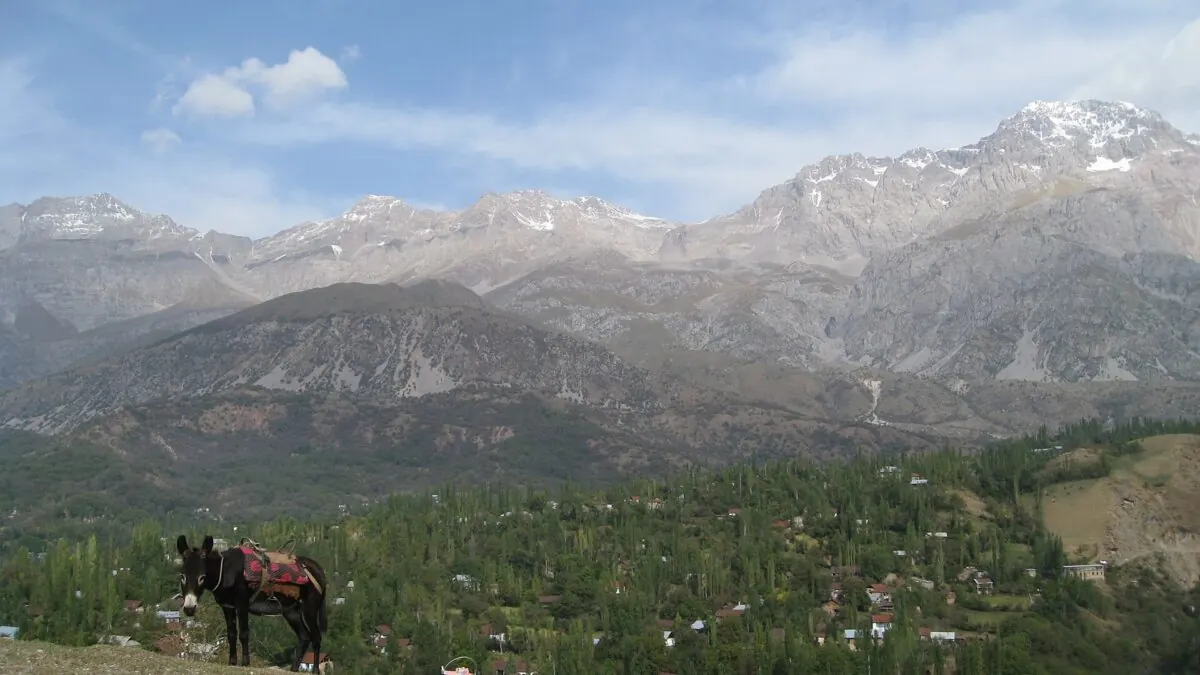
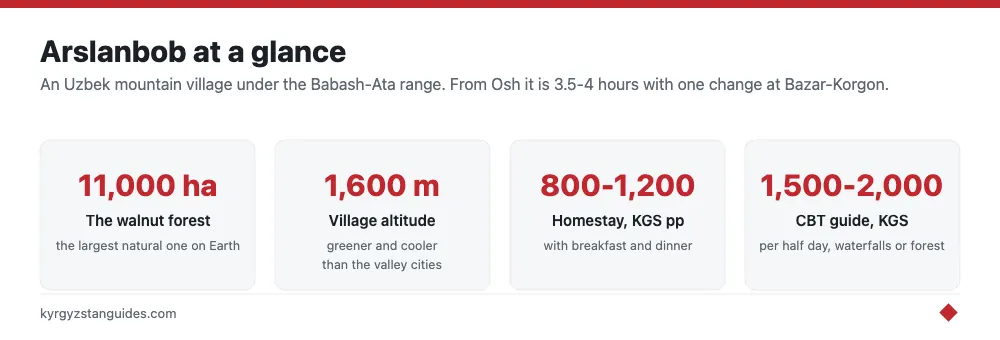
Every September, the whole village of Arslanbob moves into the trees. Families camped under the canopy, tarpaulins spread, walnuts raining down with each shake of a branch. This is the largest natural walnut forest on Earth, roughly 11,000 hectares of it, wrapped around an Uzbek mountain village in Kyrgyzstan’s Jalal-Abad region, and you can reach it in about 3.5-4 hours from Osh via Bazar-Korgon. Travelers come for the forest itself, two waterfalls, a panoramic viewpoint, some of the country’s best-run homestays, and, if they time it right, that September-October harvest.
The village sits at about 1,600 m on the slopes of the Babash-Ata mountains: greener, cooler, and more traditional than the cities on the plain below. Here is how to do it properly.
A Forest with a Legend Attached
Some of Arslanbob’s walnut trees are said to be hundreds of years old, and local legend claims Alexander the Great’s army carried walnuts from here back to Europe. Supposedly why the tree is sometimes called the “Greek nut.” Believe as much of that as you like; the forest is genuinely ancient either way, and it's no museum. Families are allocated harvest plots each autumn, and the crop remains a real part of the village economy.
You can wander the lower forest freely and unguided. But a local guide, arranged through CBT for around 1,500-2,000 KGS for a half day, turns a pleasant walk into something better, opening up the higher groves, streams, and clearings you would not find alone. If you only pay for one extra thing in Arslanbob, make it this.
The forest is more than walnuts, too. It belongs to a rare belt of relic fruit-and-nut woodland that survives almost nowhere else: wild apples, plums, and pistachios grow between the big trees, and the understory hums with birds in early summer. Walking here feels closer to an old European broadleaf forest than to anything else in Central Asia, which is part of the disorientation and most of the charm.
The Harvest, If You Can Time It
From mid-September, the village effectively relocates into the forest for several weeks. Men climb the trees, often alarmingly high, with no ropes, and shake the branches while families gather what falls; evenings end around fires among the trees. Visitors are generally welcome to watch and often to help, and if you're staying with a family that holds a plot, you may simply be brought along. It is the single best window to visit, and also the busiest: homestay beds go early, so book well ahead through CBT. Buy your walnuts then too — straight from the tarpaulin is as fresh as it gets.
Two Waterfalls and the Panorama Point
The small waterfall (about 23 m) is a short, easy walk from the village and draws steady local day-tripper traffic. The big waterfall (around 80 m) is the one to earn: a steeper 1.5-2 hour hike up the valley, far quieter, and at full power in late spring and early summer when the snowmelt runs. Wear real shoes. The final approach is rocky and often slick with spray.
The panorama viewpoint above the village delivers the classic frame: walnut canopy, village rooftops, and the Babash-Ata peaks behind. Count on a 1-1.5 hour walk up, or arrange a horse through your homestay. Sunset from here in autumn, with the forest gone gold, is the photograph everyone leaves with.
Two nights covers all three walks comfortably. One night forces you to choose between the big waterfall and the panorama point, and choosing feels wrong once you are here.
Stay with a Family — There Is No Better Option
Arslanbob runs one of Kyrgyzstan’s original and most respected Community Based Tourism (CBT) networks, and a homestay isn't the fallback here. It is the point. The CBT coordinator assigns you to a family home, the money stays in the village, and the cooking will outclass any restaurant you could have hoped for. There is no real restaurant scene anyway, which settles the question. For how these arrangements work nationally, see our yurt and homestay guide.
- Homestay with breakfast and dinner: roughly 800-1,200 KGS per person
- Guide for waterfalls or forest: around 1,500-2,000 KGS per half day
- Horse hire: about 1,000-1,500 KGS per day
- Expect warm, simple hospitality, shared bathrooms, and generous home cooking
When to Come
Each season is a different village. April to June is green and loud with water — full waterfalls, wildflowers, mild walking weather. July and August bring warm days and leafy shade, noticeably cooler than the baking plains below. The harvest weeks from mid-September into October are the most atmospheric time of all, when the forest turns gold and the village decamps into the trees. Book your homestay ahead, because beds fill fast. December to March is snowy, silent, and increasingly interesting to skiers. Slot it into a bigger route with our best time to visit Kyrgyzstan guide.
Not worth it: the muddy late-autumn weeks after the harvest ends, when the color is gone and the trails are slop.
The Winter Secret: Freeride Above the Walnuts
Few people associate Arslanbob with skiing, but the open slopes above the forest have become a quiet freeride destination. There are no lifts, access is by snowcat, snowmobile, or your own skins, arranged locally through CBT and a handful of specialist operators. The terrain runs mellow-to-moderate, the snow can be excellent, and you will likely have the mountain entirely to yourself. It slots neatly into a broader winter trip to Kyrgyzstan.
Getting There Means Changing at Bazar-Korgon
No long-distance transport runs direct; everyone changes at Bazar-Korgon. From Osh, take a shared taxi or marshrutka to Bazar-Korgon (~2 hours), then change for Arslanbob (~1.5 hours), about 3.5-4 hours and 400-600 KGS all in. From Jalal-Abad it is shorter, roughly 1.5-2 hours total via the same junction. From Bishkek it's a haul: either fly to Osh and continue by road, or endure the 10-12 hour shared taxi toward Jalal-Abad and change. The final climb from Bazar-Korgon is its own reward — the road winds up through orchards and villages until the walnut canopy closes overhead and the temperature drops a welcome few degrees.
Marshrutkas up to the village thin out in the afternoon, so travel in the morning. The mechanics of all this are in getting around Kyrgyzstan; most nationalities enter the country visa-free, but confirm your case on the official Kyrgyz e-visa portal before flying. Arslanbob pairs naturally with Osh and Sary-Chelek on a southern loop that most visitors to Kyrgyzstan never make.
Eat, Buy, and Mind Your Manners
The souvenir question answers itself: walnuts, sold by the bag straight from the harvest and cheaper here than anywhere else in the country, plus honey and dried fruit from the small village bazaar. Meals happen at your homestay. Plov, lagman, samsa, and mountains of home bread, leaning more vegetarian-friendly than the meat-heavy north.
One last thing, and it matters. Arslanbob is a traditional, predominantly Uzbek Muslim village, noticeably more conservative than Bishkek or Karakol, and it rewards visitors who arrive knowing that. The short list:
- Dress modestly — cover shoulders and knees; women may prefer longer sleeves
- Ask before photographing people, especially women
- Keep alcohol out of public view; many households don't drink
- Accept tea and food when offered. It's the heart of local hospitality
- Slow down: an evening walking the lanes between the walnut trees is worth more than another item ticked off
FAQ
How do I get to Arslanbob?
About three and a half to four hours from Osh via Bazar-Korgon. The village sits at roughly 1,600 metres on the slopes of the Babash-Ata mountains in Jalal-Abad region.
When is the walnut harvest at Arslanbob?
September and October. The whole village moves into the trees, families camping under the canopy with tarpaulins spread as walnuts come down with each shake of a branch. Families are allocated harvest plots each autumn and the crop is a real part of the village economy.
How big is the Arslanbob walnut forest?
Roughly 11,000 hectares — the largest natural walnut forest on Earth, wrapped around the village.
Do I need a guide in Arslanbob?
Not to walk the lower forest, which you can wander freely and unguided. A local guide arranged through CBT for around 1,500 to 2,000 som for a half day opens up the higher ground and turns a pleasant walk into something better.
What is there to do in Arslanbob besides the forest?
Two waterfalls, a panoramic viewpoint, and some of the country's best-run homestays. The village itself is Uzbek, and it is greener, cooler and more traditional than the cities on the plain below.
Did Alexander the Great really take walnuts from Arslanbob?
Local legend says so, and it is offered as the reason the tree is sometimes called the “Greek nut”. Treat that as a story rather than history. The forest is genuinely ancient either way, and some trees are said to be hundreds of years old.
Out of harvest season the village is at its emptiest: see Arslanbob in winter, where the skiing is done on horseback and there is no ski base at all.