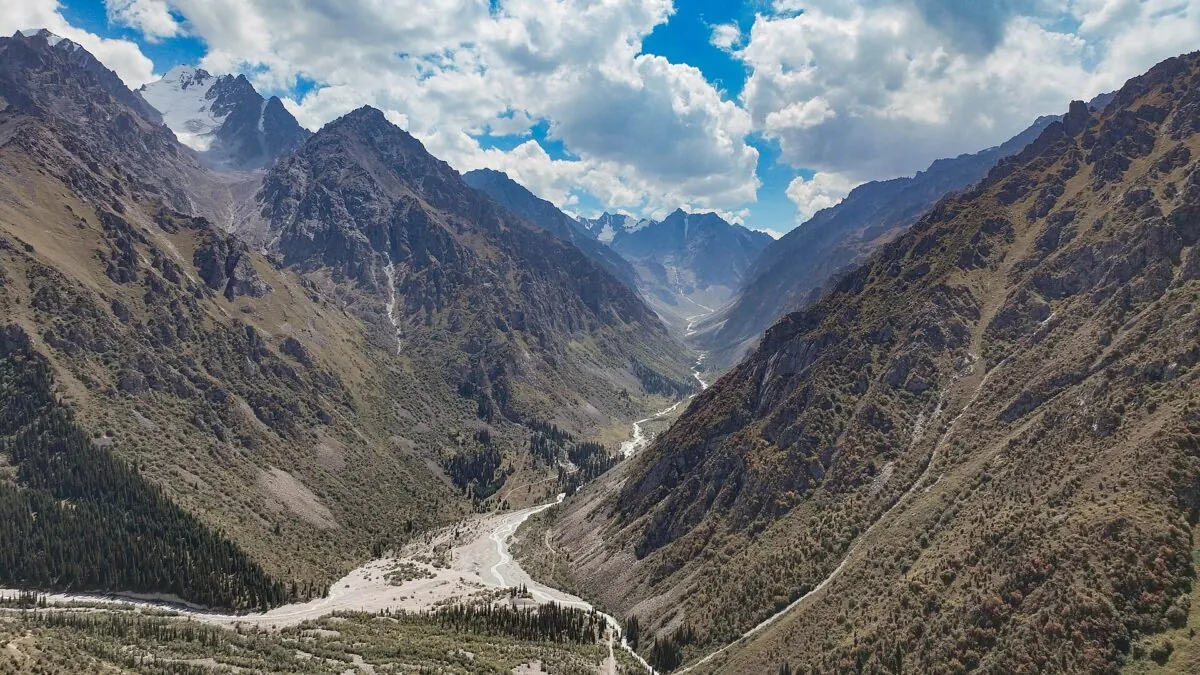
Ask anyone in Bishkek where to spend a spare day in the mountains and the answer comes back the same: Ala-Archa. Forty kilometers and about 45 minutes separate the capital’s traffic from a gorge of glaciers, 4,000 m peaks, and juniper forest (“ala-archa” means “many-colored juniper”) in Kyrgyzstan’s oldest national park, established in 1976.
The numbers: entry is 250 KGS for adults (raised from 200 in June 2026) and private petrol and diesel cars can no longer drive in, a taxi or Yandex Go from central Bishkek runs 800-1,200 KGS one way, and the classic Ak-Sai waterfall hike takes 2-3 hours each way from the alplager trailhead at 2,150 m. Depending on your appetite, the park can be a two-hour riverside stroll or an overnight at a mountaineers’ hut with a summit the next morning. Before any of that, though, there is a transport catch nobody warns you about, so start there.
The Transport Catch
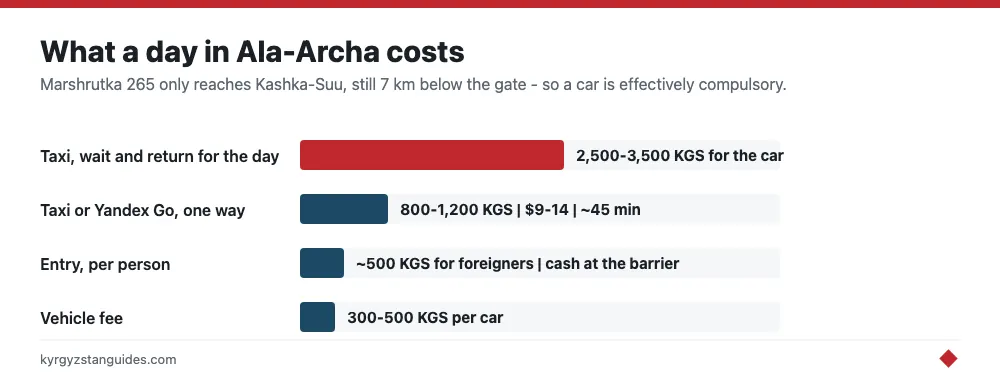
No marshrutka goes to the park gate, let alone the trailhead. Marshrutka 265 from Osh Bazaar only reaches Kashka-Suu village, which still leaves you about 7 km below the entrance and 12 km from the alplager where the trails begin. Unless you enjoy road-walking, go direct. A Yandex Go or taxi costs 800-1,200 KGS ($9-14) one way, a wait-and-return deal typically runs 2,500-3,500 KGS for the day, and hostel-organized group tours charge about 2,000-3,000 KGS per person including transport and entry. A rental car gets you to the gate, but no further: since May 2025 private petrol and diesel vehicles cannot drive up the valley.
Taxis now stop at the gate, and the final winding kilometers up to the alplager (альплагерь) are covered by the park’s free electric shuttle (see the 2025 car rule below). It also pays to arrange the return pickup in advance: mobile signal fades past the gate, and you can't summon a car by app from the trailhead.
Fees and What Awaits at the Alplager
The park is open year-round in daylight hours. Pay cash at the barrier (250 KGS for adults and 180 KGS for children aged 7 to 14 since June 2026) and keep the ticket, since rangers occasionally check on the trail. Up at the alplager you will find a small hotel, toilets, and a cafe whose opening hours are anyone’s guess. Carry your own food and water anyway, because whatever supplies exist inside the park are minimal and overpriced.
Three Trails, Three Commitment Levels
The riverside walk — easy
A broad track continues up the Ala-Archa river through juniper and pine, flat enough for children and post-plov digestion, gaining only 100-200 m. Walk 45-90 minutes to picnic meadows with glacier views up-valley and turn back whenever you like. On weekends this is Bishkek’s family picnic ground (samovars, shashlik, three generations on one blanket) and the people-watching is half the charm.
Ak-Sai waterfall. The signature day
The main event climbs east into the Ak-Sai valley: 2-3 hours one way with about 600 m of gain, first through forest, then across open slopes with huge views of Korona (4,860 m), Free Korea Peak (4,740 m), and the Ak-Sai glacier icefall. At roughly 2,750 m you reach the waterfall itself, a proper 25 m cascade that is biggest in June and early July with snowmelt. The trail is obvious and busy in summer but steep and loose in sections, so treat trail shoes, 2 liters of water, and a rain shell as the sensible minimum. Round trip with photo stops: 5-6 hours.
Ratsek Hut: overnight territory
Strong hikers continue past the waterfall another 1.5-2 hours up moraine to the Ratsek Hut at 3,350 m, the stone refuge that serves as base camp for climbs on Korona, Uchitel, and Box peaks — 1,200 m of total gain from the trailhead, a long and legitimate mountain day. Most people overnight in the hut (roughly 1,000-1,500 KGS a bunk, basic meals sometimes available in season) or camp beside it, then scramble up 4,527 m Uchitel Peak, the range’s classic first summit, the next morning. This valley is where Soviet alpinism grew up — generations trained here before the Pamir and Tien Shan giants, under Semenov-Tien-Shansky (4,895 m), the highest point in the Kyrgyz Ala-Too. More routes at this level live in our Kyrgyzstan trekking guide.
When to Go — Including Winter
June to September is prime: trails are snow-free to the waterfall, and the alpine flowers in late June are superb. July and August bring afternoon storms, so start by 9 am. Mid-September to October is quieter, with golden larch and stable weather; in spring the lower gorge works from April, but the Ak-Sai trail holds snow into May. Weekends fill with Bishkek locals (come on a weekday if you want the waterfall trail to yourself) and our best time to visit Kyrgyzstan guide shows how the park fits a longer route.
The park stays open through winter, though the activity on offer changes. From December to March the Ak-Sai valley becomes Central Asia’s most accessible ice-climbing arena, with frozen falls used for training and an annual ice festival organized with the Kyrgyz Alpine Club, while non-climbers snowshoe the lower gorge on packed trails. The road to the gate usually stays driveable, taxis charge more in snow, and trailhead temperatures sit around -5 to -15°C with short days, which makes this a properly equipped outing — covered in our Kyrgyzstan in winter guide.
Before You Go: The Five-Item Checklist
One honest caveat first: if your entire Kyrgyzstan trip is heading to Karakol’s bigger valleys and you have less than a day in Bishkek, you can skip Ala-Archa without regret — you'll see grander versions of the same range. Everyone else should go, and should bring:
- Cash for the gate — no cards, and no ATM after Bishkek
- Food and 2 liters of water, bought in the city, not the park
- Offline maps downloaded. Signal disappears in the Ak-Sai valley
- Respect for the altitude: the waterfall sits at ~2,750 m, so pace yourself if you flew in yesterday
- A rubbish bag — bins beyond the alplager don't exist, so pack everything out
Visa-free entry covers most Western nationalities for 30 days within any 60-day period; check current rules at evisa.e-gov.kg if you need one. Building capital days around the park is easy. Slot it into our things to do in Bishkek list or the 3-day Bishkek itinerary (it is also day two of our 5-day Kyrgyzstan itinerary), and give it the weekday morning it deserves.
The car rule changed in 2025, and most guides have not caught up
This is the single thing to know before you set off, because it invalidates a lot of published advice.
From 1 May 2025, private petrol and diesel cars are banned from driving inside the park. You pay at the gate and continue on an electric shuttle. Electric vehicles are the exception and may drive in, at a reported 800 KGS, raised to 880 in June 2026.
The shuttles are free. That is worth saying plainly because it is the opposite of what people assume when a park bans cars. The park's director, Talantbek Zhekshenov, announced a fleet of 50 electric cars carrying visitors at no charge, with five designated stops: Ak-Bata, Saz, Karagai-Bulak, Cher-Zhaz and Ak-Sai. Later reporting puts the fleet nearer eighty and the service at roughly every thirty minutes from 8am, so treat the exact numbers as moving.
Entry itself is modest, and it moves. It was 200 KGS for adults and 150 for ages 7 to 14 when the ban came in; from 8 June 2026 it rose to 250 KGS for adults and 180 for children, with electric-vehicle entry going from 800 to 880 KGS. Under 7 remains free. No official explanation was published for the increase.
The scale of what prompted this is the useful context. More than 100,000 vehicles a year were driving into the gorge. Park revenue went from 51 million som to 232 million som in 2024. Ala-Archa was being loved to death by its own car park, and the ban is the response.
What it means practically: a taxi or Yandex can still take you to the gate, but a wait-and-return deal now means your driver waits at the gate rather than driving you to the alplager. Budget the shuttle time into your day, and if you are aiming at a long hike, get there for the first departures.
There is a cable car now
A cableway is under construction, launched in January 2025 by the head of the Presidential Affairs Department, Kanybek Tumanbaev. The full plan is 13 kilometres; the first stage of about one kilometre was scheduled for completion that autumn, and reporting in 2026 describes a gondola of roughly ten-person cabins covering about a kilometre as open.
Whether it is running when you visit is not something I can promise. Check at the gate. What it does mean is that Ala-Archa is being actively rebuilt as a managed visitor destination rather than a valley you drive up, and anything written about it before 2025 should be read with that in mind. The quieter alternative, with no gate and no shuttle, is Alamedin gorge next door.
FAQ
Can you drive into Ala-Archa National Park?
Not in a petrol or diesel car, since 1 May 2025. You pay at the gate and take a free electric shuttle up the valley. Electric vehicles may drive in, at 880 KGS since June 2026 (800 KGS before).
How much does Ala-Archa cost?
250 KGS for adults and 180 KGS for children aged 7 to 14 since 8 June 2026 (up from 200 and 150), and free under 7. The electric shuttles inside the park are free. A taxi or Yandex from central Bishkek to the gate runs 800-1,200 KGS one way.
How do you get to Ala-Archa without a car?
No marshrutka reaches the park gate. Route 265 from Osh Bazaar only goes as far as Kashka-Suu village, about 7 km below the entrance. Take a taxi or Yandex to the gate, or a hostel-organised group tour.
How long is the Ak-Sai waterfall hike?
Two to three hours each way from the alplager trailhead at 2,150 m. Factor in the shuttle time from the gate, which is extra now that you cannot drive up.
Is there a cable car at Ala-Archa?
One is being built. The full plan is 13 km; a first stage of about one kilometre with ten-person gondola cabins has been reported as open. Check at the gate rather than relying on it.
When was Ala-Archa National Park founded?
1976, making it Kyrgyzstan's oldest national park. The name means "many-coloured juniper". It sits about 40 km from Bishkek, roughly 45 minutes by road.