Kyrgyzstan is the best-value trekking country on earth right now, and it isn't close. The nine best treks in Kyrgyzstan range from the 2–4 day Ala-Kul classic near Karakol to the Heights of Alay route beneath 7,134 m Pik Lenin, all walkable between June and September for $10–60 per day. Ninety-four percent of the country is mountains, yurt camps stand in for alpine refuges, wild camping is legal everywhere, and most routes need no permit at all — only the border-zone treks near the Chinese and Tajik frontiers involve paperwork.
Nepal has teahouse crowds; the Alps have hut fees that read like hotel bills. Kyrgyzstan has neither, and the scenery concedes nothing. This guide compares all nine routes on duration, difficulty, altitude and character, then works through the decisions that actually matter: guide or no guide, permits, real costs, where you sleep, acclimatization, gear, and the maps that still work when your signal dies. One planning note before anything else — check when to visit Kyrgyzstan, because the alpine season is shorter than most people assume.
Which trek should you pick?
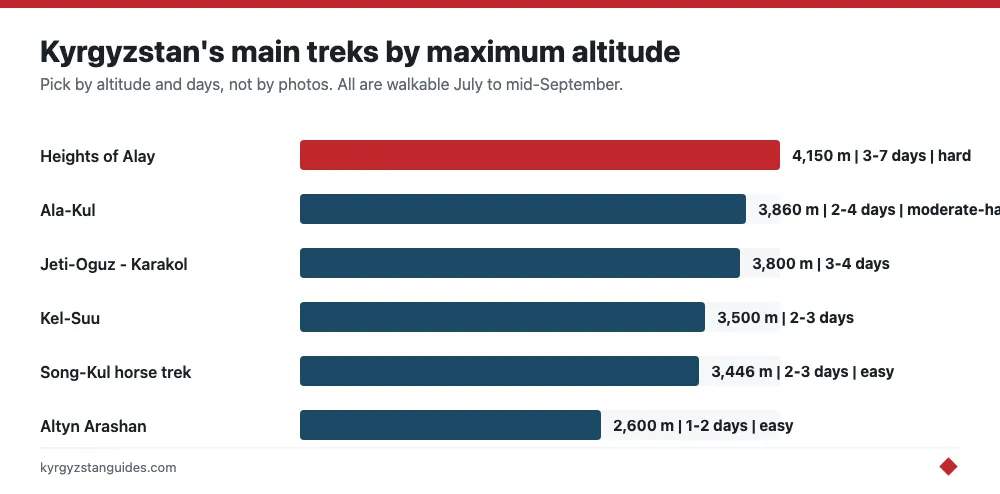
Nine options invite decision paralysis, so start with what you actually want from the trip:
- First time at altitude, or short on days: Altyn Arashan or a Jyrgalan loop. Real mountains, low commitment, a bed every night.
- The photo everyone comes for: Ala-Kul. Accept the August company; it earns the traffic.
- Culture over contours: Song-Kul by horse. The riding is easy; the yurt life is the point.
- You want nobody around: Boz-Uchuk lakes or Kel-Suu. On both you may see more horses than hikers.
- The biggest mountains you'll ever stand under: Pik Lenin base camp or the Heights of Alay loop.
- Forests and lakes instead of scree and passes: Sary-Chelek.
- A genuine multi-day traverse: Jeti-Oguz over the Teleti pass, extended across Ala-Kul if your legs agree.
If it's your first trip to the country, base yourself in Karakol. Four of the nine routes start within an hour of town, gear rental and guides are easy to arrange there, and you can stack two treks back to back without repositioning.
The 9 best treks in Kyrgyzstan compared
| Trek | Duration | Difficulty | Max altitude | Highlight |
|---|---|---|---|---|
| Ala-Kul | 2–4 days | Moderate–hard | 3,860 m | Turquoise glacial lake + hot springs finish |
| Altyn Arashan | 1–2 days | Easy–moderate | 2,600 m | Hot springs valley, gentle intro trek |
| Jeti-Oguz to Karakol Valley | 3–4 days | Moderate–hard | 3,800 m | Red rock cliffs, Teleti pass link-up |
| Song-Kul horse trek | 2–3 days | Easy | 3,446 m | Riding to a yurt-ringed alpine lake |
| Kel-Suu | 2–3 days | Easy–moderate | 3,500 m | Fjord-like lake in a remote border canyon |
| Sary-Chelek | 2–4 days | Moderate | 3,200 m | Walnut forests and seven biosphere lakes |
| Heights of Alay / Pik Lenin base camp | 3–7 days | Hard | 4,150 m | 7,000 m giants of the Pamir from Tulpar-Kul |
| Boz-Uchuk lakes | 2–3 days | Moderate | 3,500 m | Quiet chain of alpine lakes, no crowds |
| Jyrgalan valley | 1–4 days | Easy–moderate | 3,400 m | Village-based trails, Keskenkija loop |
1. Ala-Kul: the classic, deservedly
The benchmark Kyrgyz trek, and still the best two-to-four days in the Terskey Ala-Too. The standard direction runs up the Karakol Valley to the Sirota bridge camp on day one (about 15 km through spruce forest, sleeping around 2,900 m), then grinds up the moraine to the lake at 3,532 m, crosses the 3,860 m Ala-Kul pass beside water so blue it looks retouched, and drops into the Keldike valley to finish at the Altyn Arashan hot springs. Day three is the easy 14 km walk out to Ak-Suu village. Park entry is about 500 KGS, and in July and August the seasonal camps at Sirota and the lake rent tents for $10–15 a night with hot meals, so a light pack is genuinely possible. Start pass day early — afternoon cloud eats the view and the descent gully holds snow into July. Full logistics, timings and camp details are in our Ala-Kul trek guide.
2. Altyn Arashan: the easy option
A half-day walk of 14 km up a 4×4 track from Ak-Suu village to a green valley of guesthouses and hot pools at around 2,500 m. It is the perfect acclimatization leg before Ala-Kul, a satisfying overnight from Karakol on its own, and the consolation prize in shoulder season when the high passes are snowed in. The honest caveat: you are walking a road the whole way, and Soviet-era trucks full of day visitors will rattle past. If that spoils it, pay 1,000–1,500 KGS for a truck seat up and spend your energy on the side valleys above the springs instead — the walk toward the Palatka viewpoint gives you the mountain scenery without the traffic.
3. Jeti-Oguz to Karakol Valley: the quiet traverse
Start beneath the red sandstone Seven Bulls cliffs of Jeti-Oguz, walk up the Telety valley, cross the 3,800 m Teleti pass, and descend into the Karakol Valley — three to four days, carrying a tent, with a fraction of Ala-Kul’s foot traffic. The pass day is a long one: around 1,200 m of ascent, with a steep, loose final hour. The payoff is linking it with Ala-Kul for a five-to-six day traverse of the range that ends in hot springs, which is as good as multi-day trekking in Kyrgyzstan gets. Marshrutkas and cheap taxis reach the Jeti-Oguz trailhead from Karakol in under an hour.
4. Song-Kul horse trek: culture first
Two or three days from Kyzart village over the Kyzart pass to a 3,016 m lake ringed by yurts and livestock. Technically a ride rather than a hike, but no walking route delivers the nomad-culture experience this one does: kumis offered at every camp, herds moving at dusk, a horizon with no fence on it. CBT in Kochkor can organize horses, a guide-wrangler and yurt stays on a day’s notice for roughly 2,500–3,500 KGS per day. Skip it if multi-hour saddle time sounds like punishment — you can reach the lake by jeep instead. Everything else you need is in our Song-Kul lake guide.
5. Kel-Suu: the remote one
A grey-green lake wedged between sheer canyon walls at 3,500 m in Naryn’s far south, 30 km from China. The walking is modest — 10–12 km round trip from the yurt camps in the Kok-Kiya valley — but getting there is the adventure: hours of 4WD track beyond Naryn, then a border checkpoint where soldiers really do read your permit. Two quirks to plan around: it sits in a border zone, so the permit paperwork below applies, and the lake occasionally drains through its karst floor in late season. July and August are the reliable months, and combining it with Song-Kul on one southern loop saves a very long drive.
6. Sary-Chelek: lakes and walnut forest
A UNESCO biosphere reserve in the west of the country, greener, lower and warmer than the Tien Shan routes. Trails link seven lakes through walnut and fir forest, with 2–4 day approaches from Arkit village that suit trekkers who want scenery without big-pass suffering. Entry is about 500 KGS. The catch is position: it's a 10-hour-plus drive from Bishkek, so treat it as part of a southern itinerary through Osh or Jalal-Abad rather than an out-and-back from the capital. In September the walnut harvest fills the villages below the reserve, which is worth timing for on its own.
7. Heights of Alay and Pik Lenin base camp: the big one
From Osh, the Alay valley serves the country’s two heavyweight options. The gentler is the walk from the Tulpar-Kul lake yurt camps to Pik Lenin base camp at 3,600 m and on up to Traveller’s Pass at roughly 4,150 m, where a 7,134 m wall of ice fills the entire southern sky — doable in two or three days from Sary-Mogol village. The harder is the Heights of Alay loop, three to seven days crossing 4,000 m+ passes between Kojo-Kelen and Sary-Mogol: long stages, thin air, river crossings, and almost nobody on the trail. Both need the border permit, both are strictly July–August undertakings, and both reward every hard hour. Not worth it unless you are already acclimatized — come here after a northern trek, not before.
8. Boz-Uchuk lakes: the crowd-free Ala-Kul
Two to three days from Boz-Uchuk village near Karakol to a chain of small alpine lakes at 3,400–3,500 m. The scenery is the same Terskey granite-and-spruce formula as Ala-Kul with a fraction of the foot traffic; on a September weekday you may share the entire valley with a couple of herding families. There are no seasonal camps at the lakes themselves, so carry a tent and food, and arrange a yurt stay lower down if you want one soft night. This is the route to choose when the Ala-Kul camps are heaving in early August.
9. Jyrgalan: the village base
A former coal-mining village an hour east of Karakol that rebuilt itself as a trekking hub, and did it well: marked day trails to waterfalls and viewpoints, the 3–4 day Keskenkija loop over 3,400 m passes, good guesthouses, local guides and honest prices. It's the best answer for trekkers who want real routes but also a bed and a hot dinner most nights, and the valley holds snow late enough that it doubles as a freeride ski base in winter. If your trip has one rest-and-trek base outside Karakol, make it this.
When to go
July and August for anything with a 3,500 m+ pass — that covers Ala-Kul, Teleti and the whole Alay region. Mid-June to mid-September works for the lower valleys (Altyn Arashan, Jyrgalan, Sary-Chelek) and for Song-Kul. June carries leftover snowfields on north-facing pass slopes and rivers swollen with melt; September brings stable weather, golden larches and cold nights, but the yurt camps start dismantling mid-month, so late-September trekkers should assume full self-sufficiency. October is gambling territory at altitude. Lowland walks around Issyk-Kul stretch the season into May and October — our Issyk-Kul travel guide covers those.
Do you need a guide?
Kyrgyzstan is unusually friendly to independent trekkers: no national trekking permit, well-worn trails on the popular routes, and yurt camps selling meals in season. Ala-Kul, Altyn Arashan, Jyrgalan and Song-Kul are all realistic self-guided trips for hikers with normal mountain sense. Hire a guide for Kel-Suu and the Alay region (remoteness, border bureaucracy, thin rescue options), for early or late season snow on the passes, or simply for the local knowledge — $50–80 per day per group through agencies in Karakol and Osh or via CBT offices, which also pair solo travelers into groups to split the cost. Solo trekkers should know that horse-riding shepherds are often the only other people on the remote routes; that's part of the appeal, but it means self-reliance is not optional. General safety context is in our is Kyrgyzstan safe article.
Permits and paperwork
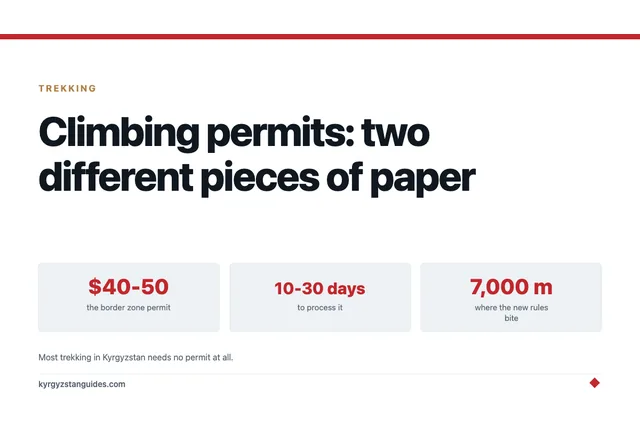
Most treks need nothing beyond small park entry fees (400–500 KGS for Karakol National Park or Sary-Chelek). The exceptions are border zones: Kel-Suu and the Pik Lenin/Alay area require a border zone permit. The state duty is 250 som and the statutory timetable four working days; the $15–30 your tour operator or yurt camp quotes is mostly their fee for handling it. See the border-zone permit rules. Apply at least two weeks ahead in peak season, carry your passport on the trail, and expect soldiers at the checkpoints to actually check — this isn't theater. Your Kyrgyz entry itself is visa-free for 60+ nationalities or handled via the official e-visa portal; the details live in our Kyrgyzstan visa guide.
What trekking in Kyrgyzstan costs
If your plan involves ropes rather than boots, see climbing in Kyrgyzstan instead. Budget $10–20 per day self-guided and $40–60 per day on organized treks with guide, pack animals and transfers. The line items, at 2026 prices (1 USD ≈ 88 KGS):
| Item | Typical price |
|---|---|
| Park entry (Karakol NP, Sary-Chelek) | 400–500 KGS ($5–6) |
| Yurt camp bed with dinner and breakfast | 1,200–1,800 KGS ($14–20) |
| Rental tent at Ala-Kul camps, per night | $10–15 |
| Trekking guide, per group per day | $50–80 |
| Porter or pack horse, per day | $30–50 |
| Full gear rental in Karakol, per day | 600–900 KGS |
| Marshrutka Bishkek–Karakol | 500–600 KGS |
| Flight Bishkek–Osh (for Alay treks) | from ~$40 |
| Truck out of Altyn Arashan | 1,000–1,500 KGS |
| Border zone permit (Kel-Suu, Pik Lenin) | $15–30 via operators |
The arithmetic favors small groups: a guide and a jeep cost the same for one person as for four, so hostels in Karakol double as partner-finding services. Solo trekkers who wait a day or two to join others routinely halve their costs.
Where you sleep on the trail
On the popular routes in July and August, seasonal yurt and tent camps mean you can trek hut-to-hut style with a light pack: Sirota and the Ala-Kul shore, Altyn Arashan’s year-round guesthouses, Song-Kul’s dozens of family camps, Kok-Kiya below Kel-Suu, and Tulpar-Kul in the Alay. Expect felt mats, heavy blankets, hot dinners and outhouse toilets for $14–20 with half board — bring a sleep liner and headlamp and you'll want for nothing. Everywhere else (Boz-Uchuk, the Teleti pass, the high Alay stages) you carry a tent. Wild camping is legal and completely normal; pitch away from stock corrals and water sources, and if herders are nearby, a greeting usually turns into a tea invitation rather than a complaint.
Altitude, weather and water
The passes here are Alpine-summit height, and treating them casually is the most common mistake on the trail. Sleep at least one night above 2,000 m before any pass day — Karakol town at 1,750 m plus a night at Sirota around 2,900 m is a sensible ladder for Ala-Kul. Above 3,500 m, a pounding headache, nausea or wobbliness means descend, not push on. Weather runs to a schedule: clear mornings, building cloud, and afternoon thunderstorms in July and August, so cross passes before 14:00. Rivers rise through the day with glacial melt — ford in the morning. Treat or boil all water below grazing altitude, which in Kyrgyzstan means almost everywhere. And be clear-eyed about rescue: there's no helicopter service waiting on standby, phone signal dies at the trailheads, and evacuation means horses and hours. Carry insurance valid to 4,000 m and leave your route with your guesthouse.
Gear: bring versus rent
Nothing on these nine routes needs technical equipment — no crampons or ropes, barring early-season snow on the passes. What you do need: a sleeping bag comfortable to -5°C even in August (yurt blankets cover camp nights, but tents at 3,500 m get properly cold), broken-in boots, trekking poles for the moraine and scree, full sun protection, and a stove if you are camping beyond the serviced routes. Gas canisters are sold in Bishkek and Karakol trekking shops — do not count on finding them elsewhere. If you would rather not fly with all that, rental shops in Karakol will kit you out completely (tent, bag, mat, poles) for 600–900 KGS per day, and the quality is decent.
Maps and navigation that actually work
Organic Maps (offline, OpenStreetMap-based) has startlingly good coverage of Kyrgyz trails, including yurt camps and springs — download the whole country before leaving Wi-Fi. Gaia GPS and Caltopo are useful for planning. On paper, the 1:100,000 sheets from the Trekking Union of Kyrgyzstan (TUK) in Bishkek cover the classic regions, and TUK also runs scheduled group hikes if you want company on a budget. Never rely on anything that needs a connection.
Frequently Asked Questions
What is the best trek in Kyrgyzstan for beginners?
Altyn Arashan: a 14 km walk on an obvious track to hot springs and guesthouses at 2,500 m, done as an overnight from Karakol. The Song-Kul horse trek and Jyrgalan’s day trails are equally forgiving. All three offer real mountain scenery without high-pass exposure or navigation problems.
Do you need a permit to trek in Kyrgyzstan?
Usually no. Most routes require only park entry fees of 400–500 KGS. Border-zone areas are the exception: Kel-Suu and the Pik Lenin/Alay region need a border permit ($15–30, 5–10 working days), which yurt camps and tour operators arrange if you apply about two weeks ahead.
How fit do you need to be for trekking in Kyrgyzstan?
For the classic treks, you should comfortably hike 6–8 hours with 800–1,000 m of daily ascent, because most cross passes between 3,400 and 3,900 m. Easier options (Altyn Arashan, Song-Kul by horse, Jyrgalan day hikes) suit anyone with average fitness. Acclimatize with a night at 2,000 m+ first.
Is wild camping legal in Kyrgyzstan?
Yes. There is no law against wild camping on public land, and it is standard practice on every route without yurt camps. Pitch away from livestock corrals and water sources, pack out all rubbish, and if herders are nearby, a greeting goes a long way — expect tea invitations, not complaints.
Do you need a guide to trek in Kyrgyzstan?
Not on the popular routes. Ala-Kul, Altyn Arashan, Jyrgalan, and the Jeti-Oguz traverse are all walkable independently, wild camping is legal everywhere, and most routes need no permit. A guide earns their fee on remote routes like Kel-Suu or the Heights of Alay, and border-zone treks near the Chinese and Tajik frontiers involve permit paperwork anyway.
What does trekking in Kyrgyzstan cost per day?
Between $10 and $60 per day depending on style. Camping with your own gear sits at the bottom of that range; seasonal camps on Ala-Kul rent tents for $10–15 a night with hot meals, park entry is about 500 KGS, and guided arrangements with transport push toward the top end — still a fraction of Alpine hut fees.