Is Kyrgyzstan safe? Yes: genuinely yes, not in the reflexive way travel writers insist everywhere is fine. Violent crime against foreigners is rare, strangers go out of their way to help lost visitors, and the things most likely to wreck your trip are a minibus driver’s overtaking habits and your own altitude planning, not anyone with bad intentions. Kyrgyzstan is widely considered the easiest and safest country in Central Asia to travel independently, and that reputation is earned.
Ask anyone who has spent a month here and the same short list of real risks comes up: pickpockets around Osh Bazaar in Bishkek, rough mountain roads, and the fact that there is no state mountain rescue service waiting if a trek goes wrong. This guide works through each of those properly, plus the fake-police scam, solo female travel, and the insurance clause almost everyone gets wrong — without the embassy boilerplate.
Crime: petty, predictable, avoidable
Petty theft in Bishkek is the main crime risk, and it clusters in exactly the places you would guess: Osh Bazaar, crowded marshrutkas, and nightlife streets after dark. Keep your phone out of your back pocket at the bazaar and you have eliminated most of the danger. Violent street crime against foreigners is uncommon, and outside the capital it drops to near zero. In Karakol, Kochkor, or Arslanbob, the biggest hazard is being invited to more tea than one human can drink.
The sensible baseline: use the Yandex Go app rather than flagging cars at night, decline drinking sessions with strangers, stay out of unlit parks after dark, and split your cash between bags. ATM skimming is rare, but stick to machines inside banks anyway — Optima and Demir are the traveler standards. Government advisories like the UK FCDO Kyrgyzstan page are worth a skim before you fly, though most of their warnings concern border zones the average visitor never goes near.
What solo women can expect
Broadly, a good experience. Solo women are a common sight on the trekking circuit between Karakol, Song-Kul, and Bishkek, and harassment levels are lower than in many far more popular destinations. Staring happens; aggressive behavior is unusual. The homestay and CBT (Community Based Tourism) network works strongly in your favor — you are usually sleeping inside a family home rather than an anonymous hotel, and CBT offices in Karakol, Kochkor, and Naryn will arrange trusted drivers and guides on request.
- Dress modestly in the more conservative south (Osh, Jalal-Abad, Batken), shoulders and knees covered saves hassle
- Use Yandex Go rather than street taxis at night in Bishkek and Osh
- On overnight transport, book two seats or simply travel by day
- Solo trekking is normal on busy routes like Ala-Kul in season; on remote routes, join a group or hire a guide (~$50–70/day) as much for navigation as for safety
- Bride kidnapping, while illegal and aimed at local women rather than tourists, reflects conservative rural gender norms — a firm no plus walking away resolves almost any awkward moment
The mountains are the risk that counts
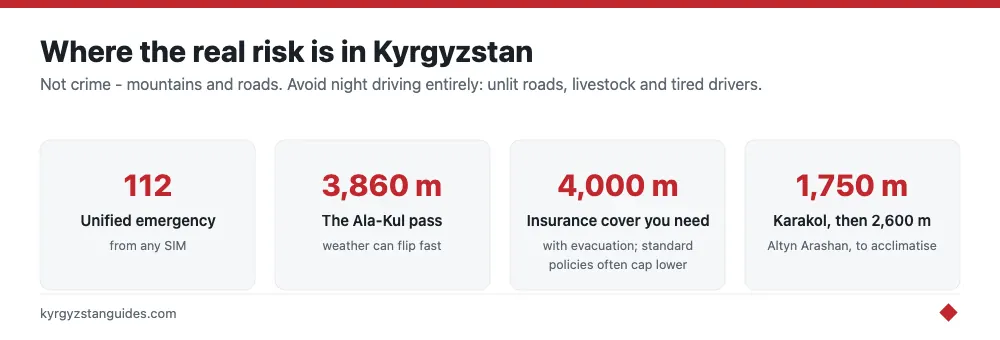
This is where travelers get into genuine trouble. The Terskey Ala-Too and the wider Tian Shan are serious ranges: the popular Ala-Kul trek crosses a 3,860 m pass, weather can flip from sun to snow inside an hour even in August, and phone signal dies within a few kilometers of most trailheads. None of that is a reason to stay home. It is a reason to plan like an adult.
Here is the part most blogs bury: Kyrgyzstan has no organized state mountain rescue service. There is no Alpine-style helicopter on standby. Evacuations are improvised through the Ministry of Emergency Situations, private helicopter charters, or horsemen recruited from the nearest jailoo, and they can take a day or more to reach you. That makes two things non-negotiable. First, travel insurance that explicitly covers trekking to at least 4,000 m with evacuation. Standard policies often cap out at 2,500–3,000 m, which quietly voids your cover on half the famous routes. Second, tell someone your route and return date: your guesthouse, a CBT office, anyone who will notice you missing.
Acclimatization matters more than fitness. Sleep a night in Karakol (1,750 m) and ideally another at Altyn Arashan (2,600 m) before crossing high passes, and learn the headache–nausea–confusion progression of altitude sickness so you turn around at stage one, not stage three. Our Kyrgyzstan trekking guide grades every major route by difficulty and remoteness.
Roads: statistically your biggest danger
Nothing else on this page comes close. Marshrutkas — the shared minibuses that run everywhere, Bishkek to Karakol for 500–600 KGS ($6–7) — are cheap and cheerful, but drivers overtake blind on mountain curves and rear seatbelts are a rumor. Shared taxis are faster and only slightly pricier, and you can pay extra for the front seat, which actually has a belt.
- Avoid night driving entirely, unlit roads, wandering livestock, and tired drivers are a grim combination, especially on the Bishkek–Osh road over the Töö-Ashuu pass
- For rough mountain routes like the road to Song-Kul, a hired 4WD with driver (~$70–100/day, split between passengers) is money well spent
- If a driver is reckless, say “akyrynyraak” (slower) or simply ask to get out, locals do both without embarrassment
- Self-driving is fine for confident drivers; the roads to Issyk-Kul are paved and decent, but carry a spare and download offline maps first
The fake police scam, and the lesser hustles
Bishkek’s classic con is the fake police officer: men in plain clothes (occasionally real-looking uniforms) flash an ID, announce a document or currency check, and ask to inspect your wallet or passport — after which money is mysteriously thinner. Real police rarely stop tourists without cause. If it happens to you: stay calm, do not hand over your wallet, offer a photocopy of your passport, and insist on walking to the nearest police station together. Scammers evaporate at that suggestion. The scam has declined sharply in recent years but still surfaces around Osh Bazaar and the nightlife streets.
Below that on the annoyance scale: airport taxi drivers at Manas quoting 2,000+ KGS for a ride that costs 600–800 KGS on Yandex Go (order from the app while you wait for your bag), and occasional creative arithmetic when change is counted at bazaars. Currency exchange offices, unusually for the region, are honest and post real rates — Bishkek’s are among the best anywhere in Central Asia.
Food, water, and the kymyz question
Stomach trouble is common but almost always mild. Do not drink tap water anywhere — bottled water costs 30–50 KGS, and a filter bottle handles mountain streams, which look pristine but sit below grazing animals in most valleys. Bazaar food is generally safe when it's hot and the stall is busy; be warier of meat salads sitting out in summer heat. Kymyz, the fermented mare’s milk offered at every jailoo, is worth trying. But accept a polite half-cup the first time, because unaccustomed stomachs frequently protest. What to actually order, and what to skip, is covered in our Kyrgyz food guide.
Osh, Batken, and the border strips
Osh and the south are safe and well worth your time. The 2010 unrest is long past; the city’s Sulaiman-Too and its enormous bazaar see a steady stream of tourists whose worst experience is mild overcharging. Apply normal precautions and dress a notch more conservatively than in Bishkek. The one region that deserves attention is the Batken area along the Tajik border, where armed clashes occurred in 2021–2022. A border agreement signed in 2025 has calmed things considerably, but stay out of the immediate border strip and check current advice if you are routing toward the Pamirs. Areas near the Chinese border, Inylchek, the Peak Lenin approaches, require permits arranged weeks in advance, which is bureaucracy rather than danger. Entry paperwork itself is easy for most nationalities; our Kyrgyzstan visa guide has the details.
Two risks nobody warns you about
First, shepherd dogs. The large Central Asian breeds guarding flocks on the jailoos take their job seriously, and a hiker walking straight through a herd reads as a threat. Give grazing animals a wide berth, and if a dog charges, stop, face it, and pick up a rock. The gesture alone usually ends the conversation, because every dog here has learned what it means. Second, politics. Kyrgyzstan has had three revolutions since independence, and Bishkek sees occasional demonstrations around White House square. They are domestic affairs that have never targeted tourists; the only rule is the obvious one — if you see a crowd forming, go find a coffee somewhere else and check the news.
Numbers to save, and the insurance test
Save these before you need them:
- 112. The unified emergency number; works from any SIM, answered mainly in Russian and Kyrgyz
- 102 (police (route through 112 if no English speaker picks up)
- 103) ambulance; basic outside Bishkek, and serious cases end up in private clinics
- 101 / via 112, the Ministry of Emergency Situations, which is the channel for mountain incidents
Apply the insurance test before you buy: does the policy explicitly cover trekking to your maximum altitude, helicopter evacuation, and medical treatment abroad? Quality care in Bishkek means private clinics, and serious cases get flown to Almaty or Istanbul. You want that flight paid for. A local SIM (O!, Beeline, or MegaCom, roughly 200–400 KGS with data) is worth it purely so 112 and Yandex Go work everywhere there's signal. Skip the money belt. You honestly do not need one here. Do not skip the insurance.
Frequently Asked Questions
Is Bishkek safe at night?
Central Bishkek is reasonably safe at night if you use Yandex Go taxis instead of walking dark side streets or flagging random cars. The main risks are pickpockets around nightlife areas and the occasional drunk wanting to practice English. Standard big-city awareness is enough.
Is Kyrgyzstan safe for solo female travelers?
Yes — solo women travel Kyrgyzstan’s main circuit routinely. Harassment is less common than in many destinations, homestays provide a family environment, and CBT offices arrange vetted guides and drivers. Dress modestly in the south, use app taxis at night, and prefer groups on remote treks.
Can you drink tap water in Kyrgyzstan?
No. Don’t drink tap water anywhere in the country. Bottled water costs 30–50 KGS, and a filter bottle or purification tablets handle mountain streams while trekking. High-altitude sources above grazing areas are cleaner, but filtering everything is the sensible default.
Is there mountain rescue in Kyrgyzstan?
Not in any organized, on-call sense. Evacuations are improvised through the Ministry of Emergency Situations (call 112) or private helicopters and can take a day or more. That’s why insurance covering trekking to 4,000m with evacuation, plus leaving your route with someone, is essential.
Is Osh safe to visit?
Yes. Osh is a normal, welcoming city today. The 2010 unrest is long past. Take usual precautions at the bazaar, dress somewhat conservatively, and you’ll have no issues. Only the immediate Tajik border strip in Batken region warrants avoiding, not the city itself.
Where does petty theft happen in Kyrgyzstan?
It clusters in predictable Bishkek spots: Osh Bazaar, crowded marshrutkas, and nightlife streets after dark. Keep your phone out of your back pocket at the bazaar and you have eliminated most of the risk. Outside the capital, street crime drops to near zero. Stick to ATMs inside banks — Optima and Demir are the traveler standards — and use Yandex Go rather than flagging cars at night.