$30 a day. That single number covers a bed, three hot meals, transport and most activities for a backpacker in Kyrgyzstan — and it isn't a hair-shirt budget. A realistic Kyrgyzstan travel budget in 2026 is $25–35 per day for backpackers, $50–80 per day for mid-range travelers, and $100+ per day for comfort with private drivers and the best guesthouses. Very few countries deliver this much mountain for this little money, especially once you notice that the yurt camp prices include dinner.
The Kyrgyz som (KGS) trades at roughly 87–89 to the US dollar in 2026, and this is a cash economy once you leave Bishkek, Karakol or Osh. Below are current, verifiable prices for accommodation, food, transport, treks and SIM cards, plus two sample 10-day budgets you can copy line by line, the regional quirks that move the numbers, and the spending habits that wreck more budgets here than any single price ever does.
How much does Kyrgyzstan cost per day?
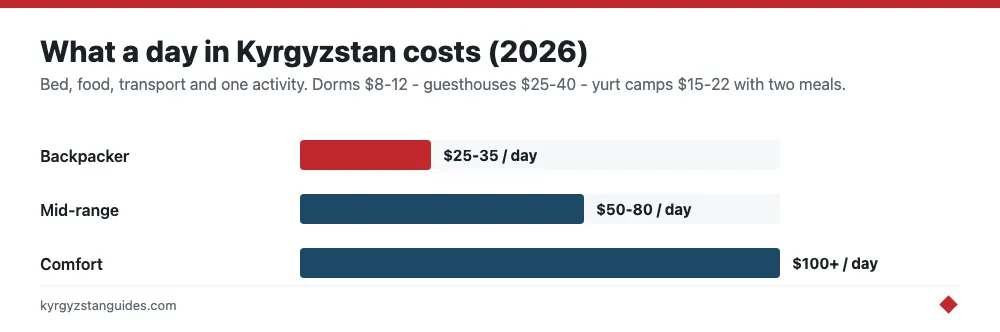
| Style | Per day | What that buys |
|---|---|---|
| Backpacker | $25–35 | Dorms and yurt camps, marshrutkas, cafe meals, independent treks |
| Mid-range | $50–80 | Guesthouse doubles, shared taxis plus occasional private driver, restaurants, guided day activities |
| Comfort | $100+ | Best hotels and lodges, car with driver throughout, private guides |
Sleeping and eating cost almost nothing by Western standards; the money in every Kyrgyzstan budget goes on transport to remote valleys and on guided activities, and on very little else. The other structural fact is that the country rewards company. Doubles cost little more than one dorm bed each, a private car splits two or four ways, and a couple traveling mid-range often ends up spending less per person than a solo backpacker who takes a private jeep to Song-Kul once.
What accommodation costs
No table needed here — the price bands are simple and they barely move across the country:
- Hostel dorms in Bishkek, Karakol and Osh run $8–12 with good standards; Interhouse and Apple Hostel are the reliable names and double as trip-partner exchanges.
- Family guesthouse doubles cost $25–40 and usually include a breakfast large enough to shorten lunch.
- Yurt camps charge $15–22 per person including dinner and breakfast — the best value bed in the country.
- CBT homestays (booked at Community Based Tourism offices in Kochkor, Karakol and Bokonbaevo) run $12–18 per person with dinner.
- Mid-range hotels in Bishkek cost $40–70: comfortable, rarely charming.
Run the yurt math once and it changes how you plan: $15–22 at Song-Kul or on Issyk-Kul’s south shore includes two hot meals, so a night in a yurt in the mountains frequently works out cheaper than a guesthouse room plus a restaurant dinner back in town. Our Song-Kul guide lists camps worth booking by name.
Food: $8 a day without trying
- Cafe/chaikhana meal (lagman, plov, manty + tea): 250–450 KGS ($3–5)
- Restaurant dinner in Bishkek or Karakol: 600–1,000 KGS ($7–11.50)
- Ashlan-fu at Karakol’s small bazaar: about 100 KGS ($1.15)
- Samsa or fresh bread from a tandyr stand: 50–80 KGS
- Bazaar fruit in season: apricots and melon for pennies per kilo
- Draft beer: 150–250 KGS; cappuccino in a Bishkek specialty cafe: 250–300 KGS
Backpackers eating in chaikhanas and bazaars spend $8–10 a day, and it takes deliberate effort to spend more than $15. Guesthouse breakfasts and yurt full-board push real food spending even lower on mountain days — on a Song-Kul or trekking day your entire food cost is already inside the bed price. The only place food spending climbs is Bishkek’s restaurant-and-craft-beer scene, and even there a big night out is $15–20. See our Kyrgyz food guide for what to order the first time so the pointing-at-the-menu phase is short.
Transport: the line item that decides your budget
| Route / type | Price | Time |
|---|---|---|
| Bishkek city bus or marshrutka | 15–20 KGS | — |
| Marshrutka Bishkek–Karakol | 500–600 KGS | 6–7 hrs |
| Shared taxi Bishkek–Karakol | 700–900 KGS | 5.5 hrs |
| Marshrutka Bishkek–Kochkor | 350–400 KGS | 3.5 hrs |
| Jeep seat Kochkor–Song-Kul | 1,200–1,500 KGS | 2–2.5 hrs |
| Car hire with driver | $50–80/day | Fuel included, negotiate multi-day rates |
| Flight Bishkek–Osh | $40–60 | 45 min |
Notice the shape of that table: everything on a paved marshrutka route costs almost nothing, and the price jumps the moment the asphalt ends. Getting to Karakol costs 500 KGS; getting the last 60 km to Song-Kul costs three times that. This is why itineraries built around marshrutka towns (Karakol, Kochkor, Osh) come in far under itineraries that chain remote valleys. In cities, use the Yandex Go app instead of hailing taxis — a cross-town Bishkek ride costs 150–250 KGS. Marshrutkas leave when full, so morning departures are more predictable. And for a group of three or four, a car with driver at $50–80 a day frequently beats public transport once you value your time at anything above zero.
Activities and trekking costs
Horse trekking costs 2,500–3,500 KGS ($28–40) per day including a local guide-wrangler, arranged on the spot at Song-Kul or through CBT in Kochkor. The three-day Ala-Kul trek from Karakol costs almost nothing independently: about 500 KGS park entry, $10–15 per night for rental tents at Sirota and the lake camps, and 1,000–1,500 KGS for the truck out from Altyn Arashan — call it $50–60 total for one of the best treks in Asia. A hired trekking guide runs $50–60 per day, porters slightly less. Eagle-hunter demonstrations near Bokonbaevo cost 2,000–2,500 KGS per group, Skazka Canyon entry is 50–100 KGS, and the Altyn Arashan hot-spring pools are 200–400 KGS. Winter travelers: a full-day lift pass at Karakol Ski Base is 2,000–2,500 KGS ($23–29), laughably cheap by Alpine standards. More route ideas and their price tags are in our Kyrgyzstan trekking guide.
SIM cards and data
Buy a SIM at Manas Airport or any city sales office — you need your passport. O!, Beeline and MegaCom all sell tourist packages of 20–50 GB for 300–500 KGS ($3.50–6) per month, which barely registers in a budget. O! has the strongest 4G in cities; MegaCom holds signal marginally better around Issyk-Kul. None of them cover Song-Kul, the Karakol gorge or Altyn Arashan, so download offline maps before leaving town — Organic Maps has the trekking trails and costs nothing.
Two sample 10-day budgets
| Category | Backpacker (10 days) | Mid-range (10 days) |
|---|---|---|
| Accommodation | $110–140 | $280–350 |
| Food | $70–90 | $130–180 |
| Transport | $60–80 | $180–250 |
| Activities | $70–100 | $110–150 |
| SIM + misc | $15–25 | $30–50 |
| Total | $325–435 | $730–980 |
These totals map onto our 10-day Kyrgyzstan itinerary almost exactly. A 7-day trip runs about 70 percent of these figures; a 3-week trip runs slightly under double the 10-day numbers, because the fixed costs (SIM, airport transfers, gear odds and ends) are already paid. International flights are excluded — Pegasus and flydubai connections are usually the cheapest way into Bishkek. Entry itself costs nothing for most visitors: 30 days within any 60-day period visa-free for most Western passports, while others use the official e-visa portal at evisa.e-gov.kg (about $50–60 with fees).
Solo, couple, or group: how the math shifts
The per-person numbers above assume you share the shareable. Solo travelers pay the full price of every private transfer, which is why the difference between a $30-a-day trip and a $50-a-day trip is usually one person’s name on the jeep receipt. The fixes are well established: hostels in Bishkek and Karakol have notice boards and group chats for splitting Song-Kul and Kel-Suu transport, CBT offices pool travelers heading the same direction, and shifting a departure by one day to join a formed group is nearly always worth it. Couples hit the sweet spot — guesthouse doubles at $25–40 beat two dorm beds in comfort per dollar, and every taxi halves. Groups of four travel mid-range for backpacker money: $60–80 a day for a car and driver looks expensive next to a marshrutka until it is $15–20 each, door to door, with photo stops.
What a cheap day and an expensive day actually look like
Abstract ranges hide how lopsided spending is here, so take two real shapes of day. A cheap one: dorm bed in Karakol ($10), ashlan-fu and bread at the small bazaar (120 KGS), an afternoon walking to a viewpoint (free), lagman and tea for dinner (350 KGS), beer with hostel trekking partners (200 KGS). Total: about $18, and it was a good day. An expensive one: check out of the dorm, private jeep seat to Song-Kul (1,500 KGS), horse ride at the lake (2,000 KGS for a half day), yurt night with two meals ($20). Total: about $60–65 — and that's roughly the ceiling of what a solo backpacker can spend in a day here without deliberately chasing comfort. Most days sit near the first number, and the average lands at $25–35 because Song-Kul-type days only come around every few days of a trip — so build the budget around that pattern rather than around the priciest day you can imagine.
Is the south cheaper?
Marginally, yes. Osh runs a shade cheaper than Bishkek on food and rooms — the bazaar is bigger, the plov is better, and dorm beds sit at the bottom of the $8–12 band. The real question is getting there: the $40–60 flight from Bishkek beats the long mountain drive on both cost-per-hour and spine comfort, and it's one of the few flights anywhere we would call a budget travel bargain in its own right — the Tien Shan from a window seat, 45 minutes, less than a night in a mid-range hotel. Once south, the Alay valley follows the same rules as everywhere else: homestays and yurts at $12–20 with meals, and 4WD transfers as the only line item that stings.
The small costs nobody budgets for
These add up to a few dollars a day and surprise people: drinking water in towns (bottled or filtered, 50–100 KGS a day unless you carry a filter), hot showers at some yurt camps (100–200 KGS where they exist at all), toilets at bazaars and bus stations (10–20 KGS, keep coins), laundry in Karakol between treks (300–500 KGS a load), and the 400–500 KGS park entry fees that gate most trailheads. None of these will bend a budget, but together they are the gap between a theoretical $25 day and a real $30 one. Travel insurance that covers trekking to 4,000 m is the one pre-trip cost not to economize on: if something goes wrong at altitude, rescue is informal, can take a long time to organize, and gets paid for in cash.
Does the season change what you pay?
Less than you might expect. Kyrgyzstan has almost no high-season price gouging: marshrutka fares, cafe menus and CBT homestay rates stay flat year-round. The exceptions are worth knowing. Bishkek and Cholpon-Ata hotels creep up 20–30 percent in July and August, when Kazakh and Russian holidaymakers fill the Issyk-Kul north shore, and the most popular Karakol guesthouses sell out weeks ahead rather than raising prices — book those early instead of paying more. In June and September you can often negotiate yurt and guesthouse rates down slightly, especially for stays of two nights or more. Winter flips the budget: accommodation gets cheaper, but transport costs more because many mountain roads need a 4×4, and the Karakol ski season (December to March) adds lift passes and gear rental of about 1,000–1,500 KGS per day. Shoulder-season travelers get the best of it — summer prices without summer competition for rooms.
Where travelers overspend
The biggest leak is solo private transport: taking a car with driver alone, instead of finding trip partners in Karakol hostels or through the CBT office, doubles a daily budget instantly. Booking horse treks and Song-Kul packages from abroad through aggregator sites comes close behind — the same yurt, horse and guide cost 30–50 percent more than they would if you walked into the CBT office in Kochkor and arranged everything for the next morning. And then there are airport currency exchange and small, repeated ATM withdrawals, where fixed card fees skim 3–5 percent off everything you spend. None of the three is hard to avoid once you know about them.
Money tips: cash, ATMs, tipping and haggling
- Carry cash outside cities. Yurt camps, homestays, drivers and village shops are cash-only. Stock up on som before leaving Bishkek or Karakol.
- Use Optima and Demir ATMs. Both dispense som (and Optima often USD) with reasonable limits; withdraw large amounts at once to save foreign-transaction fees. KICB also works with foreign cards.
- Exchange offices beat airport rates. Moskovskaya Street in Bishkek has competitive rates for clean USD and EUR notes.
- Tipping isn't expected. Nicer restaurants add a 10–15 percent service charge to the bill; nothing extra is needed. Round up for drivers and tip trek guides $5–10/day if they were good.
- Haggle at bazaars and for taxis, not in shops. Souvenir and taxi prices open 20–50 percent high; food prices at bazaars are mostly honest. Agree taxi fares before getting in, or just use Yandex Go.
- Small notes matter. Nobody in a village can change a 5,000 KGS note — break big bills in city supermarkets.
If you are driving, two 2026 costs are easy to miss: compulsory third-party insurance, where a foreign-registered vehicle without a policy is fined 13,000 som, and new tunnel tolls where foreign plates pay 200 som against 50 for local cars. Both are covered in our car rental guide.
Frequently Asked Questions
Is Kyrgyzstan cheap to travel?
Yes — it is among the cheapest mountain destinations anywhere. Backpackers manage on $25–35 a day, a filling cafe meal costs 250–450 KGS ($3–5), and a yurt stay with two meals is $15–22. Only private transport to remote valleys pushes costs up.
How much money do I need for 10 days in Kyrgyzstan?
Plan on $325–435 per person for 10 days as a backpacker, or $730–980 mid-range with private drivers and guesthouse doubles. That covers all accommodation, food, transport, activities and a SIM card, but not international flights or travel insurance.
Can I use credit cards in Kyrgyzstan?
Only in Bishkek, Karakol and Osh — supermarkets, hotels and better restaurants take Visa and Mastercard. Everywhere else is cash-only, including yurt camps, homestays and drivers. Withdraw som from Optima or Demir Bank ATMs before heading into the mountains.
Should I tip in Kyrgyzstan?
Tipping is not part of local culture. Restaurants that expect anything add a 10–15 percent service charge automatically. Round up taxi fares, and tip trekking guides and drivers $5–10 per day at the end of a multi-day trip if service was good.
How much is a SIM card in Kyrgyzstan?
A tourist SIM from O!, Beeline or MegaCom costs 300–500 KGS ($3.50–6) with 20–50 GB of data for a month. Buy it at Manas Airport or a city sales office with your passport. Expect no signal at Song-Kul or in the trekking valleys.
The bottom line: bring $35 a day if you're careful, $70 if you aren't, share your jeeps, book nothing remote from abroad, and spend the savings on an extra week — in Kyrgyzstan, time is the only thing worth splurging on.
Why do yurt camps work out cheaper than guesthouses?
Because the $15–22 per-person price at Song-Kul or on Issyk-Kul's south shore includes dinner and breakfast, a yurt night frequently beats a guesthouse room plus a restaurant dinner back in town. The same logic rewards company everywhere: doubles cost little more than one dorm bed each, and a private car splits two or four ways.