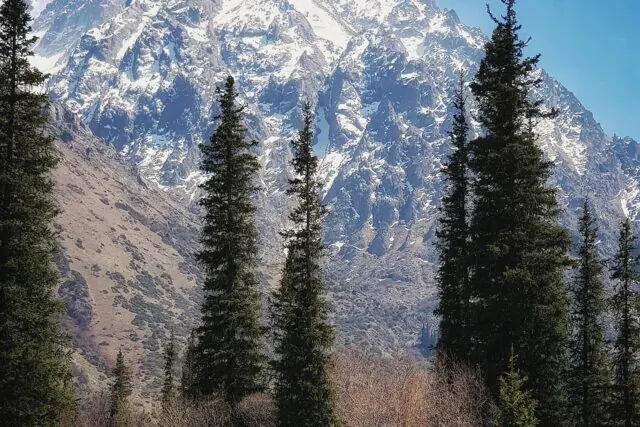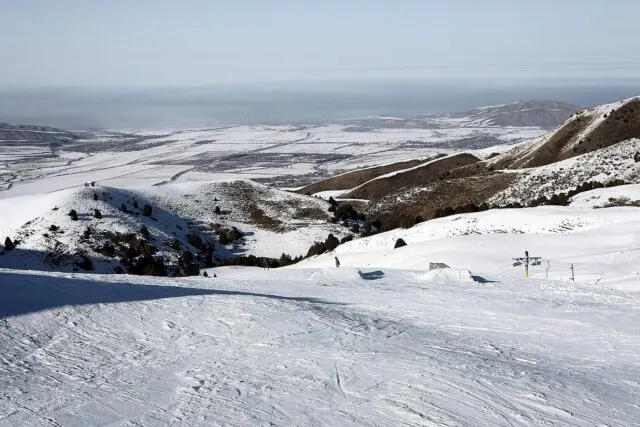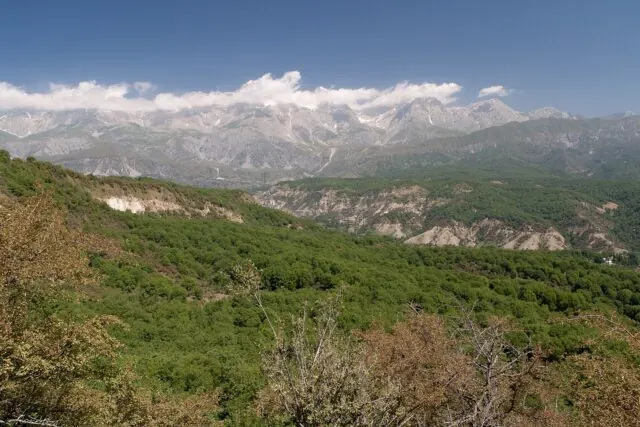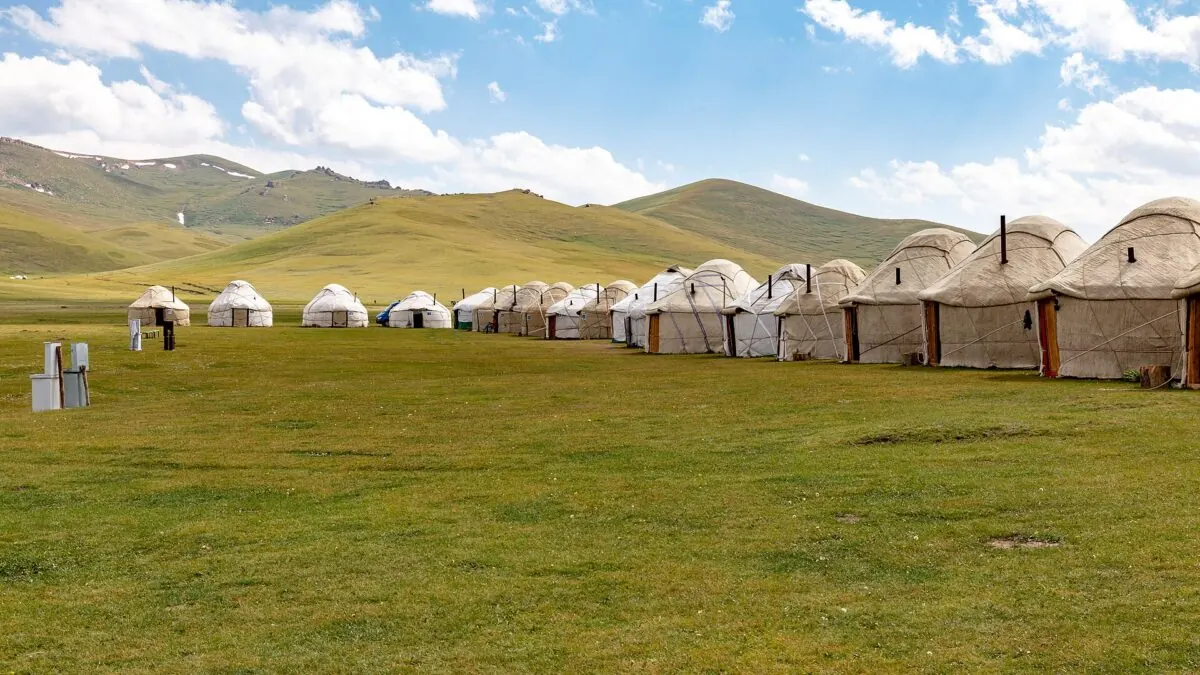
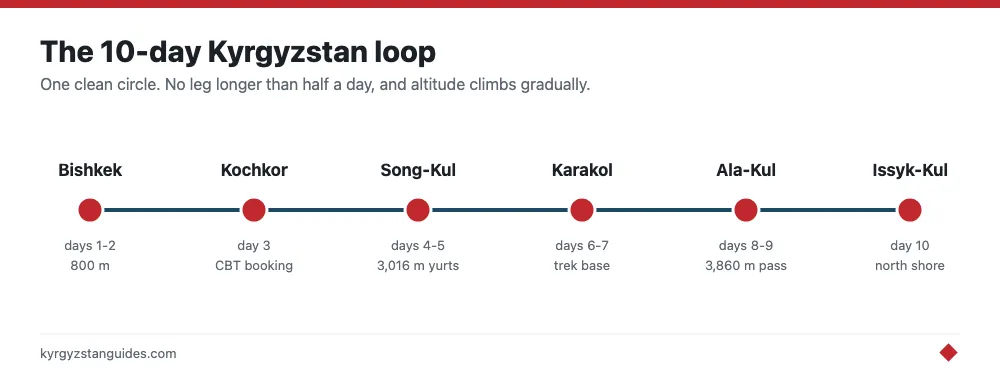
The best 10-day Kyrgyzstan itinerary runs Bishkek → Kochkor → Song-Kul → Karakol → Ala-Kul (or Altyn Arashan) → Issyk-Kul north shore → Bishkek, and costs roughly $350–$450 per person on a budget or $700–$900 mid-range. Ten days is the sweet spot for a first trip: long enough to sleep in a yurt at 3,016 m, cross a 3,860 m pass, and swim in a mountain lake the size of a small sea, without the frantic pace a one-week dash forces on you.
The route works from mid-June to mid-September, when the road to Song-Kul is open and the Ala-Kul pass is snow-free; outside that window, use the no-trekking variation near the end. Prices are 2026 figures in Kyrgyz som (KGS) at roughly 87–89 to the US dollar. Most Western passports get 30 days within any 60-day period visa-free; anyone else can check evisa.e-gov.kg. The shape of the trip in one line: two city days, two yurt days, one long transfer, three mountain days, one lake day, one travel day home.
- Days 1–2: Bishkek, plus an Ala-Archa National Park day hike. Sleep in Bishkek.
- Day 3: Marshrutka to Kochkor; book everything at CBT. Sleep in a Kochkor guesthouse.
- Days 4–5: Jeep over the Kalmak-Ashuu pass to Song-Kul; full-day horse trek. Two yurt nights.
- Day 6: Long transfer to Karakol, ideally via the south shore. Guesthouse night.
- Days 7–9: Ala-Kul trek, or the Altyn Arashan and Jeti-Oguz alternative. Tent or lodge nights, then Karakol.
- Day 10: Cholpon-Ata petroglyphs and a swim, then back to Bishkek.
Days 1–2: Bishkek, then a warm-up in Ala-Archa
Land at Manas International Airport and take express bus 153 into the city for 122 KGS cashless, 140 in cash, or a Yandex Go taxi for 1,200–1,500 KGS ($14–17). Spend day one on foot: Ala-Too Square and the changing of the guard, the State History Museum (400 KGS), Panfilov Park, and an evening plov or lagman on Chuy Avenue. Give Osh Bazaar an hour or two, it's a working market, not a show staged for visitors. Our full Bishkek guide has a walking route if you want structure.
Day two is Ala-Archa National Park, 40 minutes south of the city. A round-trip taxi with waiting time costs 2,500–3,000 KGS ($28–34), park entry about 500 KGS per car. The classic half-day hike climbs from the alplager to the Ak-Sai waterfall — 3–4 hours return, about 700 m of gain, granite walls up close. Treat it as an acclimatization day: Song-Kul sits at 3,016 m and your body will thank you for the head start.
Sleep: dorms in Bishkek run $8–12 (Interhouse, Apple Hostel), decent mid-range hotels $40–60. Use these two days for errands too: withdraw enough som for the whole loop, buy your SIM, and stock any trail snacks or gear you forgot, because after Bishkek the shopping gets thin fast.
Day 3: Bishkek to Kochkor
Marshrutkas to Kochkor leave Bishkek’s main bus station on Alma-Atinskaya 1/1 roughly hourly and cost 350–400 KGS ($4–4.50) for the 3.5-hour ride; a seat in a shared taxi is 600–700 KGS and an hour faster. Kochkor exists, for your purposes, as the logistics hub for Song-Kul. Go straight to the CBT (Community Based Tourism) office on the main street and book tomorrow’s transfer, yurt stay, and horses in a single visit — it takes twenty minutes. In the afternoon, the women’s felt-making cooperative runs shyrdak (felt carpet) demonstrations for a small donation, and it is more interesting than it sounds. Guesthouses with dinner and breakfast cost 1,500–2,000 KGS ($17–23). One warning for this day: don't arrive in Kochkor after the CBT office closes in the late afternoon, or tomorrow’s Song-Kul transfer becomes a scramble of phone calls through your guesthouse owner. Catch a marshrutka by noon and the whole chain works itself out.
Days 4–5: Song-Kul — the yurt nights
The jeep to Song-Kul takes 2–2.5 hours over the 3,447 m Kalmak-Ashuu pass. A seat in a shared 4×4 arranged through CBT costs 1,200–1,500 KGS ($14–17) each way; a private car is 5,000–6,000 KGS split between passengers. Yurt camps on the northern and eastern shores charge $18–22 per person with three meals, and the bowl of kymyz (fermented mare’s milk) offered on arrival is part of the deal. Taste it at least. Nights drop near freezing even in July, so keep a warm layer and a headlamp within reach of your bed — the toilet is a walk across a dark field, and the compensation is a night sky you won't stop talking about.
Day five is why you came. A full-day horse trek along the shore and up into the summer pastures costs 2,500–3,500 KGS ($28–40) with a local guide, and no riding experience is needed. Sunset over the water and the night sky at 3,016 m are the two images from this trip that stay with people. Routes, camps we rate, and a two-day trek option are in our Song-Kul lake guide.
Day 6: the long haul to Karakol
This is the transfer day, and you have two honest options. The scenic route is a private car from Song-Kul along Issyk-Kul’s south shore to Karakol (6–7 hours, $90–110 per vehicle split up to four ways) passing Bokonbaevo and the red cliffs of Skazka if you want a leg-stretch. The cheap route backtracks to Kochkor by shared jeep, then marshrutka or shared taxi via Balykchy to Karakol: 700–900 KGS total, about 6 hours, considerably less scenery.
Either way you sleep in Karakol, where family guesthouses charge $25–40 for a double with breakfast — our Karakol travel guide lists favorites. Eat ashlan-fu at the small bazaar for 100 KGS and go to bed early; the next three days are the physical heart of the trip.
Days 7–9: Ala-Kul, or the soft option
Option A: the three-day Ala-Kul trek
The classic route ascends the Karakol gorge (national park entry about 500 KGS) to Sirota camp, crosses the 3,860 m Ala-Kul pass above the improbably turquoise lake on day two, and descends to the Altyn Arashan hot springs before walking or trucking out to Ak-Suu village on day three. Rental tents at Sirota and the lake camps cost $10–15 per night if you don't want to carry your own. The trail is well-trodden and navigable without a guide in good July–August weather; full logistics, maps, and a packing list are in our Ala-Kul trek guide. Hire a guide (about $50–60/day) if you are solo or walking in shoulder season: the pass in fresh snow is no place to learn navigation.
Option B: hot springs without the tent
Not a camper? Take a Soviet 6×6 truck up to Altyn Arashan (1,000–1,500 KGS per person return), overnight in a basic lodge with hot-spring pools (1,500–2,000 KGS with meals), and hike the valley the next morning. Use day nine for Jeti-Oguz’s Seven Bulls cliffs and the Kok-Jaiyk valley (taxi 1,500–2,000 KGS round trip), plus Skazka (Fairy Tale) Canyon on the south shore. Entry is a token 50–100 KGS and an hour among the red towers is plenty. You lose the lake; you keep every other highlight and sleep in a bed each night.
Day 10: Cholpon-Ata and back to Bishkek
Break the return with a stop in Cholpon-Ata on the north shore: the marshrutka from Karakol takes about 2 hours (250–300 KGS). The open-air petroglyph museum (200 KGS) scatters Bronze Age carvings across a boulder field above the lake, and Issyk-Kul holds around 20°C in summer for a final swim. From Cholpon-Ata, marshrutkas to Bishkek take 4–4.5 hours (400–450 KGS). Flying out early the next morning? Skip the stop and take a direct Karakol–Bishkek shared taxi (900–1,000 KGS, 5.5–6 hours) the previous evening instead.
The budget, line by line
| Category | Budget (per person) | Mid-range (per person) |
|---|---|---|
| Accommodation (9 nights) | $110–140 | $280–350 |
| Food | $70–90 | $130–180 |
| Transport | $60–80 | $180–250 (private drivers) |
| Activities (horses, entries, springs) | $70–100 | $110–150 |
| Total | $310–410 | $700–930 |
Yurt stays with full board are the best value in the country and cost the same whether you travel budget or mid-range. The line that actually moves the total is transport: private drivers roughly triple it. A fuller day-by-day cost breakdown is in our Kyrgyzstan travel budget article.
Two ways to bend the route
No-trekking version. Swap days 7–9 for two relaxed Karakol days (Altyn Arashan by truck, Jeti-Oguz, the Sunday animal market if your timing fits) and add a night in Bokonbaevo on the south shore for an eagle-hunter demonstration (about 2,000 KGS per group) and a beach yurt camp. Everything is reachable by car, and total walking stays under two hours a day. This is also the version to run in late September or October.
Adding Osh and the south. With 13–14 days, fly Bishkek–Osh ($40–60, 45 minutes) after the loop. Climb Sulaiman-Too, eat the country’s best plov, and day-trip toward Sary-Mogol for Pik Lenin views. Fly rather than drive: the 12-hour Bishkek–Osh road only earns its hours if the mountain highway itself is the goal. Our three-week itinerary is built on the same drive-the-north, fly-to-the-south logic.
Timing and food, briefly
When to run it: July and August are the safe months, the Ala-Kul pass is reliably clear, Song-Kul’s camps are fully staffed, and the lake is warm enough to swim. Late June and the first half of September work nearly as well, with emptier trails, colder yurt nights, and a small snow risk on the pass. In October, switch to the no-trekking version; from November to May, this route simply is not available in this form.
What you will eat: lagman (hand-pulled noodles), plov, manty dumplings, and endless bread with apricot jam, at 250–450 KGS for a filling cafe meal. Yurt camps feed you enormously (soup, pasta or plov, tea, and sweets) and the quality is usually better at family camps than at the bigger commercial ones. Vegetarians survive fine with some repetition; vegans should carry supplies from Bishkek. The one dish worth planning around is ashlan-fu in Karakol, which costs 100 KGS and takes five minutes of your life.
Before you book: the short checklist
- Reserve the first Bishkek night and July–August Karakol guesthouses ahead; everything else can be arranged 1–2 days out through CBT offices in Kochkor and Karakol.
- Carry cash outside Bishkek and Karakol — yurt camps, drivers, and homestays don't take cards. Withdraw som from Optima or Demir ATMs in the cities.
- Buy a local SIM at the airport (O!, Beeline, or MegaCom, 300–500 KGS for 20–50 GB). Coverage dies in the mountains, so download offline maps — Organic Maps has the trails.
- Marshrutkas leave when full, not on schedule. Start every transfer day by 9 a.m.
- Buy travel insurance that covers hiking to 4,000 m if you are doing Ala-Kul. The pass is the one place on this route where a twisted ankle gets expensive.
FAQ
What is the best 10-day Kyrgyzstan itinerary?
Bishkek, Kochkor, Song-Kul, Karakol, Ala-Kul or Altyn Arashan, the Issyk-Kul north shore, then back to Bishkek. Two city days, two yurt days, one long transfer, three mountain days, one lake day and one travel day home.
How much does 10 days in Kyrgyzstan cost?
Roughly $350 to $450 per person on a budget, or $700 to $900 mid-range. Figures are 2026 prices in som at about 87 to 89 to the dollar.
Is 10 days enough for Kyrgyzstan?
It is the sweet spot for a first trip — long enough to sleep in a yurt at 3,016 metres, cross a 3,860 metre pass and swim in Issyk-Kul, without the frantic pace a one-week dash forces on you.
When does this itinerary work?
Mid-June to mid-September, when the road to Song-Kul is open and the Ala-Kul pass is snow-free. Outside that window the route needs the no-trekking variation.
Do I need to be fit for the 10-day route?
For the standard version, yes to a degree: it includes the Ala-Kul trek and a 3,860 metre pass. The Altyn Arashan and Jeti-Oguz alternative replaces that with far easier days if trekking is not your priority.
Where do I book the Song-Kul leg?
In Kochkor, which is the logistics town for the whole Song-Kul region. Book the jeep over the Kalmak-Ashuu pass, the horse trek and the yurt nights there, ideally as one package including meals.