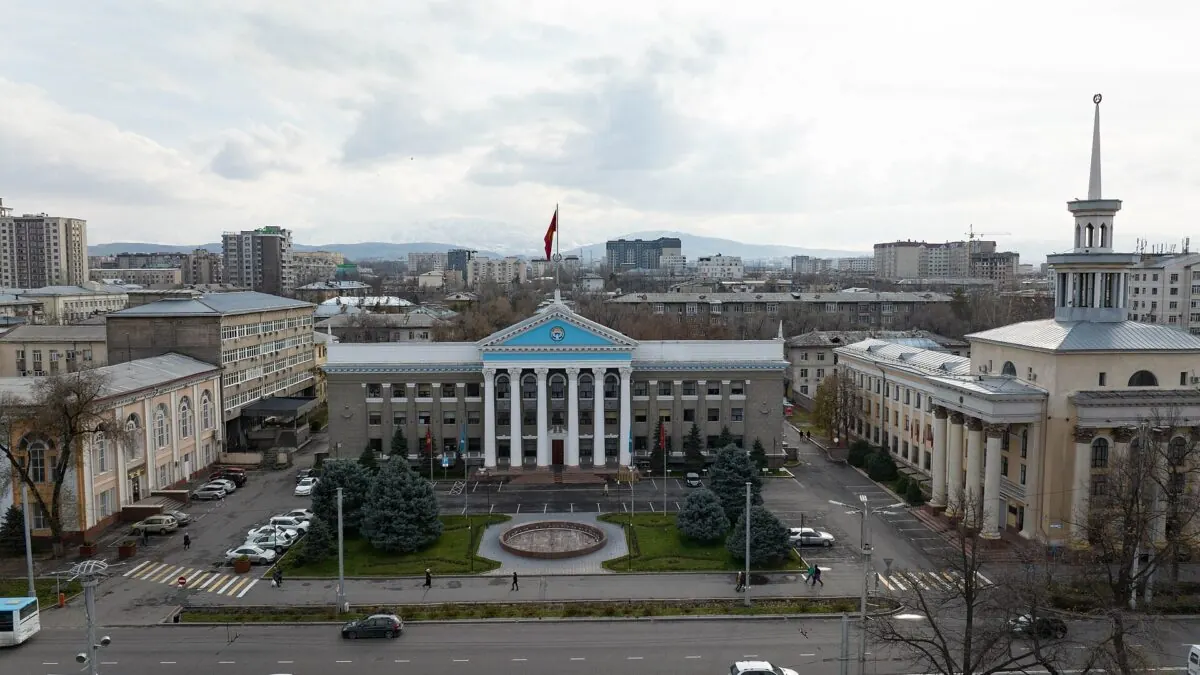
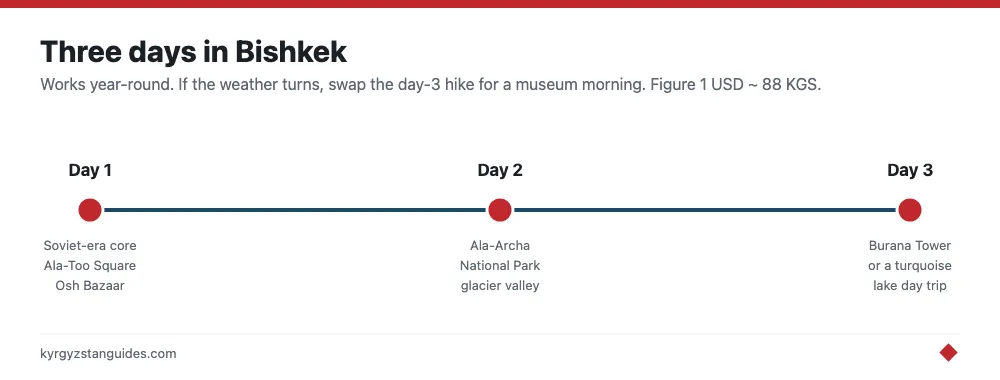
Bishkek is the most underrated capital in Central Asia, and three days is exactly how long it takes to be proven wrong about it. Most travelers treat it as a transit stop. Give it 72 hours, one day for the Soviet-era core and Osh Bazaar, one for Ala-Archa National Park, one for Burana Tower or a turquoise lake — and it repays you with leafy boulevards, brutalist landmarks, serious coffee, and mountains 40 minutes from your hotel door, all on $35–70 per person per day including a bed.
The plan below works year-round; if the weather turns, swap the day-3 hike for a museum morning. Figure 1 USD ≈ 88 KGS, and for everything that didn't fit into three days, see our full list of things to do in Bishkek.
Before day one: two apps and a neighborhood
Install Yandex Go (ride-hailing — cross-town rides 100–250 KGS, airport runs 600–800 KGS) and 2GIS (offline maps with every marshrutka route) before you land; street-hailed taxis overcharge foreigners, and the drivers who approach you in arrivals quote triple the app price. Express bus 153 links Manas Airport with the centre for 122 KGS cashless, 140 in cash, and since October 2025 it runs at 00:00, 03:00 and 05:00 too. Then base yourself around Chuy Avenue and Ala-Too Square, where everything on day 1 is walkable: dorms run $8–12 (Interhouse, Applehostel), decent 3-star hotels $35–60, and the leafier Vefa area south of the center suits cafe-lovers at $30–50. Stay near Bishkek’s main bus station only if you have a pre-dawn marshrutka to catch; splurgers get pools and proper breakfasts at the Ambassador or Orion for $90–140.
Day 1: the city on foot
Morning — Ala-Too Square and the museums
Start under the giant national flag on Ala-Too Square, where the honor guard changes on the hour with full goose-stepping ceremony. The State History Museum on the square’s north side (about 300 KGS, closed Mondays) is worth 90 minutes for its Soviet-era murals and nomadic artifacts; art lovers should add the Gapar Aitiev Fine Arts Museum two blocks east for Soviet Kyrgyz painting and felt work. Walk east through Oak Park’s open-air sculpture garden to the Kurmanjan Datka and Manas monuments, then loop past the White House to the war memorial in Panfilov Park — where the creaking Ferris wheel, running spring to autumn, buys a cheap view over the canopy to the mountains.
Afternoon — Osh Bazaar
Take a Yandex Go taxi (100–150 KGS from the center) to the city’s biggest market, and come hungry: dried melon, mountain honey, kurut (salty dried-yogurt balls), lepyoshka bread straight from the tandyr ovens, whole aisles of spices. This is a working bazaar, not a tourist set. Keep your phone in a front pocket and haggle gently.
Evening. Beshbarmak and craft beer
Order beshbarmak or lagman at Chaikhana Navat or Arzu (mains 300–500 KGS), then finish with a pint at Save the Ales, Bishkek’s pioneering craft brewery. Our Kyrgyz food guide explains what everything on the menu actually is.
Day 2: Ala-Archa, a Soviet banya, dinner in a yurt
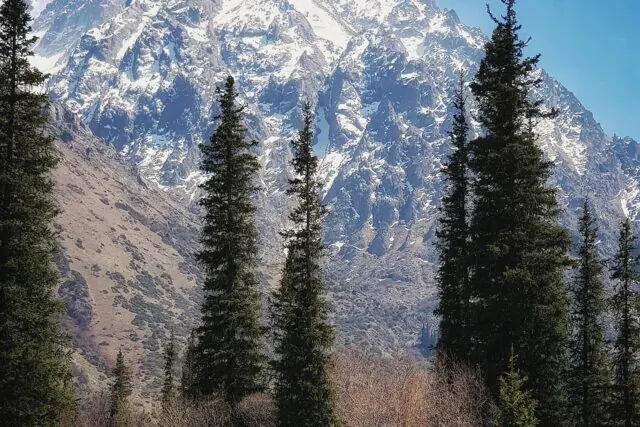
Morning and afternoon. The Ala-Archa gorge cuts into the Kyrgyz Ala-Too just 40 km south of the city, the easiest big-mountain day trip from any Central Asian capital. Arrange a round-trip taxi with waiting time for 2,000–2,500 KGS (park entry 500 KGS per car), or take Yandex Go one way for 800–1,000 KGS and negotiate a return with drivers at the gate. From the alplager at the road’s end, the trail toward the Ak-Sai waterfall climbs through juniper forest to about 2,700 m — 3–4 hours round trip with proper views of Korona Peak. Harder options are in our Ala-Archa National Park guide.
Evening. Back in town, do what locals do after the mountains: the Zhirgal Banya, a flying saucer of Soviet brutalism where a steam, plunge, and optional birch-branch beating costs 400–600 KGS. Then taxi 20 minutes south to Supara Ethno Complex, a village of carved wood and yurts serving the country’s best upscale Kyrgyz cooking (mains 400–800 KGS; book ahead on weekends).
Day 3: Silk Road ruins or one more mountain
Option A — Burana Tower
The 11th-century Burana minaret is all that remains of Balasagun, a Karakhanid capital on the Silk Road. Take marshrutka 353 from the Eastern Bus Station to Tokmok (about 150 KGS, 1.5 hours), then a local taxi the final 12 km (300–400 KGS). Climb the tower’s tight internal staircase (entry about 150 KGS), wander the field of balbals — carved stone grave markers, and be back in Bishkek by mid-afternoon.
Option B — Kol-Tor or Chunkurchak
Prefer one more mountain day? Hire a taxi to the Chunkurchak valley (45 minutes) for rolling alpine meadows, or to the Kegeti gorge trailhead for the harder hike to Kol-Tor, a milky-turquoise lake at 2,725 m: about 4–5 hours round trip, taxi 2,500–3,500 KGS return. The trail climbs steadily through pine and juniper, and the color is at its most saturated June to September. Bring a full water bottle and proper shoes: there are no facilities at either trailhead, and phone signal drops past the last village. Honest advice — if you only have two days, this is the day to cut, not Ala-Archa.
Late afternoon — souvenirs and coffee
Back in the city, hit the top floor of TSUM for magnets, felt hats, and Soviet watches at fair prices, then Tumar Art Salon for genuinely good felt art and shyrdak carpets, our Kyrgyzstan souvenirs guide ranks what deserves suitcase space. End with coffee at Sierra or Adriano; Bishkek’s cafe scene is the best between Almaty and Tbilisi.
Costs, cash, and leaving town
A dorm-and-marshrutka traveler gets through this plan on about $33 a day; with a 3-star hotel, private taxis, and restaurant dinners it climbs toward $100. Money is painless here — ATMs everywhere (Optima and Demir take foreign cards reliably), card payment in most cafes — and a tourist SIM from O! or Beeline costs 300–500 KGS for 30–50 GB with your passport. Sort both in the capital: outside Bishkek and Karakol, cash is king and coverage gets patchy.
Use the last evening to set up what comes next. Marshrutkas and shared taxis to Karakol (500–1,000 KGS, 6–7 hours) and Kochkor (350 KGS) leave from Bishkek’s main bus station on Alma-Atinskaya 1/1, mornings best; daily flights to Osh cost 3,500–5,500 KGS. Buy trekking fuel and any missing gear at the outdoor shops around Kievskaya street — selection shrinks fast beyond the capital. Most nationalities enter visa-free for 30 days within any 60-day period (check yours at evisa.e-gov.kg), and if you have two weeks in the country, our 14-day Kyrgyzstan itinerary starts exactly where this one ends.
One practical note for moving around: city buses went cashless on 1 July 2026. Tap a contactless bank card, or buy a Tulpar card from the driver for 60 som.
For one of your three evenings, book a seat at one of Bishkek’s five state theatres — no good night out in Kyrgyzstan costs less. Ballet staged by the opera house itself starts at 300 som; our guide to Bishkek’s theatres and opera has more.
FAQ
Is three days enough for Bishkek?
It is exactly the right length. One day for the Soviet-era core and Osh Bazaar, one for Ala-Archa National Park, and one for Burana Tower or a turquoise lake. Most travellers treat the city as a transit stop and are wrong about it.
How much does Bishkek cost per day?
About $35 to $70 per person per day including a bed. Dorms run $8 to $12, decent three-star hotels $35 to $60, the leafier Vefa area south of the centre $30 to $50, and pools and proper breakfasts $90 to $140.
Which apps do I need in Bishkek?
Two, installed before you land: Yandex Go for ride-hailing, where cross-town rides run 100 to 250 som and airport runs 600 to 800, and 2GIS for offline maps with every marshrutka route. Street-hailed taxis overcharge foreigners and drivers who approach you in arrivals quote triple the app price.
How do I get from Manas Airport to Bishkek?
Express bus 153 for 122 som cashless or 140 in cash. Since October 2025 it also runs at 00:00, 03:00 and 05:00, so night arrivals are covered.
Where should I stay in Bishkek?
Around Chuy Avenue and Ala-Too Square, where everything on a first day is walkable and dorms run $8 to $12. The leafier Vefa area south of the centre suits cafe-lovers at $30 to $50. With a fourth day, the Burana–Ak-Beshim–Krasnaya Rechka archaeology loop is the classic add-on.
Does the three-day Bishkek plan work in winter?
Yes, it works year-round. If the weather turns, swap the day-three hike for a museum morning — the city part of the itinerary is weather-independent.
If a spare hour opens in the plan, read up on the city’s namesake first: Mikhail Frunze, born here and dead at forty, with the house-museum and its prices covered.