Most two-week Kyrgyzstan plans fail the same way: travelers try to cover both halves of the country, penciling in Osh, Arslanbob, Song-Kul, Kel-Suu and a trek, then discover that a “300 km day” here is a six-hour day and half the trip evaporates through a minibus window. The fix is to stop treating fourteen days as two seven-day trips stapled together. The route that actually works is a single northern loop: Bishkek → Kochkor → Song-Kul → Tash-Rabat → the Issyk-Kul south shore → Karakol → the Ala-Kul trek → Jyrgalan → back to Bishkek, for roughly $450–1,000 per person on the ground.
That loop gets you yurt life on a 3,016 m pasture, a Silk Road caravanserai, red-rock canyons, an alpine lake trek and two very different towns, with no leg longer than a day and no backtracking except the lake shore you came to see anyway. It works from mid-June to mid-September, when the dirt road over the 3,446 m Kalmak-Ashuu pass to Song-Kul is open and the yurt camps are standing. Citizens of the US, UK, EU, Canada, Australia and about 60 other countries get 30 days within any 60-day period visa-free; everyone else applies through the official portal at evisa.e-gov.kg, which usually processes within three working days for around $50. Budget with 1 USD ≈ 88 KGS.
Why This Loop Beats the Alternatives
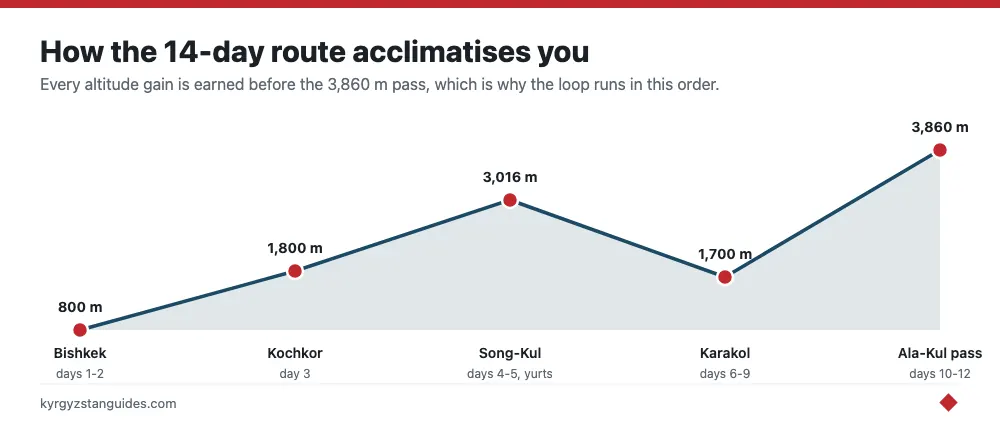
The order matters more than the stops. This route climbs gradually (Bishkek at 800 m, Kochkor at 1,800 m, Song-Kul at 3,016 m) so by the time you face the 3,860 m Ala-Kul pass on days 10–12, you have already slept five nights at altitude. Run the same stops in reverse and you would hit the trek cold from lake level, which is how people end up with pounding headaches at the pass. The loop also chains transport hubs in the right order: Kochkor is the gateway to Song-Kul, Naryn connects Song-Kul to Tash-Rabat, and the south shore road delivers you to Karakol with the canyon and eagle-hunter stops built in. Nothing requires doubling back through Bishkek mid-trip.
One caveat: this plan skips the south entirely. Osh, the Fergana valley and the walnut forests are genuinely different from the north: more Uzbek influence, better bazaars, hotter summers — but adding them by road costs two full travel days minimum. If the south matters to you, take the flight variation below rather than trying to drive everything.
The 14-Day Route at a Glance
| Days | Base | Highlights |
|---|---|---|
| 1–2 | Bishkek | Ala-Too Square, Osh Bazaar, Ala-Archa day hike |
| 3 | Kochkor | Felt workshops, arrange Song-Kul transport |
| 4–5 | Song-Kul (3,016 m) | Yurt stay, horse riding, herder life |
| 6 | Tash-Rabat | Stone caravanserai, At-Bashy valley, yurt camp |
| 7–8 | Bokonbaevo / Tosor | Skazka Canyon, eagle hunter demo, lake beaches |
| 9 | Karakol | Dungan mosque, ashlan-fu, trek prep and gear rental |
| 10–12 | Ala-Kul trek | Karakol Valley → Ala-Kul (3,560 m) → Altyn-Arashan hot springs |
| 13 | Jyrgalan | Village walks, valley viewpoints, guesthouse dinner |
| 14 | Bishkek | North shore drive back, optional Cholpon-Ata stop |
Day by Day
Days 1–2: Bishkek and Ala-Archa National Park
Land at Manas Airport, buy a SIM in the arrivals hall (O! and Beeline tourist packages run 300–500 KGS for 30–50 GB — do this now, because you will need mobile data for taxis all trip) and take a Yandex Go car to the center for 600–800 KGS, about 40 minutes. Day 1 is the capital on foot: the hourly flag ceremony on Ala-Too Square, the State History Museum behind it, the Soviet war memorial in Panfilov Park, then Osh Bazaar for dried apricots, kurut and your first bowl of lagman. Bishkek is a leafy, low-key city rather than a sight-packed one; an afternoon and an evening cover it.
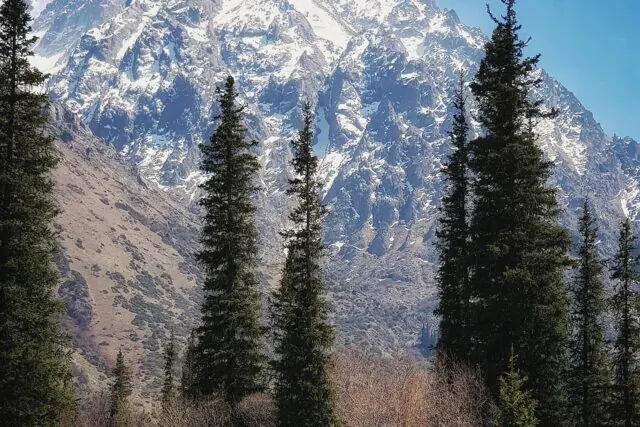
Day 2 is for legs and lungs. Hire a taxi to Ala-Archa National Park, 40 minutes south (about 2,000–2,500 KGS round trip with waiting time, plus 500 KGS park entry per car), and hike toward the Ak-Sai waterfall — a solid 4–5 hour walk that tops out around 2,700 m. This isn't filler: it's your first acclimatization day, and it makes the nights at Song-Kul noticeably easier. If the weather is foul, swap in a half-day trip to the Burana Tower minaret near Tokmok instead and save the altitude for the lake.
Day 3: Kochkor, Gateway to Song-Kul
Take a morning marshrutka from Bishkek’s main bus station on Alma-Atinskaya 1/1 to Kochkor (about 350 KGS, 3.5 hours). Kochkor is a one-street farming town that happens to run the logistics for the entire Song-Kul region: the CBT office and Jailoo Tourism, both on the main street, will book your yurt stay and a shared 4×4 on the spot for the next morning. Spend the afternoon at a shyrdak felt-carpet workshop, the patterns you see here turn up on every souvenir stall in the country, made worse and priced higher: and sleep in a guesthouse for 1,200–1,500 KGS. Two errands before the shops shut: withdraw cash (Kochkor has one of the last reliable ATMs before Naryn) and buy snacks, sunscreen and anything else you need, because there are no shops at 3,000 m.
Days 4–5: Song-Kul Lake
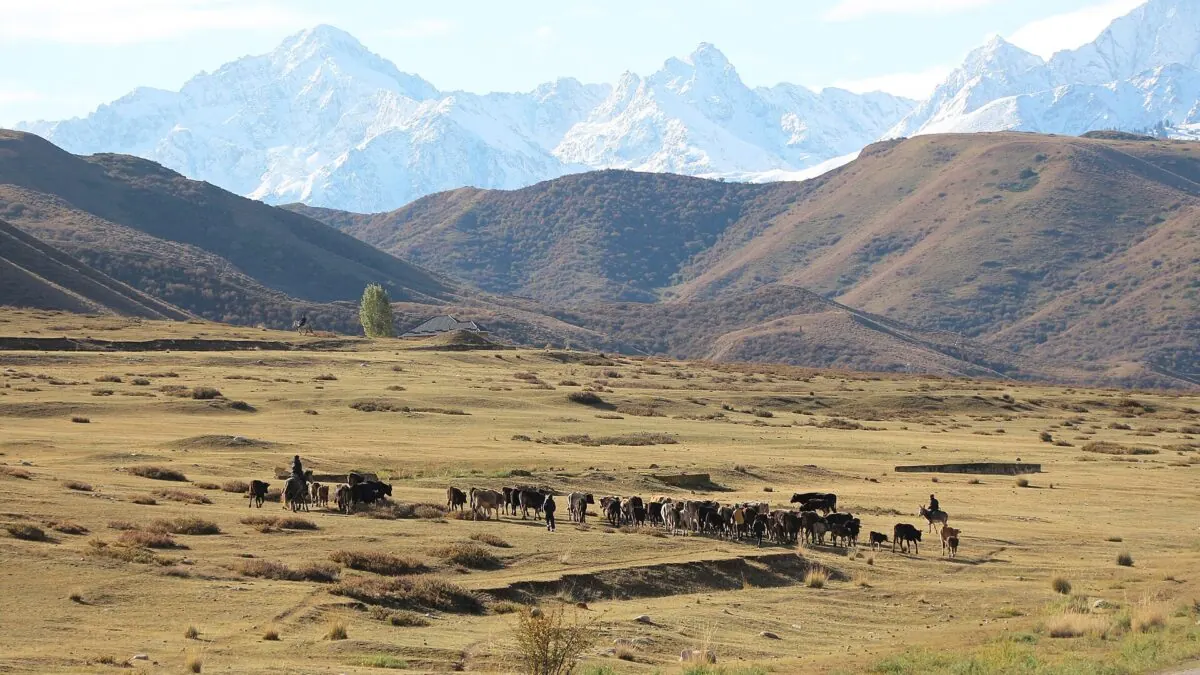
A shared 4×4 from Kochkor climbs to Song-Kul in about 2.5 hours (roughly 1,500 KGS per seat, or 5,000–6,000 KGS for the whole car) over the switchbacks of the Kalmak-Ashuu pass. What waits on the other side is the reason most people come to Kyrgyzstan: a 29 km lake in an open bowl of pasture, ringed by herders’ yurts, horses and nothing else. Camps charge around 2,000 KGS per person with dinner and breakfast; a horse and local guide for a half-day ride costs 1,200–1,500 KGS.
Two nights is the right call, and one is a mistake. Arrive mid-afternoon on day 4, walk the shoreline, watch the light go gold and eat with your host family. Day 5 belongs on horseback, riding between herder camps across pasture with no fences is something no other stop on this route replicates. Nights drop near freezing even in July, there's no electricity beyond a solar bulb, and the toilet is a long-drop a short walk from the yurt. Pack a warm layer and a headlamp and you will sleep better here than anywhere else on the trip.
Day 6: Naryn and Tash-Rabat
Arrange onward transport through your camp or CBT Naryn: south via Naryn town to the Tash-Rabat caravanserai, a squat stone Silk Road inn from the 15th century sitting at about 3,100 m in a side valley of the At-Bashy range. It is the most atmospheric building in Kyrgyzstan — domed chambers, meter-thick walls, and a setting that makes the trade-route history feel plausible rather than abstract. Overnight in the yurt camps just below it, and if you arrive with daylight to spare, walk further up the valley for the views back over the caravanserai.
Honest advice: this is the most logistics-heavy day of the loop, and Tash-Rabat is skippable if you would rather slow the trip down. Cutting it buys you a rest day on Issyk-Kul and removes the longest drives. Keep it if old stones and empty valleys are your thing; drop it if you are traveling with kids or already feeling the pace.
Days 7–8: Issyk-Kul South Shore
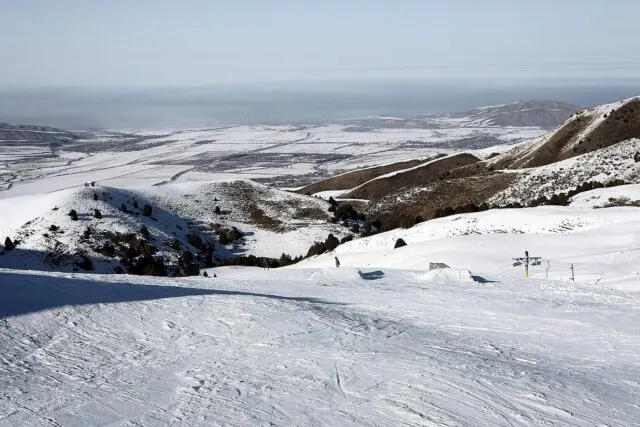
Backtrack north to the lake — a long driving day of 5–6 hours, so leave early and treat the drive as scenery rather than dead time. Base in Bokonbaevo or the beach village of Tosor for two nights. Day 8 covers the south shore’s big three: the eroded red towers of Skazka Canyon (entry about 150 KGS, go in the morning before the light flattens and the tour vans arrive), a salburun eagle-hunting demonstration booked through CBT Bokonbaevo (2,500–3,500 KGS per group), and an afternoon swim from a pebble beach you'll likely have to yourself. The south shore is the quiet half of Issyk-Kul: no resorts, no jet skis, just villages and open water with 4,000 m peaks behind it.
Day 9: Karakol
Marshrutkas run Bokonbaevo–Karakol along the shore road (200–250 KGS, about 2 hours). Karakol earns a full day on its own merits: the wooden Holy Trinity Cathedral, the pagoda-style Dungan mosque built without nails, and a Dungan family dinner of ashlan-fu, the cold spicy noodle dish the town is known for. Then switch to trek mode. Several shops in town rent tents, sleeping bags and poles for 300–500 KGS per item per day, the quality is decent and it beats hauling gear across the world, and the bazaar covers trail food. Book your first night’s camp or confirm your guide today, not on the trail.
Days 10–12: The Ala-Kul Trek
The three-day crossing from the Karakol Valley over the 3,860 m Ala-Kul pass to the hot springs at Altyn-Arashan is the best short trek in the country: a turquoise glacial lake at 3,560 m, a night in tents or rented yurts at the lake camps, and a soak in the springs to finish. The trail is well trodden in July and August, camps sell hot meals, and navigation is straightforward in good weather, so most hikers go without a guide; hire one in Karakol (about $50–70 per day) if you're solo or trekking early or late in the season. Our full Ala-Kul trek guide covers the stages, camps and costs in detail.
Not a trekker? Take a 4×4 straight up to Altyn-Arashan instead (about 6,000–8,000 KGS per vehicle return), stay two nights at the lodges, soak in the springs and day-hike up the valley. You lose the lake but keep the alpine scenery, and your knees will thank you.
Day 13: Jyrgalan
An hour east of Karakol (marshrutka around 100 KGS), Jyrgalan is a former mining village that reinvented itself as a trekking hub, and it now has the best guesthouses in the region. Around 2,500 KGS per person half board, with cooking that puts most Bishkek restaurants to shame. This is the recovery day the itinerary owes you after the trek. Walk up to the Panorama viewpoint, eat too much, sleep early. If you're somehow still hungry for trails, the valley has day hikes in every direction.
Day 14: North Shore Back to Bishkek
Return to Karakol and catch a marshrutka or shared taxi to Bishkek along the north shore (500–600 KGS and 6–7 hours; shared taxis about 1,000 KGS and an hour or two faster). If time allows, stop at the Cholpon-Ata petroglyphs, an open-air field of Bronze Age rock carvings right off the main road. The north shore is the built-up, Soviet-sanatorium side of the lake. Worth seeing from a window, not worth a night on this schedule.
What Two Weeks Actually Costs
Kyrgyzstan remains one of the cheapest mountain destinations anywhere, and this loop proves it. A backpacker doing it on marshrutkas, shared 4x4s, homestays and yurt camps spends about $420–500 per person for the full 14 days: roughly $140 on accommodation across 13 nights, $90 on food, $80 on transport, $90 on activities, entries and gear rental, and $20 on the SIM and odds and ends.
Mid-range: guesthouses and hotels instead of dorms, a private driver for the Song-Kul and Tash-Rabat legs, a few restaurant meals a day — lands around $1,000–1,100. A fully organized private tour with driver and guide runs $1,400–2,200 per person for the same route, which is worth it mainly for groups short on time or patience for bus stations. Whatever your budget, carry it in cash for the middle of the trip: ATMs exist only in Bishkek, Kochkor, Naryn and Karakol, and the yurt-camp stretches run entirely on small-denomination som.
Food is where the budget barely registers: a bazaar lunch of lagman or plov costs 150–250 KGS, guesthouse dinners are usually included or under 400 KGS, and the most expensive meal on this whole route is a splurge dinner in Bishkek. Haggling is expected for taxis and souvenirs, not for food or lodging.
Itinerary Variations
Add the South: Osh and Arslanbob by Air
Flights from Bishkek to Osh take 40 minutes and cost 3,500–5,500 KGS one way (Avia Traffic and Aero Nomad — book a few days ahead in summer). Cut Tash-Rabat and Jyrgalan, fly south after Song-Kul, and spend two days around the sacred Sulaiman-Too hill and the bazaar in Osh plus two days in the walnut forests of Arslanbob before flying back for your final Issyk-Kul and Karakol days. It is a tighter trip with more moving parts, but it's the only sane way to see both halves of the country in fourteen days.
The No-Trek Version
Replace days 10–12 with a 4×4 night at Altyn-Arashan, a morning at the Jeti-Oguz red cliffs and Broken Heart rock, and a beach day at Cholpon-Ata on the north shore. You keep every landscape type, hot springs, red rock, alpine valley, lake, and never carry more than a daypack. This version also handles bad weather gracefully, since nothing in it depends on a clear pass.
If Your Dates Fall in June or September
Early June and late September are gambles at altitude. The Song-Kul road typically opens in early June and the camps thin out fast after mid-September, so shoulder-season travelers should confirm with CBT Kochkor before committing, keep the Issyk-Kul shore as a fallback, and treat the Ala-Kul pass with respect — fresh snow up high is normal in September. The reward for the risk: golden pastures, empty camps and the best light of the year.
Got Three Weeks Instead?
Keep this loop intact and add the south properly: after Song-Kul, continue overland through Naryn and Kazarman to Osh (two rough, spectacular driving days), spend three days on Osh and Arslanbob, then fly back to Bishkek and pick up the itinerary at the Issyk-Kul south shore. Alternatively, stay north and go deeper — an extra night at Song-Kul, a horse trek instead of the drive in, and two more days of trails out of Jyrgalan will not feel like padding. Three weeks is the point at which Kyrgyzstan stops feeling like a checklist.
Booking Notes Before You Go
- Yurt camps at Song-Kul and Tash-Rabat: reserve 2–3 days ahead through CBT in July–August; walk-ins usually work in June and September.
- No permits are needed for anything on this route, including the Ala-Kul trek.
- Marshrutkas leave when full, travel before 09:00 for the best odds and shortest waits.
- Rent trekking gear in Karakol rather than hauling it; quality is decent and prices are low.
- Get travel insurance that covers hiking to 4,000 m. The Ala-Kul pass sits just below that.
- Download offline maps (Organic Maps) before leaving Bishkek; signal disappears for days at a time.
The Mistake That Wrecks Day 14
One warning to end on, because it catches people every season: transport out of Karakol thins out sharply after early afternoon, and the drive to Bishkek takes six hours on a good day. Leave by 10:00, and do not book a flight out of Manas that departs before 21:00. Better yet, give yourself a buffer night in Bishkek. Fourteen days in the mountains is a wonderful thing to almost miss your flight over.
FAQ
What is the best two-week Kyrgyzstan itinerary?
A single northern loop: Bishkek, Kochkor, Song-Kul, Tash-Rabat, the Issyk-Kul south shore, Karakol, the Ala-Kul trek, Jyrgalan, then back to Bishkek. No leg is longer than a day and there is no backtracking except along the lake shore you came to see.
Why shouldn't I do both north and south Kyrgyzstan in two weeks?
Because most two-week plans fail exactly that way. Travellers pencil in Osh, Arslanbob, Song-Kul and Kel-Suu, then discover a 300 kilometre day here is a six-hour day, and half the trip disappears through a minibus window. Fourteen days is not two seven-day trips stapled together.
How much does two weeks in Kyrgyzstan cost?
Roughly $450 to $1,000 per person on the ground, depending on whether you are using marshrutkas and guesthouses or private transfers and better rooms. Budget at about 88 som to the dollar.
Does the order of the stops matter?
More than the stops themselves. The route climbs gradually — Bishkek at 800 metres, Kochkor at 1,800, Song-Kul at 3,016 — so that by the 3,860 metre Ala-Kul pass on days 10 to 12 you have already slept five nights at altitude. Run it in reverse and you hit the trek cold from lake level.
When does the two-week loop work?
Mid-June to mid-September, when the dirt road over the 3,446 metre Kalmak-Ashuu pass to Song-Kul is open and the yurt camps are standing.
What do I need for the visa?
Citizens of the US, UK, EU, Canada, Australia and around 60 other countries get 30 days within any 60-day period visa-free. Everyone else applies through the official portal, which usually processes within three working days for around $50.