An hour before sunset, the sandstone at Skazka Canyon turns from washed-out pink to burning red-orange, and every fin and ridge suddenly throws a shadow.
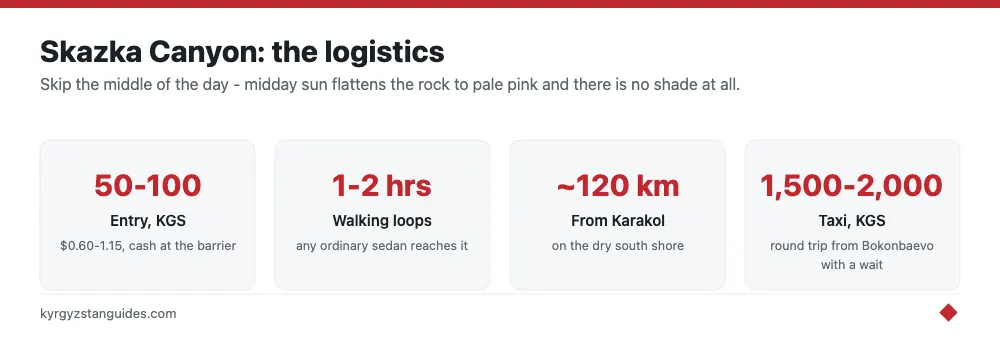
That timing matters more than anything else in this guide. The logistics are simple: entry costs 50-100 KGS ($0.60-1.15) in cash, the walking loops take one to two hours, and any ordinary sedan manages the 2 km dirt track off the south-shore highway, 4 km east of Tosor. Skazka — “Fairy Tale” Canyon. Is the most photogenic stop on Issyk-Kul’s south shore, and seeing it well costs almost nothing.
What the Fuss Is About
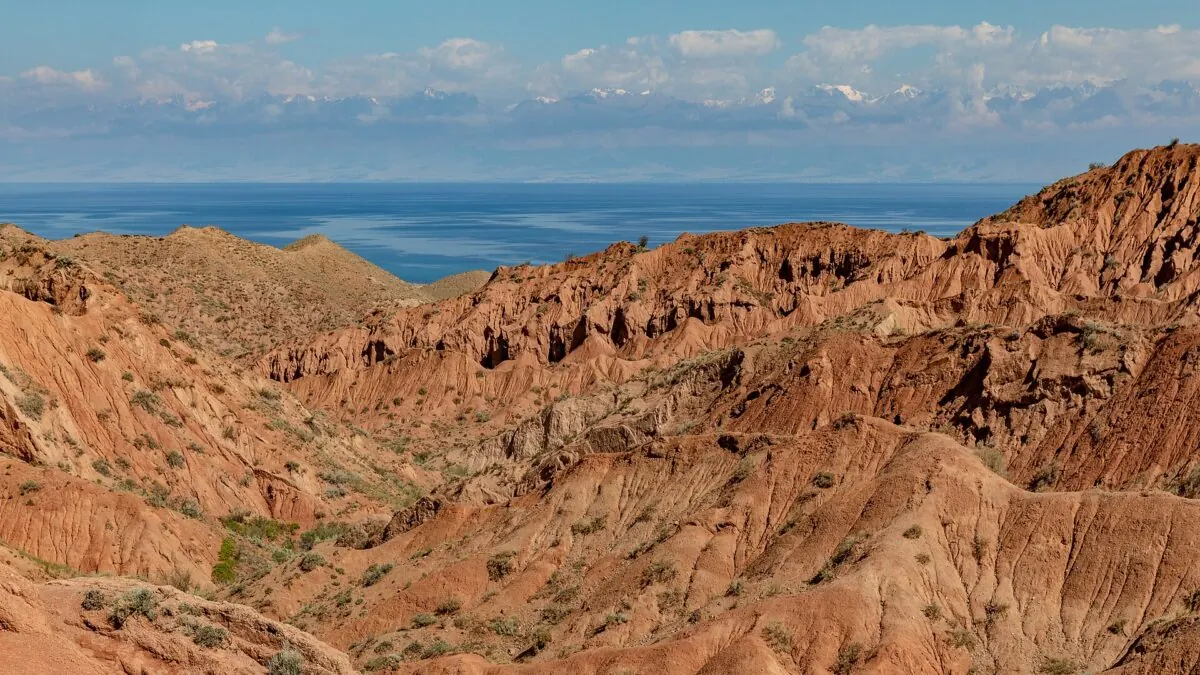
Skazka is a badlands of soft red sandstone and clay, eroded by wind and flash floods into towers, fins, and serrated ridges. A pocket-sized cousin of Utah squeezed between the Terskey Ala-Too and the lake. Soviet-era visitors named it “fairy tale” because the shapes read like a storybook; guides still point out castles, dragons, a sleeping giant. The canyon sits about 120 km from Karakol on the dry, sparsely settled south shore, a different world from the north shore’s resort strip, and covered more broadly in our Issyk-Kul lake guide.
The whole site is barely a kilometer across, which sounds like a complaint but works in its favor: an hour covers the highlights, two hours covers everything, and the only real planning decision is what time of day you show up.
Entry, Hours, and the Real Cost
You pay 50-100 KGS per person at a simple barrier partway up the access track, no online tickets, no fixed hours, and often no infrastructure beyond the barrier and a pit toilet. Carry small notes and expect the top of the range in peak summer. Because the attendant’s schedule is informal, sunrise and sunset visits are usually possible, which is exactly when you want to be there. A round-trip taxi from Bokonbaevo with a one-to-two-hour wait runs 1,500-2,000 KGS ($17-23) for the car, so a full visit rarely tops $25 even without sharing.
Walking It
There are no marked trails, and none are needed. From the parking area, follow the main gully east past the first towers for 15-20 minutes, then climb the broad path onto the Great Wall of China — the serrated ridge of stacked red rock that's Skazka’s signature formation. Walk the ridge west for the full panorama: badlands in front, snow peaks of the Terskey Ala-Too behind, and a wedge of improbably blue Issyk-Kul to the north. Descend any of several gullies back toward the entrance, detouring to whichever castle or dragon catches your eye. Footing is loose, crumbly sandstone (closed shoes with grip, not sandals) and the ridges have unfenced drops of a few meters, so keep children close.
A warning about expectations, though: arrive at noon in July and you'll wonder what the fuss is about. Midday sun flattens the rock to pale pink, shade does not exist, and afternoons can pass 30°C, so the canyon underwhelms through no fault of its own. Come at golden hour instead, shoot the Great Wall side-lit from the west, and put a person in the frame for scale: the towers read far bigger than they photograph empty. After rare summer rain, the colors deepen dramatically and the crowds vanish; go immediately. Drones are generally tolerated, but ask the attendant and avoid weekends, when day-trippers cluster on the ridge.
Getting There Without a Tour
The turnoff is on the A363 south-shore road between Bokonbaevo and Kaji-Say, marked by a small sign, with a flat 2 km walk or drive up to the barrier. From Bokonbaevo, take any marshrutka toward Kaji-Say or Karakol, ask the driver for “Skazka,” and you are there in about 30 minutes for 50-80 KGS. From Karakol, any south-shore Bishkek-bound marshrutka makes the same drop-off in about 2.5 hours (250-300 KGS); from Bishkek it's roughly 5 hours via Bokonbaevo (450-550 KGS). Moving on afterward is easier than it looks. Flag down any passing marshrutka on the highway, which come every 30-60 minutes in daylight. Our getting around Kyrgyzstan guide covers the etiquette.
Sleeping Nearby
There are no beds at the canyon itself. The closest are the beach yurt camps between Tosor and Bel-Tam, about $20-25 per person with meals, June to September, which put you 10-15 minutes away, close enough to walk in for sunrise before anyone else arrives; our yurt stay guide explains how these camps work. Kaji-Say, 15 minutes east, has simple guesthouses from $20-30 a double and a couple of year-round cafes. Bokonbaevo, 40 minutes west, is the south shore’s hub, with the widest choice of homestays, a CBT office, felt workshops, and salbuurun eagle-hunting demonstrations at about 3,000-4,000 KGS per group.
Treat the visit as a short desert hike rather than a photo stop: 1-1.5 liters of water per person, sunscreen, a hat, and a windbreaker for the ridge, where the lake breeze picks up by afternoon. There is no shop, no cafe, no water source, and no bins, pack everything out.
Make It a South-Shore Day
Skazka alone does not fill a day, and it doesn't need to. Thirty kilometers east, the Barskoon gorge road climbs past three waterfalls and two Gagarin monuments, the cosmonaut vacationed here, and a taxi day from Bokonbaevo covering both Skazka and Barskoon runs 3,500-4,500 KGS ($40-51) for the car. The winning formula is simple: sleep in a yurt camp near Tosor or Bel-Tam, spend the morning at Barskoon or with the eagle hunters in Bokonbaevo, and save Skazka for the two hours of evening light it was built for.
What the rock actually is
Skazka gets described as "ancient seabed" and as sandstone of a confidently stated age. Both deserve a caveat.
The formations are Cenozoic continental red sandstone and conglomerate from the Issyk-Kul basin fill — not marine. The basin filled with continental and lake sediments, so the occasional claim that you are looking at seashells from an ancient ocean is simply wrong.
The regional stratigraphy is well studied even if Skazka itself has not been individually mapped in anything I could reach. The relevant units are the Chu Formation, about 1.5 km of mud then sand, and the overlying Sharpyldak Formation, about 1.3 km of coarse-pebble conglomerate with cliff-forming beds over 100 m thick and granitic boulders up to a metre across. A fossil Equus gives the lower Sharpyldak a maximum age of 2.6 million years, and late-Pliocene ostracods narrow the formation to roughly 3.5 to 1.5 million years. Burial dating puts the Chu-to-Sharpyldak transition at about 2.6-2.8 million years.
So: a few million years old, continental, and the colour comes from iron in the sediment. You will find blog claims of a precise hematite percentage controlling the colour. There is no geological source for those. Ignore them.
On protection: Skazka has no site-specific designation I could find. It falls inside the Issyk-Kul Biosphere Reserve, designated by UNESCO in 2001 at 4,314,400 hectares, which is the largest protected area in Kyrgyzstan and covers the whole oblast rather than the canyon specifically.
FAQ
What is Skazka Canyon made of?
Cenozoic continental red sandstone and conglomerate from the Issyk-Kul basin fill, a few million years old. It is not an ancient seabed — the basin filled with continental and lake sediments, not marine ones.
How much does it cost to visit Skazka Canyon?
Around 50 som per person, cash only, according to the travel sources that state a figure. No official tariff document could be found, so treat it as indicative and bring small notes.
How far is Skazka Canyon from Karakol?
About an hour and a half. It is roughly 4 km from Tosor village and about thirty minutes from Bokonbaevo. From the road it is around a 2 km walk in to the formations.
How long do you need at Skazka Canyon?
About two hours for the walk in, a wander through the formations and back. Treat it as a short desert hike rather than a photo stop: carry 1 to 1.5 litres of water per person and sun protection, because there is no shade.
Is Skazka Canyon protected?
Not specifically. It sits inside the Issyk-Kul Biosphere Reserve, a UNESCO designation from 2001 covering 4,314,400 hectares across the whole oblast, but no site-level protection for the canyon itself could be found.
What is the best time of day to visit Skazka Canyon?
The hour before sunset, when the soft sandstone turns from washed-out pink to burning red-orange and every fin throws a shadow. Because the entry barrier is informally staffed, sunrise and sunset visits are usually possible. Midday light flattens the formations — if you can only pass through at noon, you will still enjoy it, but the photographs will not match the ones that sold you on it.