How do you actually get around Kyrgyzstan? Mostly in a minibus that leaves when it is full, sometimes in a shared Toyota Camry, and, for the places that make the country famous, in a hired 4×4 with a local driver who knows which river crossing washed out last week. There are no passenger trains worth mentioning, so everything moves by road or the occasional flight. Marshrutkas are the cheap backbone (Bishkek to Karakol: 500-600 KGS, about $6-7, for a 6-7 hour ride), shared taxis cost roughly double and save an hour or two, and a private car with driver runs $50-80 per day.
Domestic flights link Bishkek and Osh for $40-60, Yandex Go handles city taxis for 100-250 KGS a ride, and hitchhiking works better here than almost anywhere. This guide walks through each option with 2026 prices (1 USD ≈ 87-89 KGS), a route-planning table for the main hubs, and honest notes on winter closures, police stops and when each option stops making sense.
Marshrutkas: The Backbone
Marshrutkas are privately run minibuses (usually Mercedes Sprinters) that leave when full rather than on a timetable. On popular routes that means every 30-60 minutes from early morning until mid-afternoon; on minor routes it can mean one departure a day around 8-9 am. You pay the driver in cash (small notes), luggage goes in the back or under seats, and there are no assigned seats, so arrive early for a window. If you are tall or carrying a big pack, it's completely normal to buy a second seat: locals do it for cargo all the time, and it turns a miserable six hours into a tolerable one for an extra $6.
In Bishkek, everything starts from two stations. The Bishkek’s bus stations (Zapadnyi Avtovokzal) on Jibek Jolu Avenue handles almost all long-distance departures: Karakol, Cholpon-Ata, Naryn, Kochkor, Talas, and Osh. The smaller Eastern Bus Station serves nearby destinations like Kant, Tokmok (for Burana Tower), and Kegeti. Destination signs are in Cyrillic, but the system is friendlier than it looks: drivers shout destinations across the lot, and saying your town’s name to anyone in uniform gets you pointed at the right van. Ignore the freelance taxi drivers who intercept you at the gate insisting the marshrutka “already left”, it didn't.
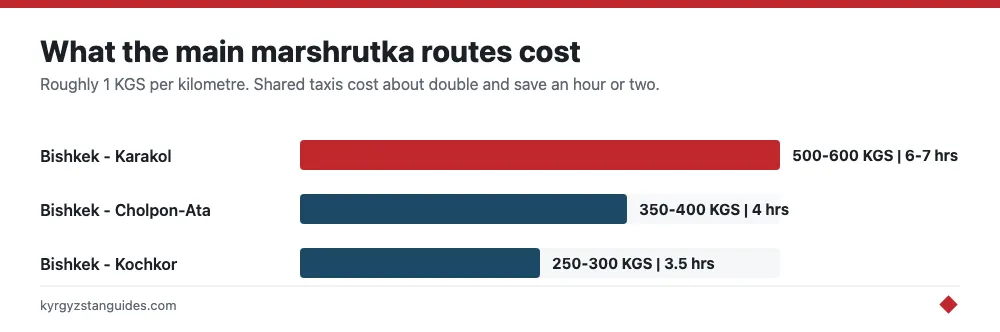
- Bishkek-Karakol: 500-600 KGS, 6-7 hours, departures every 30-60 minutes until about 17:00
- Bishkek-Cholpon-Ata: 350-400 KGS, 4 hours
- Bishkek-Kochkor: 250-300 KGS, 3.5 hours (the springboard for Song-Kul)
- Bishkek-Naryn: 400-500 KGS, 5-6 hours
- Bishkek-Osh: 1,500-2,000 KGS, 10-12 hours over the mountains, most travelers fly instead
Expect Kyrgyz pop music, frequent chai stops, and seats designed for people smaller than you. It isn't comfortable, but it's genuinely how locals travel, and at roughly 1 KGS per kilometre it keeps a Kyrgyzstan travel budget very low. One planning rule: treat mid-afternoon as the end of the transport day. Departures thin out sharply after 15:00-16:00 on most routes, and being stranded in a regional town overnight is the classic beginner mistake.
Shared Taxis: Double the Price, Two Hours Faster
Shared taxis, usually Toyota Camrys or Hondas, wait beside the marshrutka ranks at every bus station and leave when four passengers have bought seats. They cost about double the marshrutka fare (Bishkek-Karakol 1,000-1,300 KGS per seat) and save one to two hours, with a guaranteed seat and space to breathe. They are worth it on long hauls, when you're carrying trekking gear, or when the last marshrutka has already gone — shared taxis run later into the evening.
Negotiation rules: agree the price per seat before getting in, and confirm whether it's a shared ride or you're accidentally chartering the whole car (buying all four seats costs four times the seat price but leaves immediately — sometimes exactly what you want at 18:00 with a guesthouse booked at the other end). Drivers quote foreigners honestly more often than you’d expect, but knowing the going rate (ask your guesthouse first) ends any discussion quickly. Front seat costs the same and is the best in the house.
A word on night travel: shared taxis do run the Bishkek-Osh road overnight, and locals use them, but we would not. The M41 at night combines mountain passes, tired drivers and unlit hazards, and the money you save on a guesthouse isn't worth it. Travel by day; the scenery is half the reason you came.
Private Car with Driver: How the Best Places Get Reached
For the destinations that make Kyrgyzstan famous, there's often no public transport at all. A private car with a local driver costs $50-80 per day including fuel for a 4WD (Delica vans and Land Cruisers are the standard), arranged through CBT offices, guesthouses, or tour operators in Bishkek and Karakol. Multi-day trips add roughly 1,000-1,500 KGS per night for the driver’s food and lodging, which yurt camps often provide cheaply. Agree the total, the route, and who pays for the driver’s nights before leaving. A two-minute conversation that prevents every common dispute.
A driver is essential, not optional, for Song-Kul lake (rough tracks over 3,000 m passes, no marshrutkas), Kel-Suu (a border-zone permit area near China with serious off-road driving), Tash Rabat, and most trailheads. Split between three or four passengers, $60 a day becomes $15-20 each, which is why solo travelers post in the “Kyrgyzstan Backpackers” Facebook and Telegram groups to share vehicles, and why hostel noticeboards in Bishkek and Karakol function as ride-matching services every summer morning. Drivers rarely speak English; a translation app and a marked map cover 95% of situations, and the remaining 5% resolve over tea.
Self-Drive: Freedom, With Caveats
Self-drive rental has exploded since 2022. Expect $35-50/day for a sedan and $70-120/day for a proper 4WD from Bishkek agencies (Iron Horse Nomads and Travel Land Kg are established names); an International Driving Permit is officially required alongside your license, and agencies will want a deposit. The freedom is real, but so is the road reality: outside the main paved corridors (Bishkek-Karakol, Bishkek-Osh, the Issyk-Kul ring road), you're on gravel, washboard, and river fords that grow through the day as meltwater rises. For Song-Kul, Kel-Suu, or the passes into Jyrgalan, a 4WD with high clearance is non-negotiable, a rented sedan on those tracks is a tow bill waiting to happen.
Before driving off the lot: check the spare, the jack, and that the listed dents match the paperwork. Then plan fuel like it matters, because it does.
- Police stops are routine at regional checkpoints: carry passport, license, IDP, and rental documents; stay polite and you’ll be waved through
- Never pay an on-the-spot “fine” in cash without a written protocol; genuine fines are paid at banks
- Fuel up whenever you can, stations are sparse in Naryn province; Gazprom stations have the most reliable quality
- Livestock owns the road: expect horses, sheep, and cows around every blind bend, and slow right down through herds
- Do not drive rural roads at night. Potholes, unlit trucks, and animals make it dangerous
- Download offline maps (Organic Maps or Maps.me) — they mark tracks Google doesn’t
Flights: Bishkek to Osh in 45 Minutes
The one domestic route that matters is Bishkek (BSZ, formerly FRU) to Osh (OSS): $40-60 one-way, 45 minutes, flown by Asman Airlines, the state carrier. Tez Jet, which used to fly it, had its certificate annulled in July 2026. Compared with 10-12 hours on the mountain road, it's the obvious choice unless you want the scenery of the M41 itself. And to be fair, that road is one of Central Asia’s great drives if you have the day to spare. Book a few days ahead in July-August and around holidays; schedules and fares are on aero.kg. Smaller hops to Jalal-Abad and Batken exist but rarely suit tourist itineraries. Flying into Osh also lets you run a one-way south-to-north route through the country instead of backtracking.
City Taxis and Yandex Go
In Bishkek, Osh, and Karakol, Yandex Go is the app to install: rides across Bishkek cost 100-250 KGS, cars arrive in minutes, and the app removes both the language barrier and the negotiation. It accepts foreign bank cards, though paying the driver cash avoids occasional card failures. Street taxis without meters still exist — agree the price before getting in, and expect to pay 200-300 KGS for what Yandex charges 150. From Manas Airport to central Bishkek, Yandex runs 600-900 KGS; express bus 153 does it for 122 KGS cashless, 140 in cash, and now runs at night as well.
Hitchhiking Works Here
Kyrgyzstan has one of the friendliest hitchhiking cultures anywhere, flag down cars on any rural road and someone will stop within minutes. The crucial cultural note: drivers often expect a small contribution, roughly the marshrutka fare, because picking up paying passengers is informal taxi work here. Clarify with “akcha jok” (no money) before getting in if you’re hitching for free, or just hand over 50-100 KGS at the end. On remote roads, hitching is often not an alternative to transport but the only transport — herders’ trucks are how backpackers actually leave places like the Song-Kul shore when plans change. Solo women hitchhike here more than almost anywhere in Asia, but the usual judgment applies — read our Kyrgyzstan safety guide for the fuller picture.
What About Cycling?
Kyrgyzstan has become one of the world’s favorite bikepacking countries, and the same facts that make driving hard make cycling great: gravel passes with almost no traffic, water everywhere, and wild camping that's both legal in practice and spectacular. The trade-offs are real — washboard surfaces rattle racks loose, distances between food resupply points in Naryn province run to a full day’s ride, and the paved corridors carry fast trucks with no shoulder, so experienced riders route around them on the dirt. If you're not bringing your own bike, a couple of Bishkek shops rent touring-worthy mountain bikes in summer; ask at hostels for the current names. Marshrutka drivers will usually throw a bike on the back seat or roof for an extra seat’s fare, which makes one-way rides easy to design.
Winter Changes Everything
From roughly November to April, the transport map shrinks. The Too-Ashuu and Ala-Bel passes on the Bishkek-Osh road close temporarily after heavy storms (sometimes for a day or two), the tracks to Song-Kul close completely from October until early June, and Kel-Suu is unreachable outside July-September. The Issyk-Kul ring road and the Bishkek-Karakol run stay open all winter — which is why ski trips to Karakol work fine by marshrutka. Check pass conditions before winter road trips, allow an extra day of slack on either side of any mountain leg, and default to flying between Bishkek and Osh from December to March.
Route Planner: Times and Costs Between Main Hubs
| Route | Marshrutka | Shared taxi | Private car / flight |
|---|---|---|---|
| Bishkek → Karakol (400 km) | 500-600 KGS, 6-7 hrs | 1,000-1,300 KGS, 5-6 hrs | $60-80 charter |
| Bishkek → Cholpon-Ata (260 km) | 350-400 KGS, 4 hrs | 700-900 KGS, 3 hrs | $40-60 charter |
| Bishkek → Osh (670 km) | 1,500-2,000 KGS, 10-12 hrs | 2,500-3,000 KGS, 9-10 hrs | Flight $40-60, 45 min |
| Bishkek → Kochkor (185 km) | 250-300 KGS, 3.5 hrs | 500-700 KGS, 2.5-3 hrs | $35-50 charter |
| Bishkek → Naryn (310 km) | 400-500 KGS, 5-6 hrs | 800-1,000 KGS, 4-5 hrs | $50-70 charter |
| Kochkor → Song-Kul (90 km track) | None | None | 4WD 4,000-6,000 KGS/vehicle |
| Karakol → Bokonbaevo (130 km) | 200-250 KGS, 2 hrs | 400-500 KGS, 1.5 hrs | $30-40 charter |
| Karakol → Altyn-Arashan (15 km track) | None | None | 4WD 6,000-8,000 KGS return |
| Karakol → Jyrgalan (60 km) | 100-150 KGS, 1.5 hrs | Rare | 1,500-2,000 KGS charter |
| Osh → Arslanbob (160 km) | 300-400 KGS via Bazar-Korgon | 600-800 KGS | $40-60 charter |
One money note that applies to every option above: transport in Kyrgyzstan runs on cash, and on small notes specifically. Drivers can rarely break a 5,000 KGS bill, regional bus stations have no card readers, and the ATM you're counting on in a small town is often empty on market day. Break big notes at Bishkek supermarkets, keep a dedicated stash of 50s, 100s and 200s for fares, and carry the full amount for any multi-day charter before you leave the city.
Build slack into any plan that involves dirt roads: a “three-hour” drive to a trailhead becomes five after rain, and marshrutkas fill on their own schedule. If your trip is tight, our 10-day Kyrgyzstan itinerary sequences these legs in an order that minimises backtracking.
Inside Bishkek the payment system changed entirely on 1 July 2026, when cash was abolished on city buses. See Bishkek bus routes and fares for what the validator now accepts and how the free transfers work.
Frequently Asked Questions
How much does transport cost in Kyrgyzstan?
Marshrutkas cost roughly 1 KGS per kilometre: Bishkek-Karakol is 500-600 KGS ($6-7), Bishkek-Osh 1,500-2,000 KGS. Shared taxis cost about double the marshrutka fare. A private car with driver runs $50-80 per day including fuel, and the Bishkek-Osh flight is $40-60.
How do I get to Song-Kul without a tour?
There is no public transport to Song-Kul. Take a marshrutka to Kochkor (250-300 KGS from Bishkek), then arrange a shared or private 4WD through the CBT Kochkor office — around 4,000-6,000 KGS per vehicle each way. Horse treks from Kyzart village are the popular alternative.
Can I use Uber or Yandex Go in Kyrgyzstan?
Uber doesn't operate in Kyrgyzstan. Yandex Go works well in Bishkek, Osh, and Karakol, with city rides typically 100-250 KGS. It accepts foreign cards, though drivers prefer cash. Outside cities, negotiate directly with taxi drivers before getting in.
The Bottom Line
Do not rent a car by default. For most trips, the winning formula is marshrutkas between towns, Yandex within them, and a shared 4WD with driver for the two or three roadless highlights. It costs less than self-drive once you add fuel and insurance excess, and someone else worries about the river ford. Rent your own wheels only if you're a confident gravel driver who values total flexibility over money, and fly the Bishkek-Osh leg unless the M41’s scenery is itself the point.
One thing older guidance gets wrong. Bishkek’s Western Bus Station (Zapadnyi Avtovokzal) and the “Akzhol” mini-station both closed on 23 October 2024. Services moved to the municipal Bishkek Bus Station, which had opened that January: east-direction routes — Issyk-Kul, Karakol, Kochkor, Naryn — now leave from Alma-Atinskaya 1/1, and west-direction routes, including Osh and Talas, from Frunze 209. Any source still sending you to the Western Bus Station is out of date.
Should I buy a second marshrutka seat?
If you are tall or carrying a big pack, yes - it is completely normal, locals do it for cargo all the time, and it turns a miserable six hours into a tolerable ride for roughly an extra $6 on a long route.
How late do marshrutkas run in Kyrgyzstan?
Treat mid-afternoon as the end of the transport day. Departures thin out sharply after 15:00-16:00 on most routes, and being stranded in a regional town overnight is the classic beginner mistake. Shared taxis run later into the evening and are the fallback once the last minibus has gone.
How much does a private driver cost in Kyrgyzstan?
$50-80 per day including fuel for a 4WD - Delica vans and Land Cruisers are the standard - arranged through CBT offices, guesthouses or operators. Multi-day trips add roughly 1,000-1,500 som per night for the driver's food and lodging. Agree the total, the route and who pays the driver's nights before leaving.