Osh is the most underrated city stop in Central Asia, and two days here are better spent than two days almost anywhere else in Kyrgyzstan. The country’s 3,000-year-old southern capital is built around Sulaiman-Too, a UNESCO-listed sacred mountain that rises straight out of the downtown, and Jayma Bazaar, a market that has been trading on the same riverbank for roughly two millennia. It is also the practical gateway to the Pamir Highway and Uzbekistan. Fly from Bishkek in about 55 minutes for $40-60, or take a shared taxi 10-12 hours over the mountains for 1,500-2,000 KGS.
Osh feels like a different country from Bishkek: because in most ways that matter, it is. The pace is slower, the food is Uzbek-influenced, the summers are properly hot, and the culture is older than nearly anything north of the passes. What follows: the mountain, the market, the food, the logistics, and where to go next.
Sulaiman-Too, the Mountain in the Middle of Town
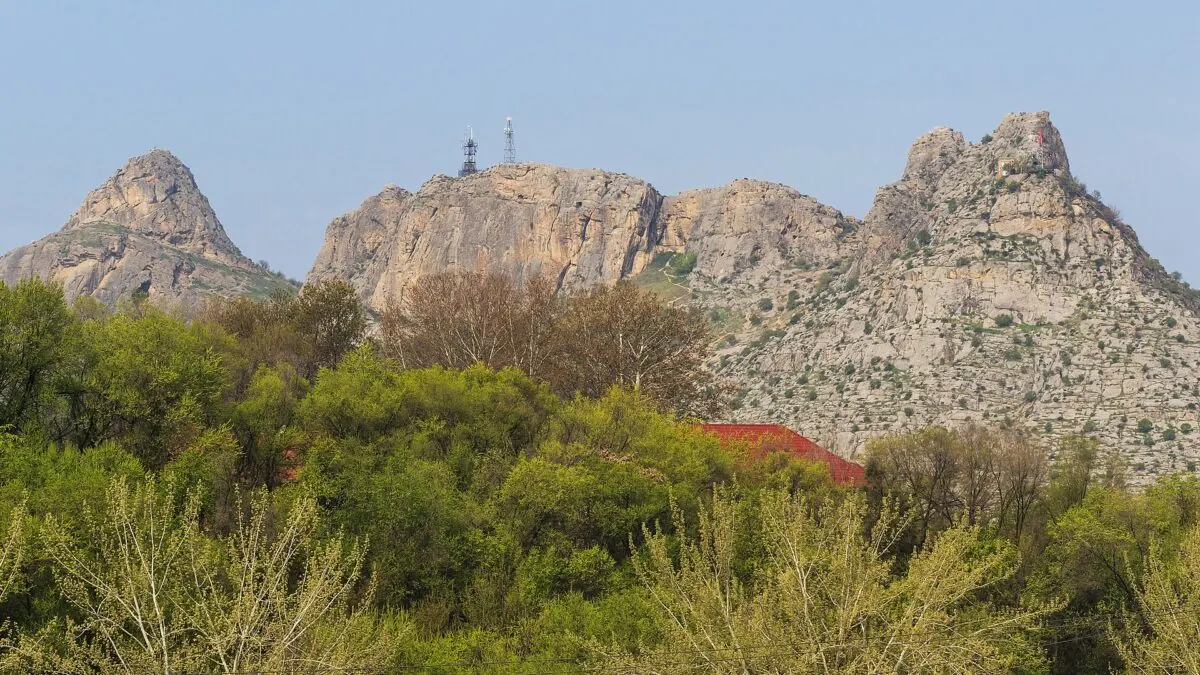
Sulaiman-Too (“Solomon’s Throne”) is a five-peaked limestone ridge visible from almost everywhere in the city. In 2009 it became Kyrgyzstan’s first UNESCO World Heritage Site, recognized as the most complete example of a sacred mountain anywhere in Central Asia. People have worshipped here for more than 1,500 years, and this is no fossilized monument: pilgrims still climb its polished rock paths daily, rubbing hollows worn smooth by centuries of hands, each one believed to cure a different ailment.
The climb to the top takes 20-30 minutes on stone steps and costs nothing. Near the summit sits a small 16th-century mosque built by Babur, founder of the Mughal Empire, who prayed here as a teenager before going off to conquer India. Halfway up, the National Historical and Archaeological Museum Complex is carved directly into a cave in the mountainside — a Soviet-brutalist arch bolted onto sacred rock, and worth the 100-150 KGS entry for the strangeness alone. Go early morning or late afternoon: you dodge the worst heat and get the best light over the city. From the top, the view explains Osh better than any museum. The green sprawl of the Fergana Valley to the west, the first ridges of the Pamir Alay to the south, and the bazaar’s rooflines threading along the river below.
Jayma Bazaar Has Been Open for 2,000 Years
Jayma Bazaar has traded on the banks of the Ak-Buura River for around two millennia, once a key Silk Road stop linking China to the Fergana Valley. It still runs for over a kilometer along the river, busiest on Sunday, and it is a working market rather than a tourist show: spices, dried fruit and nuts, hand-forged knives from Uzgen, traditional kalpak hats, bolts of fabric, and towers of fresh bread.
- Come hungry — samsa (baked meat pastries) straight from the tandoor are excellent
- Bargain politely for hats, knives, and souvenirs; food and produce are fixed price
- Watch your bag in the crowds and carry small KGS notes
- Mornings are calmer; late morning to midday is the full crush
How the South Eats
Southern Kyrgyz food leans Uzbek, and Osh takes its plov very seriously. Osh plov is drier and often sweeter than northern versions, cooked with yellow carrots, chickpeas, cumin, and sometimes raisins, traditionally eaten from a shared plate. One rule matters more than any restaurant recommendation: the best plov is gone by early afternoon. Eat it at lunch, not dinner: locals will tell you an evening plov is a plov that failed to sell.
Beyond plov, hunt down lagman (hand-pulled noodles), samsa, and shashlik grilled over coals. The tandoor bread here's denser and more decorated than in the north, stamped with patterns before baking. Compared with the meat-and-dairy staples of the mountains around Karakol, Osh cooking is warmer-spiced and more vegetable-forward, the full national picture is in our Kyrgyz food guide, but the south is where Kyrgyzstan eats best.
Getting There: Fly, Unless You Want the Story
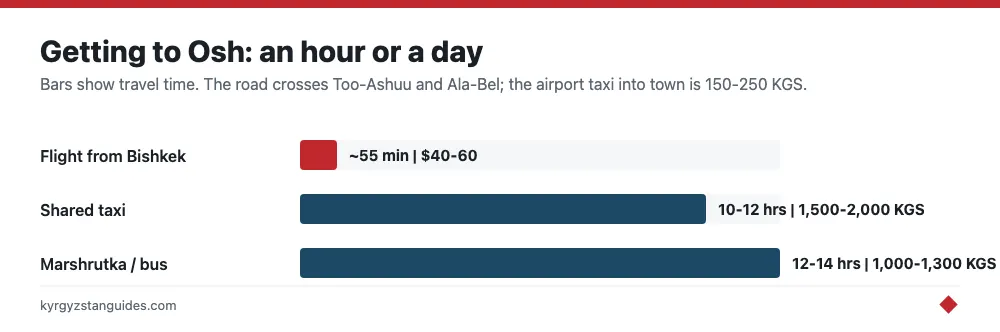
Two realistic routes from Bishkek, and the choice is time versus scenery. Several flights a day cover Bishkek-Osh in about 55 minutes, now flown by Asman Airlines — Tez Jet lost its operating certificate in July 2026 for $40-60 (2,500-3,500 KGS). Book ahead in summer, when Pamir-bound travelers fill the planes. The alternative is the road: shared taxis leave Bishkek’s Osh Bazaar terminal and grind 10-12 hours over the Too-Ashuu and Ala-Bel passes for 1,500-2,000 KGS per seat, passing the enormous turquoise sweep of Toktogul Reservoir on the way. Marshrutkas and buses do the same run in 12-14 hours for 1,000-1,300 KGS, often overnight.
Our honest advice: fly one way and, only if you genuinely like long drives, do the road the other. Twelve hours in a packed Sprinter is a story you tell once and a seat cramp you remember longer. Osh airport is about 8 km from the center; a taxi in should cost 150-250 KGS. For the wider mechanics of Kyrgyz transport, see getting around Kyrgyzstan.
Sleeping, Eating, and Day Trips
Osh has a solid spread of cheap beds: dorms around $8-12 (700-1,000 KGS), private guesthouse rooms $25-40 (2,200-3,500 KGS), and a handful of proper hotels above that. Stay near the center or the bazaar and you can walk everything that matters. Book ahead in July-August, when overland travelers stack up before the Pamir Highway season. For meals, brave the oshkhana (plov houses) near the bazaar at lunch, then the cafes along Kurmanjan Datka and Lenin streets for lagman, manti, and shashlik; the riverside restaurants along the Ak-Buura are the pleasant evening option once the heat drops.
The city also works as a base. Uzgen, 1.5 hours east, has an 11th-century Karakhanid minaret, mausoleums, and famously good rice. Arslanbob and its walnut forest sit 3-4 hours north. Sary-Chelek is a long but worthwhile detour into the biosphere reserve. And Papan Reservoir, 45 minutes out, is the local answer to a 38-degree afternoon, turquoise water in a bare rock gorge, popular with local families on summer weekends. Of the four, Uzgen is the easiest half-day and Arslanbob the most rewarding overnight; skip Papan unless you're here in the July-August heat and just want to swim.
Practical Osh
A few things worth knowing before you land. Osh is a relaxed, welcoming city and everyday travel here is safe; solo female travelers consistently report feeling comfortable. It's, however, more conservative than Bishkek — dress a notch more modestly, especially around Sulaiman-Too and the bazaar, and keep valuables zipped away in the market crush. Summer is hot: June through August afternoons regularly pass 35°C, which is why the city runs on early mornings and long evenings, and why you should too. Spring and fall are the sweet spots for walking the city. ATMs are plentiful in the center, cards work in newer cafes, but the bazaar and the oshkhana run on cash. Two days covers the city well. One for the mountain and the market, one to eat, wander, and organize whatever comes next.
Where Osh Sends You Next
Almost nobody ends a trip in Osh; the city is a hinge. It's the northern trailhead of the Pamir Highway (M41), one of the highest international roads in the world, running south through Sary-Tash into Tajikistan’s Wakhan and Bartang valleys. Most travelers arrange a shared 4×4 or join a group here, and you will need a Tajik e-visa with GBAO permit. Start it on the Tajik e-visa portal well before you arrive. From Sary-Tash you can also branch off to Pik Lenin base camp, one of the easiest close-up views of a 7,000 m peak anywhere.
For Uzbekistan, the Dostyk crossing sits about 5 km west of the center (a 15-20 minute marshrutka or taxi ride from the bazaar) and delivers you into Andijan and the Fergana Valley. It's usually straightforward and visa-free for most nationalities; check the current state of play in our border crossings guide before you commit. Whichever direction you take, give Osh its two days first. The mountain at sunset and a shared plate of plov at noon are the right way to leave Kyrgyzstan. Or to arrive.
Up the valley from Uzgen there are cold carbonated springs saltier than seawater and a kymyz cure: see Kara-Shoro national park.
The oblast capital, the 2022 shelling and the border treaty that finally settled the line in March 2025 are covered in our Batken guide.
The third city of southern Kyrgyzstan, and the place the first Soviet in the country was created in March 1917, is Kyzyl-Kiya.
FAQ
How many days do you need in Osh?
Two. The city's core sights — Sulaiman-Too and Jayma Bazaar — fit comfortably into that, and two days in Osh are better spent than two days almost anywhere else in Kyrgyzstan.
What is Sulaiman-Too?
A five-peaked limestone ridge rising straight out of downtown Osh, visible from almost everywhere in the city. In 2009 it became Kyrgyzstan's first UNESCO World Heritage Site, recognised as the most complete example of a sacred mountain anywhere in Central Asia. People have worshipped there for more than 1,500 years and pilgrims still climb it daily.
How do I get from Bishkek to Osh?
Fly in about 55 minutes for $40 to $60, or take a shared taxi 10 to 12 hours over the mountains for 1,500 to 2,000 som. The flight is the sensible choice unless the road itself is the point of the trip.
Is Osh different from Bishkek?
Substantially. The pace is slower, the food is Uzbek-influenced, the summers are properly hot, and the culture is older than nearly anything north of the passes. Osh is Kyrgyzstan's 3,000-year-old southern capital and feels like a different country from the north.
What is Jayma Bazaar?
Osh's market, which has been trading on the same riverbank for roughly two millennia. Along with Sulaiman-Too it is the reason to come, and it is a working market rather than a tourist one.
Is Osh a good base for onward travel?
Yes. It is the practical gateway to the Pamir Highway and to Uzbekistan, which is why many travellers end a Kyrgyz trip here rather than returning north to Bishkek.
South of Osh, Kyrgyz-Ata national park protects relict juniper and installed card-payment gates in 2026.
The armed resistance to Soviet power in the south is covered in the Basmachi movement in Kyrgyzstan, without either of the two usual labels.