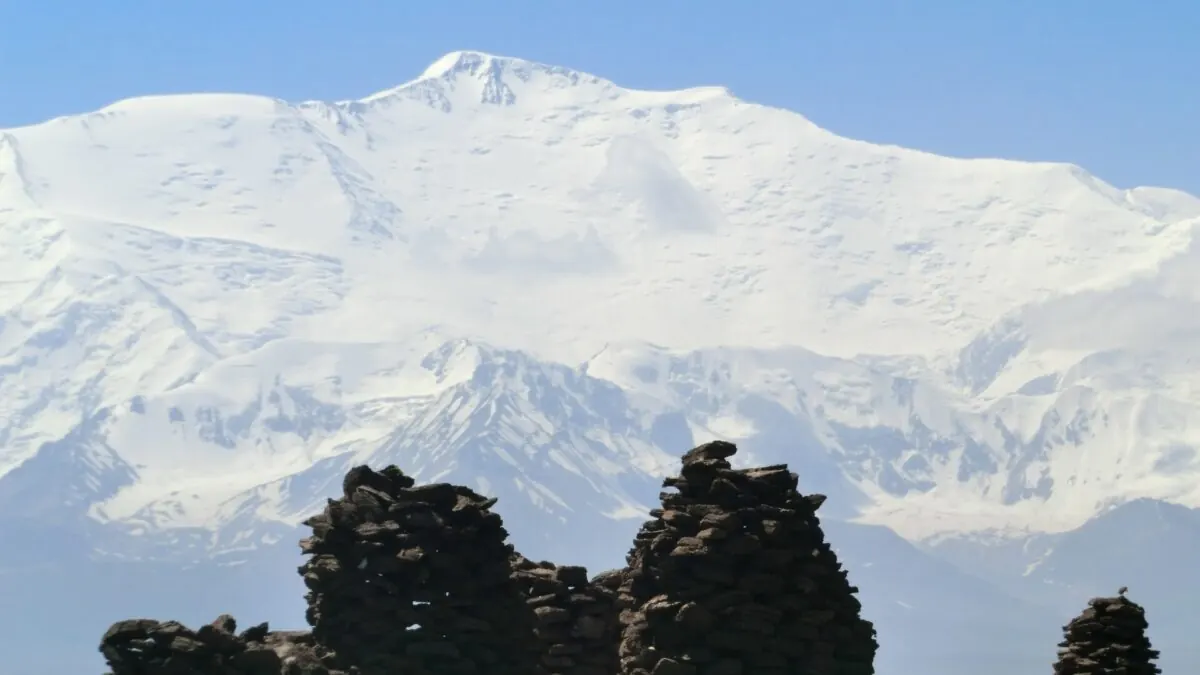
7,134 meters. That is what fills the horizon from the Travellers Pass, and you can stand there: a fit hiker on a plain walking trail. Without touching a rope. The Pik Lenin base camp trek reaches Achik-Tash camp at 3,600 m in the Alay valley of southern Kyrgyzstan, takes 3–4 days round trip from Osh, runs only in July and August, and costs roughly $200–300 per person self-guided. The classic postcard view comes from the Travellers Pass day hike at about 4,100 m.
One thing before anything else: this is a trekking objective, not a climb. Summiting Pik Lenin (officially Ibn Sina Peak) is a weeks-long, glaciated, high-altitude mountaineering expedition that demands crevasse-rescue skills and kills people most seasons. The trek to base camp and the ridge viewpoints above it's a different activity entirely, non-technical trails through edelweiss meadows and past turquoise lakes, manageable by anyone who respects the altitude.
The lay of the land
Pik Lenin sits on the Kyrgyzstan–Tajikistan border at the head of the Alay valley. On the Kyrgyz side, everything funnels through Achik-Tash, a broad grassy basin at 3,600 m dotted with yurt camps run by local families and expedition outfitters. Climbers stage here for the summit; trekkers set up here for a few nights of day hikes, returning to hot dinners and felt walls each evening.
The walking isn't technical. Trails out of camp climb the surrounding ridges and valleys at a few hundred meters of gain per day. What you cannot shortcut is the air: base camp already sits higher than most of the summits around Karakol, so the first day should be deliberately slow, and you should drink far more water than feels necessary.
Life at Achik-Tash is more comfortable than “base camp” suggests. The yurt camps serve hot dinners and breakfasts, there's usually a dining yurt with a stove where trekkers and climbers mix in the evenings, and solar panels charge phones slowly if the sun cooperates. There is no mobile signal worth relying on and no shop, so arrive with everything you need, snacks included. July evenings hover a few degrees above freezing; the blankets are thick, but a proper sleeping bag makes the difference between a good night and a long one.
A 4-day plan that respects the altitude
- Day 1: Osh to Sary-Mogol (3–4 hours), then 4WD to a Tulpar-Kul yurt camp at ~3,500 m. Short lakeside walk before dinner, nothing ambitious.
- Day 2: Move up to Achik-Tash, on foot in 3–4 easy hours across the pastures, or by vehicle in under an hour. Gentle afternoon stroll toward the meadows; sleep at 3,600 m.
- Day 3: Travellers Pass day hike, starting by 8 a.m. Back in camp by mid-afternoon before the cloud closes in.
- Day 4: Either the longer push toward Lake Lukovaya if you feel strong, or walk back down to Tulpar-Kul and ride out to Sary-Mogol and Osh.
Strong hikers can compress this to three days by skipping the Tulpar-Kul night, but the version above produces far fewer headaches, literally.
Travellers Pass: the one day hike that matters
If you have a single full day at Achik-Tash, spend it on the walk up to the Travellers Pass (Pereval Puteshestvennikov) at roughly 4,100 m. This broad saddle is the viewpoint on every Pik Lenin poster: the full north face across the glacier, the summit pyramid filling the sky, and nothing between you and it but moraine.
Reckon on 5–7 hours round trip with about 500 m of ascent and no scrambling. Start early. Partly for the light on the face, mostly because cloud routinely swallows the summit by early afternoon. Turn up at noon and you may stare at a wall of grey.
Pushing on: Camp 1 and Lake Lukovaya
With extra days and decent acclimatization, trekkers continue toward the climbers’ Camp 1 at around 4,400 m, beside Lake Lukovaya (“Onion Lake”), a milky glacial tarn under the moraine. Go as far as the moraine edge and no farther. Unroped glacier travel is precisely the risk that separates a trek from a climb, and the views from the edge are already everything you came for. Not worth it unless you're properly acclimatized: this is a big day at real altitude, and pushing it with a headache is how trekking holidays end in a 4WD evacuation.
Tulpar-Kul: the smarter first night
On the approach below Achik-Tash lies the Tulpar-Kul lake district, a scatter of small alpine lakes at about 3,500 m ringed by summer yurt camps. Spending your first night or two here instead of pushing straight to base camp does two jobs at once: it eases the altitude jump from Osh, and it puts you in front of the best single image in southern Kyrgyzstan, Pik Lenin reflected in still water at dawn. Several operators run permanent summer camps here with dinner, breakfast, and endless tea included.
In July the meadows around Tulpar-Kul and Achik-Tash fill with edelweiss, which is part of why the season is so short. Earlier there's lingering snow; later the camps start packing up as the climbing season closes.
Horses are easy to arrange at Tulpar-Kul through the yurt camps or CBT, either to ride toward base camp or to carry bags while you walk. It's a good option for mixed groups where one person wants to hike and another doesn't, and the pastures between the lakes and Achik-Tash are exactly the kind of open, rolling ground horses handle beautifully.
The border permit is not optional
The entire Alay valley approach sits inside a restricted border zone with Tajikistan, and you must carry a border zone permit tied to your passport. It's a paper document, it takes several days to process, and it cannot be conjured up on arrival in Osh. There are checkpoints on the road in, and they do check.
- Easiest route: have your yurt camp operator or a CBT office arrange it when you book. Send passport details 10–14 days ahead.
- Budget roughly 1,500–2,500 KGS ($17–28) per person depending on who processes it.
- Carry the physical permit and your passport at all times in the valley.
Getting there from Osh
Everything starts in Osh, the southern hub with daily flights from Bishkek. From there it is a two-stage journey: first to the village of Sary-Mogol in the Alay valley, then up a rough track to Achik-Tash.
- Osh to Sary-Mogol: 3–4 hours over the Taldyk Pass, about 230 km. Shared transport from Osh’s southern bus stand runs 500–700 KGS; a private car costs 6,000–9,000 KGS.
- Sary-Mogol to Achik-Tash: 40 km of dirt track, 1–1.5 hours, 4WD only. Expect 4,000–6,000 KGS per vehicle.
The single most useful contact for all of this is CBT Sary-Mogol, the local community tourism office. They arrange homestays in the village, the 4WD transfer, yurt camp bookings at Tulpar-Kul, horses, guides, and the border permit, all at fixed community rates that keep the money with the families who live here. Booking through them removes every logistical headache this trip has. If you want to string the Alay together with other regions, our Kyrgyzstan trekking guide maps the options.
Season and weather: a two-month window
July and August. That is when the yurt camps operate, the trails are snow-free, and the flowers are out. June can still hold snow high up with camps half-assembled; by mid-September the climbing season winds down and the valley empties. The wider seasonal picture is in our best time to visit Kyrgyzstan guide.
Even in midsummer, plan for cold. Nights at base camp drop toward freezing, weather flips fast between 3,600 and 4,100 m, and the UV at this altitude is brutal. A real down layer, a warm sleeping bag, full sun protection, and rain gear are the core of the kit, the Kyrgyzstan packing list has the complete rundown.
Acclimatization, honestly
Osh sits near 1,000 m; Achik-Tash sits at 3,600 m. Drive it in a day and your body notices. Plenty of unacclimatized visitors feel rough on arrival (headache, nausea, broken sleep) and the fix is boring but effective: arrive, rest, take a short gentle walk, and put off the Travellers Pass until at least your second morning. A night or two at Tulpar-Kul on the way up helps enormously. If symptoms worsen rather than fade, descend. There is no summit to bag on this trip, so there is never a reason to push through altitude sickness.
What it costs in 2026
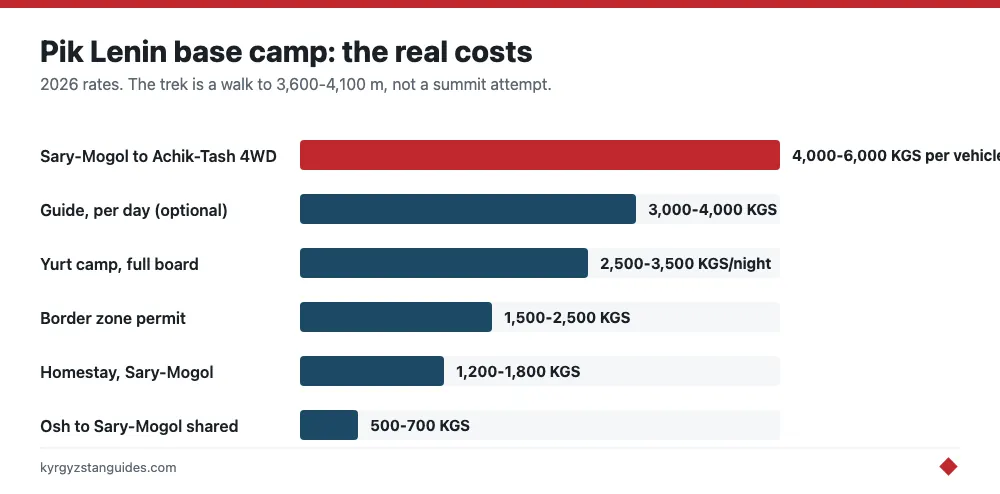
The Alay is pricier than trekking around Karakol, almost entirely because of the long 4WD transfers. Realistic figures, at roughly 1 USD = 88 KGS:
| Item | KGS | USD |
|---|---|---|
| Osh – Sary-Mogol (shared) | 500–700 | $6–8 |
| Sary-Mogol – Achik-Tash 4WD (per vehicle) | 4,000–6,000 | $45–68 |
| Yurt camp per night (full board) | 2,500–3,500 | $28–40 |
| Border zone permit | 1,500–2,500 | $17–28 |
| Guide per day (optional) | 3,000–4,000 | $34–45 |
| Homestay in Sary-Mogol | 1,200–1,800 | $14–20 |
The 4WD is the budget item that matters: split it three or four ways and the whole trip changes price bracket. All in, a self-guided 4-day trip sleeping in yurt camps lands around $200–300 per person; a guide adds $34–45 a day on top. How that fits a longer trip is covered in our Kyrgyzstan travel budget guide, and entry rules are confirmed on the official Kyrgyz e-visa portal.
Frequently Asked Questions
Is the Pik Lenin base camp trek a climb?
No. Reaching Achik-Tash base camp (3,600 m) and the Travellers Pass viewpoint (about 4,100 m) is non-technical hiking on trails. Summiting Pik Lenin (7,134 m) is a separate, weeks-long glaciated mountaineering expedition requiring ropes, crevasse-rescue skills, and serious experience.
Do I need a permit for Pik Lenin base camp?
Yes. The Alay valley approach lies in a restricted border zone with Tajikistan, so you need a border zone permit tied to your passport. Arrange it 10–14 days ahead through CBT Sary-Mogol or your yurt camp operator; it costs roughly 1,500–2,500 KGS ($17–28).
When is the best time to trek to Pik Lenin base camp?
July and August. The yurt camps at Tulpar-Kul and Achik-Tash are open, trails are snow-free, and the meadows are full of edelweiss. June may still hold snow high up, and camps close by mid-September as the climbing season ends.
Can you see Pik Lenin without climbing anything technical?
Yes - that is the whole point of the trek. The Travellers Pass day hike from Achik-Tash reaches about 4,100 m on a plain walking trail, 5-7 hours round trip with roughly 500 m of ascent and no scrambling, and faces the full north wall of the 7,134 m peak. Start by 8 a.m., because cloud routinely swallows the summit by early afternoon.
How far up can trekkers safely go?
To the moraine edge near Camp 1 at around 4,400 m, beside Lake Lukovaya - and no farther. Unroped glacier travel is precisely the line between a trek and a climb, and the views from the edge are already everything you came for.
Why spend the first night at Tulpar-Kul instead of base camp?
Two jobs at once: it eases the altitude jump from Osh by breaking it at about 3,500 m, and it puts you in front of Pik Lenin reflected in still water at dawn - the best single image in southern Kyrgyzstan. Base camp at 3,600 m already sits higher than most summits around Karakol.