The classic Kyrgyzstan packing mistake is preparing for one climate. Travelers look at July forecasts for Bishkek, pack for a hot summer trip, and then spend a 2°C night at a Song-Kul yurt camp wearing every garment they own at once. The country does this to people: 30°C in the capital and frost at your campsite can happen in the same 48 hours.
The correction is simple: pack layers, not outfits. The non-negotiables are broken-in hiking boots, a warm insulated layer even in July, a rain shell, a power bank, and a European Type C/F plug adapter, plus a 3-season sleeping bag if camping or high-altitude yurt nights are on the itinerary. Everything else on this list is refinement.
One country, three climates
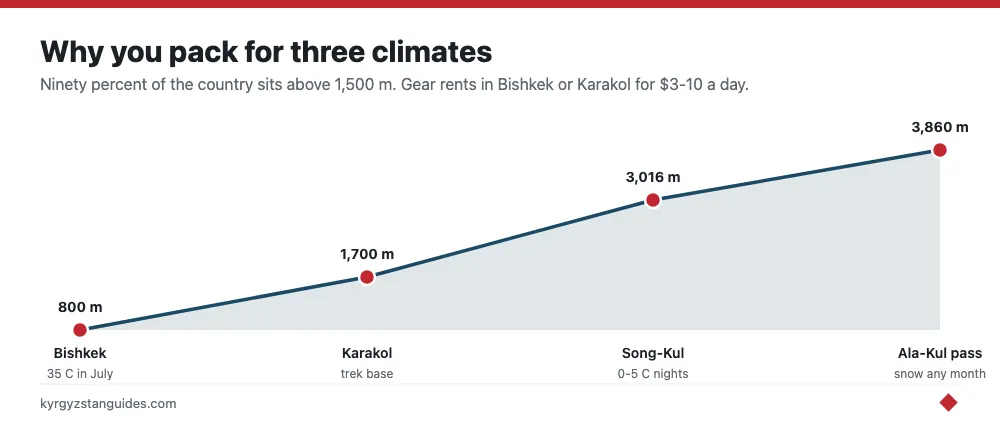
Ninety percent of Kyrgyzstan sits above 1,500 m, and itineraries swing wildly in altitude: Bishkek at 800 m can hit 35°C in July while that same afternoon at Song-Kul (3,016 m) brings hail and a night near zero. Weather at altitude turns in under an hour. The answer isn't more clothes but smarter ones: a base layer, a fleece or light down jacket, and a waterproof shell cover every situation in combination, and pack down small when they're not needed. Cotton is the enemy above the treeline: once wet, it stays wet and cold. Check our best time to visit Kyrgyzstan guide to see what your travel month actually delivers.
The trekking kit that belongs
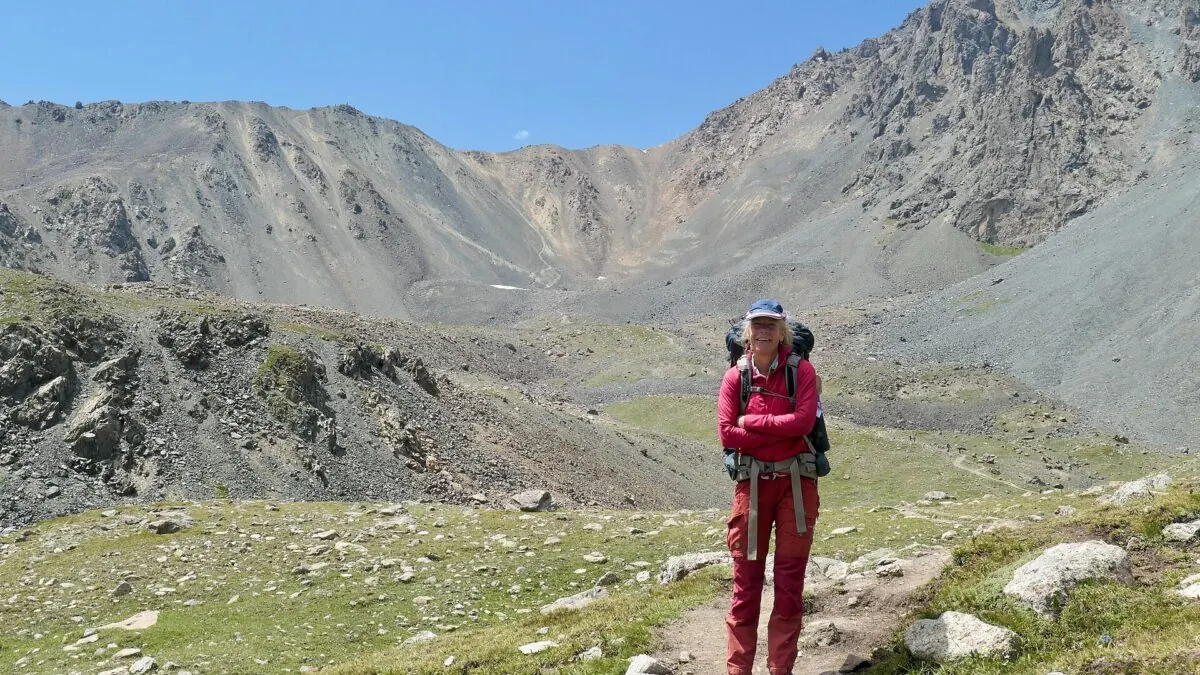
Doing any multi-day route — Ala-Kul, Boz-Uchuk, a horse trek to Song-Kul. Makes this the core of your bag. Everything here can be rented in Karakol or Bishkek for $3-10 per item per day, except the first item, which must come from home.
- Broken-in hiking boots, the single most important item on this page. Blisters end more treks in Kyrgyzstan than altitude does. Waterproof, ankle-height, worn for weeks before the flight.
- 3-season sleeping bag (comfort around -5°C) — required for camping. For yurt stays it’s optional insurance: camps provide heavy blankets that keep most people warm, but cold sleepers at 3,000 m in June or September will be glad of a bag or at least a liner.
- Trekking poles — the scree descent from the Ala-Kul pass converts every skeptic.
- Water treatment — filter bottle, Steripen, or tablets. Streams look pristine, but livestock graze nearly everywhere.
- Rain shell and waterproof pack cover (afternoon storms are the summer norm
- Warm hat, sun hat, gloves, and a buff) yes, all four, even in August
- Headlamp with spare batteries, yurt camps and trail toilets have no lighting
- SPF 50 sunscreen and sunglasses, UV at 3,000-4,000 m burns fast
- Dry bags or heavy zip-locks for electronics on river crossings and horse treks
Route-by-route gear notes live in our Kyrgyzstan trekking guide. On guided treks, confirm what the operator provides. Tents and cooking kit usually, sleeping bags only sometimes.
Season by season
Summer (June-August)
Expect 25-35°C in the valleys, 5-15°C at altitude, and afternoon storms as a standing appointment. Add to the core kit: a light down jacket for high nights, swimwear for Issyk-Kul beaches and hot springs, and insect repellent for the lakeshores. This is the season when people underpack warmth — don’t.
Shoulder seasons (April-May, September-October)
The trap months. Valleys sit at a pleasant 10-22°C while the passes are still (or already) in full winter, with freezing nights and snow entirely possible up high. Bishkek feels like spring; the mountains disagree. Add a warmer mid-layer, gloves and a beanie, gaiters for early or late treks, and a 4-season bag if camping. If an October trek is the plan, pack for both seasons and accept the weight.
Winter (November-March)
Real cold: -5 to -25°C, heavy snow in the mountains, and pavements like skating rinks. You need an insulated parka, thermal base layers, and winter boots with proper traction. Ski gear is rentable at Karakol Ski Base, so leave the skis at home. The country is superb from December to March, but only if you arrive dressed for it, our Kyrgyzstan in winter guide covers what’s actually open and worth it.
Buy in Bishkek or bring from home?
Bishkek has a genuine outdoor retail scene, which changes the packing calculus. Red Fox (the Russian technical brand) has a store on Kievskaya Street selling real down jackets, poles, and stoves at fair prices; Extremal and several smaller shops nearby cover the mid-range; and gas canisters (Epigas, Kovea, 350-600 KGS) are easy to find, which matters because you cannot fly with them. Osh Bazaar and Dordoi Bazaar sell convincing fake-brand fleeces, softshells, dry bags, and poles for 500-1,500 KGS that survive a season without complaint. Toiletries, sunscreen, batteries, and basic medicines are cheap and everywhere.
Five things you should still bring from home, because the local versions will let you down:
- Boots in your size (selection above EU 44 or in women’s-specific fits is thin
- A quality sleeping bag) rentals exist but are heavy and of uncertain loft
- A technical rain shell, the fakes look right and leak within hours
- Prescription medicines, contact lens supplies, and specialist first-aid items
- A high-capacity power bank: sold locally, but quality is a lottery
And here's the fact that shrinks your clothing pile by half: laundry is cheap and easy. Nearly every guesthouse in Bishkek, Karakol, and Osh will wash a load for 200-400 KGS, usually returned dry the same evening, and Bishkek has proper laundromats too. Three or four rotations of quick-dry clothing plus a wash every few days beats ten outfits in a heavier bag. The only stretch without laundry access is the trek or jailoo itself, and out there everyone smells like horse anyway.
Dressing for the culture
Kyrgyzstan is secular and, by regional standards, relaxed. In Bishkek, Karakol, and the Issyk-Kul resorts, dress exactly as you would in southern Europe. Shorts, dresses, and swimwear at the beach raise zero eyebrows. The south differs in degree, not kind: in Osh, Jalal-Abad, and rural Fergana-edge villages like Arslanbob, both men and women will feel more comfortable with shoulders and knees covered, and women may want a scarf handy for mosque visits (the Dungan Mosque in Karakol provides them). Nobody polices foreigners, but respect is repaid with hospitality. Add slip-on sandals for everyone. Shoes come off at every guesthouse and yurt door, and unlacing boots six times a day gets old by lunchtime.
Electronics: plugs, power, and the charging queue
Kyrgyzstan runs on 220V/50Hz with European Type C and Type F sockets, one universal adapter covers everything, and dual-voltage chargers need no converter (full specs at worldstandards.eu). The item you'll actually miss is a 10,000-20,000 mAh power bank: yurt camps run on solar panels or generators with a nightly charging queue, and multi-day treks have nothing at all. Bring a short multi-device cable set, use a headlamp instead of your phone torch, and download offline maps before leaving Wi-Fi. A local SIM makes the whole trip easier — our Kyrgyzstan SIM card guide explains why 20-50 GB costs under $6.
Paperwork and money
- Passport valid 6+ months, plus two paper photocopies stored separately, police checks and border-zone permits (Kel-Suu) want the details
- Travel insurance certificate that explicitly covers trekking to your maximum altitude
- Visa or e-visa printout if your nationality needs one — most Western passports get 30 days within any 60-day period visa-free; see our Kyrgyzstan visa guide
- Two bank cards on different networks — ATMs are city-only, so carry cash (som, small notes) for everything beyond Bishkek, Karakol, and Osh
- $100-200 in crisp US bills as an emergency reserve, exchange offices take them readily
The medical kit
Pharmacies (apteka) in Bishkek and the regional towns are well stocked and cheap, but past the last town you are your own pharmacist. Carry blister plasters (Compeed-style), ibuprofen, loperamide plus oral rehydration salts for the near-inevitable stomach wobble, antiseptic, and personal prescriptions in original packaging. Take the altitude question seriously: Song-Kul sleeps you at 3,016 m and the Ala-Kul pass tops 3,860 m, so ascend gradually, hydrate, and talk to your doctor about acetazolamide (Diamox) if you have a history of altitude sickness or a fast ascent profile. Iodine tablets or a filter cover the water problem: never drink untreated from streams below the summer pastures, which is most streams.
Leave these at home
- A wheeled suitcase — you will curse it on gravel; a 50-70 L duffel or backpack rides better in marshrutkas and on horses
- A drone, unless you have checked current rules — registration requirements exist, and border-zone flying causes real trouble
- Heavy jeans as trekking wear, high heels, or one-use formal outfits (nothing in the country requires them
- Camping gas canisters) banned in flight luggage anyway; buy in Bishkek
- Excess toiletries, sold cheaply everywhere
- Satellite-messenger anxiety — a Garmin inReach is smart for remote routes, but the infrastructure is better than Kyrgyzstan’s reputation suggests
One warning to close on, because it is the mistake that actually hurts: don't board the flight with new boots and a 20 kg pack. Lay everything out, remove a third, and keep the total under 15 kg, every gram is on your back at 3,500 m, or strapped to a horse that already carries your lunch. The traveler who packed light and layered right never thinks about their bag again. That’s the goal.
FAQ
What should I pack for Kyrgyzstan?
Layers rather than outfits. The non-negotiables are broken-in hiking boots, a warm insulated layer even in July, a rain shell, a power bank and a European Type C/F plug adapter, plus a three-season sleeping bag if camping or high-altitude yurt nights are on the itinerary.
How cold does it get in Kyrgyzstan in summer?
Cold enough to catch people out. A 2°C night at a Song-Kul yurt camp and 30°C in Bishkek can happen within the same 48 hours, which is the single most common packing mistake here.
What plug adapter does Kyrgyzstan use?
European Type C/F. Pack one before you arrive rather than relying on finding one locally.
Do I need a sleeping bag in Kyrgyzstan?
If you are camping or spending nights in high-altitude yurt camps, yes — a three-season bag. For a guesthouse-based itinerary you do not need one.
Why is packing for Kyrgyzstan difficult?
Because people prepare for one climate. Around ninety per cent of the country sits above 1,500 metres and itineraries swing wildly in altitude, so a trip can move from a hot capital to frost at a campsite within a day or two.
Are hiking boots essential?
Broken-in ones, yes, and the emphasis is on broken-in. Most of what is worth doing here involves loose ground, and a new pair bought for the trip is how people ruin the first week of it.