Kyrgyzstan is the best country in Central Asia for a woman traveling alone, and one of the easier ones anywhere in Asia — a stronger claim than most safety pages will commit to, so here is the case. Violent crime against tourists is rare, and catcalling is less common than in much of Europe. The default accommodation is somebody’s family home, where a hostess keeps an eye on things. And the backpacker trail is well-worn enough that finding trekking partners takes about one hostel breakfast.
None of this means zero hassle. You'll field endless questions about your marital status, dodge the odd drunk man on a night marshrutka, and collect stares in conservative southern villages. Still, thousands of women cross the country alone every summer and overwhelmingly report the same thing: they felt safer here than they expected, and safer than in plenty of famous destinations. What follows is the practical version — what actually happens, and the small tactics that smooth it.
The actual safety picture
The general risks, pickpockets around Osh Bazaar, reckless driving, altitude, affect everyone and are covered in our Kyrgyzstan safety guide. Specific to women: physical harassment is rare, catcalling uncommon, and Kyrgyz culture carries strong hospitality norms toward guests of either gender. The realistic annoyances are curiosity (intense, nearly always friendly), alcohol-fueled overfamiliarity from men in the evenings, and taxi drivers with an appetite for personal questions. Trust your instincts exactly as you would at home — they're calibrated correctly here, and that alone covers ninety percent of it.
North and south: two different countries
Bishkek is a secular post-Soviet city where women wear what they like, bars are mixed, and nobody looks twice at a woman dining alone. Karakol and Cholpon-Ata are relaxed tourist towns. The countryside is more traditional (defined gender roles, conservative village life, and a solo woman as a genuine curiosity) though “traditional” here usually means you get adopted, fed, and quizzed about your family rather than bothered. The south (Osh, Jalal-Abad, Batken) is more religiously conservative than the north, with more headscarves, fewer women in bars, and noticeably warmer treatment for modest dress. Nothing about any of it feels hostile, but every region rewards reading the room.
What to wear, region by region
- Bishkek — anything. Shorts, dresses, sleeveless: the most liberal place in the country.
- Issyk-Kul beaches: swimsuits are normal on the Cholpon-Ata sand; cover up once you leave it.
- Karakol and the trekking towns. Casual outdoor wear; nobody cares what hikers look like.
- Villages and yurt camps, knees and shoulders covered; loose trousers and a t-shirt are plenty.
- Osh and the south — modest: long trousers or skirt, covered shoulders.
You never need to cover your hair except inside a mosque, where a scarf is often provided at the door. On the trail, normal hiking clothes are fine everywhere in the country.
Transport tactics locals already use
Public transport is safe and full of local women — you'll rarely be the only one aboard. The tactics below come straight from what Kyrgyz women themselves do every day:
- In shared taxis, take a back seat next to another woman when possible, drivers will happily reshuffle passengers to arrange it if you ask.
- Avoid the front passenger seat in an all-male car; it invites two hours of questions.
- On marshrutkas, sit near the driver or next to women — babushkas are the best seatmates in Central Asia.
- For night journeys like Bishkek–Osh, a shared-taxi cabin beats the sleeper bus for control over who sits beside you — or just fly, it’s $40-60.
- In cities, use the Yandex Go app instead of street taxis: tracked, priced upfront, no negotiation.
Route-level detail lives in our getting around Kyrgyzstan guide.
Accommodation is your secret weapon
Kyrgyzstan’s lodging scene might be the single biggest reason solo women rate the country so highly. The standard options — family-run guesthouses ($25-40 for a double, often less for a single) and jailoo yurt camps. Mean you are effectively staying in someone’s home, with a hostess (the ene, or grandmother, usually runs the operation) taking visible responsibility for you. At a yurt stay you sleep in a shared yurt with other travelers and eat communal dinners, so anonymity is off the table: which turns out to be the appeal. Hostels in Bishkek and Karakol ($8-12 a dorm bed) are sociable and mostly family-run; several offer women-only dorms if you ask when booking.
You won’t trek alone unless you want to
Almost nobody — of any gender, treks Kyrgyzstan’s popular routes truly alone, because it's so easy to find company. Karakol’s hostels (Duet, Fat Cat, and others) run noticeboards and WhatsApp groups where hikers assemble teams for the Ala-Kul trek within a day; in July and August, you meet your trekking partners at breakfast. Local operators run fixed-departure group treks that solo travelers can join, and CBT offices will slot you into existing groups or arrange a licensed guide at about 3,500-5,000 KGS per day, split if shared. On Ala-Kul and Altyn Arashan in season you are never more than an hour from other hikers. For remote routes, take the guide. For navigation and weather far more than for personal safety. Route difficulty is graded in our trekking guide.
Marriage questions, vodka, and the scripts that work
You'll be asked, constantly and cheerfully: Are you married? Why not? Where is your husband? This is small talk, not menace — Kyrgyz people ask each other the same things within minutes of meeting. Answer however you like. Many solo women deploy an invented husband “joining me in Karakol” plus a ring; it works, but it is rarely necessary. When someone jokes “Stay here, marry my son!”, that is hospitality theater, and the expected response is to laugh, decline, and move on.
The one situation worth actively managing is alcohol. Kyrgyz hospitality includes vodka, and an all-male drinking table at a guesthouse celebration can slide into overfamiliarity. Accepting one symbolic toast is gracious; after that, “men ichpeym” (I don’t drink) is universally respected, especially from women, and nobody pushes twice. Leave drinking gatherings early rather than last — the hostess will happily conspire in your exit.
Apps, numbers, and backup
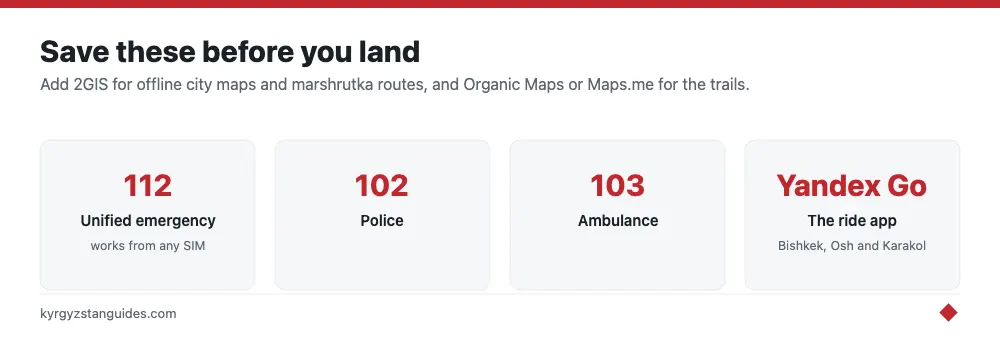
- 112 — the unified emergency number, from any SIM; 102 police, 103 ambulance.
- Yandex Go for rides in Bishkek, Osh, and Karakol; 2GIS for offline city maps and marshrutka routes; Organic Maps or Maps.me for trails.
- A local SIM on arrival — O! or Beeline, roughly 300-500 KGS with generous data; coverage reaches most valleys.
- Share live location with someone at home on long taxi rides, and photograph the plate before getting in — drivers expect it now.
- Register with your embassy’s traveler program (the UK’s travel advice page or the US STEP program) if heading somewhere remote.
Worth knowing while you plan: Kyrgyzstan has a growing bench of female guides and women-led operators. Destination Karakol can connect you with women guides for day hikes, several CBT coordinators are women, and Bishkek’s feminist-run cafés and felt-craft collectives make good first-day stops. Asking specifically for a female guide is normal and usually possible with a few days’ notice.
Small logistics nobody mentions
Tampons are surprisingly hard to find outside Bishkek’s bigger supermarkets (Globus and Frunze stock them); pads are sold everywhere, but if you’re a tampon or cup user, bring your supply from home: a menstrual cup is genuinely the best option for multi-day treks with pit latrines. Pharmacies in any town carry painkillers, UTI treatment, and most contraception without fuss, though brand names differ, so photograph your usual packaging before you fly. Guesthouse laundry (200-400 KGS a load) means you can pack lighter than you think. And if you want company before you arrive, the Central Asia backpacker WhatsApp and Facebook groups are active all summer. Plenty of women post looking for trek partners or a taxi split a few days ahead, so you can land in Bishkek with plans already made.
Frequently Asked Questions
Is Kyrgyzstan safe for a woman traveling alone?
Yes, solo female travelers consistently rate Kyrgyzstan as safe, with harassment less common than in many popular destinations. Petty theft in bazaars and road safety are the bigger risks. Normal precautions apply: watch drinking situations, use Yandex Go in cities, and share your location on long rides.
What should a woman wear in Kyrgyzstan?
In Bishkek and tourist towns, wear whatever you like. In villages and the more conservative south around Osh, cover knees and shoulders. Loose trousers and a t-shirt are enough. A headscarf is only needed inside mosques. Normal hiking clothes are fine on every trail.
Can I trek alone as a woman in Kyrgyzstan?
Popular trails like Ala-Kul are busy enough in July-August that solo women hike them regularly, but most join informal groups formed at Karakol hostels within a day. For remote routes, hire a licensed guide (3,500-5,000 KGS/day) through CBT, mainly for navigation and weather, not personal safety.
Are yurt stays safe for solo women?
Very. Yurt camps and family stays are run by households, usually with a matriarch clearly in charge, and guests sleep in shared yurts with other travelers. You’re part of a family setting rather than anonymous, many solo women call jailoo nights the safest-feeling part of their trip.
Three scenarios, played out
The shared taxi that fills with men. You’re in Kochkor heading to Naryn and the only car filling up has three male passengers. Fine to take — but it's also completely normal to wait for the next car, or ask the driver to seat you front-right while the men share the back. He will arrange it without blinking; local women do this daily.
The guesthouse toast. Your Karakol host family is celebrating a birthday and waves you to the table. Go, this is the good stuff. Accept one toast or raise your teacup instead, eat everything offered, show photos of your family, and when the vodka comes around a third time, thank the hostess and plead an early trek. Textbook exit, zero offense.
Solo at the trailhead. You arrive in Karakol wanting Ala-Kul but won’t hike it alone. Evening one: ask at the hostel desk, check the noticeboard. By morning you have two Germans and a Japanese hiker with the same plan and a shared taxi split four ways. This exact scene repeats all summer. It will repeat for you too.
Is Kyrgyzstan safe for solo female travelers?
Yes — it is arguably the easiest country in Central Asia for a woman traveling alone. Violent crime against tourists is rare, catcalling is less common than in much of Europe, and the default lodging is a family guesthouse where a hostess keeps an eye on things. The realistic annoyances are intense curiosity, marital-status questions, and the odd drunk man on a night marshrutka.
What should women wear in Kyrgyzstan?
It varies sharply by region: anything goes in Bishkek, swimsuits are normal on Cholpon-Ata beaches, villages and yurt camps call for covered knees and shoulders, and Osh and the south reward modest dress — long trousers or a skirt with covered shoulders. Hair never needs covering except inside a mosque, where a scarf is usually provided, and normal hiking clothes are fine on any trail.