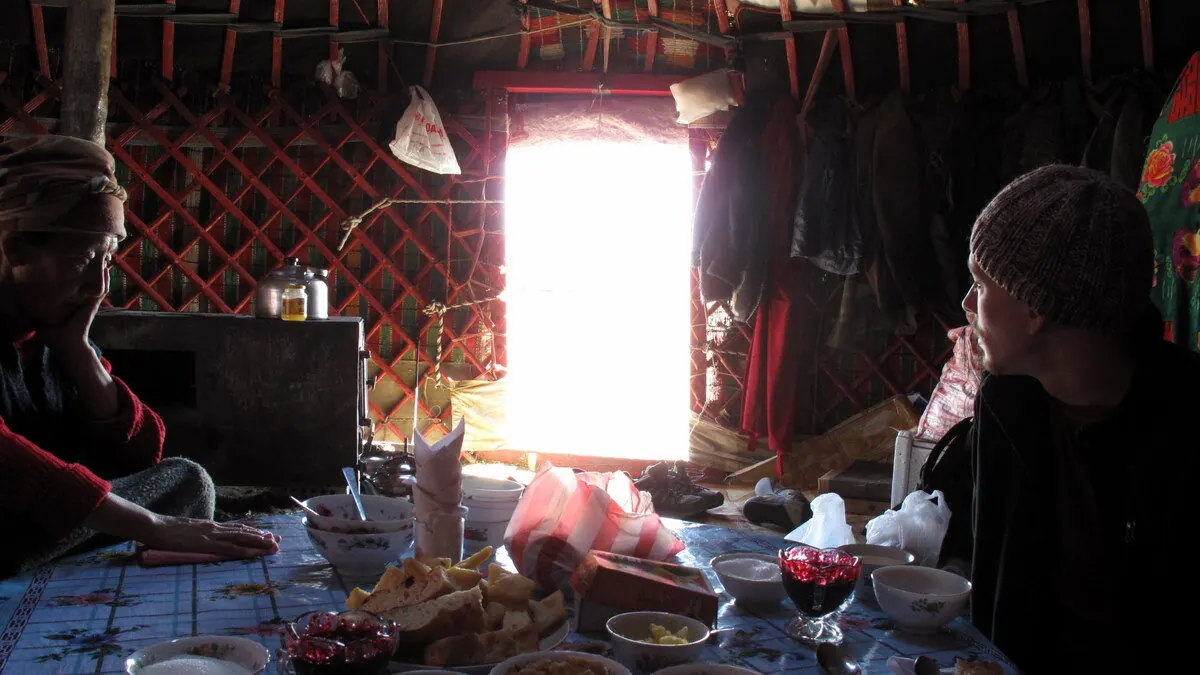
The stove burns out around midnight, and after that it’s wool blankets, starlight through the roof wheel, and the sound of horses cropping grass a meter from your head. That is what you're paying for. A yurt stay in Kyrgyzstan costs about 1,200-1,800 KGS per person per night ($14-21) including dinner and breakfast, and buys you a bed of floor mattresses in a shared felt yurt on a summer pasture (jailoo), home-cooked meals, an outhouse toilet, and no shower.
It is the most memorable accommodation in Central Asia, and also the most misunderstood — half the disappointment reviews come from people who expected a hotel with felt walls. Here is what a Kyrgyzstan yurt stay actually involves, where to do it, how to book, and the etiquette your hosts will appreciate.
Inside the felt
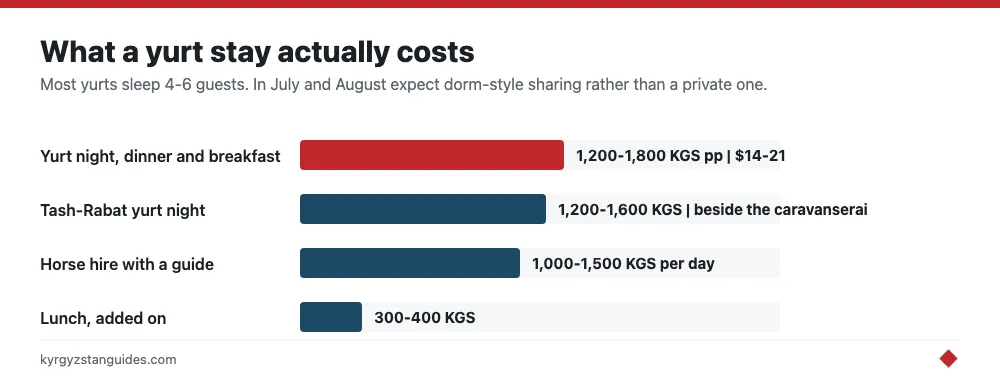
A yurt (boz-üy, “grey house” in Kyrgyz) is a round felt tent stretched over a collapsible wooden lattice, crowned by the tunduk, the roof wheel on the national flag. Inside a guest yurt: floor and walls layered with shyrdak and ala-kiyiz felt carpets, a stack of mattresses (töshök) laid out at night, heavy duvets, and usually a low table. Most sleep 4-6 guests; couples sometimes score a private yurt at quieter camps, but in July and August expect dorm-style sharing.
The standard price includes dinner and breakfast. Fresh bread with homemade jam and kaymak (clotted cream), endless tea, a hot dinner of lagman, plov, or dymdama, and porridge or eggs in the morning. Lunch can usually be added for 300-400 KGS, and most camps rent horses at 1,000-1,500 KGS ($11-17) per day with a guide.
Two experiences share one name
Knowing the difference between them saves disappointment in both directions.
- Tourist yurt camps (most of Song-Kul’s shoreline, Tash-Rabat, Tulpar-Kul): rows of 5-20 guest yurts run as a seasonal business. Cleaner bedding, sit-down group dinners, sometimes solar power and a dining yurt. Comfortable, sociable, easy to book. But the family lives off-site and the interaction is host-to-guest.
- Shepherd family stays: one or two spare yurts pitched beside a working herding family’s own. You eat what they eat, watch the evening milking, and the kids will beat you at cards. Rougher edges (variable bedding, one squat toilet, meals at family time) but this is actual jailoo life, not a staging of it.
Neither is wrong. For a first night, a camp is easy; for the story you will still be telling in ten years, stay with a family at least once. The summer migration rhythm behind all of it is explained in our nomadic culture guide.
Where to do it
Song-Kul lake (3,016 m) is the classic first choice: dozens of camps dot the shoreline from June to mid-September at 1,200-1,800 KGS, horse games erupt in midsummer, and the lake pairs naturally with a ride in from Kyzart or Kochkor. Tash-Rabat (3,100 m) puts your yurt beside a 15th-century stone caravanserai for 1,200-1,600 KGS — history and jailoo in one stop on the road toward Torugart. For wilder scenery, Kel-Suu (3,500 m) hides a cliff-walled lake in the border zone. Permit required, 1,500-2,000 KGS, July and August only — and Tulpar-Kul (3,500 m) serves up views of 7,134 m Pik Lenin from your breakfast table at 1,500-2,500 KGS. If you only have one night, make it Song-Kul; if you have three, spread them. A timing tip that matters more than the destination: arrive by mid-afternoon. You get your pick of yurts, daylight for a walk or a ride, and the full slow build of dusk over the pasture, the travelers who roll in at 7 p.m. get dinner and darkness.
Booking, three ways
- CBT (Community Based Tourism) offices in Kochkor, Naryn, Karakol, and Osh book family-run yurts, arrange transport, and set fixed fair prices — Kochkor’s office is the hub for Song-Kul. Walk in a day ahead or email via cbtkyrgyzstan.kg.
- Through your guesthouse or a tour operator — most Bishkek and Karakol guesthouses will phone a camp they know and bundle a car.
- Walk-in: at Song-Kul and Tash-Rabat in July-August you can simply show up; camps rarely turn anyone away. Riskier at small pastures, and after mid-September most yurts are dismantled and gone downhill.
Toilets, cold, and other truths
The toilet is a pit latrine in a wooden shack, 20 to 100 meters from your yurt — bring a headlamp for the 2 a.m. walk under an absurd number of stars. There are no showers on the jailoo; a few larger Song-Kul camps offer a basin of warmed water or, rarely, a bucket-shower yurt for 200-300 KGS, but the realistic plan is wet wipes for one to three nights and a proper wash back in town. Electricity means a solar panel for lights and sometimes phone charging; mobile signal is absent at most pastures, so download offline maps first.
And the cold is real. Even in August, nights at 3,000+ m drop to 0-5°C, and June or September can dip below freezing. The blankets are heavy and genuinely warm, and hosts light the central stove in the evening, but it dies by midnight. Sleep in a base layer and socks and you will be fine; sleep in the t-shirt you hiked in and you will be awake at 3 a.m. rethinking your choices.
Etiquette your hosts actually care about
- Shoes off at the door, always — the felt floor is living room, dining room, and bed.
- Respect bread. Never place it upside down, never throw it away, never step over anything food-related.
- Accept what’s offered. Take the bowl of kymyz (fermented mare’s milk) with your right hand and at least sip it; nobody minds if you don’t finish, but refusing outright is rude. Tea gets refilled forever — leave your cup full when you’re done.
- Ask before photographing people, especially women and children. A gesture at the camera and a smile is enough.
- Don’t lean on the walls or hang things from the lattice; the structure is tensioned.
- Sit where your host waves you — the spot furthest from the door is the honored one.
Pack for the night, not the trip
Beyond the full Kyrgyzstan packing list, these earn their place for jailoo nights: a headlamp (non-negotiable), wet wipes and hand sanitizer, toilet paper, a power bank, warm sleep layers and a beanie, sunscreen for the 3,000 m daytime sun, and a sleeping bag liner if shared bedding bothers you — a full sleeping bag is optional insurance for June and September. Staying with a family? Tea, sweets for the kids, or fruit from the bazaar lands far better than a money-only gesture.
Keep it small
Yurt tourism puts cash directly into herding families’ hands and is a large part of why the jailoo tradition remains economically viable, but it works best at small scale. Book family-run camps through CBT where possible, carry out your trash (there is no collection at 3,000 m), go easy on water, don’t pressure hosts for alcohol, and pay the asked price without grinding: the gap between 1,200 and 1,500 KGS is $3.50 to you and a real margin to the family. If a camp looks like a 40-yurt resort with tour buses idling outside, keep riding, the quieter pasture over the hill is the reason you came.
Frequently Asked Questions
How much does a yurt stay cost in Kyrgyzstan?
Expect 1,200-1,800 KGS per person per night ($14-21) including dinner and breakfast at most jailoo camps in 2026. Remote spots like Kel-Suu or Tulpar-Kul run slightly higher, up to 2,500 KGS. Horse rental adds 1,000-1,500 KGS per day; lunch about 300-400 KGS.
Do yurts in Kyrgyzstan have toilets and showers?
Toilets are outdoor pit latrines a short walk from the yurts; there are no showers on the summer pastures. A few larger Song-Kul camps offer warm washing water or a bucket shower for a small fee. Bring wet wipes, toilet paper, and a headlamp for night trips.
When is yurt stay season in Kyrgyzstan?
Roughly June to mid-September, matching the summer pasture migration. July and August are warmest and busiest; by late September families dismantle their yurts and descend to villages. Tash-Rabat and lower camps open slightly earlier and close slightly later than Song-Kul or Kel-Suu.
Can I arrive at a yurt camp on horseback?
Yes, and it is the natural upgrade. A two- or three-day ride from Kyzart to Song-Kul, sleeping in family yurts along the way, folds everything on this page into one trip: our horse trekking guide maps out the routes and prices.
Is there etiquette for dinner in a yurt?
More than guests expect — where you sit and which cut of meat you are handed both follow a set order, explained in the guide to Kyrgyz hospitality rules.
What is the difference between a yurt camp and a shepherd family stay?
Tourist camps are rows of 5-20 guest yurts run as a seasonal business - cleaner bedding, group dinners, sometimes solar power, with the family living off-site. A shepherd stay is one or two spare yurts beside a working herding family's own: you eat what they eat and watch the evening milking. For a first night take the camp; for the story you will still be telling in ten years, stay with a family at least once.
What time should I arrive at a yurt camp?
By mid-afternoon. You get your pick of yurts, daylight for a walk or a ride, and the slow build of dusk over the pasture. Travellers who roll in at 7 p.m. get dinner and darkness.
How cold is a night in a yurt?
Colder than most people expect. Even in August, nights at 3,000 m and above drop to 0-5°C, and June or September can dip below freezing. Hosts light the central stove in the evening but it dies by midnight, so sleep in a base layer and socks under the heavy blankets rather than in the t-shirt you hiked in.