The biggest mistake travelers make about horse trekking in Kyrgyzstan is assuming they need to know how to ride. They don’t. And skipping the trip because of it means missing the single most Kyrgyz thing you can do in the country. A fully guided multi-day ride costs roughly 2,500–4,000 KGS ($28–45) per day including your horse and guide, often with food and yurt stays bundled in, and the horses are calm, sure-footed mountain animals that carry total beginners over 3,000 m passes every week of the summer.
The classic trip is the 2–3 day ride from Kyzart village to Song-Kul lake, but strong routes also run out of Jyrgalan, Tash-Rabat, and the Alay valley. This is horse travel the way locals actually do it (crossing high passes to summer pastures and sleeping in family yurts) and it costs less per day than a mid-range hotel room back home.
Why this works here and almost nowhere else
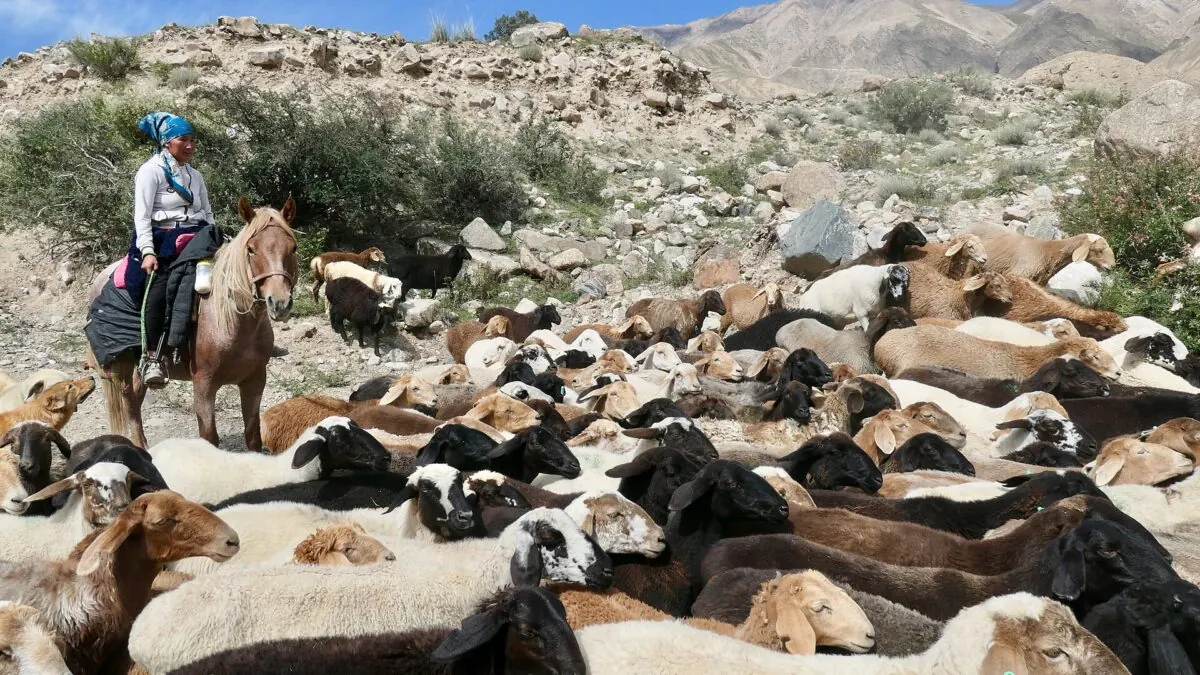
The horse is not a tourist prop in Kyrgyzstan. Families have moved between valleys and high jailoo (summer pastures) on horseback for centuries, and that living tradition is exactly what makes the trekking so good: the animals are bred for mountain terrain, the guides grew up in the saddle, and a network of yurt camps and community tourism offices makes multi-day rides genuinely easy to arrange on a few days’ notice.
- Cheap: a guided day with horse costs a fraction of comparable trips in Mongolia, Patagonia, or the Alps.
- Accessible: trailheads are a marshrutka ride from Bishkek or Karakol, and no experience is required.
- Scenic: routes cross 3,000–4,000 m passes to alpine lakes and pastures few hikers ever reach.
- Cultural: you sleep in working family yurts and eat with the shepherds who own the pastures.
The deeper background on jailoo life is in our Kyrgyz nomadic culture guide.
The four routes worth your saddle time
Song-Kul from Kyzart (2–3 days), the classic
The signature ride, and the right first choice. You start at Kyzart village, cross a couple of grassy passes, and descend to Song-Kul lake, a vast sheet of water at 3,016 m ringed by summer pastures and yurt camps. Two to three days lets you ride in, sleep by the lake, and ride out via a different valley. Gentle terrain, enormous open scenery, and a well-oiled network of homestays run by CBT Kochkor. It's popular for a reason; if crowds bother you, ride in September, or take the shorter overnight ride from Kochkor up to Kol-Ukok lake.
Jyrgalan: greener, quieter, forested
In the east near Karakol, Jyrgalan has grown into a small hub for horse trips over its high passes. The community tourism association runs well-organized multi-day rides with proper guides and yurt camps, and the forested valleys make a real contrast to Song-Kul’s open steppe. Good choice if you are already basing in Karakol.
Tash-Rabat, history at altitude
Ride out from the stone caravanserai at Tash-Rabat, a Silk Road relic in a remote Naryn province valley, up toward Chatyr-Kul lake and the pastures near the Chinese border. Higher, emptier, and more atmospheric than Song-Kul; works as a day ride or a longer trip from the local yurt camps.
The Alay valley — big-mountain backdrop
In the far south, the pastures below the Pamir deliver the biggest scenery of the four. CBT Sary-Mogol arranges rides here, and it pairs naturally with a Pik Lenin base camp trek if you are already down south. Skip it as a stand-alone trip unless you're in the Osh region anyway, the transfers are long.
What it costs
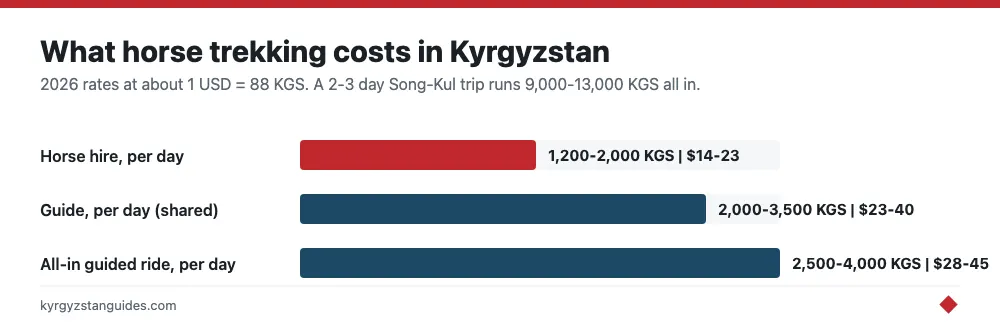
Budget roughly 2,500–4,000 KGS ($28–45) per day for a guided ride. Whether food and yurt nights are bundled in depends on the operator, so always confirm what the day rate covers before you shake hands. Figures below are realistic for 2026, at about 1 USD = 88 KGS.
| Item | KGS | USD |
|---|---|---|
| Horse hire per day | 1,200–2,000 | $14–23 |
| Guide per day (shared across group) | 2,000–3,500 | $23–40 |
| All-in guided ride per day | 2,500–4,000 | $28–45 |
| Yurt stay with full board | 2,000–3,000 | $23–34 |
| Pack horse for gear | 1,200–1,800 | $14–20 |
A typical 2–3 day Song-Kul ride with horse, guide, meals, and yurt nights lands around 9,000–13,000 KGS ($100–150) per person. The guide fee is per group, so three or four riders splitting it changes the math substantially. Our Kyrgyzstan travel budget shows where this sits in a full trip.
Booking: CBT or a private operator?
Two channels, and the right one depends on how much hand-holding you want. CBT offices (Community Based Tourism) in Kochkor, Karakol, Naryn, and Sary-Mogol set fixed community rates, hire local guides and horses, and send the money straight to the families who own the animals. Cheapest and most direct; book a day or two ahead in person or by phone. Private operators and guesthouses in Bishkek and Karakol package the same rides with more English support, online booking, and slicker logistics, at a markup that buys convenience, not a better ride.
For most independent travelers, walking into the relevant CBT office is the sweet spot. In July and August book several days ahead; good guides get spoken for.
“No experience needed”: true, but read this anyway
Guides start beginners at a walk, the horses know the trails better than you do, and nobody will ask you to do anything fancy. All true. But “no experience needed” doesn't mean “easy on the body,” and the gap between those two statements is where first-timers get surprised.
- Saddle soreness is real. After a full day in a hard nomad saddle you will ache in places you did not know existed. Padded cycling shorts under your trousers help enormously; so does standing in the stirrups on descents.
- Days are long. Six to eight hours in the saddle is normal on a Song-Kul ride — a different tiredness from hiking.
- You'll walk some of it. Steep, rocky pass descents are often done leading the horse on foot, so basic fitness matters.
- Weather turns fast. High passes get cold, wet, and windy even in July.
Tell your guide honestly if you have never ridden. A good one paces the group to the weakest rider without making a thing of it.
What a trekking day actually looks like
Mornings start slow by design: breakfast around 8, then the guide catches and saddles the horses while you pack, and the group is usually moving by 9:30 or 10. You ride 2–3 hours at a walk, occasionally a gentle trot on flat pasture, before a long lunch stop where the horses graze and everyone lies in the grass. The afternoon block is another 3–4 hours, timed to reach the night’s yurt or camp by 5 or 6. Nobody rides in the dark, and nobody rides in a serious storm — if the weather closes in on a pass, guides wait it out or reroute. Total distance rarely exceeds 25–30 km a day, which sounds modest until you have done it in a nomad saddle.
Solo travelers can nearly always join a departing group through CBT to split the guide fee. Ask what's already booked for the next few days rather than requesting a private trip first. Children from about age eight ride their own horses on the gentler routes; younger kids share with a parent. The season mirrors the yurt camps: mid-June to mid-September for the high routes, a few weeks longer at lower elevations.
Gear: what’s provided, what’s on you
Guides supply the horses, saddles, tack, and usually a pack horse; all-in trips add food and yurt bookings. Your personal kit is your problem:
- Sturdy shoes or light boots with a heel that sits in a stirrup — never flat-soled sneakers.
- Long trousers against chafing, padded shorts underneath for comfort.
- Warm layers, waterproof shell, gloves, and a hat for the passes.
- Sun hat, sunglasses, and strong sunscreen: high-altitude UV is fierce.
- Small daypack for water, snacks, and camera; heavy gear rides the pack horse.
- Personal medication plus a basic blister and painkiller kit.
The full checklist, including how to stay warm on yurt nights, is in our Kyrgyzstan packing list.
Safety, etiquette, and the horses themselves
Keep your heels down and toes up in the stirrups, never wrap the reins around your hand, and let the horse pick its own line on rough ground. It has done this route more times than your guide has. Keep a sensible gap between horses so they can't kick each other. Ask for a helmet if you want one, though few guides carry them.
On the jailoo you'll often overnight with a herder family, and small courtesies carry weight: step over the yurt threshold rather than on it, accept tea and bread when offered, take your shoes off if others do, and keep your feet pointed away from the hearth. Taste the kymyz (fermented mare’s milk) even if you don't finish it. Our yurt stay guide covers the customs in full.
Animal welfare is mostly good, well-run outfits depend on their horses, but your attention still matters. Check your horse’s tack isn't rubbing sores before you set off, walk it down steep descents, and never let anyone overload a single animal; that's what pack horses are for. If something looks wrong, say so politely. Operators with a reputation to protect will fix it.
Frequently Asked Questions
Do I need riding experience for a horse trek in Kyrgyzstan?
No. The mountain horses are calm and sure-footed, and guides start beginners at a walk and set an easy pace. Tell your guide you are new; they'll match the group to the weakest rider. Expect saddle soreness after long days, but no prior skill is required.
How much does horse trekking cost per day?
Roughly 2,500–4,000 KGS ($28–45) per day for a guided ride with horse and guide, sometimes including food and yurt stays. A full 2–3 day Song-Kul trip with meals and yurt nights typically runs 9,000–13,000 KGS ($100–150) per person.
What is the best horse trekking route in Kyrgyzstan?
The classic is a 2–3 day ride to Song-Kul lake from Kyzart village, with gentle terrain and yurt camps by the lake. Jyrgalan, Tash-Rabat, and the Alay valley below Pik Lenin are excellent alternatives, each with its own scenery and community operators.
Should I book through CBT or a tour operator?
CBT offices offer the cheapest, most direct option with fixed community rates that pay local families; book in person a day or two ahead. Private operators and guesthouses charge more but provide English support and online booking, which suits travelers who want everything arranged before arrival.
How many days should I allow for the Song-Kul ride?
Two to three days from Kyzart village: enough to ride in, sleep by the lake and ride out via a different valley. For a first ride, book it through CBT Kochkor and give it three days rather than two — the extra lake morning is the part you will remember.
Can solo travelers and children join a horse trek?
Yes. Solo travelers can nearly always join a departing group through CBT to split the guide fee, so ask what is already booked for the next few days before requesting a private trip. Children from about age eight ride their own horses on the gentler routes; younger kids share with a parent.