Is Jyrgalan actually worth the detour, or is it just Karakol with fewer restaurants? Honest answer: if you hike or ski, it is worth it, and if you like your trails empty, it's the better base. Jyrgalan is a former coal-mining village 60 km east of Karakol where the 3-4 day Keskenkija Loop starts at the village edge, marked day hikes reach the Turnaly waterfalls and Eki-Chat gorge, and marshrutka 380 gets you there from Karakol in about an hour for 100 KGS ($1.15).
The village sits at 2,300 m in a dead-end valley of the Terskey Ala-Too, which means nobody passes through by accident. It's the rare place in Central Asia where trails are signposted, guesthouses are excellent, and you can walk all day without meeting another traveler. Here is how it got that way, and how to use it.
A Coal Village That Reinvented Itself
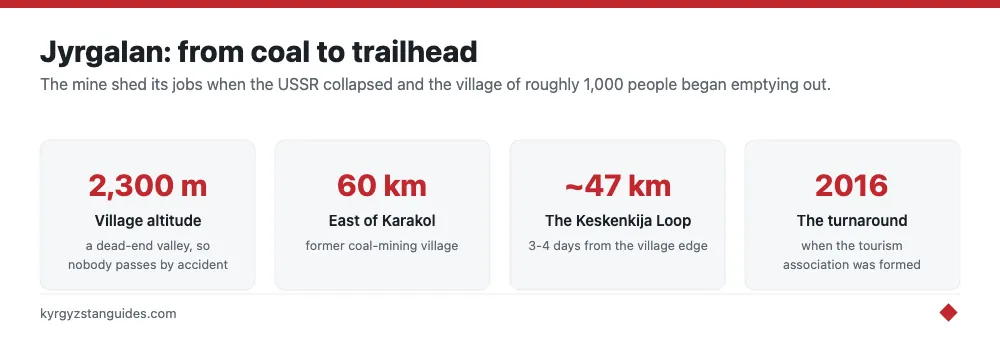
Jyrgalan (also spelled Jyrgalang or Dzhergalan) was built in the Soviet era around a coal mine, and a small pit still works the hillside above the village. When the USSR collapsed, the mine shed most of its jobs and the village of roughly 1,000 people began emptying out. The turnaround came in 2016, when a USAID-backed project helped locals, led by guesthouse owners Emil and Gulmira Ibakov, form the Destination Jyrgalan organization, part of the wider Alakol-Jyrgalan initiative.
The results are unusually concrete: color-coded markers on more than a dozen routes, printed hiking maps, trained guides and horsemen, and a cluster of family guesthouses that run on advance bookings rather than luck. Jyrgalan now appears on itineraries that a decade ago drove straight past the turnoff. Yet visitor numbers remain a fraction of what Ala-Kul absorbs in August. Every valley in Kyrgyzstan is trying to copy this model. None has managed it yet.
The Keskenkija Loop
Jyrgalan’s signature trek is a 3-4 day, roughly 47 km circuit through the ridges south of the village, jailoo pastures, larch-lined gorges, and three passes between 3,200 m and 3,400 m. Unlike the Ala-Kul corridor, you will mostly share the trail with shepherds.
- Day 1: Jyrgalan to the Keskenkija gorge via the Terim Tor Bulak pass (~3,400 m), about 15 km, 6-7 hours, camping by the river
- Day 2: Keskenkija valley over a second pass to the Kok-Bel area — 13-14 km through wildflower meadows and herder camps
- Day 3: Return over the final ridge to Jyrgalan — 15-18 km, or split it into two shorter days with an extra camp
Call it moderate: no scrambling, no glacier, but sustained climbs of 700-900 m a day. You need a tent, stove, and food for the full circuit: no yurt camps sell meals on this loop yet, which is precisely why it still feels wild. Local guides run about 2,500-3,000 KGS ($29-34) per day and pack horses with a horseman 2,000-2,500 KGS per day, both booked through your guesthouse or Destination Jyrgalan. June through September is the window; the passes hold snow into early June. Our Kyrgyzstan trekking guide shows where it sits among the country’s multi-day routes.
Day Hikes You Can Do From the Guesthouse Door
Eki-Chat gorge is the easy half-day: a gentle 12 km round trip south to a jailoo where two streams meet below a wall of firs — about 4 hours at a relaxed pace, 300 m of ascent. Herder families camp there June-August and will often wave you over for kymyz.
Turnaly waterfalls is the classic full day: 15-16 km round trip east up the valley to a pair of falls below the Turnaly ridge, roughly 5-6 hours plus lunch, marked the whole way and doable on horseback (about 1,500-2,000 KGS with a horseman). Go in June for peak snowmelt flow.
Tulpar-Tash, the “winged horse stone” of local legend, is the arrival-afternoon hike: a short, steep 2-hour climb to a rock outcrop with the best panorama of the village, the mine scar, and the wall of 4,000 m peaks behind. Do it first and the map of your next few days draws itself.
Practicalities for all of these: there's no gear shop and no ATM in the village, so bring cash and anything technical from Karakol. Mobile signal covers the village itself but fades fast up the valleys. Download offline maps before you arrive, even though the marked trails make navigation close to foolproof. Guesthouses will pack a lunch if you ask the evening before.
Winter Is the Second High Season
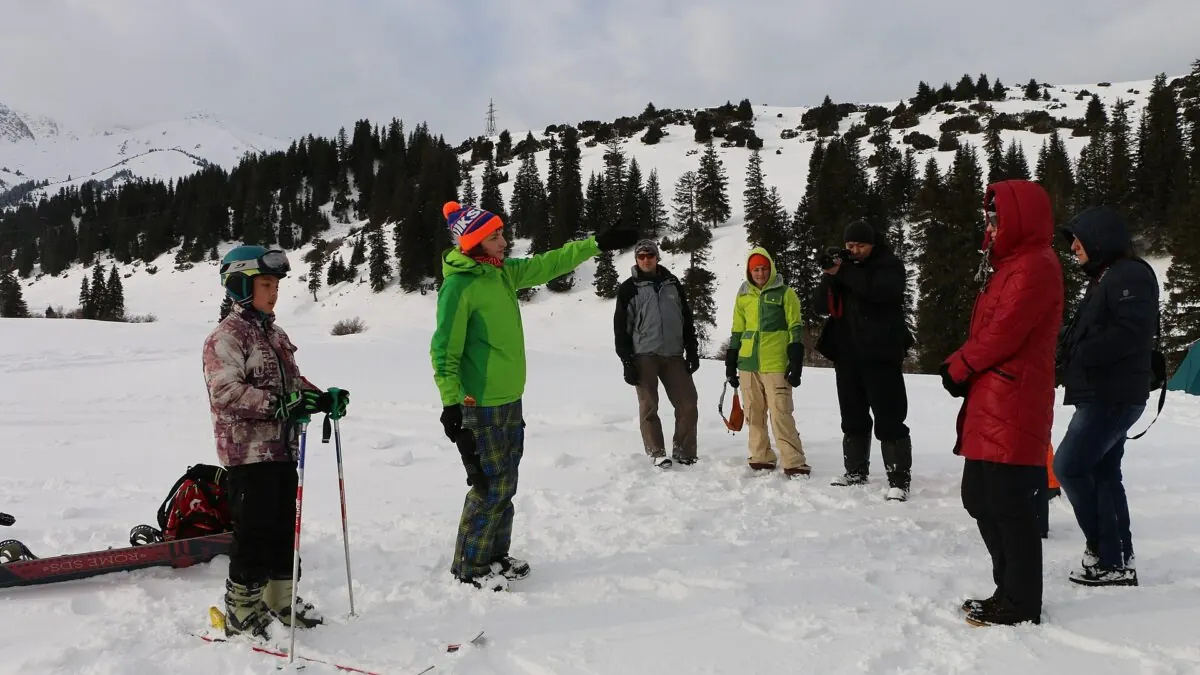
From December to March, Jyrgalan becomes Kyrgyzstan’s most accessible backcountry ski base. The valley sits in a snow pocket that holds dry, continental powder on slopes from 2,500 m to about 3,200 m — ten minutes’ skinning from your guesthouse door. Local operators run guided ski touring and splitboard days for roughly $60-90 per person including guide and avalanche kit, and multi-day freeride packages with banya and full board from around $100-130 per day. Snowshoe trips to the frozen Turnaly falls cover the non-skiers. It pairs naturally with the pistes at Karakol Ski Base, 90 minutes away; our Kyrgyzstan in winter guide handles the combined-trip logistics.
Guesthouses Worth Planning Around
Jyrgalan’s dozen-plus family guesthouses are, plainly, the best village accommodation in the country. A direct product of the destination project’s training. Expect spotless rooms, wood-fired banyas, and enormous home cooking. Alakol Guesthouse, the original, run by Emil and Gulmira, does doubles with half board for around $40-50; the other family places (Ayana, Datka, and more) run $25-40 per double with breakfast and dinners around 400 KGS; summer-only yurt camps on the village edge charge about $20-25 per person with meals. Book ahead for July-August and the February freeride peak via the Destination Jyrgalan website or Booking.com — this isn't a place to gamble on walking in.
Getting There, and When
Marshrutka 380 leaves Karakol’s small bus station (ask for the Ak-Suu direction stand) roughly every 1-2 hours from about 8:30 am, takes an hour on a now fully paved road, and costs 100 KGS. The last one back leaves Jyrgalan around 4-5 pm — confirm with the driver. A taxi runs 1,200-1,500 KGS ($14-17) and any guesthouse can arrange one. From Bishkek, ride the 6-7 hour marshrutka to Karakol first (500-600 KGS) — details in our Karakol travel guide — and overnight there if you arrive late.
Timing is simple to state. June brings green valleys, full waterfalls, and lingering snow on the passes; July and August are warm and stable, with herders on every jailoo — the Keskenkija window. September means golden larches, crisp nights, and trails to yourself; December through March is the powder season at -5 to -15°C. The shoulder months, April, May, October, November, are mud and unstable snowline, and best skipped entirely. If your dates flex, take early September: August conditions, nobody around. Our month-by-month guide lines Jyrgalan up with the rest of a route.
The Verdict: Stay 2-3 Nights or Don’t Bother
Day-tripping Jyrgalan from Karakol misses the point entirely. The village works on a slow rhythm. A warm-up climb to Tulpar-Tash the first afternoon, a full day on the Turnaly trail or horseback, dinner cooked by your hosts, banya, and a kind of quiet you won't find anywhere on the Issyk-Kul shore. Two nights is the minimum to do one proper hike; three lets you add a horse day or do nothing at all, which here is a legitimate activity. Trekkers should budget a night on either side of the Keskenkija Loop. Come for less than that and you have paid the bus fare to look at a trailhead.
FAQ
Is Jyrgalan worth visiting?
If you hike or ski, yes, and if you like empty trails it is the better base than Karakol. The village sits at 2,300 metres in a dead-end valley of the Terskey Ala-Too, so nobody passes through by accident.
How do I get to Jyrgalan from Karakol?
Marshrutka 380, about an hour, for 100 som — roughly $1.15. The village is 60 kilometres east of Karakol.
What hikes start from Jyrgalan?
The three to four day Keskenkija Loop starts at the village edge, and marked day hikes reach the Turnaly waterfalls and the Eki-Chat gorge. It is one of the rare places in Central Asia where trails are actually signposted.
What was Jyrgalan before tourism?
A coal-mining village. Its transition to a trekking and ski destination is one of the more successful community tourism stories in the country, and it is why the guesthouse standard is so much higher than the village's size would suggest.
Is Jyrgalan better than Karakol as a base?
For trails, yes; for restaurants and logistics, no. Karakol has the gear shops, the agencies and the food. Jyrgalan has the empty trails and the signposting, which is the trade-off the choice comes down to.
Can I visit Jyrgalan in winter?
Yes — it is a ski touring and freeride destination as well as a summer trekking one, which is unusual for a Kyrgyz village of its size and is the reason its guesthouses stay open year-round.
The ski season is a different proposition: the village becomes a touring base with no lift and no patrol. The full Jyrgalan winter guide has the posted prices, plus the coal mine underneath the village.