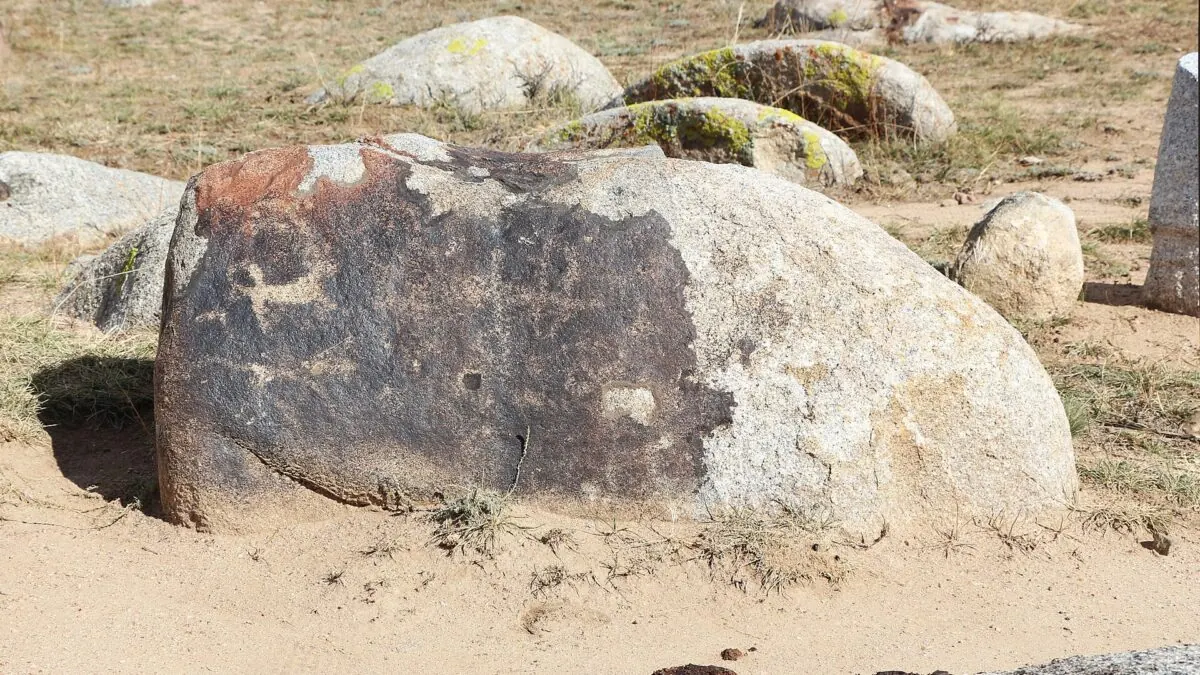
More than 2,000 petroglyphs — some carved almost 3,000 years ago — sit in a boulder field above Cholpon-Ata, and most visitors never leave the beach below. This is Issyk-Kul’s resort capital: a north-shore town 265 km from Bishkek (about 4 hours and 350–400 KGS by marshrutka) with sandy beaches, the Ruh Ordo cultural complex, summer boat trips, and the hippodrome that staged the World Nomad Games.
Come in July–August for 22–24°C water and the full resort circus, or in June and September for the same beaches at half the price. Either way, one or two days covers it: the sights that matter, a swim, and the gorge loop east of town.
Know what you're getting
Issyk-Kul is the world’s second-largest alpine lake — 182 km long, 1,607 m above sea level, slightly saline, never frozen. The Soviet Union built its lakeside sanatoria along this north shore, and Cholpon-Ata was the flagship. Today a town of about 15,000 swells several-fold each summer with families from Bishkek and Almaty, and it's unapologetically a resort: shashlik smoke, banana boats, karaoke. Accept it on those terms and it's good fun. For the wider lake, including the quieter south shore, see our Issyk-Kul travel guide.
The beaches
- Central (city) beach, sandy, gently shelving, 10 minutes’ walk from the main bazaar; free entry, sunbeds about 150–200 KGS a day
- Golden Sands (Zolotye Peski). The long strip east of the center with the clearest water and the most space; paid sections 100–200 KGS
- Resort beaches (Karven Club and the Raduga area west of town): groomed sand and pools; day passes for non-guests typically 500–1,000 KGS
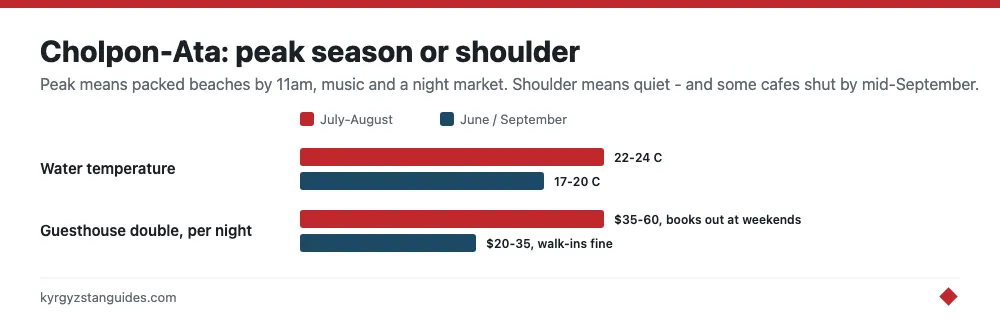
Water peaks at 22–24°C in late July and August; June and September run a brisker 17–20°C. Mornings are calm, and an afternoon breeze reliably kicks up small waves: good for kids, annoying for photographers.
The petroglyphs are the real sight
On the moraine above town sits a 42-hectare open-air museum of glacial boulders carved from the Bronze Age through the Saka-Usun period (roughly 800 BC–300 AD) into the Turkic Middle Ages. Long-horned ibex dominate, alongside snow leopards, hunting scenes, and sun symbols; the biggest panel, a 3-meter boulder of ibex and predators, is signposted near the far end of the marked loop. Entry is about 200 KGS ($2.30), open daylight hours. Go before 10am or after 5pm. There is no shade, and low light makes the carvings far easier to read. Allow 1–1.5 hours, and take the guide at the gate (around 500 KGS): unguided visitors walk past half the best stones.
Ruh Ordo, the hippodrome, and the water
Ruh Ordo (“spiritual center”), named after the writer Chingiz Aitmatov, is a lakeside sculpture park built around five identical white chapels representing five world religions, plus statues of Aitmatov, Manas, and assorted philosophers. Entry is about 600 KGS ($7) with an optional guided tour. It's kitschy, Instagram-oriented, and strangely likeable, with the best lake panorama in town from its promenade. Budget an hour — and if you must choose between this and the petroglyphs, this is the one to drop.
The 10,000-seat hippodrome was built for the first World Nomad Games in 2014 and hosted the 2016 and 2018 editions: kok-boru, er enish horseback wrestling, mounted archery. Outside event weeks you can usually walk in free or for a token fee and sometimes catch training; summer weekends often bring smaller kok-boru matches. Ask at your guesthouse. If your trip lines up with a games year, plan around it: our World Nomad Games guide covers dates and tickets.
From the pier by Ruh Ordo, hour-long cruises run all summer for about 400–600 KGS per person, with swimming stops on calm days; small-boat charters go for 2,500–4,000 KGS an hour, negotiable at the dock. The view is the point — from a kilometer out, the snow line of the Kungey Ala-Too stacks up behind the beach umbrellas.
Peak season or shoulder?
| Factor | July–August | June / September |
|---|---|---|
| Water temperature | 22–24°C | 17–20°C |
| Guesthouse double | $35–60, books out weekends | $20–35, walk-ins fine |
| Beaches | Packed by 11am | Quiet outside weekends |
| Atmosphere | Music, rides, night market | Sleepy; some cafes shut by mid-Sept |
Late June is the sweet spot: swimmable water, everything open, pre-peak prices. See the best time to visit Kyrgyzstan for how lake season fits the trekking calendar.
The gorge day trip everyone should make
Forty minutes east, a dirt road climbs the fir-lined Grigorievka (Chon Ak-Suu) canyon past three small lakes to jailoo pastures with summer yurts, crosses a ridge, and descends the gentler Semenovka valley: whose Kyrchyn gorge hosts the World Nomad Games’ cultural village. A taxi loop with stops costs 2,500–3,500 KGS ($29–40) per car; horse rides at the top run about 500–700 KGS an hour. Half a day is enough, though yurt camps in Grigorievka take overnighters.
Logistics: getting there, sleeping, eating
From Bishkek’s main bus station on Alma-Atinskaya 1/1, marshrutkas leave every 30–60 minutes in summer (about 4 hours, 350–400 KGS); shared taxis do it in 3–3.5 hours at 600–800 KGS a seat. From the east, any Bishkek-bound marshrutka out of Karakol drops you on the main road: about 2.5 hours, 250–300 KGS. In August, book onward seats a day ahead. Most nationalities enter Kyrgyzstan visa-free; if you need one, use the official e-visa portal.
Sleep within 15 minutes’ walk of the central beach — the town strings out for kilometers along the highway, and “lake view” listings can be a 40-minute walk from the water. Family guesthouses in the backstreets north of the bazaar run $20–35 per double with breakfast (look for “комнаты” signs in shoulder season); small hotels near the central beach with A/C cost $40–70 and earn it in August; the Karven- and Raduga-style resorts west of town charge $80–150 with pools and private sand. Food is shashlik-and-plov country: skewers 150–250 KGS, lagman and plov 250–350 KGS at the main-road cafes and the night market, plus smoked chebak from lakeside fish stalls. Carry cash — the Optima and KICB ATMs on the main street take foreign cards but can empty on August weekends, and only the big resorts reliably accept plastic.
Our verdict
Cholpon-Ata earns one full day and a lazy morning: petroglyphs early, beach after lunch, boat at golden hour, gorges the next day. Not worth it if your trip is built around trekking and your time is tight — the south shore is wilder and cheaper, and the mountains do not care about banana boats. But as a decompression stop between Bishkek and Karakol, it does exactly what a beach town should.
FAQ
Is Cholpon-Ata worth visiting?
As Issyk-Kul's resort capital, on its own terms — shashlik smoke, banana boats and karaoke. One or two days covers the sights that matter, a swim and the gorge loop east of town. For quiet, go to the south shore instead.
What are the Cholpon-Ata petroglyphs?
More than 2,000 carvings in a boulder field above the town, some made almost 3,000 years ago. They are the real sight here, and most visitors never leave the beach below.
How do you get to Cholpon-Ata from Bishkek?
About 265 km, roughly four hours by marshrutka for 350-400 KGS.
When is the best time to visit Cholpon-Ata?
July and August for 22-24 °C water and the full resort season, or June and September for the same beaches at about half the price.
Which beach should you use in Cholpon-Ata?
Central beach is sandy, gently shelving and ten minutes from the main bazaar, with free entry and sunbeds around 150-200 KGS. Golden Sands, east of the centre, has the clearest water and the most space, with paid sections at 100-200 KGS.
How big is Cholpon-Ata?
About 15,000 people, swelling several times over each summer with families from Bishkek and Almaty. Issyk-Kul itself is 182 km long at 1,607 m, slightly saline, and never freezes.