Eighty-nine countries sent athletes to the 2024 World Nomad Games in Astana. The first edition, back in 2014, drew nineteen. In one decade, a festival Kyrgyzstan invented to keep its steppe sports alive has grown into the biggest ethnosport event on the planet — and in 2026 it's expected to come home.
The World Nomad Games are a biennial championship of nomadic sports — kok-boru, horseback wrestling, eagle hunting, mounted archery and dozens more — founded by Kyrgyzstan in 2014 and hosted three times at the Cholpon-Ata hippodrome on Lake Issyk-Kul. After Turkey (Iznik, 2022) and Kazakhstan (Astana, 2024), the sixth edition is slated to return to Kyrgyzstan; confirm dates and host on the official channels before booking anything. Here is what to watch, what it costs, why the ethno-village upstages the stadium, and how to see kok-boru in any year at all.
Kok-boru first. Everything else after.
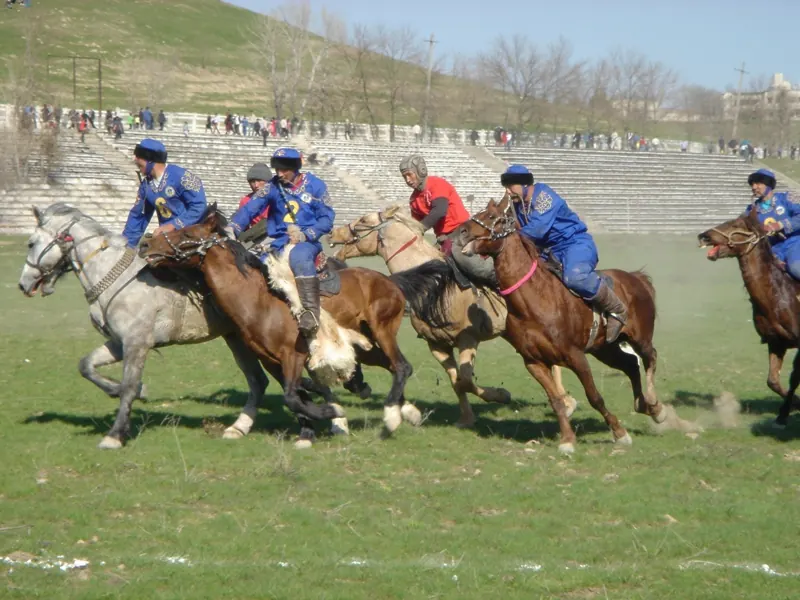
One sport carries the Games, and it isn't a close contest. Kok-boru puts two teams of four riders (rotating from squads of eight or more) into a dust bowl with a 30–35 kg goat carcass, which they wrestle off each other at full gallop and hurl into the opponent’s tai kazan, a raised goal ring. Three 20-minute periods, no padding, no apologies. Kyrgyzstan has won every Games final — usually against Kazakhstan, usually in front of a crowd that makes a football derby sound like a library.
Book your trip around the kok-boru bracket and treat everything else as a bonus. One honest tip: the semifinals deliver the same intensity as the final with far easier seats.
The rest of the program is deep — 20 to 40 disciplines run at once, so no two spectators see the same Games:
- Er enish — wrestling on horseback. Two riders grapple until one hits the ground; bouts can end in seconds.
- Kyz kuumai — “catch the girl.” A man chases a woman at full gallop and tries to kiss her; on the return leg she chases him with a whip and uses it. Once a courtship game, now a crowd favorite the women frequently win.
- Salburun — the hunting arts: golden eagles and taigan hounds working lures, plus horseback falconry and archery. The berkutchi (eagle hunters) of Bokonbaevo dominate.
- At chabysh. Endurance horse races of 10–80 km, ridden bareback, often by teenage jockeys.
- Mas-wrestling. A Yakut tug-of-war over a board with a shared stick. Brutally simple, and one of the fastest-growing federations at the Games.
- Toguz korgool, the cerebral counterweight: a Kyrgyz mancala-family board game with nine-stone pits, played at championship level in dead silence a hundred meters from the kok-boru dust.
- Belt wrestling and archery — dozens of national styles (alysh, kurash, gyulesh), and traditional archery on foot and at full gallop, where Turkish, Hungarian and Kazakh teams push the Kyrgyz hosts hard.
Kyrchyn gorge is the real show
Ask people what they remember from a Cholpon-Ata Games and most don’t say the stadium. They say Kyrchyn: a mountain gorge 30–40 minutes above town in the Semenovka valley, where each Kyrgyz region (plus guest nations) builds an encampment of several hundred yurts. You drift between manaschi reciting the Manas epic, felt-makers rolling wool, komuz orchestras, wedding re-enactments, hunting dogs, and endless free tastings of kymyz and boorsok. Horse games and eagle demonstrations run on the gorge floor all day. In 2018 entry was free.
Budget half a day minimum and carry cash: the craft stalls here are some of the best souvenir shopping in the country, see our souvenir guide for what a fair price looks like. Getting up is easy in a Games year: shuttle buses run from central Cholpon-Ata and the hippodrome, and shared taxis wait at the turnoff (200–400 KGS). The gorge sits near 2,000 m, so an afternoon can flip from t-shirt weather to hail in twenty minutes. Pack a shell even under a blue sky.
Where are the 2026 Games?
Back in Kyrgyzstan, by every current indication, with the Issyk-Kul region the natural venue and September the traditional slot — the 2014–2018 editions all ran in early-to-mid September, when the lake shore is reliably dry and warm. Host announcements and exact dates shift, so verify on the official World Nomad Games site and Kyrgyz Ministry of Culture channels about six months out, then book accommodation immediately: the town sells out fast in a Games year. Our Cholpon-Ata guide covers where to stay and how to get there.
Tickets, beds and getting there
Attending has historically been cheap. At the Cholpon-Ata editions many events and all of Kyrchyn were free; premium seats for the opening ceremony and the kok-boru final sold for roughly 500–2,000 KGS ($6–23), released through the official site and local box offices a few weeks out. The real money goes on a bed. Guesthouses that charge $25–40 in a normal summer can double or triple during the Games, so book two to three months ahead, or stay in Bosteri or Karakol and commute.
From Bishkek, marshrutkas leave Bishkek’s main bus station on Alma-Atinskaya 1/1 for Cholpon-Ata at about 400–500 KGS (4–5 hours); shared taxis run 700–1,000 KGS. Most nationalities enter Kyrgyzstan visa-free for up to 30 days within any 60-day period; everyone else can use the official e-visa portal. For the wider region. Beaches, canyons, the south shore — see our Issyk-Kul travel guide.
No Games this year? Watch anyway
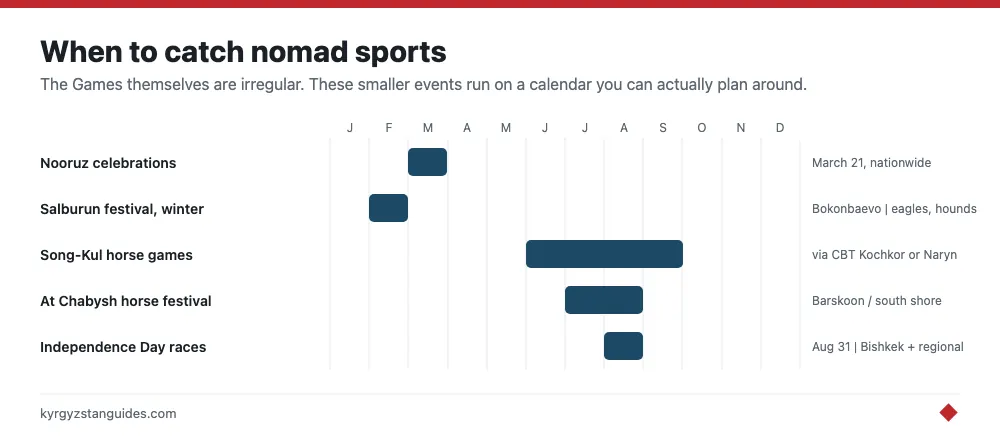
The Games are biennial and sometimes abroad, but Kyrgyzstan stages smaller versions of the same spectacle every single summer:
| Event | Where | When | What you’ll see |
|---|---|---|---|
| At Chabysh horse festival | Barskoon / Issyk-Kul south shore (venue varies) | Usually July–August | Long-distance races, kok-boru, kyz kuumai, crafts |
| Salburun festivals | Bokonbaevo area | Winter (Feb) & summer editions | Eagle hunting, taigan hounds, horseback archery |
| Song-Kul horse games | Song-Kul jailoo, via CBT Kochkor/Naryn | June–September, on request | Kok-boru, er enish, ulak for small groups (3,000–6,000 KGS/group) |
| Independence Day races | Bishkek & regional hippodromes | August 31 | Kok-boru league matches, racing |
| Nooruz celebrations | Nationwide | March 21 | Games, music, sumolok feasts |
The Song-Kul option is the most flexible: and honestly the most atmospheric, since you watch from a grassy slope instead of a grandstand. CBT coordinators can arrange a private kok-boru or horse-games demonstration by local herders with a few days’ notice; details in our Song-Kul guide.
Six things we’d tell a first-timer
- Go to the kok-boru semifinals as well as the final — same intensity, easier seats.
- Give Kyrchyn at least half a day; mornings are quieter for photos.
- Bring sun protection and layers. September at 1,600–2,000 m is hot at noon and cold by evening.
- Carry cash in som — card acceptance at venues and yurt camps is minimal.
- Study the schedule the night before; events shift, and announcements come mostly in Kyrgyz and Russian.
- Tack on the south shore: Skazka canyon and the Bokonbaevo eagle hunters are under two hours away.
One last piece of homework: read our Kyrgyz nomadic culture guide before you go. The Games make far more sense once you know why a tunduk sits on the national flag.
Frequently Asked Questions
When and where are the next World Nomad Games?
The sixth edition is expected in Kyrgyzstan in 2026, most likely in the Issyk-Kul region in early September, following Astana 2024. Hosts and exact dates are confirmed roughly a year out, so check the official World Nomad Games website before booking flights or Cholpon-Ata accommodation.
How much do World Nomad Games tickets cost?
Cheap by international standards. At past Cholpon-Ata editions many events and the Kyrchyn ethno-village were free, while premium seats for the opening ceremony and kok-boru final ran roughly 500–2,000 KGS ($6–23). Accommodation is the real cost — Issyk-Kul guesthouses can double or triple prices during the Games.
Can I see kok-boru and eagle hunting outside the Games?
Yes, every year. The At Chabysh horse festival (usually July–August), winter and summer salburun festivals near Bokonbaevo, Independence Day matches on August 31, and private horse-games demonstrations at Song-Kul arranged through CBT (about 3,000–6,000 KGS per group) all run regardless of the Games calendar.
The women’s side of the same tradition — the elechek, the shökülö and the beldemchi, and what is genuinely still worn — is in Kyrgyz women’s dress.
How many countries compete at the World Nomad Games?
Eighty-nine sent athletes to the 2024 edition in Astana, against nineteen at the first Games in 2014. In a decade it has grown from a Kyrgyz initiative to keep steppe sports alive into the largest ethnosport event in the world.
What sports are at the World Nomad Games besides kok-boru?
Between 20 and 40 disciplines run at once, including er enish (wrestling on horseback), kyz kuumai, salburun hunting arts with golden eagles and taigan hounds, at chabysh endurance races of 10–80 km ridden bareback, mas-wrestling, belt wrestling and traditional archery, plus toguz korgool, a nine-pit board game played in silence.
What is Kyrchyn?
An ethno-village in a gorge 30–40 minutes above Cholpon-Ata in the Semenovka valley, where each Kyrgyz region and guest nations build encampments of several hundred yurts. Manaschi reciting the Manas epic, felt-making, komuz orchestras and eagle demonstrations run all day. In 2018 entry was free, and many visitors remember it more clearly than the stadium.
Has Kyrgyzstan ever lost the kok-boru final?
Not at the World Nomad Games. Kyrgyzstan has won every final, usually against Kazakhstan. A practical tip: the semifinals deliver much the same intensity as the final with far easier seats.