Kyrgyz nomadic culture is the best reason to visit Kyrgyzstan, better than the peaks, better than the lakes, and it isn’t close. Not because it's photogenic (it is), but because it's still a working economy rather than a costume show: every June, tens of thousands of families drive their horses, sheep, and yaks up to high pastures called jailoo, live in felt yurts until September, milk mares for kymyz, and come back down before the October snows.
The most direct way in is a yurt stay on a working jailoo such as Song-Kul or Tash Rabat, arranged through a Community Based Tourism (CBT) office for roughly 1,800-2,500 KGS ($20-28) per person per night including meals. This guide covers what that world actually consists of, the yurt and its felt, the Epic of Manas, eagle hunting, kok-boru, the hospitality code, the layered religious landscape: and how to visit it without turning someone’s home into a photo prop.
Still real. With one caveat
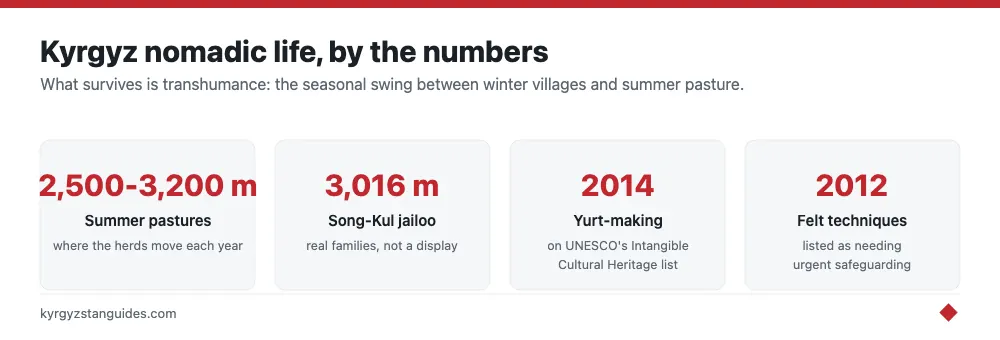
Nobody in Kyrgyzstan is fully nomadic year-round anymore. What survives is transhumance: the seasonal swing between winter villages and summer pastures, typically at 2,500-3,200 meters. Around a quarter of the population works in livestock herding, and the June migration to the jailoo is an economic necessity, not heritage theater. Pastures like Song-Kul (3,016 m), the Suusamyr valley, and the Alay foothills fill each summer with herding camps: real families, real animals, and increasingly a guest yurt or two earning useful extra income. By late September the pastures empty again, the felt comes down, and the high valleys go silent until the following June.
That dual economy is exactly what makes the experience honest. At Song-Kul lake you can sleep ten meters from a family milking mares at dawn: the tourism is layered onto the herding, not the other way around. The shepherds ride out at 6 a.m. whether or not a guest is watching. If your itinerary only allows one cultural experience in the whole country, make it a night up there; a folklore dinner show in a Bishkek restaurant isn't a substitute, and you shouldn't let anyone sell it to you as one.
The yurt, and the felt inside it
The Kyrgyz yurt (boz-üy, “grey house”) is a serious piece of engineering: a collapsible willow lattice wall (kerege), curved roof poles (uuk), and a central wooden crown (tunduk) that works as skylight, chimney, and structural keystone, all wrapped in layers of pressed felt. An experienced family raises one in two to three hours, and the whole house loads onto two horses or one small truck. Interiors follow strict logic: hearth in the center, the honored guest seat (tör) opposite the door, men’s gear on one side, the kitchen on the other. Look at the Kyrgyz flag. A red field, a yellow sun, and inside the sun, the tunduk. In 2014 UNESCO inscribed the craft of making Kyrgyz and Kazakh yurts on its Intangible Cultural Heritage list. To sleep in one, our yurt stay guide covers camps, prices, and what to expect.
Everything soft inside that yurt is felt, and the felt is women’s work of generations. Two carpet techniques dominate: ala-kiyiz, where dyed wool is pressed and rolled directly into the felt in flowing designs, and shyrdak, where contrasting felt layers are cut into mirror-image ornaments, ram’s horns, hooked spirals. And hand-stitched into quilted mosaics. A genuine shyrdak takes weeks to make, traditionally formed part of a bride’s dowry, and lasts decades on the floor. UNESCO placed both techniques on its List of Intangible Cultural Heritage in Need of Urgent Safeguarding in 2012; women’s cooperatives in Kochkor, Bokonbaevo, and Naryn now carry the craft, and a felt-making demonstration in Kochkor costs around 400-600 KGS. Watch one before you buy anything.
Manas: half a million lines, carried by memory
The Epic of Manas is the anchor of Kyrgyz identity: a verse epic of roughly 500,000 lines, about twenty times the Iliad and Odyssey combined, telling how the hero Manas united the forty Kyrgyz tribes. The sun on the flag has forty rays for exactly this reason. UNESCO listed the Manas trilogy in 2013, but the living part is the manaschi: reciters who perform without instruments, rocking and gesturing in a semi-trance, improvising within a memorized framework. Legendary 20th-century manaschi like Sagymbay Orozbakov and Sayakbay Karalaev each carried hundreds of thousands of lines in their heads.
You can hear recitation at cultural festivals, at the Manas Ordo complex near Talas, and at evening performances some Karakol and Bishkek guesthouses arrange. Typically free to 500 KGS. You won't understand a word. It does not matter; the rhythm is electric, and watching a teenager perform a poem older than most nations explains more about this country than any museum.
The epic sits inside a wider oral tradition. The komuz, a three-stringed fretless lute, is the national instrument, and good players perform it behind the head, upside down, and mid-flourish without dropping the melody. Alongside it stand the akyn. Improvising bards who duel in verse at festivals, trading rhymed insults and praise on the spot. If a guesthouse offers a komuz evening, take it; it costs little and beats anything on a stage in the capital.
Eagles, hounds, and the salburun hunt
Hunting with golden eagles (berkut) survives most visibly around Bokonbaevo on Issyk-Kul’s south shore, where a community of berkutchi keeps the tradition alive under the Salburun Federation. Salburun is the broader traditional hunt. Eagles, taigan sighthounds, and horseback archery working together. Winter is the genuine hunting season; summer demonstrations (about 2,500-3,500 KGS per group, bookable via CBT Bokonbaevo) show the training and the bond between hunter and bird.
The ethics come down to who you pay. Traditionally an eagle is taken young, hunted with for eight to ten years, then released back to the wild to breed. A cycle the serious hunters take seriously. A demonstration by a practicing berkutchi family is worth your money. A roadside bird kept permanently tethered for tourist selfies isn't, and every som handed over keeps it there. The CBT-affiliated hunters in Bokonbaevo are the benchmark.
Kok-boru and the games on horseback
Kok-boru, two mounted teams wrestling a 30-plus-kg goat carcass toward a goal, is the national sport and the loudest, dustiest spectacle in Central Asia. There is a professional league, and village matches erupt during autumn festivals and Nooruz (March 21). Around it cluster er enish (horseback wrestling), kyz kuumai (a chase in which the woman whips the man if he fails to catch her), and long-distance races whose jockeys are often children who could ride before they could argue about it. The biggest showcase is the World Nomad Games; between editions, hippodrome matches in Bishkek and village games arranged through CBT (roughly 3,000-6,000 KGS per group at Song-Kul and similar jailoos, June-September) fill the gap. And riding is the other half of the culture, see our horse trekking guide to do it rather than watch it.
The nomad table, the guest, and the layered faith
Nomadic food logic is simple: everything a horse, a sheep, or a mare’s udder can provide. Kymyz. Fermented mare’s milk, lightly fizzy, sour, about 1-2.5% alcohol: is the national drink, best fresh on a jailoo between May and August; roadside sellers on the Suusamyr and Song-Kul routes charge 80-120 KGS a bowl. Kurut, rock-hard dried yogurt balls, is the original travel snack. Celebration food centers on beshbarmak (“five fingers”): boiled meat over hand-cut noodles, with strict etiquette about who receives which cut. The full menu is in our Kyrgyz food guide.
Identity runs through the bloodline as much as the table. Tradition holds that a Kyrgyz should be able to name seven generations of forefathers (the jeti ata) and genealogy (sanjyra) still shapes introductions in rural areas; asking an older host about their tribe and valley of origin isn't rude but a compliment, and can unlock an hour of family history. Hospitality itself is close to sacred: a guest is traditionally seen as sent by God, and refusing tea or bread offends. Expect the seat of honor, endless refills (leave your cup half-full when you're done, or it will be refilled forever) and bread treated with reverence, never placed upside down. Religiously, Kyrgyzstan is Sunni Muslim, but nomadic distance from urban mosques preserved a thick pre-Islamic layer: Tengrist reverence for sky, mountains, and springs, sacred sites (mazars) tied with prayer ribbons, and healing traditions that coexist comfortably with Islam. The deepest cut came from neither faith: Soviet collectivization in the 1930s ended full nomadism, settled families into villages, and folded herds into collective farms. Yet transhumance survived inside the kolkhoz system: which is why jailoo culture rebounded so quickly after 1991 instead of having to be reinvented.
How to see it without spoiling it
The best infrastructure is CBT: a network of local coordinators in Kochkor, Naryn, Bokonbaevo, Karakol, and beyond who place travelers with herding families and keep the money local. Book yurt stays, eagle demonstrations, felt workshops, and horse games a day or two ahead through the regional office. A jailoo yurt stay at Song-Kul, Tash Rabat, or Jyrgalan runs 1,800-2,500 KGS ($20-28) per person with meals, June through September. Come in July or August for full jailoo life, shoulder months for quieter valleys; our guide to the best time to visit Kyrgyzstan breaks it down month by month, and UNESCO’s Intangible Heritage lists give background on the traditions you'll meet.
Then it comes down to manners. Before you duck through a yurt door, know these:
- Accept tea and at least taste what's offered; never refuse bread outright.
- Ask before photographing people, inside yurts especially, a yurt is a home, not a set.
- Do not step on the threshold or point your feet at the hearth.
- Dress modestly in villages; swimwear belongs at Issyk-Kul beaches only.
- Pay fair prices without grinding hosts down — a night’s homestay income matters here.
- Give the kymyz an honest try. Half a bowl, sipped slowly, wins more goodwill than any phrasebook.
The cradle feast that follows a birth, and the cradle itself, are covered in beshik toi.
Much of this is carried in the language itself: see Kyrgyz proverbs, with literal translations and the collections they come from.
The other great family celebration, and the most expensive one after a wedding, is sunnot toi.
FAQ
Is nomadic life in Kyrgyzstan still real?
Yes, and that is the point. Every June tens of thousands of families drive horses, sheep and yaks up to high pastures called jailoo, live in felt yurts until September, milk mares for kymyz, and come back down before the October snows. It is a working economy rather than a costume show.
How do I experience nomadic culture in Kyrgyzstan?
A yurt stay on a working jailoo such as Song-Kul or Tash Rabat, arranged through a Community Based Tourism office for roughly 1,800 to 2,500 som per person per night including meals.
What is a jailoo?
A high summer pasture. Families move up to them in June and stay until September, which is the rhythm the entire pastoral year is built around.
When can I visit a jailoo?
Roughly June to September. Outside that window the families have come down, the yurts are packed away and the pastures are empty, so a jailoo visit in spring or autumn is not a shorter version of the same thing — it is a different and emptier place.
How much does a yurt stay cost?
About 1,800 to 2,500 som, or $20 to $28, per person per night including meals when arranged through a CBT office. That price is fixed and published rather than negotiated.
Is a yurt stay comfortable?
Warm and basic. Expect felt walls, mattresses on the floor, a stove, no plumbing and no electricity beyond solar. The nights are genuinely cold at jailoo altitude even in July, which is the thing most visitors underestimate.