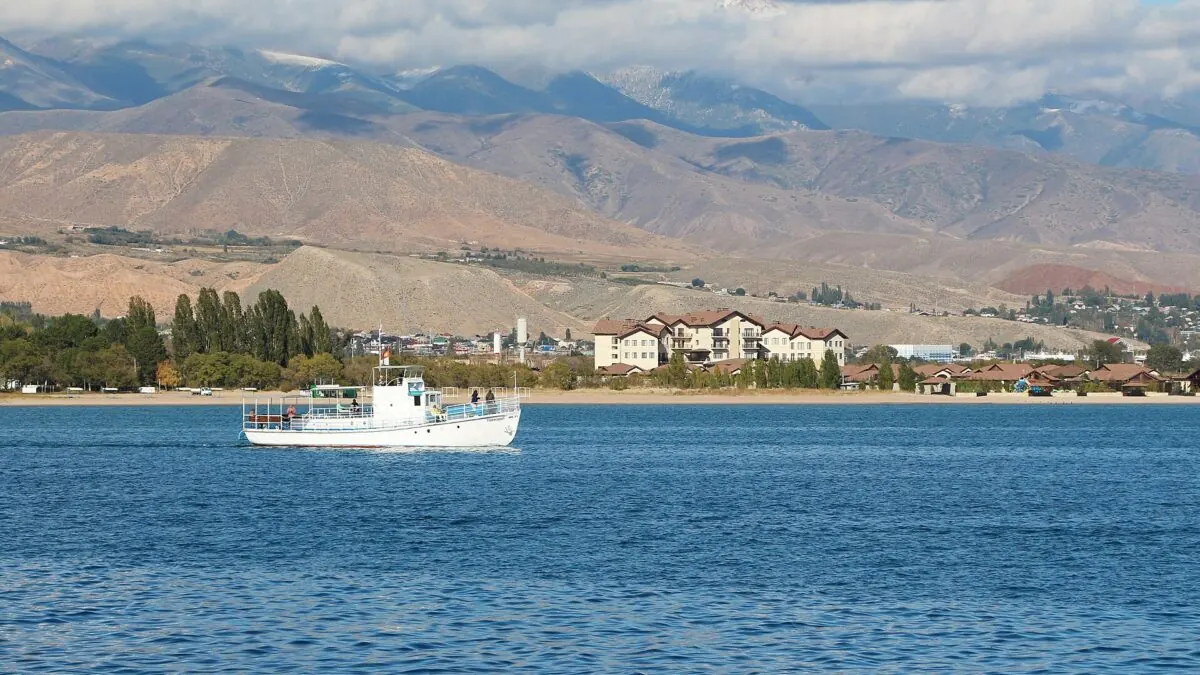
182 kilometers long, up to 668 meters deep, sitting at 1,607 meters in the Tian Shan. And never once frozen in recorded history. Issyk-Kul is the second-largest alpine lake on Earth after Titicaca, mildly saline, geothermally fed (the name means “warm lake”), and split into two very different trips: a resort-lined north shore centered on Cholpon-Ata, and a quiet south shore of canyons, empty beaches, and eagle hunters.
Here is the thing most first-time visitors get backwards: the lake is the summer holiday for much of Central Asia, yet foreign travelers usually just transit the north shore on the way to Karakol. That wastes the best part. The south shore is the Kyrgyzstan you actually came for, this guide covers both sides, the swimming season, a loop itinerary, and the transport to string it together.
The Numbers Behind the Lake
A few more figures frame everything else. The lake stretches up to 60 km wide, ringed by two mountain walls (the Kungey Ala-Too to the north and the Terskey Ala-Too to the south) with 4,000 m ridgelines rising straight off both shores. Salinity runs about 0.6%, enough to keep it ice-free but nowhere near seawater. Swimming season is July-August, when the water hits 19-22°C.
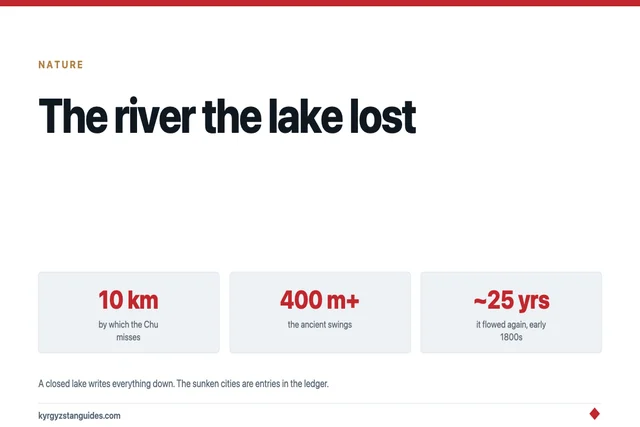
The lake also hides history. Divers have mapped submerged settlements from the Saka era and the medieval Silk Road along the northern shallows, and locals will happily tell you at least three competing legends about drowned cities. What is verifiable is strange enough: a huge, mildly salty sea at altitude that has outlived every empire built on its banks.
North Shore: Beaches, Sanatoriums, Shashlik Smoke
The north shore is the developed side — a 100 km ribbon of sanatoriums, guesthouses, and beach resorts centered on Cholpon-Ata, 4-5 hours from Bishkek. In July and August it fills with Kazakh, Russian, and Kyrgyz holidaymakers; expect loud music, banana boats, and grills working all day. If that sounds like a warning, it half is, but the north shore is worth the money beyond the sand.
The open-air petroglyph field above Cholpon-Ata holds more than 2,000 carvings from the Bronze Age to the Turkic era: ibex, snow leopards, and hunting scenes scratched onto glacial boulders (entry ~200 KGS; go near sunset). Ruh Ordo, a lakeside cultural complex with chapels for five faiths and a Chingiz Aitmatov museum, is kitsch but oddly compelling at ~700 KGS. And the Soviet-era sanatoriums, built like beached ocean liners, are worth a stroll even if you skip the mud treatments.
East of town, two green side-valleys cut north into the Kungey Ala-Too. Grigorievka (Chon Ak-Suu) gorge has a rough road running 30 km past waterfalls to a chain of small alpine lakes, with summer yurts selling kymyz and horse rides along the way; Semenovka is gentler and connects to it by a loop track. A shared taxi from Cholpon-Ata covers both in a half day for about 2,000-2,500 KGS, and it is the best few hours the north shore offers.
South Shore: The Quiet Side
The south shore has almost no resort strip, just villages, red-rock canyons, and long empty beaches backed by the snow line of the Terskey Ala-Too. This is where the lake stops being a beach holiday and becomes a destination.
Bokonbaevo is the center of Kyrgyz salburun (traditional hunting) culture. Demonstrations with golden eagles cost roughly 2,000-3,500 KGS per group, arranged through CBT offices or directly with eagle-hunting families, money that keeps the tradition alive rather than in a museum. The Bel-Tam yurt camp on the beach nearby (~$30 per person with meals) is the south shore’s best sleep: yurts on the sand, peaks across the water.
Then the canyons. Skazka (Fairy Tale) Canyon is a pocket-sized badlands of red hoodoos five minutes off the shore road (entry ~100 KGS). Barskoon gorge stacks waterfalls beneath fir forest, plus two Yuri Gagarin monuments as a Soviet-era bonus. Tamga, an old Soviet military-resort village, has a laid-back beach and carved Buddhist inscription stones in the hills behind. All three chain into a single driving day, and none of them will be crowded.
When Can You Actually Swim?
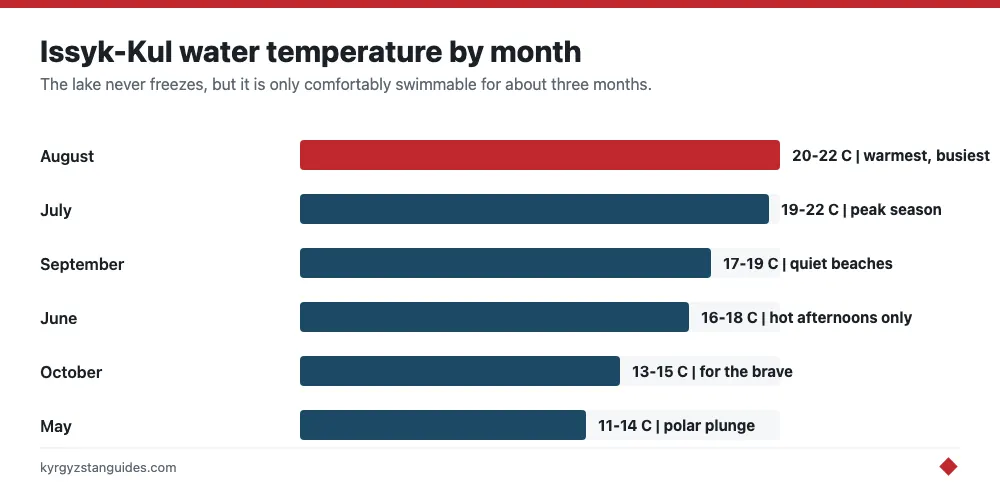
Mid-June to early September, with July and August the only reliably warm months. The lake never freezes, but “never frozen” is not the same as “warm”. Spring water is bracing, and locals treat May dips as endurance sport.
| Month | Water temperature | Verdict |
|---|---|---|
| May | 11-14°C | Polar-plunge territory |
| June | 16-18°C | Swimmable on hot afternoons |
| July | 19-22°C | Peak season. Best swimming |
| August | 20-22°C | Warmest water, biggest crowds |
| September | 17-19°C | Quiet beaches, still pleasant early in the month |
| October | 13-15°C | For the brave; hotels near-empty |
Beach quality varies more than temperature does. Cholpon-Ata’s central beaches are sandy but packed and charge 50-100 KGS for loungers; the strands east of Bosteri are wider and calmer. On the south shore, the beaches at Tamga, Tosor, and beside the Bel-Tam yurt camp are often completely empty — pebbly in places, but with the Terskey snow peaks straight across the water. For the wider weather picture, see our guide to the best time to visit Kyrgyzstan.
The Loop: 3-4 Days Around 440 km of Shoreline
Day one: Bishkek to Cholpon-Ata for a beach afternoon and the petroglyphs at sunset. Day two: continue to Karakol for the Dungan Mosque, cathedral, and an ashlan-fu lunch. Days three and four: the south shore — Jeti-Oguz, Barskoon waterfall, Skazka canyon, an eagle-hunting demonstration near Bokonbaevo, and a yurt-camp night: before returning to Bishkek.
With two spare days, detour to Song-Kul via Kochkor on the way back; our Song-Kul lake guide explains how. The whole circuit slots neatly into our one-week Kyrgyzstan itinerary. If you have to cut something, cut a north-shore beach day, not a south-shore one.
A note on pacing: the loop looks short on a map and isn’t. The south-shore road is slower than the north’s, every canyon stop eats more time than planned, and the eagle demonstrations run on the family’s schedule, not yours. Three days means constant motion; four is comfortable; five lets you add a Grigorievka half-day and an unhurried yurt night. Drivers quote the full circle from Bishkek as a two-day sprint. Decline it. You would see the lake mostly through a windshield.
Transport, Timed Right
From Bishkek’s main bus station on Alma-Atinskaya 1/1, marshrutkas run all day to Cholpon-Ata (~400-450 KGS, 4-5 hours) and Karakol (500-600 KGS, 6-7 hours); shared taxis cost about double and save an hour or two. Along the shores, short-hop marshrutkas connect villages for 50-150 KGS, but they thin out on the south side. Locals hitchhike, and a small payment to the driver is customary. A hired car with driver costs $60-90 per day and is the practical way to string the south-shore sights together; self-drive rentals from Bishkek run $50-80 per day. There are no scheduled passenger boats, and the old Balykchy rail line carries only a slow summer tourist train.
Two timing notes that save real pain. First, the last marshrutkas back to Bishkek leave Karakol and Cholpon-Ata by late afternoon. Plan your final day around that or budget for a taxi. Second, on summer Sundays the Bishkek-bound road jams with returning weekenders; travel the loop clockwise and you dodge the worst of it. Most nationalities enter Kyrgyzstan visa-free for 30 days within any 60-day period; if yours doesn’t, apply through the official e-visa portal before you travel.
Sleeping and Spending
- Cholpon-Ata: beach resorts and sanatoriums $40-90; guesthouses $25-40. Book ahead for July-August
- Karakol: the best-value base for the east end, guesthouse doubles $25-40
- Tamga / Tosor (south shore): family guesthouses $20-35 including dinner
- Bokonbaevo area: Bel-Tam beach yurt camp, ~$30 per person with meals
Daily costs around the lake mirror the rest of the country: $30-40 per day covers a guesthouse bed, three cafe meals, marshrutka hops, and an entry fee or two, while $70-90 buys a resort room or a private driver. The one genuine trap is July-August Cholpon-Ata, where beachfront rooms triple in price and are still worse value than a south-shore guesthouse. If your dates are flexible, the first half of September buys the same lake with half the people and two-thirds the prices.
Is the Lake Worth It Outside Summer?
For swimming, no. For everything else, September is arguably the best month on the water — warm days, empty beaches, golden poplars along the shore roads — and the south-shore canyons are good from May clear through October, when low sun makes the red rock glow. Even winter has a case: the lake never freezes, so you get steam rising off open water against snowbound peaks, and a lakeside stop pairs naturally with ski days at Karakol Ski Base an hour up the road. What does not work is April and early May, when the beaches are windblown, half the guesthouses are shut, and the mountains are still too snowbound to compensate. Match your dates to what you want from the lake, not the other way around.
The same properties that make the lake pleasant — deep, unfrozen, closed, slightly saline — are why the Soviet Union chose it for torpedo testing in 1943, at a facility still operating under a Russian lease.
Frequently Asked Questions
Can you swim in Issyk-Kul lake?
Yes — Issyk-Kul is mildly saline, clean, and swimmable from mid-June to early September. July and August are best, with water at 19-22°C. The lake never freezes, but outside summer it's genuinely cold; locals treat May and October dips as endurance sport.
Which is better, the north or south shore of Issyk-Kul?
North shore for beaches, resorts, and nightlife around Cholpon-Ata; south shore for scenery, eagle hunters, Skazka canyon, and yurt camps with hardly any crowds. With 3-4 days, do both as a loop, they're different trips that happen to share a lake.
How do you get to Issyk-Kul from Bishkek?
Marshrutkas leave Bishkek’s main bus station on Alma-Atinskaya 1/1 throughout the day: about 400-450 KGS and 4-5 hours to Cholpon-Ata, or 500-600 KGS and 6-7 hours to Karakol. Shared taxis cost roughly double and run faster. A private car with driver costs $60-90 per day.
One thing older guidance gets wrong. Bishkek’s Western Bus Station (Zapadnyi Avtovokzal) and the “Akzhol” mini-station both closed on 23 October 2024. Services moved to the municipal Bishkek Bus Station, which had opened that January: east-direction routes — Issyk-Kul, Karakol, Kochkor, Naryn — now leave from Alma-Atinskaya 1/1, and west-direction routes, including Osh and Talas, from Frunze 209. Any source still sending you to the Western Bus Station is out of date.
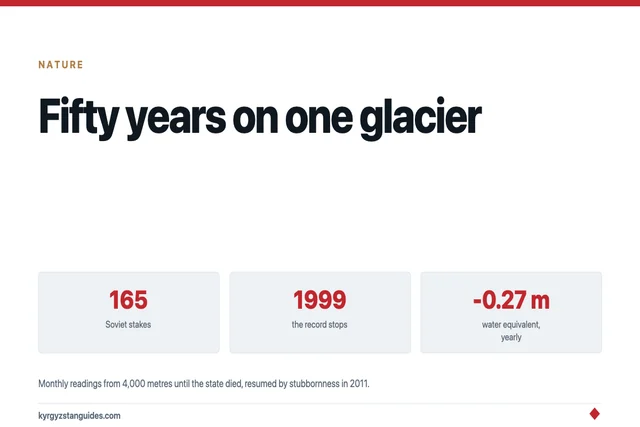
Further west along the same shore, Chon-Kyzyl-Suu holds a research station that has measured this range continuously since 1948.
Is Issyk-Kul salty?
Mildly - about 0.6 per cent salinity, enough to keep the lake ice-free through winter but nowhere near seawater. The name means "warm lake", and it has never frozen in recorded history despite sitting at 1,607 metres.
What is there to see on the north shore besides beaches?
The open-air petroglyph field above Cholpon-Ata, with more than 2,000 carvings from the Bronze Age to the Turkic era (about 200 som, best near sunset); the Ruh Ordo cultural complex at about 700 som; and the Grigorievka and Semenovka gorges, which a shared taxi covers in a half day for 2,000-2,500 som.
How many days does the Issyk-Kul loop take?
Three to four days for the full 440 km of shoreline: Bishkek to Cholpon-Ata, on to Karakol, then the south shore - Jeti-Oguz, Barskoon, Skazka canyon and an eagle-hunting demonstration near Bokonbaevo - before returning to Bishkek.