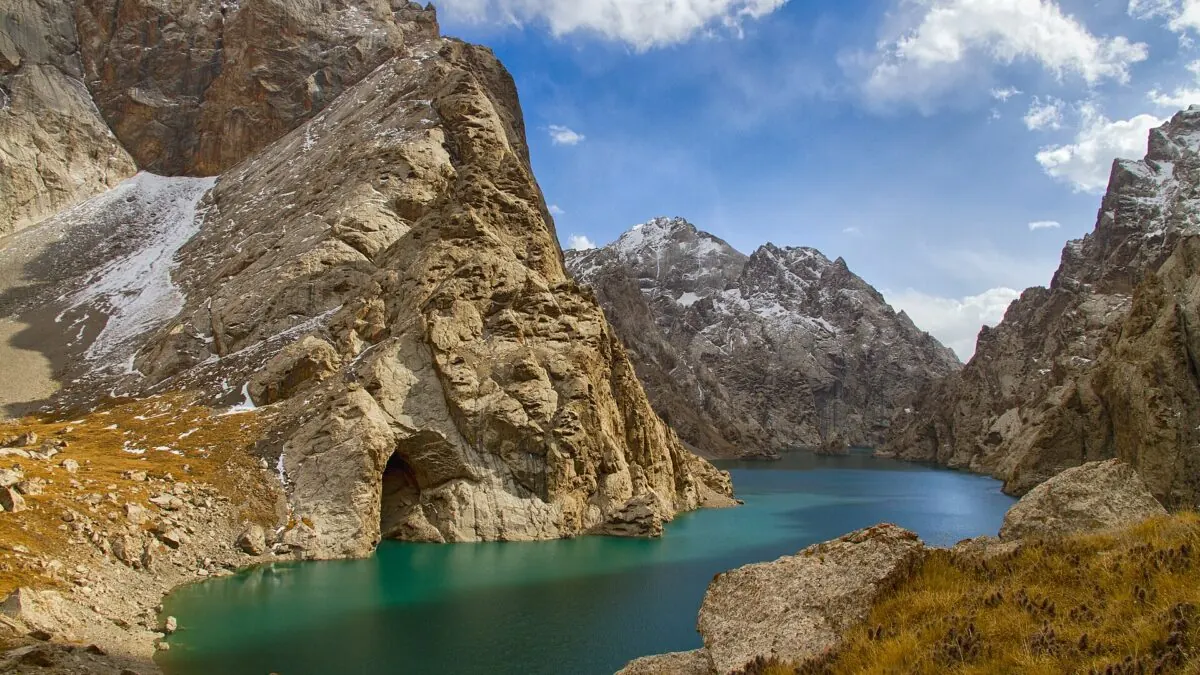
You can't visit Kel-Suu without a border-zone permit. The statutory processing time is four working days and the state duty is 250 som, though agencies quote six to ten working days and advise a fortnight; most visitors arrange it through a tour operator or CBT Naryn — sort that first, and everything else about the trip falls into place. Kel-Suu is a canyon lake at 3,500 m near the Chinese border in the Naryn region, reached by 4×4 via Naryn and the Kok-Kiya valley and then a 10-12 km hike or horse ride, with a season that runs mid-June to September. When the water is high, boats thread the flooded canyon between sheer rock walls; when it's low, the lake may have partly drained itself through the floor.
That combination, the hardest access in the country and one of its most dramatic payoffs. Is the whole Kel-Suu proposition. You'll likely see more marmots than people. Here is the permit, the timing, the route, the costs, and the honest odds on that boat trip.
The Permit Comes First
Kel-Suu lies inside a restricted border zone along the frontier with China. The permit isn't optional, can't be bought at the checkpoint on the day, and is checked (with your passport) at the border-zone control post on the way in.
- Apply 2-4 weeks ahead, processing is not instant
- Go through a tour operator or CBT Naryn, who submit the application for you
- Provide passport details (sometimes a scan) for every traveler in the group
- Carry the physical passport on the trip itself
Since an operator or CBT has to handle the paperwork anyway, most travelers book the whole thing, permit, 4×4, and yurt camp, as one package, and that is our recommendation too. What you shouldn't do is turn up in Naryn expecting to leave the next morning. The paperwork doesn't care about your schedule.
A Short Season at 3,500 Meters
The window is mid-June to September. Outside it, the tracks are snowbound and the yurt camps are packed away. July and August are the most reliable months, but reliability is relative up here: at 3,500 m it can be cold, windy, and snowing in any month you can name, so bring real layers. Our Kyrgyzstan packing list covers what actually belongs in the bag. To line Kel-Suu up with the rest of a route, start with the best time to visit Kyrgyzstan.
The Drive: Naryn, At-Bashy, and the Kok-Kiya Valley
Naryn, the regional capital on the old Silk Road, is the staging post, stock up on cash, snacks, and anything you forgot here, because it's the last town of any size you'll see. From there the route runs south through At-Bashy and into the remote Kok-Kiya valley on rough, unpaved tracks that demand a genuine 4×4 and a driver who knows the river crossings, roughly 5-7 hours to the yurt camps depending on conditions. Early-season trips can lose an hour or more to swollen rivers; late-season ones gain it back on firmer ground.
This is high, empty, treeless country: rolling jailoo pasture, grazing yaks and horses, and almost no permanent settlement. There is no fuel, no shop, and no mobile signal for much of the way: which isn't a flaw in the trip but the substance of it, and one more reason to travel with an experienced operator rather than a rented Prado and optimism.
Yurt Camps and What the Trip Costs
You don't sleep at the lake; you sleep at seasonal yurt camps in the Kok-Kiya valley, a 10-12 km approach short of it. The camps run only in summer and offer the real, unpolished version of nomad hospitality, felt mats and blankets, home cooking, and a wood or dung stove doing battle with the night temperatures. There is no electricity beyond a solar panel and a car battery, no showers, and dinner is whatever the family cooked, which is usually better than it has any right to be at this altitude. Our yurt stay guide sets expectations properly.
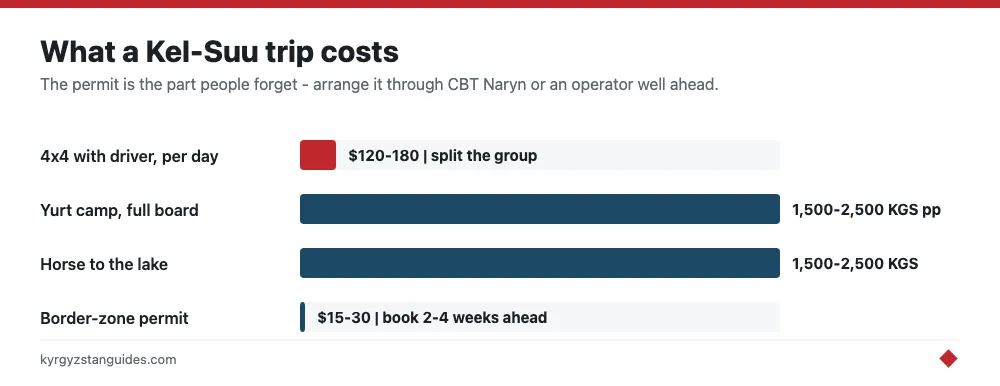
| Item | Approx cost (2026) | Notes |
|---|---|---|
| Border-zone permit | $15-30 / person | Via operator or CBT Naryn, 2-4 wks ahead |
| Yurt camp, full board | 1,500-2,500 KGS/person/night | Meals included |
| 4×4 hire with driver (from Naryn) | $120-180 / day | Split between the group |
| Horse to the lake and back | 1,500-2,500 KGS | Popular alternative to walking |
Add it up and Kel-Suu is not cheap by Kyrgyz standards — the permit, the vehicle, and the distance see to that. The single biggest lever is the group: a 4×4 split four ways turns an expensive trip into a reasonable one. Budget for two to three nights of full board, the driver for the duration, and horse hire if you would rather ride than walk. For where this sits in a whole-trip budget, see our Kyrgyzstan travel budget.
The Last 10-12 km: Walk It or Ride It
From the camps, the lake is a further 10-12 km each way. On foot, allow 3-4 hours in each direction over uneven ground at altitude. Flat on the map, never flat underfoot. On horseback, the camps arrange it for around 1,500-2,500 KGS, and it is the better choice for most people at this elevation; if you enjoy the saddle, our horse trekking guide will make the case for more. Some operators shave distance off by driving partway when the track allows. Either way, the reveal earns the effort: the valley pinches, the canyon opens, and the water appears hemmed in by vertical rock, a fjord dropped into the middle of dry Central Asia.
The Boat Trip Nobody Can Promise You
The signature Kel-Suu experience is a boat ride deeper into the flooded canyon, where the water threads between cliffs too steep to walk. Here is the caveat that should shape your expectations: Kel-Suu drains through a natural siphon in its rock basin, an underground channel that can empty the lake dramatically, sometimes within days. Full lake, hard to forget ride. Drained lake, shrunken water and no boats at all. Recent-year patterns are no guide either, the siphon answers to snowmelt, rainfall, and geology nobody has fully mapped.
No operator can guarantee the level on your dates, and anyone who does is selling you weather. Treat the boat as a bonus, not the point, the canyon amphitheater is spectacular from the shore regardless, and the drained version has its own strange appeal, like being shown the plumbing of a mountain range.
Pair It with Tash-Rabat
You're already organizing a 4×4 and border-region permits, so use them twice. Tash-Rabat, the beautifully preserved stone caravanserai on the old route toward the Torugart Pass, sits off the same corridor south of Naryn, and a loop threading Naryn, Tash-Rabat, and Kel-Suu over three to five days is the standard play — the best-value way to see Kyrgyzstan’s far south-east in one push. Continuing to China? Check the border crossings guide, and confirm your own entry situation on the official Kyrgyz e-visa portal.
Frequently Asked Questions
Do you need a permit for Kel-Suu Lake?
Yes. Kel-Suu sits in a restricted border zone next to China, so you need a border-zone permit. Arrange it 2-4 weeks in advance through a tour operator or CBT Naryn, who need your passport details to apply. Without the permit you will be turned back at the checkpoint.
How do you get to Kel-Suu Lake?
Drive from Naryn south through At-Bashy into the Kok-Kiya valley by 4×4: roughly 5-7 hours on rough tracks to the yurt camps. From the camps it's a further 10-12 km on foot or horseback to reach the lake itself. There is no public transport; you need a hired vehicle or tour.
What is the best time to visit Kel-Suu?
Mid-June to September is the only realistic window. The high passes and tracks are snowbound outside this period, and the yurt camps only operate in summer. July and August are the safest bet for weather, though even then it can be cold and snow is possible at 3,500 m.
Why does Kel-Suu Lake sometimes disappear?
Kel-Suu drains through an underground siphon in its rock basin, so its water level swings dramatically and it can partly empty within days. When it's full, boat trips through the flooded canyon are the highlight; when it's low, the lake shrinks and boats may not run. Levels are unpredictable.
Get the permit right and everything after it's just a long, beautiful drive.
How long does the Kel-Suu permit take?
The statutory processing time is four working days with a 250 som duty, but agencies quote six to ten working days and advise allowing a fortnight. Apply two to four weeks ahead through a tour operator or CBT Naryn - it cannot be bought at the checkpoint on the day, and it is checked with your passport at the border-zone post.
Will the boats be running on Kel-Suu?
Only when the water is high enough to flood the canyon - and some years the lake partly drains itself through its floor. Treat the boat trip as a possibility rather than a promise; the drive, the Kok-Kiya valley and the lake itself are the dependable parts of the trip.