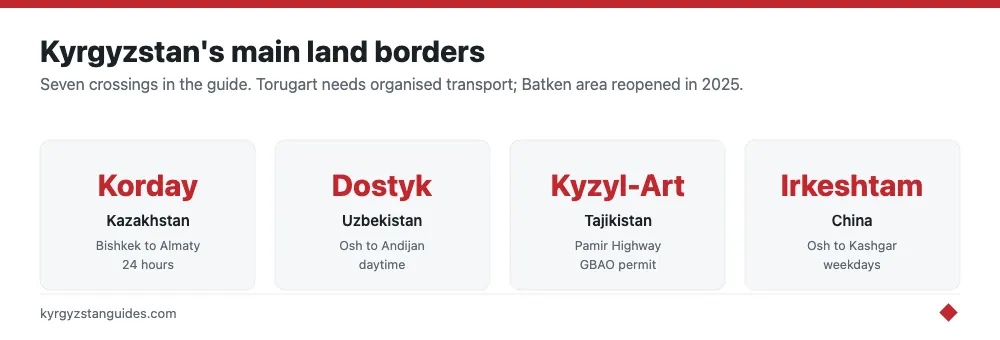
Kyrgyzstan has working land borders with all four of its neighbors in 2026: Kazakhstan at Korday (the Bishkek–Almaty run, 4-5 hours door to door), Uzbekistan at Dostyk near Osh, Tajikistan over the Pamir Highway’s Kyzyl-Art pass, and China at Torugart or Irkeshtam. Most nationalities covered by Kyrgyzstan’s visa-free regime (30 days within any 60-day period) or its e-visa can use any of them, and at the big crossings the process is a plain walk-across: stamp out, cross no-man’s-land on foot or by shuttle, stamp in.
The catch is that Central Asian borders change status more often than almost anywhere else on the planet. Crossings close for national holidays, weekends, weather, or politics with little notice, and a months-old blog post (this one included) is not a source of truth. Below: how each border actually works, what transport looks like on both sides, what it costs, and how to confirm a crossing is open before you commit to a six-hour taxi ride toward it.
Kazakhstan: Korday, the workhorse
Korday sits about 20 km north of Bishkek and handles more travelers than every other crossing combined. It links the capital with Almaty, roughly 235 km away, efficiently enough that the whole journey, including the border, takes 4-5 hours.
The mechanics: direct minibuses and shared taxis leave Bishkek’s main bus station on Alma-Atinskaya 1/1 from early morning (around 1,500-2,000 KGS / $17-23 for a shared taxi seat, less by bus). At the border everyone gets out with their bags, walks through the Kyrgyz hall, crosses the bridge over the Chu River, and queues again on the Kazakh side. Bags through an X-ray at both ends, questions rare. Twenty to sixty minutes is normal; Friday evenings and holiday weekends can triple that. Onward transport waits on the far side, and coming the other way it leaves from Almaty’s Sayran station. Korday is open 24 hours, which is the cheat code: cross before 8 a.m. or late at night and you can be through in fifteen minutes.
Two quieter alternatives exist for drivers and cyclists who want to skip the scrum: Ak-Tilek/Karasu east of Bishkek and Chaldovar to the west. Both are daytime-only and see so little foreign traffic that guards may photograph your passport out of novelty, but they work.
Two details trip people up at Korday. The clock: Kyrgyzstan runs an hour ahead of Kazakhstan, so you gain an hour heading to Almaty and lose it coming back. And phones sometimes latch onto the wrong network’s time in the border zone, which has cost more than one traveler a bus. And your own vehicle: drivers cross with temporary import paperwork and must buy local third-party insurance on the far side; the vehicle queue moves on a completely different (slower) rhythm than foot traffic, so overlanders should budget half a day where walkers budget an hour.
Uzbekistan: Dostyk and the Fergana Valley
The main Kyrgyzstan–Uzbekistan crossing is Dostyk, just 5 km from central Osh at the eastern lip of the Fergana Valley. A taxi from the Osh Bazaar area to the border runs about 200-300 KGS ($2-3.50). The walk-across usually takes 30-45 minutes total, after which shared taxis run to Andijan in about an hour, and from Andijan, trains and taxis fan out to Fergana city, Margilan’s silk workshops, and on to Tashkent. Leave Osh in the morning and you can be eating plov in Fergana by mid-afternoon.
Dostyk is generally open daily in daylight hours and is straightforward in both directions. One quirk deserves respect: Uzbek customs occasionally asks about medications, because codeine-based painkillers and some sleeping pills are controlled substances in Uzbekistan — keep prescriptions with the packaging. If Dostyk is jammed or closed, Uchkurgan in the north serves Namangan, but Dostyk has the most reliable hours and the best transport on both sides.
Tajikistan: high road or low road
Kyzyl-Art pass, the Pamir Highway
The classic: the Pamir Highway from Osh to Murghab and Khorog crosses at Kyzyl-Art, a 4,280 m pass south of Sary-Tash, and it's one of the most remote border crossings in Central Asia. The two posts sit roughly 20 km apart with nothing between them: no facilities, no money changers, no phone signal, and virtually no independent transport. Nearly everyone crosses in a pre-arranged 4WD booked in Osh; budget $150-250 per vehicle to Murghab, split between passengers. Paperwork is the other hurdle: you need a Tajik visa or e-visa plus a GBAO permit for the Pamir region, both arranged in advance (the e-visa system lets you add the permit at application). The pass can close after snowfall even in July, and its open-to-foreigners status has flip-flopped in recent years: verify both directions before setting off. Many travelers stage the trip around the Pik Lenin base camp trek from Tulpar-Kul, which sits conveniently on the way. Do not plan to sleep at the pass itself: 4,280 m with no acclimatization is a miserable, occasionally dangerous night.
The Batken crossings
The low-altitude route: the crossings in the Batken region (Kairagach/Guliston and others near Isfara) connect southwestern Kyrgyzstan with northern Tajikistan and Khujand. This border saw armed clashes in 2021 and 2022 and was fully closed for years afterwards. The landmark delimitation agreement signed in 2025 reopened crossings and restored transport links, but the détente is recent — check the current status and your government’s advice for the Batken region before routing through, and read our Kyrgyzstan safety guide for the wider context. When open, this is the sane way to reach Khujand and northern Tajikistan without a 4,000 m pass.
For the region itself, our Batken guide explains how a treaty finally settled the border line in March 2025, and deals with the oblast capital and the 2022 shelling. West of Batken in the same region is Sulukta, a coal town mining 600 metres beneath its own houses, with a narrow-gauge railway running into Tajikistan.
China: Torugart vs Irkeshtam
Both crossings lead into Xinjiang and funnel toward Kashgar, but they operate under completely different rules, and picking the wrong one costs real money.
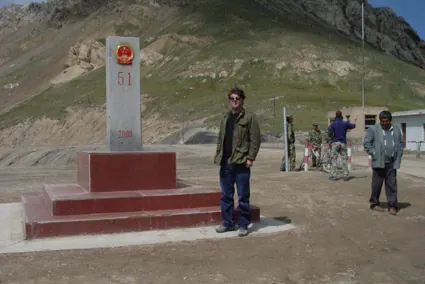
Torugart (3,752 m), south of Naryn past the Tash-Rabat caravanserai, is a “Class 2” port, and the standard advice from operators is that foreigners may only cross with pre-arranged transport and paperwork organized by a licensed agency on the Chinese side, booked days or weeks ahead (no official source sets this out; see below). Expect $200-350 for the vehicle-and-permit package. It's the scenic, historic route, you retrace a Silk Road artery past a 15th-century caravanserai, but it's bureaucracy on wheels. Skip it unless the romance of the route itself is the point, or a tour is already paying for it.
Irkeshtam, at the end of the road past Sary-Tash, is the independent traveler’s choice: no special permit needed beyond a valid Chinese visa. Take a shared taxi or arranged car from Osh to the border (about 250 km), walk or shuttle through the long no-man’s-land, then board the Chinese-side transfer to the customs post at Ulugqat (operators generally describe it as compulsory) and onward transport to Kashgar. One scheduling rule is firm: both Chinese crossings close for Chinese public holidays. Weekend closures and China-side lunch breaks of an hour or two are also widely quoted for both, but the Chinese side of Irkeshtam has run 24 hours since June 2025 (see below), so confirm the hours for your date. Start early, carry snacks, and do not bank on a Friday-afternoon arrival — if a weekend closure does apply, missing the window means sleeping in Sary-Tash until Monday.
Every crossing at a glance
| Crossing | Connects | Hours | Best for |
|---|---|---|---|
| Korday | Bishkek ↔ Almaty (Kazakhstan) | 24 hours | Everyone; fastest route in/out |
| Ak-Tilek / Karasu | Bishkek ↔ southeast Kazakhstan | Daytime | Drivers, cyclists avoiding queues |
| Dostyk | Osh ↔ Andijan (Uzbekistan) | Daytime, daily | Fergana Valley, Tashkent |
| Kyzyl-Art | Sary-Tash ↔ Murghab (Tajikistan) | Day, seasonal | Pamir Highway trips (GBAO permit) |
| Batken area | Batken ↔ Isfara/Khujand (Tajikistan) | Check status | Northern Tajikistan (reopened 2025) |
| Torugart | Naryn ↔ Kashgar (China) | Not 24-hour; check | Organized tours with permits |
| Irkeshtam | Osh ↔ Kashgar (China) | Chinese side 24 hours since June 2025; check | Independent travelers to China |
Rules that apply at every land border
- Cross early and midweek. Queues peak Friday through Sunday and before public holidays in any of the five countries involved — and Central Asia has a lot of public holidays.
- Expect a no-man’s-land gap. At Kyzyl-Art and Irkeshtam the posts sit many kilometers apart; a shuttle or your arranged vehicle covers it, and you cannot always walk.
- Change only survival money at the border. The changers at Korday and Dostyk offer mediocre rates, swap enough for a taxi and do the rest in the next city. Small, crisp USD bills are the universal backup everywhere.
- Confirm your visa works for land entry. Kyrgyzstan’s e-visa is valid at major land crossings, but check your named entry point when applying; Uzbek and Tajik e-visas have historically listed approved crossings too.
- Get the stamp. Make sure you actually receive an entry stamp, a missing one is a serious headache at exit, solvable only with time and patience you’d rather spend elsewhere.
- Carry snacks and water. Remote posts have zero services, and one-to-two-hour lunch closures are standard.
How do you check a border is actually open?
Not from an advisory page updated quarterly, and not from this article. The single best resource is Caravanistan’s border pages and forum, where travelers post first-hand reports weekly. Cross-check with your embassy’s advice for the Batken and GBAO areas specifically, then ask your guesthouse or the nearest CBT office, locals typically know within a day when a crossing’s rules change, long before any website does. Once you’re inside the country, our getting around Kyrgyzstan guide covers the marshrutka, shared-taxi, and domestic-flight network that connects to every one of these borders.
Torugart is also the crossing the China-Kyrgyzstan-Uzbekistan railway is being built through. Construction does not change the rules for travellers, and a border zone with a major project inside it is not becoming easier to enter.
Which crossings foreigners may actually use
The distinction that matters, and that trips people repeatedly, is between bilateral and multilateral crossings. A bilateral post is open only to citizens of the two countries it joins. A multilateral one takes third-country nationals. They look identical from the road.
A worked example from the Uzbek border makes it concrete: Mingtepa/Kara-Bagysh is bilateral — the two countries' citizens only, on foot, daytime hours. Khanabad/Bek-Abad is multilateral, open to third-country nationals and running 24 hours.
This catches people out when a crossing extends its hours. In the 2026 summer season, from 20 May to 1 October, the Kadamjai, Chechme and Ak-Kyya posts in Batken region moved to round-the-clock operation — but explicitly only for Kyrgyz and Uzbek citizens. For everyone else the procedure was unchanged and international checkpoints remained the only option. A headline about a border opening 24/7 may not be about you.
Karkyra: seasonal, and the 24-hour question is unsettled
The Karkyra crossing in Tyup district, opposite Kazakhstan's Kegen, is the short way between Karakol and Almaty, and its status is genuinely muddled.
Historically it has been seasonal, processing passengers from May to October, closing on 31 October and reopening on 1 May. In the 2026 season it ran extended summer hours from 21 July to 31 August, 08:00 to 21:00 Bishkek time, up from a 17:00 close.
On whether it is now permanently 24-hour, the sources genuinely conflict. Russian-language reporting in August 2025 said it had gone round-the-clock under a presidential agreement. Kazakh reporting in January 2026 described its parliament only then ratifying the protocol that would change the regime from daylight hours to 24-hour. And the July 2026 announcements describe fixed 08:00-21:00 hours, not 24/7.
The defensible reading: daylight operation with seasonally extended summer hours, with a 24-hour regime agreed but not evidenced as in force. Plan around daylight and check before you commit to a late arrival.
That reading has since been confirmed from the Kyrgyz side. On 22 September 2026 the deputy chairman of the State Border Service, Mansur Isakov, stated that Karkyra currently works 09:00 to 20:00 rather than round the clock, that the reduced schedule was set unilaterally by the Kazakh side citing lower tourist traffic, and that Kyrgyzstan is ready to operate it 24 hours. The protocol that would make it permanent was ratified by Kazakhstan’s lower house in January 2026 and still has no announced effective date. For the route itself, see our guide to Karakol to Almaty.
Elsewhere on the Kazakh border, Besagash and Kamyshanovka — to be renamed Aksu and Tömönkü-Chüy — were put forward in late 2025 for international status, having previously been open only to citizens of the two countries.
Tajikistan reopened in 2025
This is recent enough that a lot of published advice still says the border is shut. It reopened on 13 March 2025, after nearly four years closed, the day after the two presidents signed the delimitation agreement in Bishkek.
The two posts that opened that day were Kairagach in Leilek district and Kyzyl-Bel in Batken district, both shut since the armed conflict of May 2021. Our page on the border settlement covers how that agreement came about, and the formation of the Kyrgyz SSR traces how the republic on the Kyrgyz side of that line climbed its administrative ladder — oblast, ASSR, union republic.
China: holiday closures and an asymmetry
Torugart and Irkeshtam both close for Chinese public holidays, and each closure is announced separately by the Kyrgyz border service. Two worked examples: for New Year 2026 both shut on 1 January, with Irkeshtam resuming at 22:00 that day and Torugart at 08:00 on the 2nd. For the Spring Festival they closed from 22:00 on 16 February and reopened at 08:00 on 20 February.
Check the Chinese holiday calendar before planning either crossing, because the closures are short, absolute and not always well advertised on the Kyrgyz side.
There is also an asymmetry worth knowing. The Chinese side of Irkeshtam has run 24 hours since June 2025. Kyrgyzstan asked for the same at Torugart in April 2026 and raised it again at a customs meeting in Urumqi in September 2026; as of mid-September 2026 Torugart is still not 24-hour. The same meeting agreed congestion thresholds and a daily exchange of data on waiting vehicles, which tells you what the practical problem is.
Two things I am not going to state, because no official source exists either way. The daily hours widely quoted for Torugart and Irkeshtam — 10:00 to 16:00 with a lunch break and weekends closed — conflict with the confirmed 24-hour Chinese side of Irkeshtam. And whether pre-arranged Chinese transport or a guide is mandatory at these crossings rests on operators’ statements, which differ in detail, with nothing official behind them; the arrangements described above are the usual practice, not a published rule. Ask your operator and get it in writing.
A general caution on sourcing here: we could not find a consolidated, current page of crossing hours from the state border service, customs or the foreign ministry, and closures are announced crossing by crossing. Nobody, including this page, can give you a reliable master table of opening hours. Verify the specific crossing you need, close to the date.
Frequently Asked Questions
Which is the easiest border crossing into Kyrgyzstan?
Korday, between Almaty and Bishkek, is the easiest: open 24 hours, served by constant marshrutkas and shared taxis on both sides, and a simple walk-across process. The whole Almaty–Bishkek journey takes about 4-5 hours and costs roughly $15-25 by shared transport.
Can I cross from Kyrgyzstan to China independently?
Yes, via Irkeshtam, which needs only a valid Chinese visa — take transport from Osh to the border and the Chinese-side shuttle onward to Kashgar. For Torugart, operators advise pre-arranged transport and permits through a licensed Chinese agency, though no official source sets this out. Both close for Chinese public holidays; weekend closures are widely quoted too, but the Chinese side of Irkeshtam has run 24 hours since June 2025, so confirm hours before you travel.
Is the Kyrgyzstan–Tajikistan border open in 2026?
Yes. After the 2025 border delimitation agreement, crossings reopened, including the Batken-area posts closed since the 2021-2022 clashes. The Kyzyl-Art pass on the Pamir Highway also operates seasonally. Status can still change quickly, so verify on Caravanistan’s forum days before you travel.
Do I need a special permit for the Pamir Highway crossing?
You need a Tajik visa or e-visa plus a GBAO permit to enter Tajikistan’s Pamir region via Kyzyl-Art. Arrange both in advance. The e-visa system lets you add the GBAO permit at application. No special Kyrgyz permit is needed on the Kyrgyzstan side.
Is Kyrgyzstan’s e-visa valid for land border entry?
Yes, the Kyrgyz e-visa from evisa.e-gov.kg is accepted at major land crossings, though you should confirm your chosen entry point is listed when applying. Citizens of about 60 countries, including the EU, UK, and US, don’t need any visa for stays up to 30 days within any 60-day period.
One parting rule that outranks everything above: borders here reward morning people. Stamp out before nine on a Tuesday and the whole system works the way the map promises; roll up at dusk on a Friday and you will learn more about Central Asian bureaucracy than you ever wanted to. Build a buffer day around any crossing your onward flight depends on.
How long does the Korday border crossing take?
Twenty to sixty minutes is normal; Friday evenings and holiday weekends can triple that. The cheat code is that Korday is open 24 hours — cross before 8 a.m. or late at night and you can be through in fifteen minutes. Remember the clock: Kyrgyzstan runs an hour ahead of Kazakhstan, and phones sometimes latch onto the wrong network's time in the border zone.