By late afternoon the tour vans have gone, the caretaker has locked the door, and the valley is quiet except for horses and the stream.
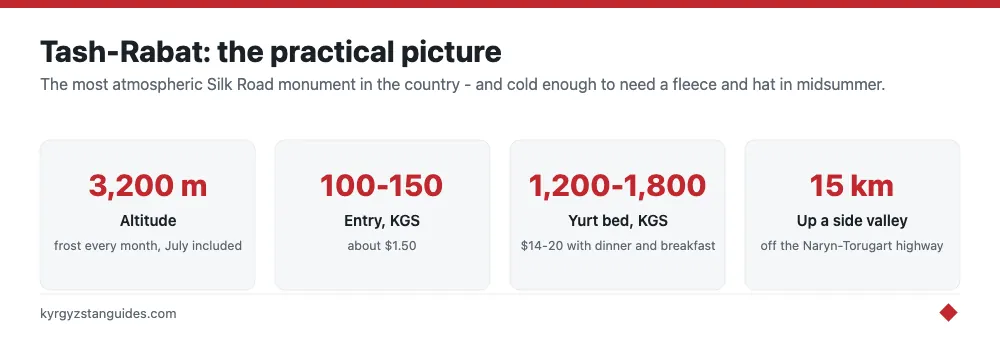
That is when Tash-Rabat makes sense. It is a beautifully preserved stone caravanserai at 3,200 m in the At-Bashy district of Naryn region. The most atmospheric Silk Road monument in Kyrgyzstan. Entry costs about 100–150 KGS (~$1.50), a bed in a yurt camp beside the ruins runs 1,200–1,800 KGS ($14–20) with dinner and breakfast, and getting there means a 2-hour drive from At-Bashy town or 3.5–4 hours from Naryn city, no public transport covers the final 15 km. Stay the night. You can still do exactly what merchants did five centuries ago: arrive at dusk, eat mutton, drink tea, and sleep beside the fortress under a ludicrous number of stars.
Five centuries of shelter
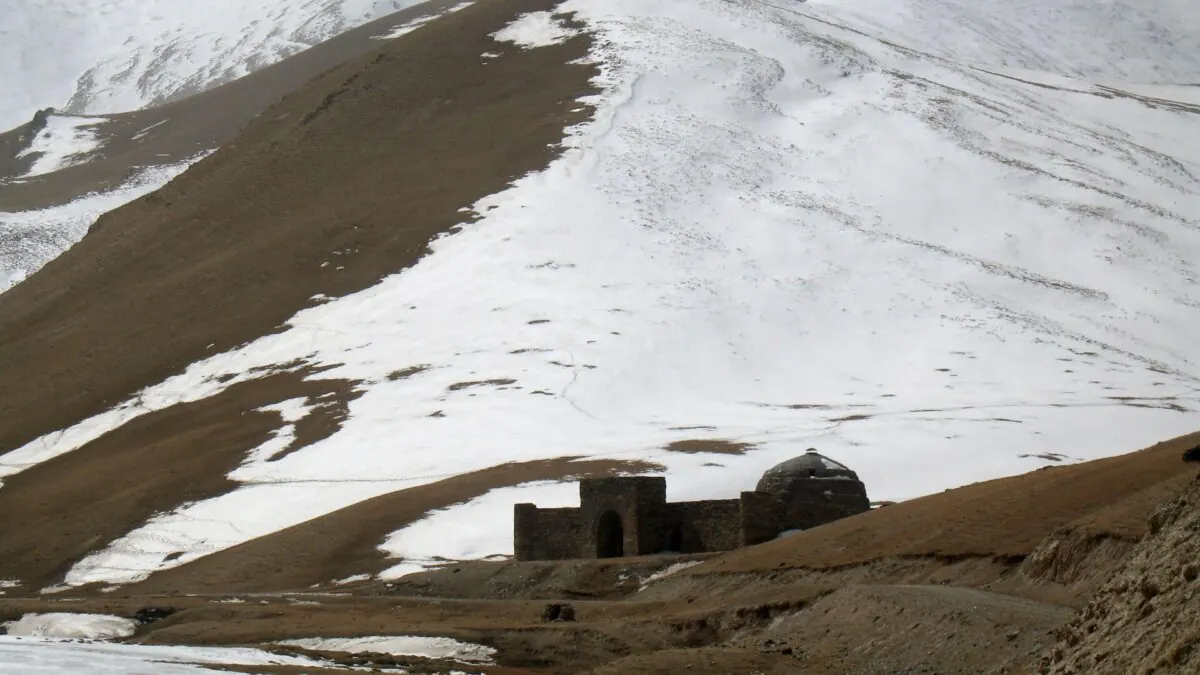
Tash-Rabat (“stone fortress”) is usually dated to the 15th century, though many archaeologists argue it stands on the foundations of a 10th-century Christian or Buddhist monastery, the unresolved debate is part of the appeal. It served as inn and stronghold on the Silk Road branch linking the Fergana and Chuy valleys with Kashgar in China, one long day’s ride below the Torugart pass. Caravans paid for protection as much as shelter: the walls are meters thick, and the single entrance was easy to defend against the raiders who worked these passes.
The building is dug into the hillside, so from behind it reads as a grassy mound with a dome. Inside, a central corridor leads to a domed hall ringed by around 31 cells. Sleeping quarters, storerooms, a well, and pits billed as either dungeons or cold storage. Bring a headlamp: the interior is dark and cold even in July, and far more evocative for it. The Soviet restoration of the late 1970s was heavy-handed in places, and the cement it introduced is now judged inappropriate, but it saved the structure.
A night at the yurt camps
Two or three family-run camps operate on the meadows within sight of the monument from June to mid-September; Sabyrbek’s is the longest-established. Expect felt-lined yurts with thick blankets, a dinner of laghman or besh barmak, and an outhouse, the real thing, not glamping. At 3,200 m, frost hits every month of the year, July and August included, so pack a fleece, hat, and decent socks. If yurt life is new to you, our yurt stay guide explains the etiquette, and the region features in our nomadic culture guide.
The evening rhythm is worth the whole journey. Ask your hosts whether the caretaker can let you into the monument at dusk — golden light through the dome’s oculus is the photograph everyone comes for. After dinner, step outside: with zero light pollution, the Milky Way over the dome is as good as night skies get in Central Asia. Mornings start with fresh bread, kaymak, and jam around 7–8 am. Most camps run on solar lamps, there is no phone signal in the valley, and everything is cash-only — the nearest ATMs are in Naryn city, so carry all the som you need, with a margin for horse rides. Tell someone your plans before you leave Naryn and treat the trip as a proper disconnection.
Getting there
The monument lies 15 km up a side valley off the Naryn–Torugart highway, about 60 km southwest of At-Bashy town and 110 km from Naryn city. Three realistic options:
- Via Naryn (most common): marshrutka or shared taxi from Bishkek to Naryn (6–7 hours, ~600–800 KGS), overnight there, then hire a car through CBT Naryn or your guesthouse. Around 4,000–6,000 KGS return per car including waiting time.
- Via At-Bashy (cheapest): shared taxi from Naryn to At-Bashy (~200–300 KGS, frequent in the morning), then negotiate a local driver for the final leg. Roughly 3,000–4,500 KGS return per car if you bargain. Allow time.
- On a tour: multi-day trips from Bishkek or Naryn bundle Tash-Rabat with Song-Kul or Kel-Suu, which is sensible given the distances.
The access road is rough gravel but passable to careful 2WD cars in dry summer weather. Coming from China, Tash-Rabat is the natural first stop after the Torugart pass, 60-odd kilometers away — though Torugart requires pre-arranged transport and permits on both sides, as covered in our border crossings guide. Overlanders should check current Torugart rules on Caravanistan before committing.
The ride toward Chatyr-Kul
The classic excursion is the day trip up-valley to the 3,800 m pass overlooking Chatyr-Kul, a vast alkaline lake shimmering below the Chinese border ridge. On foot it is a full day — 6–8 hours round trip of steady climbing on herders’ paths; on horseback about 5–6 hours, and hiring a horse and guide from the yurt camps (1,500–2,500 KGS per day) is how most people do it.
One hard rule: the viewpoint is fine, but descending to the lake itself is not. Chatyr-Kul sits inside the military border zone, approaching it requires a permit arranged one to two weeks ahead through a tour operator, and rangers do patrol. For nearly everyone the pass is the right target — the lake below, the Torugart road snaking toward China, and usually not another soul in sight.
When to go — and who should skip it
Mid-June to mid-September is the season: camps up, grass green, road dry. July and August bring the warmest days (15–20°C) with frost at night and possible snow flurries in any month. From October to May the camps are gone and the valley is snowbound — winter visits are for the genuinely equipped only, and shoulder weeks in June and September mean fewer tour groups and sharper light. Skip Tash-Rabat only if old stones leave you cold and Naryn is not on your route anyway; it is a long drive for one building, and the overnight is what justifies it.
Better still, do not make it a single destination at all. Sharing a driver across several days costs little more than point-to-point hires, and a tight loop — Bishkek to Song-Kul for yurts and horses, then Naryn, Tash-Rabat, and Kel-Suu before heading back, fits in 5–6 days. Kel-Suu sits in the same border zone and needs the same style of permit, so arrange both at once. Our Song-Kul guide and Kel-Suu guide cover the other two corners of the triangle.
Read this before you plan a visit: it is under restoration
This is the most important thing on the page and it is not in any guidebook yet. Tash-Rabat is in poor condition and under active restoration, and in May 2026 the Ministry of Culture publicly asked citizens and tourists to temporarily refrain from visiting, and told tour operators to plan around it.
The damage is structural. The slate masonry is flaking and crumbling, stones are falling out of the walls, and the mortar has degraded to powder leaving voids behind it. Wind, snow, temperature swing and humidity did most of it. The rest is us: people and livestock entering freely, tourists walking on the roof, and yaks trampling it in winter.
The work began in 2025 under the state programme Köönö tarykh syrlary, which runs 2023 to 2027. The contractor is OAO Yug-Stroyservice, working to a design by the Kyrgyzrestavratsiya institute. It is the first major intervention in more than forty years, and it is undoing as well as repairing: the Soviet campaign of the late 1970s introduced cement that is now judged inappropriate, and the new work uses historic mortar of lime, clay and gypsum.
Expect it to take three to four years, because the crews can only work June to August at 3,200 m. The roof alone was costed at around five million som. A temporary metal canopy and perimeter fencing are up, and parts of the complex are cordoned off for machinery.
What that means for you: the building is not legally closed — the ministry's wording is to refrain, not a prohibition — but you would be visiting a fenced building site under a canopy, and you would be adding to the footfall that is part of the problem. Check the current position before committing a long drive to it.
What it actually is, and the numbers people get wrong
UNESCO's own dossier describes a square building on the Kara Koyun river at 3,200 m, with an external wall perimeter of 32.4 by 34.8 to 32.4 by 35.1 metres, built of slate plates, its tower-decorated facade turned east. Inside: a central corridor, a square hall, and a set of rooms roofed by one large dome and nineteen small ones. It dates to Karakhanid times, the 11th to 12th centuries, and functioned until Timur's era.
The room count is where sources part company. UNESCO counts one large dome plus nineteen small. Most travel writing says thirty-one domed cells. On-site reporting in May 2026 counted thirty-four rooms with cupolas and vaults, in a footprint of roughly 33 by 35 metres. Anywhere from twenty to thirty-four, depending on what you count as a room.
On dating, the official position is the 11th to 12th centuries. The national tourism portal says fifteenth. Go with Karakhanid and treat the later figure as a minority view.
One story to handle carefully: you will read that Tash-Rabat was originally a Nestorian Christian monastery before becoming a caravanserai. It is repeated everywhere. I could not find a single primary or peer-reviewed source for it that was not ultimately circular, and UNESCO's dossier says only "caravanserai, Karakhanid, 11th-12th centuries". Treat it as an old hypothesis nobody has substantiated rather than as history.
Finally, a practical correction: Tash-Rabat itself does not require a border-zone permit. The permit applies to the restricted ground beyond it — Chatyr-Kul, the Torugart corridor, Kel-Suu.
FAQ
Can you visit Tash-Rabat in 2026?
It is not legally closed, but in May 2026 the Ministry of Culture asked tourists to temporarily refrain from visiting while restoration is under way, and told operators to plan around it. A canopy and fencing are up and parts are cordoned off. Check the current position before driving out.
Why is Tash-Rabat being restored?
The slate masonry is flaking, stones are falling from the walls and the mortar has crumbled to powder. Weather did most of it; visitors walking on the roof and yaks trampling it in winter did the rest. Work began in 2025 and is expected to take three to four years, June to August only.
How old is Tash-Rabat?
UNESCO dates it to Karakhanid times, the 11th to 12th centuries, in use until Timur's era. The national tourism portal says fifteenth century, which is a minority view.
How many rooms does Tash-Rabat have?
It depends who is counting. UNESCO describes one large dome and nineteen small ones; travel sources usually say thirty-one cells; on-site reporting in 2026 counted thirty-four rooms. The building is about 33 by 35 metres.
Was Tash-Rabat a Christian monastery?
Widely claimed, never substantiated. No primary or peer-reviewed source could be found for the Nestorian monastery theory, and UNESCO's dossier describes only a Karakhanid caravanserai.
Do you need a permit for Tash-Rabat?
No. The border-zone permit applies to the restricted ground beyond it — Chatyr-Kul, Kel-Suu and the Torugart corridor — not to Tash-Rabat itself.