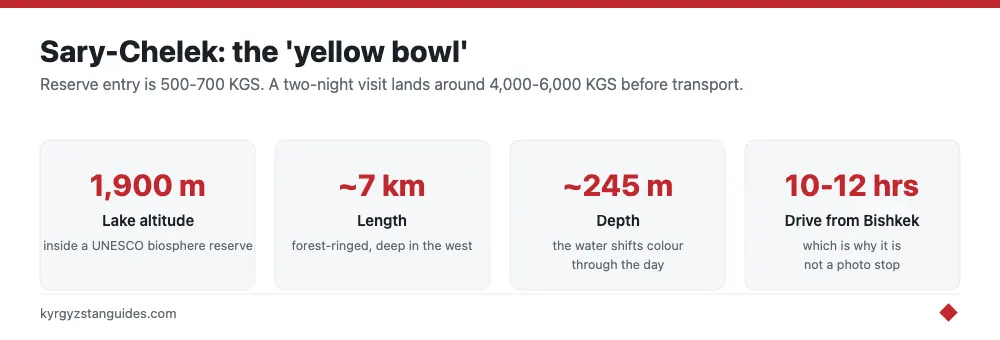
The classic Sary-Chelek mistake is planning it as a day trip. It isn't one. From Bishkek the drive alone runs 10-12 hours, and treating the lake as a photo stop wastes the very thing you drove all that way for. Sary-Chelek is a deep, forest-ringed alpine lake in western Kyrgyzstan’s Jalal-Abad region, protected inside a UNESCO biosphere reserve, and the right way to see it is to base yourself in Arkyt village, pay the 500-700 KGS reserve entry, and give it a full day or two on foot.
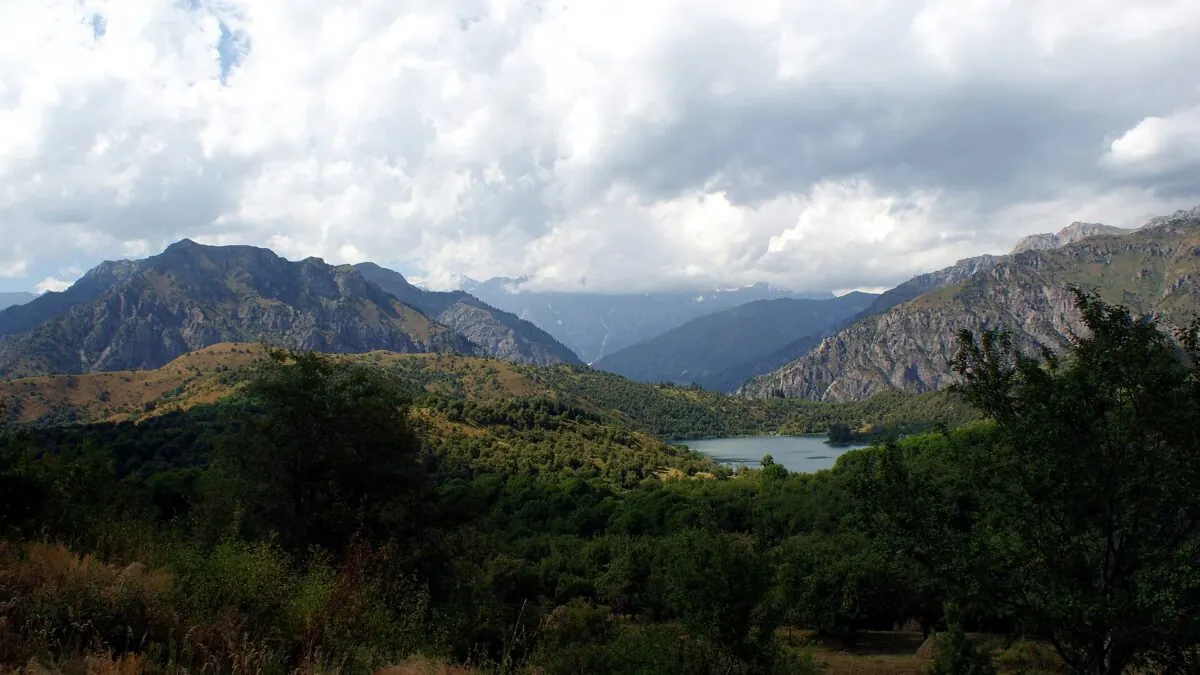
The name means “yellow bowl.” The lake sits at about 1,900 m, stretches roughly 7 km, plunges to around 245 m deep, and shifts from turquoise to deep blue with the light. Many people who have seen every lake in the country call it the most beautiful, and because it's on the way to nowhere, it stays quiet even in August.
What the Reserve Protects
The Sary-Chelek Biosphere Reserve was established in 1959 and joined UNESCO’s World Network of Biosphere Reserves in 1978. Its roughly 24,000 hectares of the western Tian Shan hold relic walnut-fruit forest, the same rare woodland belt as Arslanbob — plus bears, lynx, wild boar, and more than 150 bird species. Six smaller lakes hide in the folds above the main one, each smaller and warmer than the last, scattered through meadows that see a handful of walkers a week.
Because it's a strict reserve rather than a park, movement is regulated. You can visit the main lake and the designated trails; the core zone and some upper lakes are off limits. The rangers at the Arkyt checkpoint will tell you where you can and can't go: listen to them, both because it is their job and because the rules are what has kept this place intact.
What It Costs
Everything is paid in cash at the ranger post near Arkyt: there's nowhere to use a card, so arrive with som in hand. Reserve entry runs 500-700 KGS per person, plus 100-300 KGS if you bring a vehicle into the reserve. An Arkyt homestay with breakfast and dinner costs about 1,000-1,500 KGS per person, and a local guide for the upper-lake hikes, optional but worth it, charges 1,500-2,500 KGS per day. All told, a two-night visit lands around 4,000-6,000 KGS per person before transport, which by Kyrgyz standards makes this a cheap destination that merely charges you in hours on the road.
Arkyt, the Village at the Gate
Arkyt is the small village at the reserve’s edge and the only sensible base. A cluster of family homestays offers simple rooms with half board; from the village it is a short drive or a longer walk up to the main lake viewpoint. The overnight matters for more than convenience: staying puts you at the water early, before the domestic day-trippers arrive around midday, and lets you build the visit around a proper hike rather than a glance. For how these family stays work in practice — what to bring, how meals run, what to pay: see our yurt and homestay guide.
A day at the lake has a natural shape. Go up early, walk the viewpoint circuit while the water is glass-flat and the light is low, then push on toward the upper lakes before the heat builds. By early afternoon the day-trippers have arrived at the main viewpoint and you're two valleys past them; by evening you're back in Arkyt for dinner and the kind of village quiet that ends conversations mid-sentence. Two nights makes all of this unhurried.
The Walks: Viewpoint, Upper Lakes, Walnut Woods
The main lake is the headline, but the chain of smaller lakes above it's the reward for coming this far. Three walks cover the range of effort:
- Main lake viewpoint circuit — easy, 1-2 hours, the classic panorama everyone photographs
- Upper lakes hike (Kyla-Kol/Iyri-Kol and the smaller pools) — moderate, 3-5 hours, best with a guide
- Forest walks through the walnut-fruit woodland, shaded, quiet, and full of birdsong in early summer
Trail marking inside the reserve is inconsistent, which is the practical argument for hiring a guide in Arkyt for the upper lakes: the junctions are unsigned, and the difference between the right shoulder of the valley and the wrong one is a two-hour detour. If this kind of walking is your idea of a trip well spent, our Kyrgyzstan trekking guide maps out the country’s bigger routes.
Swimming Yes, Camping Mostly No
You can swim in Sary-Chelek. The water is clean and cool, warming enough to enjoy from July to early September; walk away from the main viewpoint to find quieter pebbly entry points. The depth means the temperature drops fast a few strokes out, even in August, so treat it as a swim-and-out rather than an afternoon float. No soap, no shampoo. This is a protected water body, and the rangers take it seriously.
Camping is the reverse story. Pitching a tent at the main lakeshore is generally not permitted, and wild camping in the core zone is flatly not allowed. Do not assume you can sleep by the water — ask the rangers at the checkpoint whether any designated areas are open, and default to an Arkyt homestay, which is warmer, cheaper than a fine, and comes with dinner.
When to Go, and How to Get In
Two windows stand out. Late May to June brings wildflowers, waterfalls at full flow, and vivid green slopes; September delivers gold forest, stable weather, and thinner crowds. July and August are warmest for swimming but busiest with Kyrgyz holidaymakers, and winter takes most of the appeal off the table along with the road access. Slot it into a bigger route with our best time to visit Kyrgyzstan guide.
Getting in is the filter that keeps the crowds out. From Bishkek it is 10-12 hours via Tash-Komur and Kerben, and most people break the journey overnight. From Osh or Jalal-Abad it is a more civilized 5-7 hours via Tash-Komur. Public transport gets you as far as Tash-Komur or Kerben; from there you arrange a local car up to Arkyt: your homestay can usually set this up if you call ahead, which beats negotiating cold at a junction. Drivers know the run well and quote it as a fixed price, not a meter. Many travelers pair Sary-Chelek with Arslanbob in the same broad region, a natural combination, though the connecting roads are slow, and the general mechanics are in getting around Kyrgyzstan.
Why It Beats the Famous Lakes
Where Issyk-Kul has resorts and Song-Kul has yurt camps by the dozen, Sary-Chelek has forested mountains dropping straight into clear water and, for much of the year, hardly anyone around. The biology is part of it (no other Kyrgyz lake sits inside relic fruit forest with this much bird life) but mostly it is the feeling of a landscape that has not been arranged for you. If your trip is built around scenery and quiet rather than convenience, this is the best lake in the country. If it's built around convenience, be honest with yourself and stay at Issyk-Kul.
Final warnings, because this is the post where they matter: bring all the cash you'll need, since there are no ATMs anywhere near Arkyt; fuel up before Kerben; don't attempt the last stretch after dark, because the road is rough and unlit; and give the itinerary a buffer day, because out here a landslide or a late driver is a schedule change, not an anecdote. Sary-Chelek punishes tight planning and rewards slack. Build your trip accordingly.
The third Kyrgyz component of the same UNESCO property, with a pilgrimage shrine inside it, is Padysha-Ata.
FAQ
Can I visit Sary-Chelek as a day trip?
Not from Bishkek. The drive alone runs 10 to 12 hours each way, and treating the lake as a photo stop wastes the thing you drove all that way for. Base yourself in Arkyt village and give it a full day or two on foot.
How much does it cost to enter Sary-Chelek?
500 to 700 som for reserve entry. The lake is protected inside a UNESCO biosphere reserve, so access is ticketed rather than open.
How big is Sary-Chelek lake?
It stretches roughly 7 kilometres and sits at about 1,900 metres, a deep forest-ringed alpine lake in western Kyrgyzstan's Jalal-Abad region. The name means “yellow bowl”.
Where do I stay at Sary-Chelek?
Arkyt village, which is the base for the reserve. Staying there is what turns Sary-Chelek from a long drive and a photograph into a proper visit.
How long does it take to get to Sary-Chelek?
From Bishkek, 10 to 12 hours of driving. That distance is the single most important planning fact about the lake and the reason most itineraries that include it do not work.
Is Sary-Chelek protected?
Yes. It lies inside a UNESCO biosphere reserve, and it is also one of three Kyrgyz components of the Western Tien-Shan World Heritage property alongside Besh-Aral and Padysha-Ata.