Jeti-Oguz is a gorge of massive red conglomerate cliffs 28 km southwest of Karakol; a round-trip taxi costs 800-1,200 KGS ($9-14), the famous Seven Bulls rock wall takes half a day to see properly, and the yurt camps in the Valley of Flowers, 5 km further up, are what turn it into an overnight.
You can treat it as a two-hour photo run, a full day with a horse, or the trailhead for a multi-day traverse toward Ala-Kul. Here is how each version works.
Seven Bulls and a Grim Legend
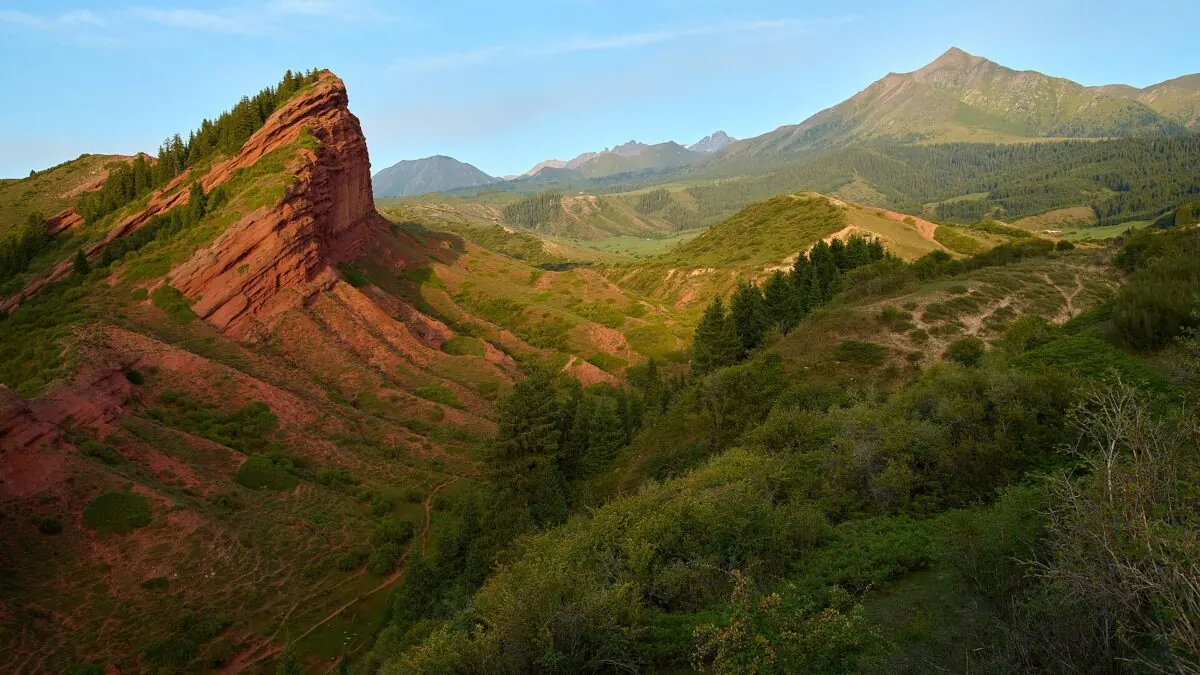
Jeti-Oguz means “seven bulls” in Kyrgyz, and the formation delivers on the name: a rank of seven rounded red cliffs, several hundred meters high, shouldering out of the fir forest like animals at a trough. The rock is Tertiary conglomerate stained rust-red by iron oxide, tilted and carved by the Jeti-Oguz river. The legend is suitably dark. A khan stole another ruler’s wife and, on a sage’s advice, killed seven bulls at a feast; as the seventh fell, the earth heaved, the bulls turned to stone, and the khan was crushed beneath them.
One tip beats all others here. From the road you only ever see the bulls end-on; the full frontal view of all seven is from the ridge across the river, a steep but short 20-minute climb from the road bridge below the sanatorium. Do it, it is the difference between a shrug and the photo you came for.
Broken Heart Rock, Two Kilometers Early
Before the bulls, the road passes Broken Heart — a single red outcrop cleft down the middle, which legend blames on a maiden who died of grief between two dueling suitors. A 15-minute path climbs the slope opposite for the classic shot of the split face. Sunset light does it the most justice; at midday the red flattens considerably. In summer, a couple of stalls between the two formations sell kymyz and honey.
Kok-Jaiyk: Where It Becomes a Destination
Five kilometers past the sanatorium, the gorge opens into Kok-Jaiyk — the “green meadow” everyone calls the Valley of Flowers. From late June through July it earns the name, with slopes of wild poppies, geraniums, and edelweiss below the snowline of the Terskey Ala-Too. This is where Jeti-Oguz stops being a photo stop. Half a dozen yurt camps operate June to mid-September at about $15-25 per person with meals; book through CBT Karakol or simply arrive before mid-afternoon. An easy 1.5-hour walk, or 30 minutes on horseback, reaches the Devichi Kosy (“Maiden’s Braids”) waterfall threading down the cliff at the valley’s head. If a night in a yurt is on your list, this is one of the easiest places in the country to do it well; our yurt stay guide has the details.
Hikes, Horses, and the Route Toward Ala-Kul
Day walkers have three obvious options: the Seven Bulls viewpoint ridge (40 minutes round trip), the Valley of Flowers plus waterfall loop (3-4 hours return from the sanatorium, gentle gradients the whole way), and the upper Kok-Jaiyk meadows (1-2 hours past the yurt camps toward the moraine, with glacier views and near-guaranteed solitude).
Horses are the valley’s other specialty and one of Kyrgyzstan’s best low-commitment rides. Herders and yurt camps rent horses with a guide for about 500-700 KGS ($6-8) per hour, or 2,000-2,500 KGS for a half-day loop to the waterfall and upper pastures. Multi-day horse treks over the passes toward the Karakol Valley run around $70-90 per day through CBT, including horseman, meals, and camps; if riding is the main event of your trip, our horse trekking guide compares the country’s best bases.
Trekkers should know Jeti-Oguz as the western gateway to Karakol’s high routes. From the Valley of Flowers, a trail climbs east over the Teleti Pass (3,759 m) and drops into the Karakol Valley, a strenuous two-day camping stage, then continues up to Ala-Kul lake (3,532 m) and exits over the Ala-Kul pass to the hot springs at Altyn Arashan. The full traverse takes 4-5 days, needs a tent and food for the Teleti stages, and wants settled weather from July to mid-September; stage-by-stage detail is in our Ala-Kul trek guide.
The Sanatorium: A Curiosity, Not a Destination
The concrete blocks below the bulls belong to the Jeti-Oguz sanatorium, opened in 1932 around radon-laced hot springs that Soviet medicine prescribed for everything from joints to nerves. Yuri Gagarin was famously sent here to recuperate after his 1961 spaceflight, and a boulder he supposedly favored downstream is still pointed out as “Gagarin’s rock.” Non-guests can usually take a 20-30 minute hot bath for a few hundred som, and basic rooms are rentable. Honest verdict: unless faded Soviet interiors are specifically your thing, give it 15 minutes and sleep up-valley in the camps or back in Karakol instead.
Getting There and When to Go
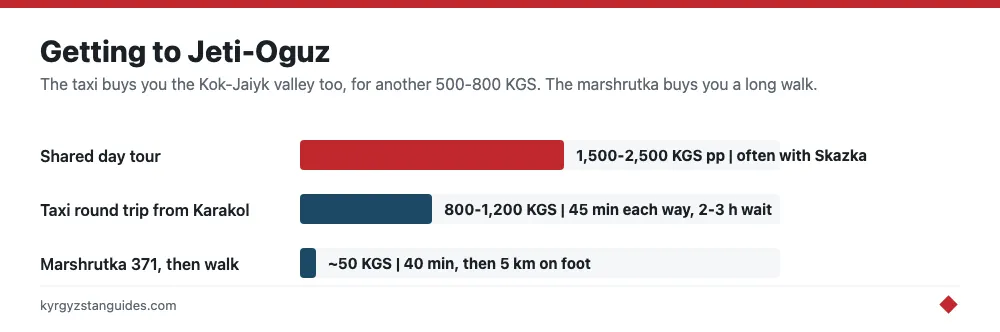
| Option | Route | Cost |
|---|---|---|
| Taxi round trip | Karakol to the rocks, 45 min each way, 2-3 h wait | 800-1,200 KGS; +500-800 to Kok-Jaiyk |
| Marshrutka 371 + walk | Karakol to Jeti-Oguz village (40 min), then 5 km on foot or hitching | ~50 KGS |
| Shared day tour | Guesthouse-arranged, often combined with Skazka or Barskoon | 1,500-2,500 KGS pp |
The road is paved to the sanatorium; the track beyond to the Valley of Flowers is rough but passable to careful sedans in dry weather. Agree the waiting time and the Kok-Jaiyk extension before setting off. Renegotiating at the rocks always costs more. For where to stay in town and the other valleys within reach, see our Karakol travel guide. Jeti-Oguz is one of a string of valleys cut into the Terskey Ala-Too above Issyk-Kul’s south shore; further west along that shore, Chon-Kyzyl-Suu hosts a research station that has tracked the range, uninterrupted, since 1948.
May to September is the season, with the bloom peaking roughly June 20 to July 20 and September bringing golden light and empty trails before the camps fold mid-month. The rocks themselves work year-round — snow-dusted red conglomerate on a clear January day is arguably the best photo of all, and the road to the sanatorium stays open in winter. The gorge sits at 2,200 m, so summer afternoons that start hot can flip to thunderstorms by 4pm: pack a rain shell, a warm layer for yurt evenings, cash in small notes (nothing up-valley takes cards), and offline maps, since signal fades past the sanatorium.
So — Day Trip or Overnight?
If all you want is the Seven Bulls photo, half a day from Karakol with the ridge climb does it, and does it well. But if you are here between late June and mid-September, a night in Kok-Jaiyk turns Jeti-Oguz from a nice stop into one of the easiest great mountain evenings in Kyrgyzstan. Given the choice, stay.
FAQ
What is Jeti-Oguz?
A gorge of massive red conglomerate cliffs 28 km southwest of Karakol. The name means "seven bulls", after a rank of seven rounded red cliffs several hundred metres high standing out of the fir forest.
How do you get to Jeti-Oguz?
A round-trip taxi from Karakol costs 800-1,200 KGS. The Seven Bulls themselves take about half a day to see properly.
Where is the best view of the Seven Bulls?
Not from the road, where you only ever see them end-on. The full frontal view of all seven is from the ridge across the river, a steep but short twenty-minute climb from the road bridge below the sanatorium.
What is Broken Heart Rock?
A single red outcrop cleft down the middle, about two kilometres before the bulls. Legend attributes the split to a maiden who died there.
Should you stay overnight at Jeti-Oguz?
It depends what you want. It works as a two-hour photo stop, a full day with a horse, or the trailhead for a multi-day traverse toward Ala-Kul. The yurt camps in the Valley of Flowers, 5 km further up, are what make an overnight worthwhile.
What is the rock at Jeti-Oguz made of?
Tertiary conglomerate stained rust-red by iron oxide, tilted and then carved by the Jeti-Oguz river.