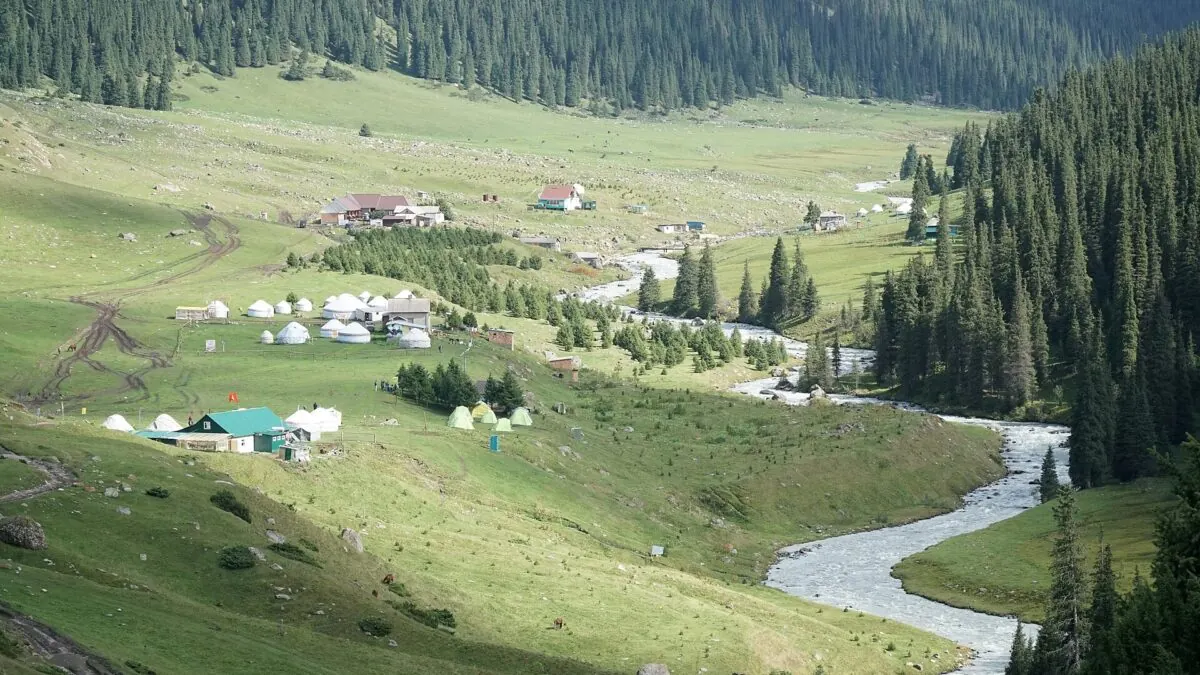
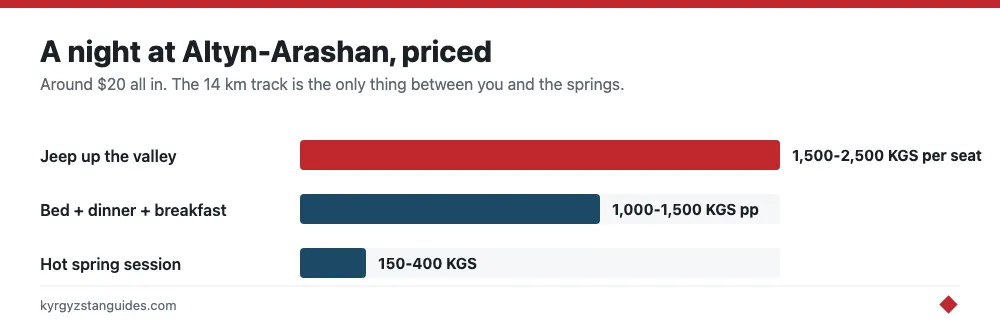
Altyn-Arashan is the best overnight trip from Karakol, and it isn't close. For about $20 all-in — 1,000–1,500 KGS ($11–17) for a guesthouse or yurt bed with dinner and breakfast, plus 150–400 KGS for a private hot-spring pool — you get an alpine valley at 2,435 m where genuinely thermal water steams beside the Arashan River, spruce forest climbs the slopes, and the tent-shaped pyramid of Palatka peak (about 4,260 m) seals off the head of the valley.
The catch is the road. Fourteen kilometers of boulders, ruts, and river fords separate the valley from Ak-Suu village, and you either hike it in 4–5 hours or pay 1,500–2,500 KGS per person for a round trip in an ex-military UAZ. Both options are covered below, with 2026 prices throughout (1 USD ≈ 87–89 KGS).
What you are actually visiting
The name means “golden spa” in Kyrgyz. Altyn-Arashan sits in the Arashan gorge, a side valley of the Ak-Suu region roughly 10 km southeast of Karakol, and it is technically a state nature reserve. In practice the “village” is a scattering of timber guesthouses, yurts, and hot-spring huts along a kilometer of riverbank. There is no shop, no ATM, and only patchy solar electricity. Mobile signal dies around the halfway point of the road, so download offline maps before you leave town — Maps.me and Organic Maps both carry accurate trails.
The springs are real thermal water, not heated tanks: sulfurous water surfaces at up to 50°C and is piped into concrete pools inside small wooden and stone bathhouses. A soak at dusk, snow peaks above the spruce line, costs less than $5. Little in Kyrgyzstan beats it for the money.
The road decides your trip
Every visit starts in Ak-Suu village (marked Teploklyuchenka on older maps), 12 km east of Karakol — marshrutka 350 gets you there for about 50 KGS. From the village edge, the dirt track climbs 14 km and roughly 1,000 vertical meters. This is famously one of the worst “driveable” roads in the country. A normal car won't make it, and standard rental 4x4s regularly turn back with damage.
Hiking is free and better than it sounds: the track follows the river the whole way, mostly in forest, gaining height steadily rather than steeply. Count 4–5 hours up with a daypack, 3–3.5 down. Carry at least 1.5 liters of water and snacks. Nothing is sold before the guesthouses, and start early in July and August, when afternoon thunderstorms build fast in the Terskey Ala-Too.
The UAZ transfer is the lazy (or knee-preserving) option. Karakol guesthouses and operators such as Arashan Travel send Soviet-era UAZ vans and GAZ-66 trucks up daily in season: 60–90 minutes each way, usually with a fixed pickup the next day. It's violent (passengers get airborne) but it turns the valley into an easy overnight. The compromise most people land on: ride up, walk down the next morning.
Horses are the third way: about 3–4 hours up with a guide, arranged in Ak-Suu or Karakol.
How long to stay? One night is the minimum that makes sense: day-trippers spend more hours on the road than in the valley. Two nights is the sweet spot if you want a real day hike in between. Aim to reach the valley by mid-afternoon either way, so you have time to claim a bed, book a pool slot, and walk up-valley before dinner.
What everything costs
| Item | Cost (2026) |
|---|---|
| Guesthouse or yurt bed, dinner + breakfast | 1,000–1,500 KGS ($11–17) pp |
| Hot spring session (30–60 min, private hut) | 150–400 KGS ($2–5) pp |
| UAZ / GAZ-66 transfer, round trip | 1,500–2,500 KGS ($17–28) pp |
| Horse with guide, one way up | ~2,500 KGS pp |
| Camping near the guesthouses | 200–300 KGS |
| Marshrutka 350, Karakol to Ak-Suu | ~50 KGS |
Bring cash in small notes. Nobody in the valley takes cards, and overnight guests usually get a free or discounted soak, ask when you check in.
Picking a pool
Each guesthouse controls its own bathhouses, which is why prices vary. Pools range from pleasantly warm (~35°C) to seriously hot (45–50°C); the keeper will tell you which is which, and asking for “sredniy” (medium) is a safe default. Swimwear is normal, towels aren't provided, and the pools stay open year-round. An evening session after a day on the trail is, in our view, non-negotiable.
Two practical notes. First, limit hot soaks to 15–20 minutes at a time at this altitude, especially on your first evening. The combination of 45°C water and 2,435 m of elevation flattens people who marinate too long. Second, book your slot when you arrive rather than after dinner; the huts fill in sequence and the best evening times go to whoever asked first.
Sleeping in the valley
Accommodation is simple: dorm-style rooms in timber guesthouses, or yurts sleeping four to six. Arashan Travel runs one of the best-organized bases, and half a dozen family operations line the river — including the guesthouse founded by Valentin, a legendary local mountain figure. Full board at 1,000–1,500 KGS per person is excellent value considering every ingredient arrives by UAZ. Camping is tolerated on the meadows upriver for a small fee, or free farther from the buildings.
Food is home cooking, and it's better than it has any right to be at this distance from a road: dinner is usually a soup or plov with bread, jam, and endless tea, breakfast is kasha or eggs. Vegetarians are fine with a day’s notice; anything more specific than that's a stretch, so bring your own snacks and any supplements. Between meals there's nothing to buy, no beer kiosk, no chocolate stand, which does wonders for the atmosphere.
Almost nothing here is on Booking.com. Reserve through your Karakol guesthouse or a CBT office, or simply walk in. Outside late July to mid-August there are nearly always beds. Expect solar lighting, outdoor toilets, and blankets that are warm but worth topping up with a sleeping bag liner. Nights sit near 5–10°C even in July and can dip below freezing in June and September; a swimsuit, quick-dry towel, headlamp, rain shell, and water filter cover the rest of the kit, and our Kyrgyzstan packing list handles the details.
Day hikes from the guesthouse door
Altyn-Arashan is a trailhead as much as a destination. With one full day:
- Toward Ala-Kul (Keldike valley): follow the river south, then climb west toward the Ala-Kul pass. Reaching the 3,532 m lake and returning is a hard 8–10 hour day with about 1,100 m of gain; plenty of hikers go partway for the views and turn around, which is a perfectly good day out.
- Palatka viewpoint meadows: continue 1–2 hours up-valley on the main track for the classic postcard angle on the tent-shaped peak. Flat, easy, ideal rest-day walk.
- Anyr-Tör side valley: a quieter 4–5 hour round trip east into a hanging valley with small glacial streams and almost nobody else on the trail.
- Taldy-Suu direction: strong hikers can push northeast toward the passes linking to the Jyrgalan side. Ask locally about current conditions first.
The Ala-Kul combination
The smartest way to visit is not as a stand-alone trip at all. Run the 2–3 day loop from the Karakol valley: sleep near Sirota or the lake, cross the 3,860 m Ala-Kul pass, then descend the Keldike valley so Altyn-Arashan lands on your final night: hot water exactly when your legs need it, then an easy walk or truck ride out to Ak-Suu. Route details, camps, and costs are in our Ala-Kul trek guide. If you're choosing just one trek for a Karakol trip, this loop is the one.
Winter works too
A couple of guesthouses, Arashan Travel among them, stay open on request from December through March, reached by snowcat, 6WD truck, or ski skins depending on conditions. Steaming pools ringed by snow, daytime temperatures of -5 to -15°C, and a growing ski-touring and snowshoe scene. Arrange everything in advance from Karakol; walk-ins do not work in January. Our Kyrgyzstan in winter guide covers the season’s logistics, the best time to visit breakdown handles the shoulder months, and the forums at caravanistan.com carry recent road reports.
Verdict
Go, and stay the night, day trips waste the best hours, when the UAZ crowds leave and the pools empty out. Ride up and walk down if you only do one direction on foot. Skip it only if you're already doing the full Ala-Kul loop, because you'll pass through anyway and a separate trip buys you nothing new.
FAQ
How much does Altyn-Arashan cost?
About $20 all in: 1,000 to 1,500 som for a guesthouse or yurt bed with dinner and breakfast, plus 150 to 400 som for a private hot-spring pool. Prices are 2026 figures at roughly 87 to 89 som to the dollar.
How do I get to Altyn-Arashan?
Fourteen kilometres of boulders, ruts and river fords separate the valley from Ak-Suu village. Either hike it in four to five hours, or pay 1,500 to 2,500 som per person for a round trip in an ex-military UAZ.
Can I drive to Altyn-Arashan in a normal car?
No. The track is boulders, ruts and river fords, which is why the standard vehicle is an ex-military UAZ. Walking it is a genuine four to five hour hike rather than a stroll.
Are the hot springs at Altyn-Arashan real?
Yes, they are real thermal water rather than heated tanks. The valley sits at 2,435 metres with the water steaming beside the Arashan River, spruce forest on the slopes and the 4,260 metre pyramid of Palatka peak closing off the head of the valley.
Is there electricity or phone signal at Altyn-Arashan?
Barely. There is no shop, no ATM and only patchy solar electricity, and mobile signal dies around the halfway point of the road. Download offline maps before leaving Karakol.
What is Altyn-Arashan actually like?
The name means “golden spa” in Kyrgyz. It is not a village so much as a scattering of timber guesthouses, yurts and hot-spring huts along about a kilometre of riverbank, roughly 10 kilometres southeast of Karakol, in what is technically a state nature reserve.
The same geothermal system surfaces lower down at Ak-Suu, a sanatorium village a 25-som marshrutka from Karakol.