Most travelers do not need a visa for Kyrgyzstan: citizens of 55 countries — including all EU states, the UK, USA, Canada, Australia, Japan and South Korea — enter visa-free for a maximum of 30 calendar days within any 60-day period. This changed on 31 December 2025 under Cabinet of Ministers Resolution No. 855; the previous rule was 60 days within 120, and a great deal of material online is still out of date. The change was reported when it took effect, and the authoritative source is the Kyrgyz foreign ministry. If your country isn't on the list (India is the biggest example), Kyrgyzstan runs a straightforward e-Visa system at evisa.e-gov.kg, typically processed within 3–7 working days. There is no visa on arrival for ordinary tourists, so the small minority who do need paperwork must sort it before flying.
This guide covers exactly who qualifies for visa-free entry in 2026, how the e-Visa application works step by step and what gets applications rejected, which borders accept which documents, the registration rules that still confuse travelers, what an overstay actually costs, and how to legally stay past the visa-free window. Rules do change, so verify against the official portal or a Kyrgyz embassy before booking flights — but as of 2026, everything below reflects how entry actually works.
Who can enter Kyrgyzstan visa-free in 2026?
Kyrgyzstan has one of the most open visa regimes in Asia — a deliberate policy dating to 2012, when it became the first country in the region to scrap visas for its major tourist markets. The 60-day visa-free list covers, among others:
- All EU/EEA countries plus the UK, Switzerland and Norway
- USA, Canada, Australia, New Zealand
- Japan, South Korea, Singapore, Malaysia, Brunei, Mongolia, Vietnam
- Gulf states: Saudi Arabia, UAE, Qatar, Kuwait, Bahrain, Oman
- Others: Turkey, Israel, Bosnia, Serbia, Argentina, Brazil, Chile and more
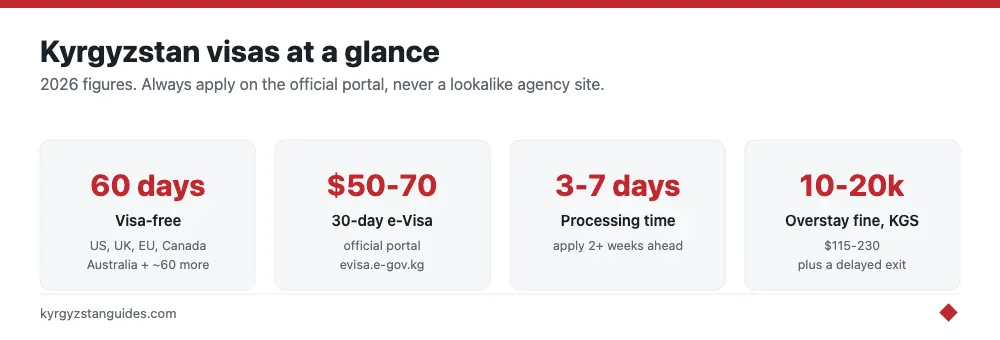
Citizens of most CIS countries (Russia, Kazakhstan, Armenia, Azerbaijan, Georgia, Ukraine and others) enter visa-free under separate agreements, generally for 90 days or without a formal limit. The detail that generates the most reader questions is how the 30 days are counted. It's cumulative within a rolling 60-day period, not per entry. That is the substantive change from the old rule: leaving and re-entering no longer resets the clock, so two separate two-week visits inside 60 days use the full allowance. The border-run routine described below still works, but it no longer buys you a fresh 30 days if you're still inside the same 60-day window. It is also worth knowing that visa-free really does mean free of charge and free of forms — there's no fee, no arrival card, and in normal cases nobody asks about onward tickets. You get stamped at the desk and walk out of the airport.
Who needs a Kyrgyzstan e-Visa?
If your passport is not on the visa-free list, you almost certainly need an e-Visa applied for in advance — there is no visa on arrival at Manas airport for ordinary tourists. The largest groups of travelers who need one:
- India — fully e-Visa eligible; apply online with a passport scan and photo. This is by far the most common e-Visa nationality among our readers.
- China, South Africa, Philippines, Indonesia, Thailand and most of Africa, South Asia and Latin America outside the exemption list.
- Pakistan, Bangladesh, Nigeria and some others fall under a stricter category that can require additional clearance or an invitation-supported consular visa — check the portal’s eligibility tool for your passport before assuming e-Visa access, and budget extra weeks if you're in this group.
e-Visa costs and processing times
| e-Visa type | Validity / stay | Approximate cost (incl. fees) | Processing |
|---|---|---|---|
| Tourist, single entry | Up to 30 days’ stay | $50–70 | 3–7 working days |
| Tourist, single entry (long) | Up to 90 days’ stay | $60–90 | 3–7 working days |
| Business / multiple entry | Varies by agreement | $80–130 | 5–10 working days |
Fees vary by nationality and are paid online by card; the amounts above include the payment gateway surcharge, which the portal adds at checkout and which surprises people expecting the headline fee. Approvals arrive by email as a PDF.
How to apply: the e-Visa, step by step
The application takes about 20 minutes if your documents are ready. In order:
- Create an account on the official portal. Go there directly — there are lookalike agency sites that charge $30+ on top just for retyping your form into the same system.
- Upload your passport data page. A flat, sharp, full-page scan; passport valid at least six months beyond travel is the safe standard.
- Upload a recent photo against a plain light background — passport-photo rules apply, phone photos are accepted if they meet them.
- Enter travel dates and a first-night address. Any Bishkek or Osh hostel booking works; nobody checks whether you actually sleep there.
- Choose your entry checkpoint. e-Visas are valid at listed checkpoints, so pick the one you'll really use — Manas for most people.
- Pay by card and wait. Status updates come by email; approvals typically land within a week.
- Print two copies of the PDF. Airlines want to see it at check-in, and officers at land crossings sometimes want a physical copy to stamp beside.
Apply at least two weeks before travel. The common rejection reasons are mundane: blurry passport scans (the number one issue), photos with busy backgrounds, names entered differently from the passport’s machine-readable line, and expired card payments that void the application without any obvious error message. A rejection does not blacklist you — fix the file and resubmit — but each round eats processing days you may not have.
Which border crossings can you use?
Visa-free travelers can use any international checkpoint. e-Visa holders must enter through the checkpoints listed on the portal, which include all of the main ones below.
By air
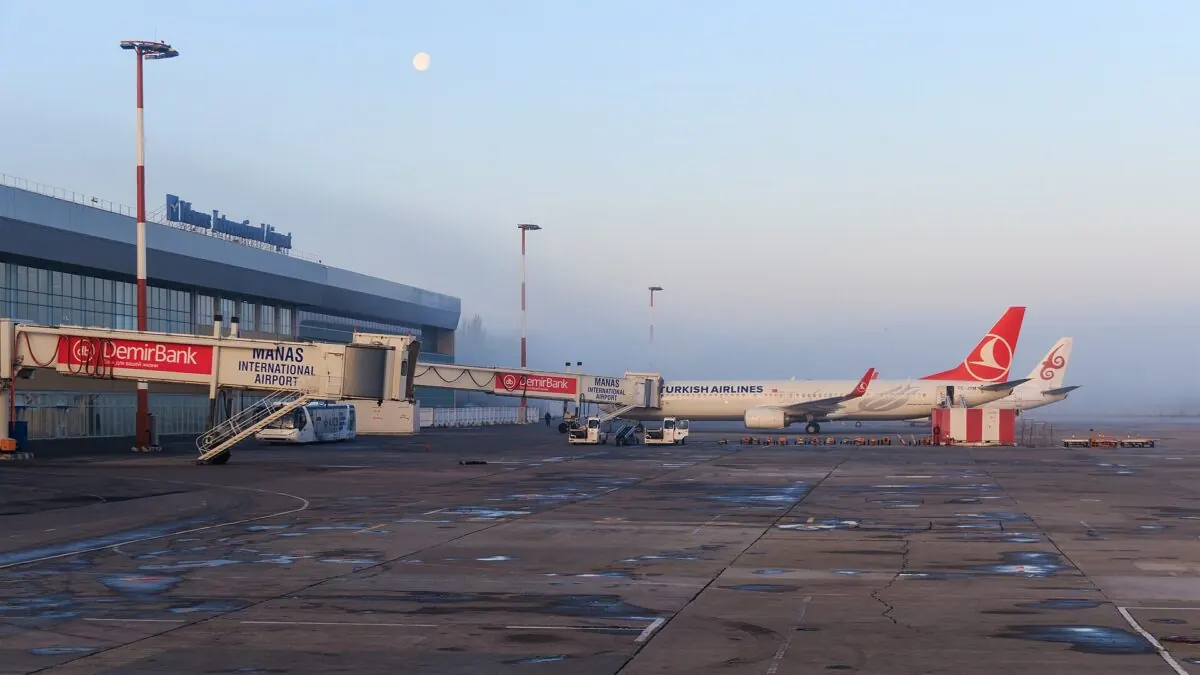
Manas International Airport (BSZ, formerly FRU), 23 km north-west of Bishkek, handles the vast majority of arrivals, with direct flights from Istanbul, Dubai, Delhi, Tashkent and Moscow. Osh Airport (OSS) serves the south and is the smarter entry point if your trip centers on the Alay mountains or the Fergana Valley. Immigration at Manas is quick — usually under 20 minutes even off the night flights — and you get a passport stamp showing your entry date. Photograph that stamp before leaving the airport — if your passport is later lost or stolen, having a picture of the entry stamp makes the replacement process at your embassy and the migration office go much faster.
By land
- Kazakhstan — Korday/Ak-Jol: the busiest land border, 30 minutes from Bishkek, open 24 hours. Walk across and take a marshrutka or taxi on either side. Weekends get crowded; midweek mornings move fastest.
- Uzbekistan — Dostuk: right at the edge of Osh, the standard route from the Fergana Valley. Open daily and straightforward since Uzbekistan’s own liberalization.
- Tajikistan: crossings in the Batken region have opened and closed repeatedly in recent years; after the 2025 border agreement the situation has improved, but check current status locally before building a Pamir Highway connection around any specific crossing.
- China — Torugart and Irkeshtam passes: open but bureaucratic; Torugart requires pre-arranged transport and permits on the Chinese side, so you can't simply turn up and walk across — it has to be booked as part of an organized trip.
Do you need to register after arrival?
For most readers on a normal trip: no. But the wording matters now, because the registration-free window and the visa-free allowance are two different clocks and both changed recently. A normal two- or three-week trip still involves zero paperwork after the passport stamp. This is one of the things that makes Kyrgyzstan genuinely easier than some of its neighbors, where registration slips still haunt guesthouse check-ins and travelers hoard them for the exit inspection.
Registration still applies to some nationalities — including several CIS and e-Visa categories — staying beyond a short grace period, commonly cited as 5 working days for those not exempt. It's done at a Population Service Center (TsON) in Bishkek or Osh, and decent hotels will handle it for guests who need it. If you're on an e-Visa, ask your first hotel on arrival whether your nationality requires it — the question takes thirty seconds, and if registration was needed and skipped, that usually surfaces as a fine at the airport on your way out, when there's no time left to fix anything.
Passport checks once you're inside the country
Day to day, your passport spends most of the trip in a bag. Hotels and guesthouses record your details at check-in, buying a SIM card requires showing it, and banks want it for over-the-counter exchanges — and that's roughly the full list in the cities, where random police document checks on tourists are uncommon. The exception is the mountains: anywhere near the Chinese or Tajik frontiers (Kel-Suu, the Inylchek approaches, the Pik Lenin area), military checkpoints will inspect both your passport and your border zone permit, sometimes twice on one road, and a photocopy won't satisfy them — carry the original there. Elsewhere, a paper photocopy plus a phone photo of your data page and entry stamp is a sensible split: enough to satisfy any casual request, while the original stays somewhere dry and theft-proof.
What happens if you overstay?
Overstaying your visa-free allowance or your e-Visa validity is taken seriously even when the trip was innocent. Expect an administrative fine (typically in the 10,000–20,000 KGS / $115–230 range), a delayed exit while paperwork is processed, and in more serious or repeat cases a re-entry ban. If a hospital stay or a road closure traps you in the country, go to the migration authorities before the deadline passes. Extensions for force majeure are far easier to arrange in advance than an overstay is to fix at the airport, where the officer at the exit desk has no authority to waive anything.
Staying longer: how the border run works, and its limits
There is no simple tourist extension, so long-stayers use geography instead. The Kazakh border at Korday is 30 minutes from Bishkek by marshrutka or Yandex taxi; you exit Kyrgyzstan, walk the bridge, enter Kazakhstan (itself visa-free for most of the same passports), turn around after lunch or a night in Almaty if you fancy it, and re-enter with a fresh 60-day stamp. The whole exercise costs a few dollars in transport and half a day of queueing. It's legal, common and unremarkable — border officers process dozens of these a week. Bear in mind that the reset is customary rather than written into any law, so a pattern of many back-to-back runs stretching over months can eventually draw questions at the booth. And anyone who is actually relocating (remote workers, volunteers, students) should look at proper long-term visas or a residence permit rather than living stamp to stamp.
Combining Kyrgyzstan with its neighbors
Most passports that enter Kyrgyzstan visa-free also get visa-free entry to Kazakhstan and Uzbekistan (30 days each in most cases), which is why the classic Central Asia overland loop needs no visas at all for Western travelers — a sentence that would have sounded like science fiction in 2010. The friction in a multi-country route comes from Tajikistan, which requires its own GBAO permit for the Pamir Highway on top of its entry rules, and from China, whose Torugart and Irkeshtam crossings demand advance arrangements no matter what passport you hold. Entering Kyrgyzstan multiple times on one trip — say Bishkek, a Kazakh detour to Almaty and Charyn Canyon, then back — is completely fine on visa-free stamps, but e-Visa holders need multiple-entry validity for the same loop, so choose the visa type with the full route in mind.
Entry requirements checklist
- Passport valid for at least 3 months beyond your planned stay (6 months is safer and required by some airlines)
- e-Visa PDF printed, if applicable — two copies
- First-night accommodation address (asked on e-Visa forms and occasionally at the desk)
- Travel insurance that covers trekking to 4,000 m — not checked at the border, but essential given the mountain rescue situation we cover in our Kyrgyzstan safety guide
- Some USD cash in clean, newer bills — exchange offices in Bishkek give the best rates, and our Kyrgyzstan travel budget guide breaks down daily costs
- Border zone permit if trekking near the Chinese border (Inylchek glacier, Peak Lenin area) — arranged through tour operators 2–4 weeks ahead; this is separate from your visa and catches people who assumed the stamp covered everything
Onward tickets are rarely asked for, and there are no vaccination requirements. That is the entire bureaucratic footprint of a Kyrgyzstan trip — for most nationalities, less paperwork than renting a car at home.
Registration changed again in September 2026
Two clocks run at once here and conflating them is the commonest mistake. The visa-free allowance is how long you may be in the country. The registration-free window is how long you may be here before you must register your address. They are different lengths and they changed separately.
On 21 September 2026 the state institution Kyzmat announced a new registration procedure, under Cabinet Resolution No. 592 of 28 August 2026. The key change for visitors: the registration-free window was cut from 60 days to 30 for citizens of 23 states, including the United States, United Kingdom, Canada, Australia, New Zealand, Japan, South Korea, Singapore and most of Western Europe.
In practice that aligns it with the visa-free allowance, which is already 30 days in any 60. If you are on a normal trip you will leave before either clock runs out and nothing changes for you.
If you do need to register, the conditions are now specific. You register at your actual address, online or in person through Kyzmat, no later than the last day of your permitted stay without registration. The property must offer at least 12 m² per person. If your host is not the owner, you need notarised owner consent or a power of attorney — which is the part that catches people staying with friends.
Two traps worth knowing. You must re-register within ten working days if your address, passport, stay length or purpose changes. And registration is refused if you apply within three days of the window closing — at that point you are simply told to leave. Do not leave it to the last moment.
A departure of more than 30 calendar days voids your registration entirely.
What an overstay actually costs
The fines are set in calculation indices, and one index is 100 som. Under Article 431 of the Code on Offences, as amended in April 2025, the scale runs by length of overstay:
Up to one month — 55 indices, about 5,500 som. One to three months — 100 indices. Three to six months — 150. Six to twelve months — 175. Over a year — 200 indices, about 20,000 som.
Staying for a purpose other than the one you declared on entry, or breaching transit rules, is a separate 100-index offence. Failing to comply with an order to leave within 30 days brings expulsion, court-ordered, with detention in a specialised centre for up to 30 days pending removal.
There is also a consequence beyond the fine that most accounts omit. Overstayers are refused entry for a period equal to the visa-free stay they abused. Overstay a 30-day entitlement and you are looking at a 30-day bar, not a warning.
And you cannot simply walk out. Leaving after an overstay requires an exit visa, category L, valid up to ten days, and the consular fees are steep: a Cabinet decree of 30 April 2026 sets $200 for up to three months, $1,100 for three months to a year, $2,200 for one to two years, and a further $1,100 for each additional year.
One humane exception: ethnic Kyrgyz and immediate family of Kyrgyz citizens who have overstayed get one entry to regularise their status, with 30 working days from entry to do it.
Frequently Asked Questions
Do US citizens need a visa for Kyrgyzstan?
No. US citizens enter Kyrgyzstan visa-free for up to 30 calendar days within any 60-day period, with no registration required during that time. You just need a passport valid beyond your stay — you get a stamp on arrival at Manas airport or any land border. The allowance was reduced from 60 days on 31 December 2025.
Can Indian citizens get a visa on arrival in Kyrgyzstan?
No. Indian travelers must apply for an e-Visa in advance at evisa.e-gov.kg. It costs roughly $50–70 including fees, is processed in 3–7 working days, and is accepted at Manas airport and the main land borders. Apply at least two weeks before flying.
How long can I stay in Kyrgyzstan visa-free?
Sixty days per stay for most Western nationalities, including EU, UK, US, Canadian, Australian, Japanese and Korean passport holders. The limit is cumulative within a rolling 60-day period rather than per entry, and most CIS nationals have separate, more generous arrangements under regional agreements — Eurasian Economic Union citizens may stay 90 days within 180.
Can I extend my visa-free stay?
There is no simple tourist extension. The standard solution is a same-day border run: cross into Kazakhstan at Korday, 30 minutes from Bishkek, and re-enter to receive a fresh 60-day stamp. Long-term stays technically require a proper visa or residence permit instead.
Do I need to register with the police in Kyrgyzstan?
Most visa-free nationals on a short trip are exempt. Under the procedure announced on 21 September 2026 the registration-free window was cut from 60 to 30 days for citizens of 23 states, including the US, UK, Canada, Australia, New Zealand, Japan, South Korea, Singapore and most of Western Europe. Check your category on the official e-Visa portal.
Do I need an onward ticket or proof of funds?
Almost never. Kyrgyz border officers do not routinely ask for onward tickets, hotel bookings or bank statements from visa-free travelers. Airlines occasionally ask at check-in for e-Visa holders, so carry your visa PDF and a rough itinerary; that settles every question in practice.
Stamped in? The bureaucracy is over and the good part starts — spend your first day on our things to do in Bishkek list, and line your dates up against the best time to visit Kyrgyzstan before you plan the mountains.
One trap worth knowing about. The Kyrgyz Ministry of Foreign Affairs publishes its own visa and visa-free regimes page, and as checked on 23 September 2026 that page was still dated February 2025 and still listed the allowance as up to 60 days. It has not been updated for Cabinet Resolution No. 855 of 31 December 2025. If you check the official site and come away thinking you have 60 days, that is why. The current rule is 30 calendar days within any 60-day period.