Our verdict, stated first: Kyrgyzstan is one of the cheapest mountain destinations an Indian traveler can reach, and once you're on the ground the rupee stretches remarkably far.
Plan on roughly ₹2,000–3,000 a day as a backpacker and ₹5,000–7,500 a day at mid-range comfort, excluding your international flight and e-Visa. A frugal 10-day trip with flights can come in under ₹70,000 per person. The Kyrgyz som trades at about 87–89 to the US dollar and near parity with the rupee — ₹100 is close to 100–103 som — which is why costs here feel so gentle. We build these figures for Indian travelers through research rather than a receipt from our own trip, so read them as realistic ranges to sanity-check on the ground.
The daily budget, two ways
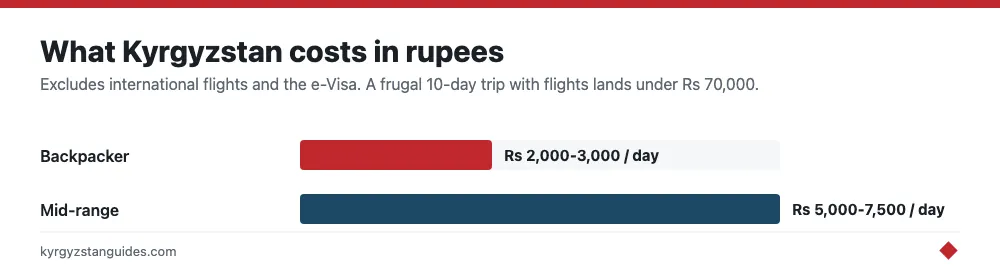
Your daily spend splits cleanly into two styles. The backpacker lives in dorms and guesthouses, eats where locals eat, and moves by marshrutka — the shared minibuses that are the backbone of Kyrgyz transport. The mid-range traveler takes private guesthouse rooms, mixes in shared taxis, and pays for the odd guided activity. Neither is expensive by Indian standards; the gap between them is comfort, not survival.
| Daily item | Backpacker | Mid-range |
|---|---|---|
| Bed | Dorm ₹700–1,050 | Guesthouse room ₹2,100–3,500 |
| Food (3 meals) | ₹500–800 | ₹900–1,600 |
| Local transport | Marshrutka ₹100–500 | Shared taxi ₹500–1,200 |
| Activity / entry | ₹0–500 | ₹800–2,000 |
| Rough daily total | ₹2,000–3,000 | ₹5,000–7,500 |
The single biggest lever on your total is where you sleep. Choose dorms and homestays over hotels and you roughly halve the daily figure. The second lever is transport style: marshrutkas cost a fraction of a private taxi, and using them is genuinely part of the experience rather than a hardship.
What everyday things cost in rupees
Ranges are useful, but it helps to picture the actual price tags. Here is roughly what your money buys, converted to rupees at current rates — small amounts, which is the whole point.
- A bowl of laghman or plov at a local canteen: around ₹150–300.
- A loaf of fresh nan bread from a bazaar: ₹20–40.
- A bottle of water or a chai: ₹30–60.
- A dorm bed in Bishkek or Karakol: ₹700–1,050 a night.
- A marshrutka across town: ₹15–30; the long Bishkek–Karakol run is only a few hundred rupees.
- A shared taxi seat between towns: ₹400–900 depending on distance.
- A night in a yurt with dinner and breakfast: ₹1,300–1,900.
- A local SIM with generous data: a few hundred rupees to set up.
The one line that surprises people is guided treks and horse hire, which cost more relative to everything else — a guided multi-day horse trek can run several thousand rupees a day once you add horses, a guide, and food. That is still cheap for what it is, but it's where a splurge shows up on the total.
A sample 10-day cost
Numbers land better when they add up to a trip. Take a fairly typical 10-day loop — Bishkek, then east to Karakol and the Issyk-Kul lake region, a couple of nights in a yurt, and back — done on the frugal end of comfortable. Sleeping mostly in guesthouses with a yurt night or two, eating local, and moving by marshrutka with the odd shared taxi, the on-the-ground spend works out around ₹25,000–35,000 for the ten days.
Add a return flight from India at the typical ₹25,000–45,000 and the e-Visa at roughly ₹5,000–7,000, and the all-in cost of a frugal 10-day trip lands somewhere near ₹55,000–85,000 per person — competitive with a good domestic Himalayan holiday and far more remote. Push to mid-range comfort and the on-the-ground figure roughly doubles, but the flight and visa stay fixed, so the total climbs more gently than you might fear. If you want to see the trip this budget maps onto, our 10-day Kyrgyzstan itinerary follows almost exactly this route.
Where the money quietly leaks
Kyrgyzstan is cheap, but a few things drain a budget faster than expected. Private taxis for long distances, hired instead of marshrutkas, can cost ten times the shared fare. Booking every yurt stay and trek through a Bishkek agency adds a comfortable margin you could skip by arranging things locally in Karakol or Kochkor. And CBT-style community tourism, while excellent, is priced per service, so a week of guided activities adds up.
None of these are traps exactly — they're choices. But being aware of them is the difference between a ₹2,000 day and a ₹5,000 one for essentially the same experience. For the dollar-and-som version of these numbers with more granular breakdowns, our Kyrgyzstan travel budget guide goes deeper.
Money-saving tips that actually work
A handful of habits keep the daily figure at the low end without making the trip feel like a grind.
- Use marshrutkas as your default. They go almost everywhere for a few rupees and are half the adventure; our guide to getting around Kyrgyzstan shows how the network works.
- Sleep in homestays and guesthouses. They are cheaper than hotels, and the meals and local advice thrown in are worth more than a star rating.
- Eat where the drivers eat. Roadside canteens serve the same plov and laghman as tourist spots for a third of the price.
- Self-cater from bazaars. Bread, fruit, nuts, and vegetables are cheap, and many guesthouses have kitchens — a lifesaver for vegetarians too.
- Arrange treks locally. Book horse trips and guides in trailhead towns like Karakol or Kochkor rather than through a capital-city agency.
- Carry enough som into the mountains. Rural areas and yurt camps are cash-only, and running dry forces expensive backtracking.
So here is your pre-trip checklist on money: fix your style (backpacker or mid-range) before you book so you plan the right beds; budget ₹2,000–3,000 or ₹5,000–7,500 a day accordingly; add the flight and e-Visa as separate fixed costs; carry US dollars in clean notes to change plus plenty of som for the mountains; and default to marshrutkas, homestays, and local canteens. Do that and Kyrgyzstan will cost you less per day than almost any mountain trip you have taken at home.
Frequently Asked Questions
How much does a Kyrgyzstan trip cost per day in rupees?
Budget roughly ₹2,000–3,000 a day as a backpacker staying in dorms and eating locally, or ₹5,000–7,500 a day at mid-range comfort with private rooms and some shared taxis. Both figures exclude your international flight and e-Visa.
What does a 10-day Kyrgyzstan trip cost from India?
On-the-ground costs for a frugal 10-day loop run about ₹25,000–35,000. Add a return flight at ₹25,000–45,000 and the e-Visa at roughly ₹5,000–7,000, and the all-in total lands near ₹55,000–85,000 per person.
Is Kyrgyzstan cheaper than a Himalayan trip in India?
On daily spend, often yes — the som sits near parity with the rupee, so food, transport, and beds cost little. The flight and e-Visa are the added expenses over a domestic trip, but a frugal traveler can still keep the whole thing competitive with a good Himalayan holiday.
What is the Kyrgyz som worth against the rupee?
Close to parity — ₹100 is roughly 100 to 103 som, with the som trading at about 87 to 89 to the US dollar. That near-parity is why costs here feel so gentle to an Indian traveller.
How much should I budget per day as a backpacker?
Roughly ₹2,000 to ₹3,000 a day at backpacker level, or ₹5,000 to ₹7,500 at mid-range comfort, excluding the international flight and the e-visa.
Can I do Kyrgyzstan on a tight budget from India?
Yes. A frugal ten-day trip including flights can come in under ₹70,000 per person, which makes it one of the cheapest mountain destinations an Indian traveller can reach.