Down a lane in Karakol, a row of small kitchens sells one cold, spicy, sour bowl for about a dollar, and locals line up for it in any weather. Ashlan-fu is a chilled Dungan noodle dish, wheat noodles and squares of wobbly starch jelly in a tangy chili-and-vinegar broth, and Karakol is the one place in Kyrgyzstan to eat it properly, at the bazaar stalls given over to it, usually for small change. It is unlike anything else in the country’s mostly warm, mild, meaty food, and it's the single most addictive cheap thing you can eat here.
You'll see versions in Bishkek, but they never quite land. Ashlan-fu is a Karakol dish, tied to the town’s Dungan community, and it is worth timing a stop around. Here is what is in the bowl, where to eat it, and why one is never enough.
What is in the bowl
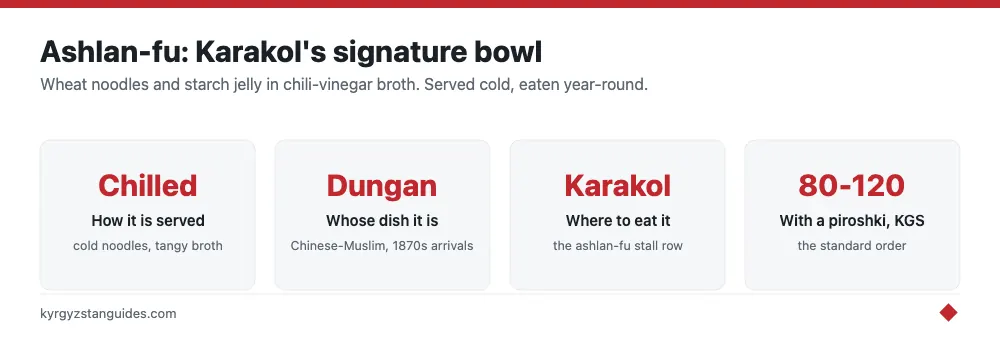
Ashlan-fu is built from two kinds of noodle-like elements in a cold, sharp sauce. The first is ordinary wheat noodles. The second, and the thing that makes the dish, is a starch jelly, cut into slippery, translucent strips that wobble on the spoon, and what it is set from depends on who you ask. Both go into a bowl and are drowned in a broth that is where the magic happens: cold, thin, and loaded with vinegar, garlic, chili oil and soy, sour and hot at once, with a spoon of red laza chili on top for those who want it fiercer.
It arrives cold, which surprises first-timers, and it's almost always eaten with a fried piroshki, a small stuffed pastry, on the side, so you alternate between the sharp, cool bowl and the hot, greasy bread. That contrast is half the pleasure. Some stalls will ask whether you want it more sour or more spicy, and how much broth you would like; if you are unsure, say a little of everything and adjust with the chili on the table.
The dish is Dungan in origin, brought by the Chinese Muslims who fled north into the Russian Empire in the winter of 1877-78. They carried a whole tradition of noodle and starch cookery with them, and ashlan-fu is its coldest, sharpest expression, a close cousin of the pulled-noodle laghman the same community made its name on. That shared heritage is why Karakol, with the largest Dungan population in the country, is the natural home of both.
Where to eat it: the Ashlan-fu row
In Karakol, ashlan-fu has its own addresses: two clusters of small family stalls that sell essentially nothing else, one at Ak-Tilek bazaar and one in an alleyway at Bugu Bazaar, both covered in detail below. This is where you want to be. There is no need to research a specific name: walk the row, pick the stall with the longest local queue, and point. You eat standing or perched at a shared counter, shoulder to shoulder with people on their lunch break, and a bowl plus a piroshki comes to little more than a dollar.
The women who run these stalls have often made the same dish for decades, and each guards small differences in the chili, the vinegar balance, and the firmness of the jelly. Try more than one if you can; it is cheap enough to make a small crawl of it. For everything else worth doing in town while you're there, our Karakol travel guide has the rest, and the same town’s Dungan kitchens make it the best place in the country for hand-pulled noodles generally.
Why it is so addictive
The pull of ashlan-fu is the collision of sensations in one cheap bowl: cold against a warm day, sour against oily, the smooth slide of the jelly against the chew of the noodle, the slow build of garlic and chili. It resets you after a mountain day the way almost nothing else does, and because it's light and cold rather than heavy and rich, you can eat it and still want dinner. Add the ritual, the row, the queue, the standing counter, the piroshki, and it becomes less a snack than a small event.
It also stands almost alone. Most of what you eat in Kyrgyzstan is warm, mild and built around meat and dough, so a dish that's cold, sour and fiery is a genuine shock to the routine, and shocks are memorable. Travelers who arrive skeptical of a cold noodle soup tend to leave having eaten it two or three days running. It photographs badly and tastes brilliant, which is usually the sign of food worth trusting.
A practical note: it's served cold and the broth is water-based, so if you have a sensitive stomach, choose a busy stall with high turnover, which in practice means most of the ones with a local line. That caution aside, this is a dish to seek out on purpose. If your route touches the eastern end of Issyk-Kul at all, build in a Karakol lunch and eat ashlan-fu until you have found your favorite stall.
One more reason it sticks with people: it's almost impossible to overspend. A bowl and a piroshki, twice, still leaves you change from a few dollars, so the barrier to trying it, and trying it again the next day at a different stall, is close to zero. That combination of cheap, distinctive and place-specific is rare, and it is why ashlan-fu ends up on so many travelers’ shortlist of the best single thing they ate in Kyrgyzstan. Come to Karakol hungry, skip breakfast if you have to, and give the row a proper afternoon.
Nobody agrees what the jelly is made of
The wheat noodles are not in dispute. The second element is, and the disagreement is worth knowing about because it changes the texture you get.
Most Russian and Kyrgyz-language reporting describes the fu as a starch jelly: a slurry of bean, potato or corn starch cooked, poured out to set into a solid block, then cut or grated into strips. Karakol's own destination management organisation describes the two components differently, as thick rice noodles and thinner wheat noodles, with no jelly at all. Both descriptions come from people who know the dish.
The likeliest explanation is that there is no single recipe, and that individual cooks in the row use what they use. The practical consequence for you is that two bowls from two stalls thirty metres apart can be genuinely different dishes, which is an argument for eating more than one.
The name backs the jelly version. Ashlan-fu appears to come from the Chinese liangfen, the cold starch-jelly dish, joined to the Kyrgyz ash, meaning food. The dish is a migrant twice over: Chinese in technique, Kyrgyz in name.
Where the row actually is
There are two documented ashlan-fu clusters in Karakol, not one, and travel writing tends to blur them into a single vague lane.
Ak-Tilek bazaar: RFE/RL documented two full rows of ashlan-fu traders in the centre of this market, run predominantly by Dungan women, who maintain that it is Karakol's water that makes the local version different. By 2021 a separate report counted around eighty competing vendors setting up from the morning at the central market.
Bugu Bazaar, the Small Bazaar: the Karakol DMO documents an alleyway here given over entirely to ashlan-fu. The best-known stall, Saida's, is inside it, open Monday to Saturday, 08:00 to 20:00, closed Sunday, selling the bowl alongside freshly fried potato pirozhki. It is reported to move an average of 600 bowls a day, and once took a wedding order for 400 portions to go.
That Sunday closure is the detail worth acting on. If Karakol is a one-night stop and that night is a Saturday, eat this on arrival rather than planning it for the morning.
What it costs, and the day they cooked 1.5 tonnes of it
The price history is a neat little index of Kyrgyz inflation. At Ak-Tilek in 2013 a serving was 20-30 som. In 2019 Saida's was quoted at 30 som, under fifty US cents. By 2021 a market bowl was around 60 cents, with the fried pirozhok about 18 cents on top. In November 2022 a sit-down restaurant in Karakol charged 85 som for a 250 g portion.
That last figure is the one to hold onto, because it explains a gap you will notice: the restaurant price is roughly double the market price, for a dish whose entire character is the standing counter and the queue. Eat it at the bazaar.
For scale of local attachment: on 1 July 2019, for Karakol's 150th anniversary, the city ran an Ashlyamfu-Fest at which more than twenty cooks prepared 1.5 tonnes of the stuff, yielding over 3,000 servings, with sanitary inspectors and police on site. No record body certified it and it does not appear to have become an annual fixture, but it is a fair measure of how the town feels about a bowl of cold noodles.
The community behind it
The Dungan arrival was not a gradual settlement. Peer-reviewed work published in Heliyon in 2023 records that the first wave fled China in the winter of 1877-78, crossing the Torugart pass in three groups, bound for Osh, for the southern shore of Issyk-Kul, and for Tokmok by way of Naryn. Roughly one third survived the crossing. A second wave followed in 1881-83.
The Issyk-Kul group founded Yrdyk, about 7 km west of Karakol, on a date that sources put at either 1877 or 1880. It was initially larger than Karakol itself. A later Dungan settlement, Milyanfan, founded in 1924, was named "rice valley" after its founders drained marshland to grow rice.
The community has kept growing. National Statistical Committee figures put the Dungan population at 72,240 in 2019 and 76,573 in 2022, in a country of about 6.94 million. This is a living cuisine with a constituency, not a heritage performance.
One thing to be clear about, because you will see it claimed: ashlan-fu has no UNESCO listing and no Slow Food Ark of Taste entry. The Kyrgyz products on the Ark are jarma, yak's milk saru mai, and the dried kandek apricot of Batken. Ashlan-fu's reputation rests on a queue, not a certificate.
FAQ
What is ashlan-fu made of?
Wheat noodles plus a second element that sources describe differently: either strips of starch jelly set from bean, potato or corn starch, or thicker rice noodles. Both go into a cold, sharp broth of vinegar, garlic and chilli. Recipes vary stall to stall.
Where is the ashlan-fu row in Karakol?
There are two clusters. Ak-Tilek bazaar has two documented rows of traders, and Bugu Bazaar, the Small Bazaar, has an alleyway given over to the dish. Saida's, the best-known stall, is inside Bugu Bazaar, open Monday to Saturday 08:00-20:00 and closed Sunday.
How much does ashlan-fu cost?
Cheap, and it has risen steadily: 20-30 som in 2013, 30 som in 2019, around 60 US cents in 2021. A sit-down restaurant charged 85 som for a 250 g portion in late 2022, roughly double the bazaar price for a worse version of the experience.
Is ashlan-fu served hot or cold?
Cold, which surprises most first-timers. Sales peak in September and October rather than high summer, and a warm winter version exists, but the standard bowl is chilled.
Why is ashlan-fu associated with Karakol?
It is a Dungan dish, and Karakol has the country's most established Dungan community, descended from refugees who crossed from China in the winter of 1877-78. The stallholders themselves argue it is Karakol's water that makes the local version different.
Is ashlan-fu UNESCO-listed or a Slow Food product?
No to both, despite claims you may see. Kyrgyzstan's Slow Food Ark of Taste entries are jarma, yak's milk saru mai and Batken's dried kandek apricot. Ashlan-fu has no UNESCO inscription.