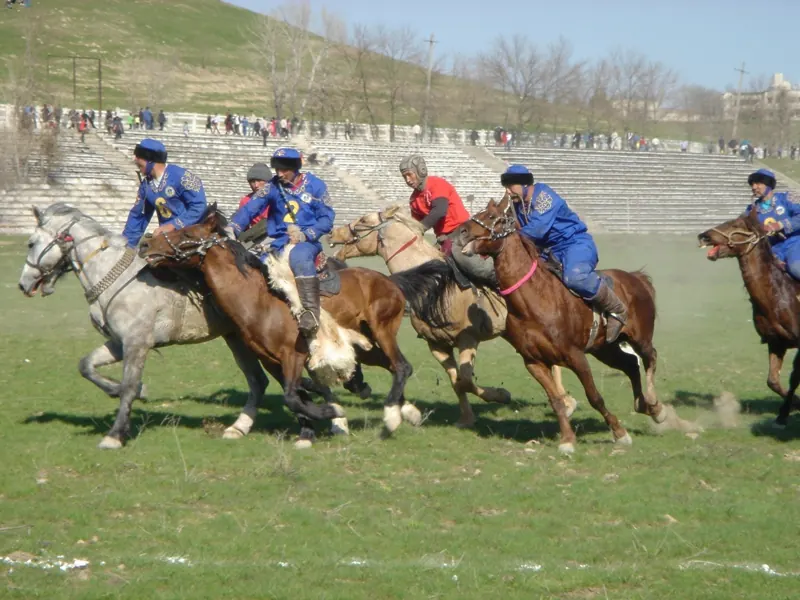
Two teams of horsemen thunder across a field fighting for a headless goat carcass, and the aim is to scoop the 30-odd-kilogram body off the ground at a gallop and drop it into the opposing team’s goal, a raised stone or clay well called a tai kazan. That is kok-boru, Kyrgyzstan’s national sport: part rugby, part polo, played at full speed by riders who can lean out of the saddle to grab a weight the size of a small child while surrounded by other horses. It looks like chaos on first watch, but it runs on clear rules, and you can see it at village festivals, national holidays, and above all the World Nomad Games.
Below is how the game actually works, when and where a traveler can realistically catch a match, what it means to Kyrgyz culture, and practical tips for watching without getting in the way. If the goat carcass gives you pause, we address that squarely too.
The rules, roughly
Strip away the spectacle and kok-boru is a goal-scoring game. Two teams — usually four riders each on the field at a time in the modern regulated version — compete to control the ulak, the beheaded goat carcass, and deposit it in the opponent’s goal. Each successful drop into the tai kazan scores, and the team with more goals at the end of the timed periods wins. Matches in the standardized format run in halves with substitutions, on a marked field, with referees on horseback.
The carcass is used because it's heavy, durable, and has limbs to grip: a rider hangs off the saddle to snatch it from the ground or wrestle it from another player, then clamps it against the horse’s flank or under a leg while riding. Wrestling the ulak away from an opponent mid-gallop is the core skill, and it takes as much from the horse as the rider: the best kok-boru horses are trained to push, hold position, and stay calm in a scrum. Teamwork matters more than it looks, riders screen for the carrier and open lanes toward the goal, exactly as in any goal sport.
There are fouls. You cannot whip an opponent’s horse, deliberately ride someone down, or use the reins as a weapon. And modern tournaments enforce them to keep both riders and horses safer than the old free-for-all village version. The traditional form, played across Central Asia under names like buzkashi in Afghanistan and kokpar in Kazakhstan, could involve dozens of riders and few limits; what you will most likely watch today is the regulated national-sport version with teams, a field, and a clock.
Where and when to see it
The realistic answer for a visitor is: at an organized event, not by luck. Kok-boru is not played daily, and turning up in a random village hoping to catch a match rarely works. Your best chances line up with festivals and holidays.
- World Nomad Games, the biggest stage, when it is held, drawing national teams and full stadiums; the single best place to see top-level kok-boru with commentary and crowds
- National holidays — Nowruz (around March 21) and Independence Day (August 31) often feature matches or demonstrations in regional centers
- Jailoo and village festivals. Summer pasture celebrations, especially around Song-Kul and other high-summer gatherings, sometimes stage games alongside eagle hunting and horse events
- Tourist-oriented ethno-festivals: events like the Kyrchyn festival held near Issyk-Kul during major games put on kok-boru along with yurt-building, music, and craft demonstrations
Summer, roughly June through September, is when informal matches and festivals cluster, which also overlaps with the best trekking and yurt-stay season. See our note on when to visit for the wider calendar. Outside of scheduled events, ask a local guesthouse or community-based tourism office; they will know if anything is planned nearby, and a game is rarely advertised far in advance.
What it means to Kyrgyz culture
Kok-boru isn't just a sport; it is a compressed piece of nomadic identity. It grew out of a horse culture where riding was survival, and where the skills the game tests, control at speed, strength in the saddle, reading a chaotic field, were the same skills that herded livestock, defended it from wolves, and moved a family across the mountains twice a year. The name itself points to that world: kok-boru translates roughly as “gray wolf,” and one origin story frames the game as a stylized reenactment of chasing down a wolf that raided the herd.
Because of that heritage, the game carries real weight. Winning a match brings honor to a village or region, the best riders are local celebrities, and a big game is a social event: families gather, food is cooked, and elders watch from the good spots. It sits alongside eagle hunting, horse racing, and other equestrian traditions as part of a living nomadic heritage that Kyrgyzstan has deliberately revived and promoted, partly through the World Nomad Games, as a source of national pride. For the broader context of that culture, our nomadic culture guide puts kok-boru among the yurts, jailoo life, and crafts it belongs with.
It's worth being honest about the goat. The carcass is real, and for many first-time spectators that is confronting. Two things are true at once: the animal is typically slaughtered for meat as it would be anyway, and after the game the carcass is often cooked and eaten, so it isn't waste; and the practice grows from a herding society where the line between livestock and food is closer to daily life than most visitors are used to. You don’t have to love that framing, but understanding it is fairer than reacting to the image alone.
Spectator tips
Watching kok-boru is thrilling and, up close, genuinely a bit dangerous — half a ton of horse can leave the marked area fast. A few practical points make it better and safer.
- Keep your distance from the field edge. Riders and horses spill over the boundary during scrums; stand where locals stand, and further back than you think you need to
- Bring a zoom or long lens. The action is fast and moves across a big field; a phone wide shot won’t capture much, and getting closer for a better photo is exactly the wrong instinct
- Sun, dust, and time. Games are outdoors, often on dusty ground, and events run long with unclear schedules: bring water, sun protection, and patience
- Watch the horses, not just the ball. Once you know to look, the horsemanship, a mount holding its ground in a shoving match, wheeling on command, is as impressive as the scoring
- Ask before filming people, and respect the occasion. At a village festival you are a guest at a community event, not at a staged show; a little deference goes a long way
If kok-boru whets your appetite for the horse culture behind it, riding some of it yourself is very doable. Our horse trekking guide covers multi-day rides through the same pastures where the game is played.
The bottom line for planning: don’t leave kok-boru to chance. If seeing it matters to you, build your trip around a festival window or a World Nomad Games year, ask locally once you arrive, and treat any match you catch as the highlight it is. This is the most vivid window into nomadic Kyrgyzstan you can watch from the sidelines.
Frequently Asked Questions
Is kok-boru the same as buzkashi?
They are close relatives. Kok-boru is the Kyrgyz version of the same Central Asian horseback carcass game known as buzkashi in Afghanistan and kokpar in Kazakhstan. Kyrgyzstan has standardized its form into a regulated team sport with a marked field, timed halves, and referees, while some traditional versions elsewhere remain looser and larger.
Can tourists watch kok-boru, and where?
Yes, but usually only at organized events rather than by chance. The World Nomad Games is the best stage; national holidays like Nowruz and Independence Day, summer jailoo festivals near Song-Kul, and ethno-festivals near Issyk-Kul are other reliable options. Ask a local guesthouse or tourism office about anything scheduled nearby.
Is a real goat used in the game?
Yes. A headless goat carcass, weighing roughly 30 kilograms, serves as the object players fight to control and drop into the goal. It is confronting for some visitors, though the animal is typically slaughtered for meat and often cooked and eaten after the match, reflecting the herding culture the game comes from.
How many riders are on a kok-boru team?
In the modern regulated version, usually four riders per team on the field at a time, with substitutions, timed halves, a marked field and referees on horseback. The older village form could involve dozens of riders at once with far fewer limits.
How heavy is the ulak in kok-boru?
Around 30 kilograms — roughly the weight of a small child. Riders have to lean out of the saddle at a gallop to lift it off the ground, then clamp it against the horse's flank or under a leg while riding.
What does kok-boru mean?
Roughly "grey wolf". One origin story frames the game as a stylised re-enactment of chasing down a wolf that had raided the herd, which fits the herding society the sport comes from.
What are the fouls in kok-boru?
You cannot whip an opponent's horse, deliberately ride someone down, or use the reins as a weapon. Modern tournaments enforce these to keep riders and horses safer than the old unregulated village version.