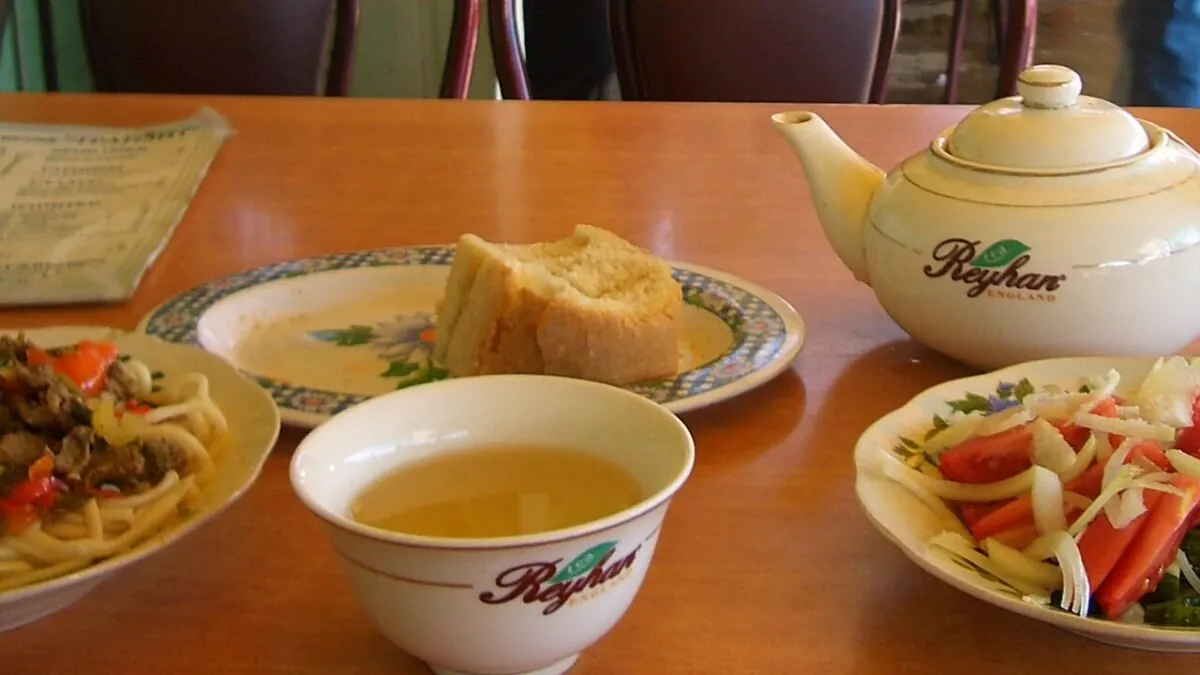
If you eat one dish on repeat in Kyrgyzstan, it will probably be laghman. Laghman is a hand-pulled noodle dish closely associated with Kyrgyzstan’s Dungan and Uyghur cooks, served two main ways: as a brothy soup (suiyuk laghman) or stir-fried with the sauce clinging to the noodles (boso laghman), typically 200-350 KGS a bowl. The noodles are stretched by hand to order, the topping is a stir-fry of beef, peppers, tomato, onion and garlic, and the result is the single most reliable thing you can order in a roadside cafe anywhere in the country.
It is also, quietly, one of the better dishes for travelers who want vegetables on the plate and one of the easier mains to adapt if you don't eat meat. Below: the types worth knowing, where the best versions live, how to order it the way locals do, and what your options are as a vegetarian.
What laghman actually is
The heart of laghman is the noodle. A ball of wheat dough is rested, oiled, and then pulled, coiled, and slapped against the counter until it stretches into long, springy, uneven strands, thicker and chewier than anything you get from a machine. That texture is the whole appeal, and any cafe that respects itself pulls the noodles fresh rather than boiling a dried packet. The sauce, called the tsai or waju, is a fast, high-heat stir-fry of beef, capsicum, tomato, onion, garlic and often a long green pepper, seasoned with soy, cumin and a little chili.
Received wisdom has the dish arriving in Kyrgyzstan with the Dungan (Chinese Muslims who settled here in the 1870s and 1880s) and the Uyghurs, a story that is less documented than it sounds (more on that below). Whatever its route, it kept its Central Asian noodle-shop character, and its close tie to those two communities is why laghman tends to carry more vegetables and more spice than the mild Kyrgyz core of the national cuisine, and why the best bowls are usually found in Dungan and Uyghur cafes rather than in national-cuisine restaurants.
Soup versus fried: the two you'll meet
Almost every laghman decision comes down to soup or fried, and they eat very differently.
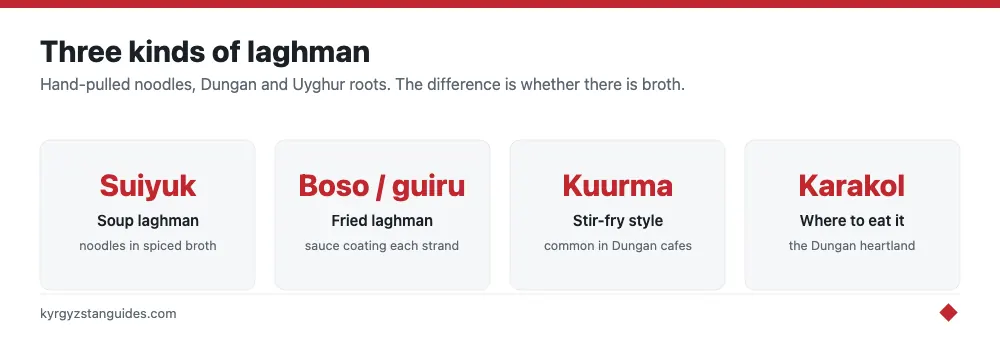
| Type | What it is | Best when |
|---|---|---|
| Suiyuk laghman (soup) | Noodles and stir-fried topping in a spiced broth, eaten with a spoon | Cold days, mountain evenings, when you want something restorative |
| Boso laghman (fried) | Noodles stir-fried with the topping, little or no broth, sauce coating each strand | When you want the noodle texture front and center |
| Kuurma / tsomyan style | Fried noodles closer to a Chinese-style stir-fry, often with extra veg | A change of pace, common in Dungan cafes |
Neither is more authentic than the other; both are everyday orders. If you are cold and tired after a trek, the soup version is the one that fixes you. If you came for the noodles themselves, order it fried. A useful trick: a jar of laza, the oily chili paste, usually sits on the table, so order the dish mild and add heat yourself to taste.
Where the best laghman is
Karakol is the laghman capital, and it isn't close. The town has the country’s largest Dungan community, and its cafes pull noodles that people drive across the region for. If you're anywhere near the eastern end of Issyk-Kul, this is where to eat it, and our Karakol travel guide points you to the streets where the Dungan kitchens cluster. The same town is home to ashlan-fu, so a laghman-and-ashlan-fu afternoon is an easy and very good plan.
Elsewhere, the rule is simple: eat laghman where the room is busiest and where the sign or the crowd hints at a Dungan or Uyghur kitchen. Osh and the southern chaikhanas do strong versions too, tilted a little toward the Uzbek and Uyghur end. Bishkek has plenty of competent laghman, especially in cafes run by Dungan families, though for the truly memorable bowl the east still wins.
Vegetarian laghman
Laghman is more adaptable than most Kyrgyz mains, but it isn't automatically meatless, so a little care helps. The noodles themselves are just wheat, water and oil, and the topping is heavy on vegetables, which is a good start.
- Ask for it “etsiz” (without meat). Many Dungan and Uyghur cafes will happily stir-fry the vegetable topping without the beef.
- Be aware the broth in soup laghman is usually meat-based, so the fried (boso) version is the safer vegetarian bet.
- Dungan and Uyghur kitchens carry the widest range of vegetable dishes, so you have more than laghman to fall back on there.
- In cities you will also find gan fan (rice with a vegetable stir-fry) and plenty of fresh salads to round out a meal.
For the full picture on eating meat-free here, including which dishes are reliably safe and how to brief a guesthouse in advance, see our vegetarian food guide.
The bottom line
Laghman is the order you can trust when you do not know a town, can't read the menu, and just want a good, cheap, filling meal. Get it fried in Karakol at least once for the noodles, keep the soup version in reserve for cold mountain nights, and remember the chili jar is there so you control the heat. Few dishes reward a traveler this consistently for so little money.
There is no UNESCO listing for laghman, and the Uyghur numbers are falling
Laghman gets described as heritage often enough that it is worth stating the position: no UNESCO intangible heritage element anywhere covers laghman, or hand-pulled noodles, in Central Asia or outside it. A search of the whole ICH register for "laghman" returns nothing. A search for "noodle" returns exactly one element worldwide, the Pyongyang Raengmyon custom from North Korea, inscribed in 2022.
Kyrgyzstan does have food on the lists — the multinational flatbread element from 2016 and maksym, the fermented grain drink, added in 2025 — but nothing noodle-related.
The more interesting number concerns the people who brought the dish. Between the 2010 and 2022 censuses, Kyrgyzstan's recorded Uyghur population fell 35%, from 48,500 to 31,600, while the Dungan population grew from 58,100 to 66,500. Both communities are central to noodle cooking here, and they are moving in opposite directions. Nobody serving you laghman will mention it, and it is the kind of context that changes how you read a menu.
One thing I will not do is tell you the dish's origin story with confidence. That laghman reached Central Asia through Uyghur and Dungan migration in the Qing period is plausible and generally held, and I could find no peer-reviewed or primary source establishing it. Take it as received wisdom, not documented history.
Three styles, and where to compare them
Karakol's own destination organisation sets out the distinction more cleanly than most menus do:
Traditional laghman is the soupy one, noodles sitting in a broth you eat with a spoon. Boso laghman is fried — noodles stir-fried with the topping, little or no broth, sauce clinging to each strand. Guyru, also written guiro, is boiled and less soupy than the traditional version, sitting between the two.
Beyond that, the organisation notes that Uyghur, Uzbek and Dungan cooks each have signature styles with different ingredients and herbs, which is why the same dish name produces genuinely different bowls in Karakol, Osh and Bishkek. Karakol is the place to compare all three in one town, and some restaurants there will make a vegetarian version on request.
On price, an honest caveat: no official or statistical series exists for restaurant dishes in Kyrgyzstan. Traveller sources converge on roughly 200-350 som for laghman in a simple canteen or chaikhana in Bishkek or Osh, with mid-range restaurants running 600-1,200 som a head, at an exchange rate near 87 som to the dollar in September 2026. Those are estimates with a date attached, not facts.
Frequently Asked Questions
What is the difference between soup and fried laghman?
Soup laghman (suiyuk) serves the pulled noodles and stir-fried topping in a spiced broth eaten with a spoon, while fried laghman (boso) stir-fries the noodles with the topping so the sauce coats each strand with little or no broth. Both are everyday orders; the fried version showcases the noodle texture, the soup is more restorative.
Where is the best laghman in Kyrgyzstan?
Karakol, which has the country’s largest Dungan community and cafes that pull noodles people travel for. Osh and the southern chaikhanas do strong Uzbek- and Uyghur-leaning versions, and Bishkek has good Dungan-run cafes, but the east is the standout.
Can you get vegetarian laghman?
Yes, with a little care. Ask for it etsiz (without meat) at a Dungan or Uyghur cafe, and choose the fried version, since soup broth is usually meat-based. The noodles are just wheat and the topping is vegetable-heavy, so a meatless stir-fry is easy to arrange.
What is the difference between boso and guyru laghman?
Boso laghman is fried — the noodles are stir-fried with the topping so the sauce clings to each strand, with little or no broth. Guyru, also written guiro, is boiled and less soupy than the traditional version, sitting between the fried and soup styles.
How much does laghman cost in Kyrgyzstan?
Traveller sources converge on roughly 200–350 som a bowl in a simple canteen or chaikhana, with mid-range restaurants running 600–1,200 som a head, at about 87 som to the dollar in September 2026. No official price series exists for restaurant dishes, so treat these as dated estimates rather than facts.
Is laghman on the UNESCO heritage list?
No. No UNESCO intangible heritage element anywhere covers laghman or hand-pulled noodles. Searching the register for "noodle" returns one element worldwide, the Pyongyang Raengmyon custom from North Korea, inscribed in 2022. Kyrgyzstan does have flatbread (2016) and maksym (2025) on the lists.
Who brought laghman to Kyrgyzstan?
The Dungan, Chinese Muslims who settled here in the 1870s and 1880s, and the Uyghurs. That laghman arrived through Qing-period migration is generally held and plausible, but no peer-reviewed or primary source establishing it turned up, so treat the origin story as received wisdom rather than documented history.