Let us correct a common assumption before you pack: the idea that a vegetarian can simply “manage” in Kyrgyzstan by ordering around the meat is optimistic. This is one of the most meat-centered cuisines you'll meet, and pretending otherwise sets you up for a hungry, frustrating trip.
The honest reality: Kyrgyz national food is built on mutton, horse, beef, dairy, and bread, and a strict vegetarian will need to plan actively — leaning on Dungan and Uyghur restaurants, self-catering from bazaars, and a few reliable fallbacks in the cities. It's entirely doable, but it does not happen by accident. We research this for Indian and other vegetarian travelers rather than eating our way across the country ourselves, so take the guidance below as a practical map, not a personal food diary.
Why the cuisine is so meat-heavy
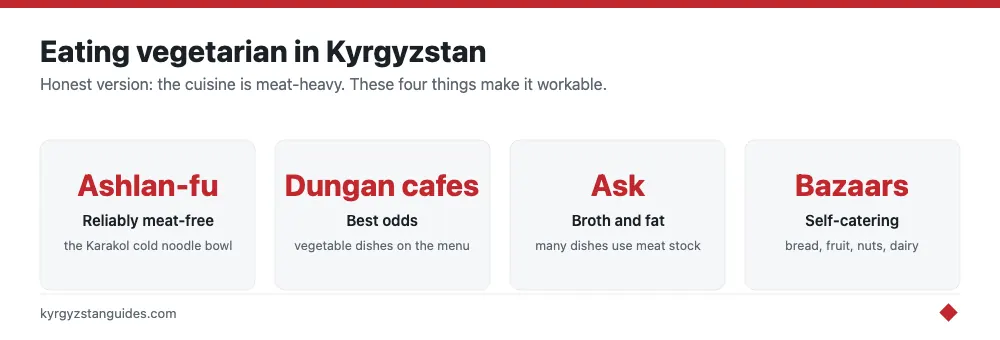
Kyrgyz food grew out of a nomadic, herding life, and it shows. The signature dishes — beshbarmak (boiled meat over noodles), plov (rice cooked with meat and fat), and the ubiquitous shashlik (grilled skewers) — are meat first and foremost. Even where a dish looks vegetable-forward, the stock, the fat, or a scattering of meat is often part of it. Broth made from bones underpins a lot of the cooking, so “vegetable” soup isn't a safe assumption.
This is not hostility to vegetarians — the concept is simply unfamiliar in much of the country, especially in rural areas and yurt camps where the menu is whatever the family cooks. Understanding that going in changes how you approach every meal: you aren't looking for a vegetarian menu, you're assembling vegetarian meals from what exists. Our broader Kyrgyz food guide walks through the national dishes one by one, including which are quietly meat-free.
What you actually can eat
The good news is that the building blocks of a decent vegetarian diet are all present and cheap. Bread is everywhere and excellent — fresh nan comes with almost every meal. Fresh tomato-and-cucumber salads are a summer staple. Dairy is abundant: yogurt, cheese, butter, and the fermented drinks Kyrgyz families make. Eggs are easy to find, and bazaars overflow with fruit, nuts, potatoes, and vegetables in season.
Where things get genuinely good is the regional cuisines. Dungan and Uyghur communities — ethnic groups with roots in western China — cook a style that includes real vegetable dishes, and their restaurants are your single best friend as a vegetarian. Look especially for:
- Vegetable laghman — hand-pulled noodles tossed with fried vegetables; ask for it without meat and it is a proper meal.
- Fried vegetable dishes and stir-fries in the Uyghur style, often built around peppers, cabbage, and potato.
- Ashlan-fu — a cold Dungan noodle dish from the Karakol area that's often vegetarian or easily made so; a local specialty worth seeking out.
- Manti or samsa — usually meat-filled, but pumpkin versions exist; always confirm before ordering.
In Bishkek and Osh you also have a genuine safety net: Indian restaurants, pizza places, and international cafes where a vegetarian meal is straightforward. Treat those cities as the places to eat well and stock up before heading into the mountains, where choice narrows sharply. Karakol, with its Dungan heritage, is a bright spot in the east; our Karakol travel guide points to the food scene there.
Self-catering is your real strategy
For anyone stricter than a flexible vegetarian, self-catering is not a backup plan — it is the plan. Bazaars in every town sell fruit, vegetables, nuts, rice, lentils, bread, and dairy for very little, and most guesthouses and homestays have a kitchen you are welcome to use. Cooking your own food a few nights removes all the guesswork and often eats better than the local canteen.
Carry a stash of familiar food from India for the road: ready-to-eat mixes, instant meals, spice sachets, and dry snacks travel well and rescue you at yurt camps and on long transport days where nothing vegetarian is on offer. Specialty Indian ingredients are scarce outside Bishkek, so bring what you can't live without. A small jar of a favorite masala turns plain bazaar vegetables into something that tastes like home. If you are planning a homestay-heavy trip, our Kyrgyzstan yurt stay guide explains how meals work when you're staying with a family — useful for arranging a vegetarian version ahead of time.
Phrases that save meals
A few words in Russian — the lingua franca — go a long way, because “vegetarian” isn't a concept every cook will parse. The most useful is to state plainly that you do not eat meat rather than trusting the label. Learn to say, roughly, “ya ne yem myaso” (I don’t eat meat) and “bez myasa” (without meat), and be specific: some cooks count chicken or fish as not-meat, and broth as not-meat. Naming the things you avoid — meat, chicken, fish, broth — works better than the word vegetarian alone.
Pointing at ingredients at the bazaar, showing a written note in Russian, or using a translation app all help. Patience and a smile do the rest; the unfamiliarity is genuine, not rudeness, and most people will try hard to feed you once they understand.
Notes for Jain travelers
Jain travelers face the steepest challenge, and honesty serves you better than reassurance here. Avoiding onion, garlic, and root vegetables in a cuisine that leans heavily on potatoes and onions means restaurant food is rarely reliable, and even Dungan vegetable dishes usually include both. For a strict Jain diet, self-catering is effectively mandatory.
The workable approach is to base yourself where guesthouse kitchens are available, shop the bazaars for fruit, permitted vegetables, rice, and dairy, and carry a substantial supply of Jain-friendly ready food from India for the days when cooking is not possible — long transport days, remote yurt camps, and trailhead nights. Fruit, nuts, bread, and dairy will carry you a long way when a full meal isn't an option.
The bottom line, with a warning
Vegetarians can eat well in Kyrgyzstan, but only the prepared ones do. The traveler who assumes it'll sort itself out ends up living on bread and cucumber; the one who maps out Dungan restaurants, uses guesthouse kitchens, learns three Russian phrases, and packs a food stash from home eats variously and cheaply.
So take this as the warning to act on before you go: don't rely on finding vegetarian food once you are in the mountains. Stock up in Bishkek or Osh, confirm your homestay can cook meat-free, carry emergency food for the remote days, and never assume a soup or a “vegetable” dish is free of broth or meat without asking. Get those habits in place and the meat-heavy reputation stops being a problem — ignore them and it very quickly becomes one.
FAQ
Is Kyrgyzstan difficult for vegetarians?
Yes, and the idea that you can simply order around the meat is optimistic. This is one of the most meat-centred cuisines you will meet — national food is built on mutton, horse, beef, dairy and bread — and a strict vegetarian needs to plan actively rather than improvise.
Where should vegetarians eat in Kyrgyzstan?
Lean on Dungan and Uyghur restaurants, self-cater from bazaars, and use a few reliable fallbacks in the cities. Those cuisines brought the noodles and vegetables into the local food landscape and are where the options actually are.
Can a vegan travel in Kyrgyzstan?
It is harder again, because dairy is as central as meat here — butter, cream, fermented milk and cheese run through the everyday diet. Self-catering from bazaars becomes less of a supplement and more of the main strategy.
Will guesthouses cook vegetarian food?
Often, if you ask clearly and in advance. The difficulty is that “no meat” is not always understood as excluding meat stock or animal fat, so it is worth being specific rather than assuming.
Is vegetarian travel in Kyrgyzstan doable?
Entirely doable, but it does not happen by accident. The difference between a good trip and a hungry one is whether you planned for it before arriving.
Why is Kyrgyz food so meat-heavy?
Because it is nomad food. A pastoral economy at altitude produced a cuisine built around what livestock provide — meat and dairy — with bread and onions alongside, and vegetables arriving later through the borrowed Uzbek, Dungan and Uyghur dishes.