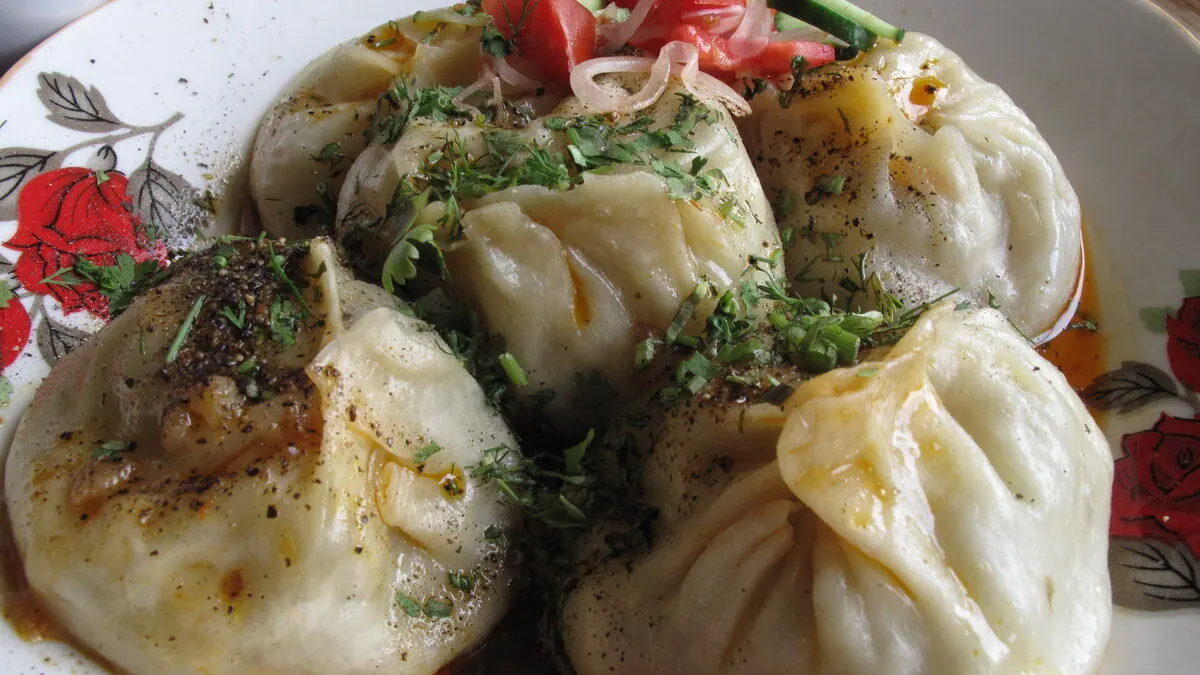
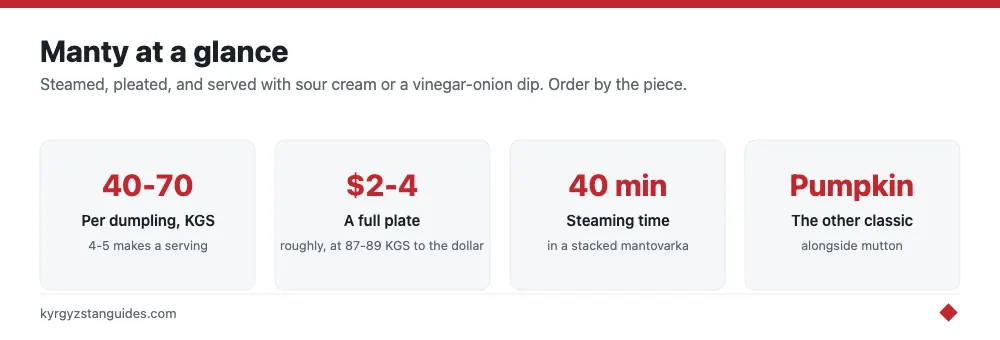
Manty is a palm-sized steamed dumpling, and in Kyrgyzstan the good ones are made with hand-chopped mutton and onion, sometimes pumpkin in autumn, then eaten with your fingers after you bite a corner off to let the broth out. A plate costs around 400 som in a mid-range Bishkek café in 2026 (about $4.50), or 475 som for five at the Navat chain, and the best come out of a stacked metal steamer called a mantovarka, not a microwave. They are bigger, juicier, and less fussy than their Chinese cousins, and they are one of the few dishes here that a non-meat-eater can actually count on, thanks to the pumpkin version.
Below is what the filling really is, how locals eat them without wearing the juice, where to find a proper plate, and how the Kyrgyz version differs from the Chinese and Turkish dumplings that share the name. Prices assume 1 USD around 87-89 KGS.
What’s actually inside
The classic filling is mutton and onion, and the detail cooks are proud of is that the meat is chopped by knife, never put through a mincer. Ask why and you'll get a small lecture: minced meat goes to paste and weeps its juice into the steamer, while hand-chopped meat holds its texture and keeps the fat in little pockets that melt into broth as the dumpling cooks. A knob of fat-tail sheep fat usually goes in too, which is the whole point of the juice you are about to spill down your wrist.
Then there is pumpkin. From roughly September through the winter, kabak (pumpkin) manty appear on menus and at bazaar canteens, sometimes mixed with a little meat, sometimes entirely meat-free. This is the quiet vegetarian win of the Kyrgyz autumn, and it's genuinely good rather than a consolation prize — sweet, dense, faintly nutty, and often the plate that regulars order by choice. Potato manty turn up occasionally in the same spirit. If you don’t eat meat, the phrase to learn is “etsiz” (without meat), and pumpkin season is your window. Manty also have a rolled, sliced cousin, oromo, which has its own guide.
The dough is a plain unleavened wheat wrapper, rolled thin, pleated into a pouch or twisted into a little topknot, and steamed for around 40-45 minutes. That steaming, not boiling or frying, is what separates real manty from the frozen imitations. You want the wrapper tender but intact, holding a spoonful of broth that survives until your first bite.
How to eat them without a mess
Manty are finger food, and there is a technique. Pick one up, bite a small hole in the top or side, and sip or let the hot broth run out before you eat the rest — committing to a full bite of an untouched dumpling is how you end up with mutton fat on your shirt and a burnt tongue at once. A fork is fine in city restaurants and no one will judge you, but the dumpling was designed for a hand.
They usually arrive with something sharp to cut the richness: a dab of vinegar, a smear of chili paste, or a spoonful of thin sour-cream or tomato-and-onion sauce depending on the kitchen. Four or five is a light meal, six to eight is a proper one, and portions are honest: order conservatively the first time. Tea, not soda, is the correct partner, and it keeps coming.
Where to find the good ones
The reliable rule is the same as for most food here: the busiest window is the right window. At Osh Bazaar in Bishkek there is often a line at the manty steamer before the first lid comes off in the morning, which tells you everything about turnover and freshness. National-cuisine restaurants do a tidy sit-down plate; bazaar canteens and roadside cafes do them cheaper and, frequently, better, because the volume keeps the steamer moving. Our Bishkek guide points to the bazaar food stalls worth your morning.
Guesthouse and yurt-stay kitchens are the other place manty shine, especially the homemade pumpkin ones, and if you're booking a yurt stay it is worth asking whether the family makes them. For the wider menu, beshbarmak, plov, laghman, and the rest of the dumpling family, our Kyrgyz food guide lays out what to order and what it costs. Two ordering habits help: eat the big plate at lunch when the steamer is freshest, and don’t order manty at a place whose sign screams shashlik — specialists beat generalists here every time.
Manty vs the Chinese and Turkish versions
The name travels across Central Asia and beyond, but the dumplings diverge. Chinese baozi and jiaozi are the distant relatives most travelers know: baozi use a leavened, fluffy bun dough and are often steamed as soft pillows, while jiaozi are small, thin-skinned, and usually boiled or pan-fried, eaten a dozen at a time with a soy-and-vinegar dip. Kyrgyz manty sit apart on all three counts — unleavened wrapper, much bigger, steamed, and eaten in single figures because each one is a mouthful and a half of meat and juice.
Turkish mantı run the opposite direction: tiny dumplings, sometimes barely fingernail-sized, boiled and drowned in garlicky yogurt with a drizzle of chili-butter on top. Delicious, but a different dish entirely — there the sauce is the event and the dumpling is the vehicle. Central Asian manty, the Kyrgyz one included, keep the dumpling itself center stage: the broth lives inside, the fat is the flavor, and the sauce is a supporting note you can take or leave. If you have eaten dumplings anywhere from Xi’an to Istanbul, arrive without assumptions.
The verdict: manty is the easiest of Kyrgyzstan’s headline dishes to love on the first try, the safest bet for a light meal, and (in pumpkin season) the most dependable plate for anyone skipping meat. Find the steamer with the line, order five, bite a corner first, and let the broth do the rest.
The origin story everybody repeats, and why it does not hold up
Two claims follow manty around. The first is that the Turkic word is the parent of Chinese mantou, Korean mandu and Greek manti. The second is that the dish first appears in writing in Hu Sihui's Yinshan Zhengyao of 1330.
Neither survives a look. The direction of borrowing between the Turkic, Chinese and Korean words is genuinely contested and I could find no philological work establishing it either way, only food writing asserting it. And the 1330 citation traces back through mirrors rather than to the text: an independent reading of Yinshan Zhengyao describes a boiled dumpling of mutton, sheep's fat, onion, mandarin peel and ginger, and does not mention manti at all. A 15th-century Ottoman cookbook is sometimes offered instead, equally unconfirmed.
So the honest position is that manty is old, that it is shared across a huge stretch of Asia, and that nobody writing in English has shown where it started. That is less satisfying than a date, and more accurate than one.
While we are clearing things up: no UNESCO intangible heritage element anywhere covers manti, dumplings or dumpling-making. Kyrgyzstan's only two food-related inscriptions are the multinational flatbread element of 2016, covering lavash, katyrma, jupka and yufka, and maksym, the fermented grain drink, added in 2025.
What separates a Kyrgyz manty from the others
The filling is the tell. The Karakol destination organisation documents lamb and onion as the traditional filling, with pumpkin as a seasonal variant rather than a year-round option, and Karakol specifically known for the jusai version, made with garlic chives. Ask for jusai manty in Karakol and you will get a nod you would not get in Bishkek.
Juiciness comes from fat, deliberately: fat-tail or internal lamb fat goes into the mix, and pumpkin does the same job in the vegetable versions. The accompaniment is laza, roasted chilli in oil, and depending on the house you may also get vinegar and broth, butter and pepper, or soured milk.
They are steamed and only steamed, in a stacked multi-tier pot called a manty-kaskan, Russified as a mantovarka, with perforated trays. Reckon 40 to 45 minutes of steaming. If someone offers you a boiled manty, they are making something else.
For contrast, the Turkish end of the family is unrecognisable: Kayseri mantı are pea-sized and boiled, served under garlicky yoghurt with chilli butter and sumac, and locals joke that forty should fit on a spoon. Central Asian manty are a two-bite proposition at minimum.
What they cost, and the January 2026 jump
Prices here moved sharply and recently, so old figures will mislead you. At the Navat chain in Bishkek, meat manty run 475 som for five pieces. At the budget end, a place called Manty 199 opened in central Bishkek in January 2025 selling a portion at 199 som across six varieties.
Then came a rule change with a very visible effect. From 1 January 2026 the Kyrgyz cabinet banned separately itemised service charges. Bishkek cafés folded the old 10-15% into their menu prices, and manty portions that had been 200-250 som went to 400. If you are comparing against a guide written in 2025, expect 60-100% more, close to double at the cheaper end.
One caution on southern prices: I could not find any current, checkable price source for Osh, so treat any Osh figure you read, including a confident one, as unverified.
FAQ
What are manty?
Steamed dumplings, traditionally filled with lamb and onion, cooked only by steam in a stacked multi-tier pot called a manty-kaskan for about 40 to 45 minutes. They are a two-bite item at minimum, not the small boiled dumplings of Turkey.
Where did manty come from?
Nobody has shown it. The common claims - that the Turkic word gave rise to Chinese mantou and Korean mandu, and that the dish first appears in a 1330 Chinese text - are not supported by any source that stands up. The dish is old and shared across Asia; the origin is unsettled.
What is the difference between Kyrgyz and Turkish manty?
Almost everything except the name. Kyrgyz manty are large and steamed, filled with lamb, onion and fat. Kayseri manti in Turkey are pea-sized and boiled, served under garlicky yoghurt with chilli butter and sumac.
What is jusai manty?
Manty filled with garlic chives, a version Karakol is specifically known for. Pumpkin manty are the other common variant, though they are seasonal rather than available year-round. Karakol's other food specialities are Dungan rather than Kyrgyz: ashlyanfu and ganfan.
How much do manty cost in Bishkek?
Around 400 som for a portion in a mid-range café as of 2026. They were 200-250 som until the cabinet banned separately itemised service charges on 1 January 2026 and venues folded the 10-15% into menu prices. The Navat chain charges 475 som for five.
Are manty UNESCO heritage?
No. No UNESCO element anywhere covers manti or dumpling-making. Kyrgyzstan's only food-related inscriptions are the multinational flatbread element of 2016 and maksym, the fermented grain drink, added in 2025.