How should you get from Bishkek to Osh? For most travelers, fly. A one-way ticket runs about $40-60, the flight takes roughly an hour, and it turns a punishing travel day into a lunchtime hop. The alternative is 10-12 hours in a shared taxi or marshrutka grinding over two mountain passes on the M41. A spectacular drive, but one that eats a full day and, in bad weather, more than that.
Kyrgyzstan is split by mountains, and Osh sits in the Fergana Valley on the far southern side. There is no train. So the choice comes down to a short cheap flight or a long scenic slog by road. We think the flight wins on almost every trip, but the road has a real case on the right day. This guide lays out both, with 2026 prices (1 USD is about 87-89 KGS).
The Flight: Fast, Cheap, and Usually the Answer
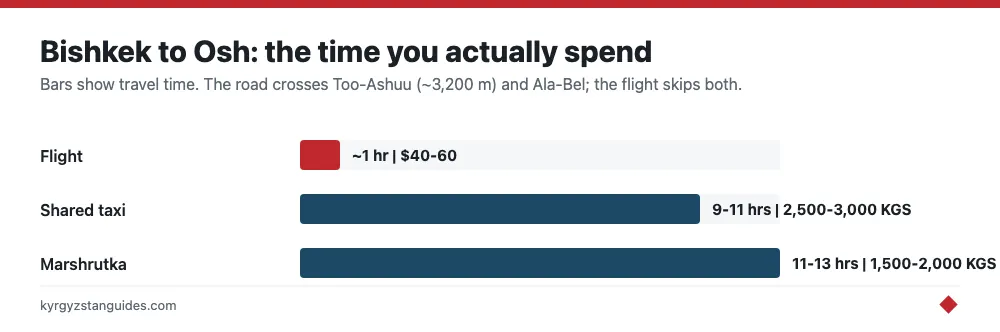
Bishkek (airport code BSZ since August 2025, formerly FRU, out at Manas) and Osh (OSS) are connected by several flights a day. The state carrier Asman Airlines is the one confirmed flying the route; Tez Jet, long a mainstay here, had its operating certificate annulled on 10 July 2026. The hop is about an hour in the air, and fares typically land in the $40-60 range one-way when you book even a few days ahead. Buy on the airlines’ own sites or through aero.kg, which aggregates domestic schedules and prices in one place.
These are small regional jets and turboprops, so baggage allowances are tight. Expect around 20 kg checked and a strict cabin limit, with trekking gear or excess bags charged extra at the counter. Book ahead in July and August and around public holidays, when seats sell out and last-minute fares climb toward $80-90. Schedules also shift with weather and demand, so treat any tight onward connection with suspicion and leave buffer. In winter (roughly December to March), flying is often the only reliable way south at all, because the passes can close after storms.
One underrated benefit: flying into Osh lets you run the country one direction, north to south, or south to north, instead of doubling back. Land in Osh, work your way up through Arslanbob, Sary-Chelek and the lakes, and finish in Bishkek without ever backtracking or repeating a road day.
The Road: 10-12 Hours Over the M41
The overland route is the M41, the Bishkek-Osh highway. And it's one of Central Asia’s great drives. From Bishkek it climbs the Too-Ashuu pass (through a long, dank Soviet tunnel near 3,200 m), drops into the wide green Suusamyr valley, crosses the Ala-Bel pass, then runs the shore of the Toktogul reservoir (a startling band of turquoise against dry hills) before the long descent into the Fergana Valley and Osh. The scenery lives up to everything drivers say about it.
You cover it two ways. A shared taxi (usually a Toyota Camry, four passengers) costs around 2,500-3,000 KGS per seat and takes 9-11 hours. A marshrutka minibus is cheaper at roughly 1,500-2,000 KGS but slower and more cramped, closer to 11-13 hours with stops. Both leave from Bishkek’s west-direction bus station at Frunze 209, departing when full rather than on a timetable, so morning is the safe window. Confirm the per-seat price before you get in, carry cash in small notes, and buy a second seat if you're tall — it is normal here and transforms the ride. For the full breakdown of stations and fares, see our guide to getting around Kyrgyzstan.
Flight vs Road, Side by Side
| Flight (BSZ-OSS) | Road (M41) | |
|---|---|---|
| Price | $40-60 one-way (up to $80+ last-minute) | Shared taxi 2,500-3,000 KGS; marshrutka 1,500-2,000 KGS |
| Duration | ~1 hour in the air | 10-12 hours door to door |
| Comfort | High (short, seated, over by lunch | Low to medium) cramped, long, but scenic |
When the Road Is Actually Worth It
We default to flying, but there are specific situations where the M41 makes sense. Take the road when the scenery is the point. If you came to Kyrgyzstan for landscape and have a spare day, the Suusamyr valley and Toktogul shore are worth a whole day of your attention, not a glance from 30,000 feet. Take it if you want to break the journey: some travelers stop overnight near Toktogul or in Suusamyr, stretching the drive into a two-day trip with a mountain guesthouse in the middle. And take it if flights really are sold out in peak season and your dates won’t move.
Skip the road if you are short on time, prone to motion sickness (the switchbacks are relentless), traveling in winter, or simply want to arrive in Osh with energy left to explore. The Osh travel guide covers the Sulaiman-Too mountain and the great bazaar you’ll want fresh legs for. Whichever way you go, bookend the trip with a day in the capital — our things to do in Bishkek covers the parks, bazaars and easy day trips worth catching before you head south.
Day vs Night Travel
If you do drive, go by day. Shared taxis run the route overnight, and locals use them to save a night’s accommodation, but we wouldn't. The M41 at night combines high passes, tired drivers, unlit trucks, potholes and livestock wandering onto the asphalt, and on top of that you miss the scenery, which is half the reason to choose the road in the first place. Leave Bishkek at 6 or 7 am so you reach Osh before nightfall. An overnight taxi saves you the price of a guesthouse bed and very little else.
Booking, Step by Step
For the flight: check aero.kg or the Asman Airlines site, book 3-7 days out in high season, and pay by card. Foreign cards usually work; if one is declined, try another or book through a Bishkek travel agency for a small fee. For the road, just show up at Bishkek’s west-direction bus station on Frunze 209 in the morning: no advance booking, cash only. Either way, this leg is cheap by any standard, so it barely dents a Kyrgyzstan travel budget.
Two things changed for Kyrgyz aviation in 2026: the EU lifted its twenty-year ban on all Kyrgyz carriers in June, and a month later TezJet lost its licence after a runway accident. Our guide to domestic flights covers who actually flies now.
Frequently Asked Questions
How long is the flight from Bishkek to Osh?
The flight takes roughly one hour in the air. Adding check-in and airport time, budget about three hours door to door. Still a fraction of the 10-12 hours the same trip takes by road over the mountains.
How much does a Bishkek to Osh flight cost?
Expect about $40-60 one-way when booked a few days ahead with Asman Airlines or through aero.kg. Last-minute seats in July, August and around holidays can climb to $80-90, so book early in peak season.
Is the Bishkek to Osh road safe?
By day, yes: it’s a busy main highway, though the mountain switchbacks demand an alert driver. Avoid traveling it at night, when unlit trucks, potholes, tired drivers and livestock make the passes genuinely risky. In winter, passes can close after storms.
Which airlines fly Bishkek to Osh?
Asman Airlines is the confirmed operator on the route. Tez Jet, long a mainstay, had its operating certificate annulled on 10 July 2026 after a runway accident, so older guidance naming it is out of date. Two things changed for Kyrgyz aviation in 2026: the EU lifted its twenty-year ban on all Kyrgyz carriers in June, and TezJet lost its licence a month later.
Which bus station do Osh-bound services leave from in Bishkek?
Frunze 209, the west-direction station. This matters because Bishkek's Western Bus Station and the "Akzhol" mini-station both closed on 23 October 2024. East-direction routes for Issyk-Kul, Karakol, Kochkor and Naryn now go from Alma-Atinskaya 1/1. Any source sending you to the Western Bus Station is out of date.
What does the Bishkek to Osh road actually cross?
The M41 climbs the Too-Ashuu pass through a long Soviet tunnel near 3,200 m, drops into the Suusamyr valley, crosses the Ala-Bel pass, then runs along the Toktogul reservoir before descending into the Fergana valley. It is one of Central Asia's great drives and takes 9–13 hours depending on vehicle.
Should I travel the Bishkek-Osh road at night?
No. Shared taxis run overnight and locals use them to save a night's accommodation, but the M41 at night combines high passes, tired drivers, unlit trucks, potholes and livestock on the asphalt — and you miss the scenery, which is most of the reason to choose the road. Leave at 6 or 7 am to arrive before dark.