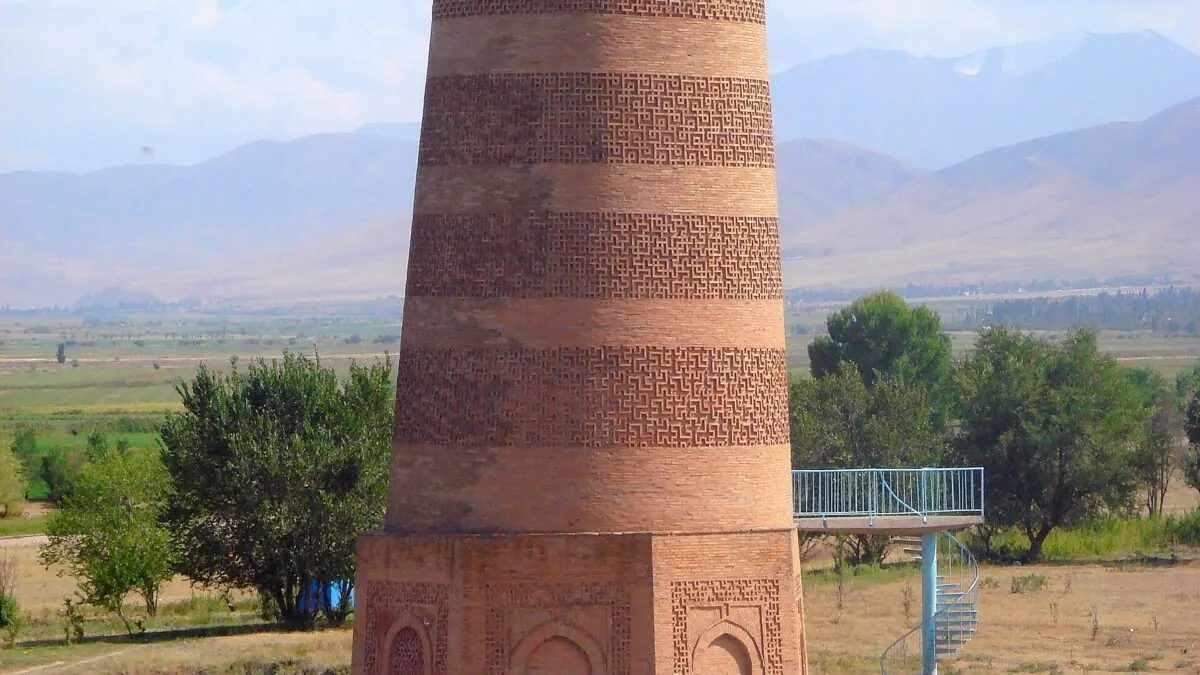
What does a thousand-year-old city look like when almost nothing survives above the grass? At Burana, it looks like a single brick tower standing alone on the Chuy plain, a scatter of carved stone figures, and the low mounds of everything the earthquakes took down.
The Burana Tower is an 11th-century minaret near Tokmok, about 71 km east of Bishkek by UNESCO's reckoning, and it is the most accessible ancient site in the country — an easy half-day trip with a modest entry fee, a climbable tower, an eerie field of balbal stones, and a small museum. It marks the site of Balasagun, a former Silk Road capital of the Karakhanid dynasty that has otherwise almost entirely vanished.
A capital that mostly disappeared
Balasagun was a real city — a Karakhanid and later regional capital on the Silk Road, prosperous in the 10th and 11th centuries. What you see today is what earthquakes and time left behind: the tower, reduced from an estimated original 40-plus meters to about 24 today, grave markers, and grassed-over foundations. The minaret was once attached to a mosque long gone. Standing at its base, the interesting mental exercise is imagining the busy city that filled the empty plain around it. This is a site you read as much as look at, which is why the on-site museum matters.
The balbal stones
The most photographed feature after the tower is the open-air collection of balbals, carved stone figures, some clutching a cup to the chest, gathered from across the Chuy valley and set up in rows on the grass. They are Turkic grave markers, most from roughly the 6th to 10th centuries, thought to represent the dead or defeated enemies. Wandering among the weathered faces is quietly strange, and it's free to walk the field. Alongside them sit petroglyphs and millstones, the ordinary debris of a vanished settlement. For where this fits in the broader story of the region’s nomads, our nomadic culture guide is a useful companion read.
Climbing the tower
Yes, you can climb it, and you should. A steep, narrow, dark spiral staircase inside the brickwork winds up to a viewing platform near the top, from which the whole Chuy plain and the wall of the Tian Shan spread out. Two honest warnings: the internal stairs are cramped, unlit in stretches, and not for anyone uneasy with tight spaces or steep steps, and the external metal staircase to the entrance can be exposed. Bring a phone torch, wear grippy shoes, and take it slowly. It is a short climb but a genuine one; if the stairs are out of reach, the balbal field and museum are on flat ground, as our accessible travel guide notes.
The museum and the practicalities
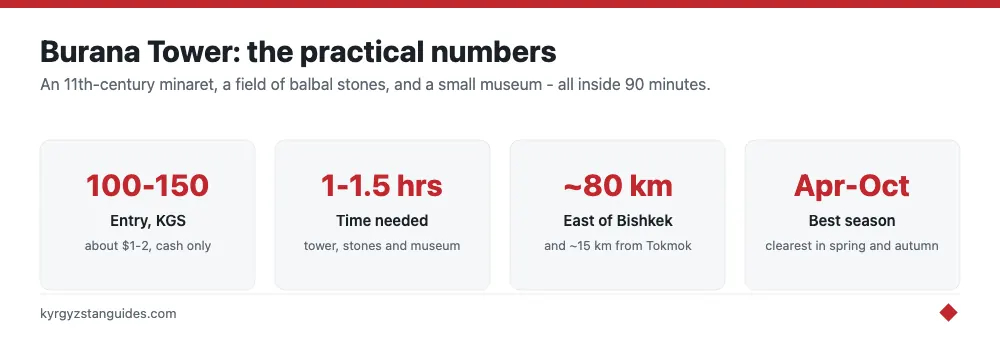
A small museum near the entrance holds finds from the site (coins, ceramics, jewelry, and carved fragments) and gives the context that turns a lone tower into a story. It's compact; 20–30 minutes covers it. Here is the practical picture:
| Detail | What to expect |
|---|---|
| Entry | Around 100–150 KGS ($1–2), cash |
| Time needed | 1–1.5 hours for tower, stones, and museum |
| Location | ~15 km from Tokmok, ~71 km east of Bishkek |
| Best season | April–October; clearest in spring and autumn |
There is little shade and no real cafe on site, so bring water and a hat in summer, when the plain gets hot. Spring, when the Chuy valley greens up and the mountains still hold snow, and autumn are the most pleasant times to come.
Making it a day trip from Bishkek
Burana is one of the simplest half-days out of the capital. There is no direct public transport to the tower itself, so the usual approach is a marshrutka from Bishkek’s eastern bus station to Tokmok (about 80 KGS, 1.5 hours), then a short taxi from Tokmok to the site and back with a wait, roughly 300–500 KGS for the car. Easier still is hiring a taxi or driver from Bishkek for a half-day round trip, around 2,500–4,000 KGS depending on your bargaining and wait time: reasonable split between a few people. Booking a half-day tour is the hands-off option. For the mechanics of marshrutkas and taxis, see our getting around Kyrgyzstan guide.
Burana pairs well with other Chuy-valley stops on the way back: the Konorchek canyons and Ala-Archa are both feasible extensions for an energetic day, and Shamsi gorge, ninety minutes from the capital, is another — a hunting concession in its former life, now a snow leopard sanctuary, with no ticket, no facilities and almost no visitors. The road to Tokmok passes Kant, twenty kilometres east of Bishkek, which has a cement works that opened a new line in 2025 and a Russian air base that has been there since 2003. Bishkek itself has a tangled story — three names, and no settled answer on what the current one means: see Pishpek, Frunze, Bishkek. Burana slots naturally into a longer capital-region plan; our roundup of things to do in Bishkek shows where it fits. On its own, though, it's a two-hour visit, not a full day, so plan the rest of your time accordingly.
A final word of caution, because it catches people out: manage your expectations. This isn't a restored, monumental complex, it is one weathered tower and a field of stones on an open plain, and travelers who arrive expecting a grand Silk Road ruin sometimes leave underwhelmed. Come for the atmosphere and the thousand years of history under your feet, read the museum first so you know what you are looking at, and it delivers. Arrive expecting a spectacle and it won’t.
It is a World Heritage Site, and almost nobody mentions it
Burana is not merely an old tower on a plain. It is an inscribed component of a UNESCO World Heritage property: Silk Roads: the Routes Network of Chang'an-Tianshan Corridor, inscribed in 2014 as a transnational property shared by China, Kazakhstan and Kyrgyzstan, running 5,000 km and comprising 33 components in all.
Burana is component 1442-009, "City of Balasagun (Site of Burana)", with a core zone of 36.58 hectares inside a buffer zone of 1,900 hectares. The property was inscribed on criteria (ii), (iii), (v) and (vi). Kyrgyzstan holds exactly three of the 33 components, and all three are within an easy drive of Bishkek: Burana, the city of Suyab at Ak-Beshim, and Nevaket at Krasnaya Rechka. If you have come this far, the other two are worth the extra hour.
UNESCO's statement of outstanding universal value singles Burana out for one thing specifically: as the corridor's marker of early Islam, set against Zoroastrianism, Manichaeism and Nestorian Christianity documented elsewhere along the route. That is the frame to hold while you are looking at it. This was where one religion arrived and settled in among several others.
How much of the tower is missing, and who put it back
The figure that makes Burana make sense is the one you cannot see. The minaret originally stood somewhere around 45 to 46 metres. What survives is 24 to 25 metres. Roughly half the structure is gone, taken down by earthquakes, with the decisive collapse usually placed in the 15th century. Sources vary by a metre at each end, which is why the stump is quoted as both 24 and 25 m.
What you climb is therefore a base, not a tower. The internal spiral stair is lit by two windows, and it is tighter and darker than people expect. The brick is fired clay, and the structure did double duty as minaret and watchtower.
It has been rebuilt twice in the modern era, in 1927-28 and again in 1970-74, with the archaeological and museum complex established in 1976. So the tidy, re-pointed look of the lower courses is not a thousand years old. Knowing that is not a disappointment, it is the difference between reading a ruin and reading a restoration.
The city underneath, and the man who came from it
Balasagun was founded in the 10th century on an older settlement, and after the Karakhanid state split it served, with Kashgar, as a capital of the Eastern Khanate. The Mongols spared it and renamed it Gobalik, the good city. By the 15th century it had disappeared.
The excavated footprint runs to 25-30 km², with a central fortress, bazaars, four religious buildings, a bathhouse, two rings of walls and a ceramic water main that piped water in from a nearby canyon. Surveys ran in the 1920s, the 1950s and the 1970s. Standing on the grass, what you are actually standing on is a city the size of a modern district, of which one broken minaret and a scatter of stones remain above ground.
Its best-known son is Yusuf Balasaguni, born and educated here, author of the Kutadgu Bilig, the 11th-century Turkic mirror-for-princes that is one of the foundational texts of Turkic literature. Kyrgyzstan puts him on its money. He came from this field.
FAQ
Is Burana Tower a UNESCO World Heritage Site?
Yes. It is component 1442-009, "City of Balasagun (Site of Burana)", of the transnational Silk Roads: Chang'an-Tianshan Corridor property, inscribed in 2014 by China, Kazakhstan and Kyrgyzstan. Its core zone is 36.58 hectares.
How tall is the Burana Tower?
About 24-25 metres today, from an original of roughly 45-46 metres. Earthquakes took the upper half, with the decisive collapse generally placed in the 15th century.
What was Balasagun?
A Karakhanid city founded in the 10th century that served, with Kashgar, as a capital of the Eastern Khanate. The Mongols spared it and renamed it Gobalik. It had vanished by the 15th century. The excavated area covers 25-30 km².
What are the balbal stones at Burana?
Carved stone figures used as grave markers, gathered into a field beside the tower. They were brought here from around the region rather than found in place. Counts given on site range from about 80 to 100; no official figure has been published.
How do you get to Burana Tower from Bishkek?
It is about 71 km east. Take a marshrutka from the Eastern Bus Station to Tokmok, roughly 80-120 KGS and 1 to 1.5 hours, then a taxi for the last 12 km or so, around 300-500 KGS return with waiting time.
Can you climb the Burana Tower?
Yes. A narrow internal spiral staircase lit by two windows goes to the top of the surviving stump. From up there you are standing over Balasagun — the capital whose rulers may lie in the Kök-Tash tomb a valley away. It is tight and dark, and not for anyone uneasy in confined spaces.