Start with two animals that are not in Kyrgyzstan, because they are the ones people worry about.
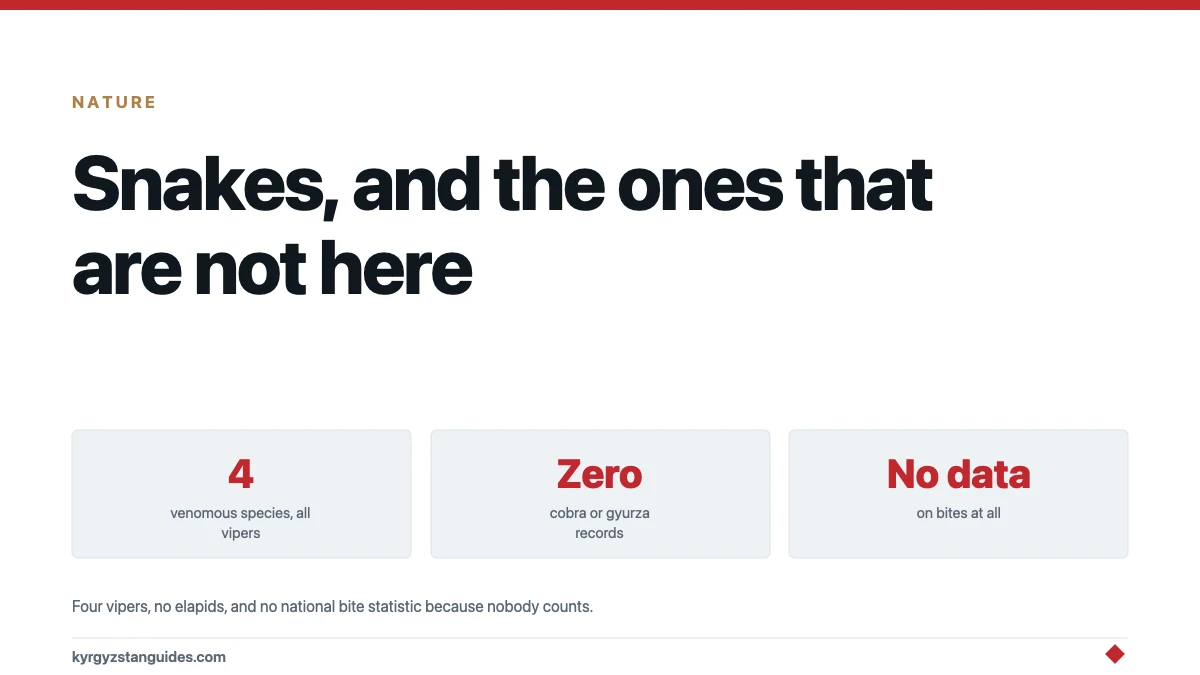
There are no records of the blunt-nosed viper, the gyurza, and no records of the Central Asian cobra in the occurrence data for this country. Both turn up in Central Asian writing and get attached to Kyrgyzstan by association. Neither appears in 752 reptile records from Kyrgyzstan resolving to 35 species.
We are stating that as strong evidence rather than proof, because occurrence records are not a formal checklist. But if someone tells you there are cobras here, ask what they are citing.
What is actually venomous
Four species, all vipers. No elapids at all — no cobras, kraits or their relatives, which is the family responsible for most of the world's neurotoxic bites.
| Species | Records | Notes |
|---|---|---|
| Halys pit viper, Gloydius halys | 35 | The commonest venomous snake here |
| Gloydius caraganus | 10 | Recently split from G. halys |
| Steppe viper, Vipera renardi | 12 | Red Data Book listed |
| Gloydius rickmersi | 3 | A recently described high-altitude pit viper |
A common adder appears once in the record, which is almost certainly a misidentification or a mapping error rather than a population.
Russian-language herpetological summaries put both the steppe viper and the Halys pit viper in Kyrgyzstan up to 3,000 to 3,200 metres, the steppe viper in desert and semi-desert, the pit viper across a wider range including mountains. A Halys pit viper runs to about 70 centimetres of body with a 10-centimetre tail, brownish to yellowish-grey in steppe populations.
Nobody counts the bites
We looked for a Kyrgyz snakebite statistic. There isn't one.
No national incidence figure, no hospital case series, no fatality record that we could find. The World Health Organization's global assessment puts the world burden at roughly 5.4 million bites and 81,000 to 138,000 deaths a year, and locates that burden in sub-Saharan Africa, South Asia and Southeast Asia. Central Asia is not among the named high-burden regions, and the 2024 global systematic review does not surface Central Asian country estimates either.
The honest reading: Kyrgyzstan has four venomous snakes, all of them vipers, none of them front-fanged elapids, and snakebite is rare enough here that nobody counts it.
We also could not find official Kyrgyz Ministry of Health first-aid guidance for snakebite, or any confirmation that antivenom is stocked, which product, or at which hospitals. Every Russian-language first-aid page we reached was Belarusian, Kazakh or Russian. If you want that answered before a remote trip, ask your insurer and your evacuation provider directly rather than relying on a travel article — including this one.
The snakes you will actually meet
The commonest snake in the record is not venomous at all.
Elaphe dione, the Dione or steppe ratsnake, leads the dataset with 107 records. Harmless.
Natrix tessellata, the dice snake, 30 records, is the one you will see near water — swimming, or basking on rocks by a river. Harmless, and it will leave.
Eryx miliaris, the dwarf sand boa, 19 records. A small burrowing constrictor of sandy ground. Harmless.
Hemorrhois ravergieri, the spotted whip snake, 14 records, and Psammophis lineolatus, the steppe ribbon racer or arrow snake, 8 records, are both rear-fanged. That means they have venom and grooved teeth at the back of the jaw for subduing lizards. Neither is considered dangerous to people.
Platyceps karelini, Karelin's racer, makes up the rest.
The lizards, which are most of the herpetofauna
Kyrgyzstan's reptile fauna is dominated not by snakes but by small desert and steppe lizards, and the distribution tells you something about the country: these are animals of the Chui valley, the Fergana fringe and the Issyk-Kul basin, not of the high Tien Shan.
Racerunners, genus Eremias, are the ones underfoot on dry ground — seven species, led by E. velox, E. nikolskii and E. stummeri, together making up over 240 records.
Skinks — Ablepharus deserti, Asymblepharus alaicus and relatives, small, smooth and fast.
Geckos — Altiphylax tokobajevi, Mediodactylus russowii, Alsophylax pipiens.
Agamas — the toad-headed agama Phrynocephalus helioscopus, and the rock agamas Paralaudakia lehmanni and P. himalayana, which sit conspicuously on boulders.
And the sheltopusik, Pseudopus apodus, a legless lizard that looks exactly like a snake and is not one. It is large, bronze, and entirely harmless, and it is the single most common cause of a visitor reporting a snake sighting.
Where the reptiles are, and where they are not
The distribution is the useful thing, because it tells you when to stop thinking about this at all.
Kyrgyzstan's reptile fauna is a desert and steppe fauna that happens to live in a mountain country. The racerunners, toad-headed agamas and geckos that dominate the records are animals of hot, dry, low ground: the Chui valley around Bishkek, the fringes of the Fergana basin around Osh and Jalal-Abad, and the shores of Issyk-Kul.
Go up and they thin out fast. The vipers reach around 3,200 metres and most of the lizards do not get near that. On a trek at 3,500 metres you are in a landscape with essentially no reptiles in it, which is not true of the approach walk to get there.
The seasonal pattern follows from the same logic. These are ectotherms in a continental climate with hard winters, so they are active from roughly spring through early autumn and not at all in the cold months. Mid-morning and late afternoon on warm rock is when they are out; the middle of a hot day and any cold night, they are not.
The one you should actually respect
If we had to name a single genuine caution, it is not about venom.
It is that the Central Asian tortoise is Red Data Book listed and described as threatened with complete extinction in Kyrgyzstan, and it is also the reptile most likely to be picked up, photographed, moved, or offered for sale to a tourist. Buying one is not a souvenir transaction. It is trade in a nationally listed species with international protection on top.
Leave it where it is, and do not pay anyone who has moved it.
Three reptiles on the Red Data Book
Three are listed in the national Red Data Book, and the legal consequence is significant.
The grey monitor, Varanus griseus, described as very rare here, in deserts, semi-deserts and mountain foothills.
The Central Asian tortoise, Agrionemys horsfieldii, 15 to 20 centimetres, described as threatened with complete extinction in Kyrgyzstan and also internationally listed.
The eastern steppe viper, Vipera renardi, whose numbers are described as continuously declining, historically harvested for its venom.
That last one matters practically. Because the steppe viper is Red-Data-Book listed, killing one is not a neutral act — the Criminal Code provision covering rare and endangered species carries five to seven years. The impulse to kill a snake near a campsite is a legal problem here, as well as an unnecessary one.
What to actually do
Watch where you put your hands on warm rock. That is the whole of it.
Vipers here are ambush animals that rely on not being seen and will not pursue you. The bites that do happen in viper country worldwide are overwhelmingly to hands and lower legs, and a high proportion involve someone handling or killing the animal.
If you see one, walk around it. Do not photograph it from a metre away. Do not try to move it. Do not kill it, for the reason above.
Boots and long trousers on scree and in dry grass cover most of the residual risk. Above about 3,200 metres the question largely stops applying.
And if you are worried about the wrong thing: the animal most likely to cause you a medical problem in the Kyrgyz mountains is not a snake. See marmots in Kyrgyzstan for the one that actually carries a documented disease risk.
FAQ
Are there venomous snakes in Kyrgyzstan?
Yes, four species, all vipers: the Halys pit viper, Gloydius caraganus, Gloydius rickmersi and the steppe viper. There are no elapids — no cobras or kraits — and no records of the blunt-nosed viper or gyurza either, despite both being commonly attached to Kyrgyzstan in regional writing.
How common are snakebites in Kyrgyzstan?
There is no published national figure. No incidence statistic, hospital series or fatality record could be found, and Central Asia does not appear among the regions WHO identifies as carrying the global snakebite burden. Bites appear to be rare enough that nobody counts them.
Is there a cobra in Kyrgyzstan?
No records exist. The Central Asian cobra does not appear anywhere in the 35 species resolved from Kyrgyz reptile occurrence data. It occurs elsewhere in Central Asia, which is how it gets attached to Kyrgyzstan in general writing.
What snake will I see in Kyrgyzstan?
Most likely the Dione ratsnake, which is the commonest species recorded and is harmless, or the dice snake near water, also harmless. You may also see a sheltopusik, a large legless lizard that is frequently mistaken for a snake and is not one.
What should I do if I see a snake in Kyrgyzstan?
Walk around it. Vipers here ambush and do not pursue. Do not handle, move, photograph at close range, or kill it — the steppe viper is on the national Red Data Book, and the criminal provision covering rare and endangered species carries five to seven years.
How high do snakes live in Kyrgyzstan?
Both the steppe viper and the Halys pit viper are recorded up to around 3,000 to 3,200 metres. Above that the question largely stops applying. The broader reptile fauna is concentrated much lower, in the Chui valley, the Fergana fringe and the Issyk-Kul basin.