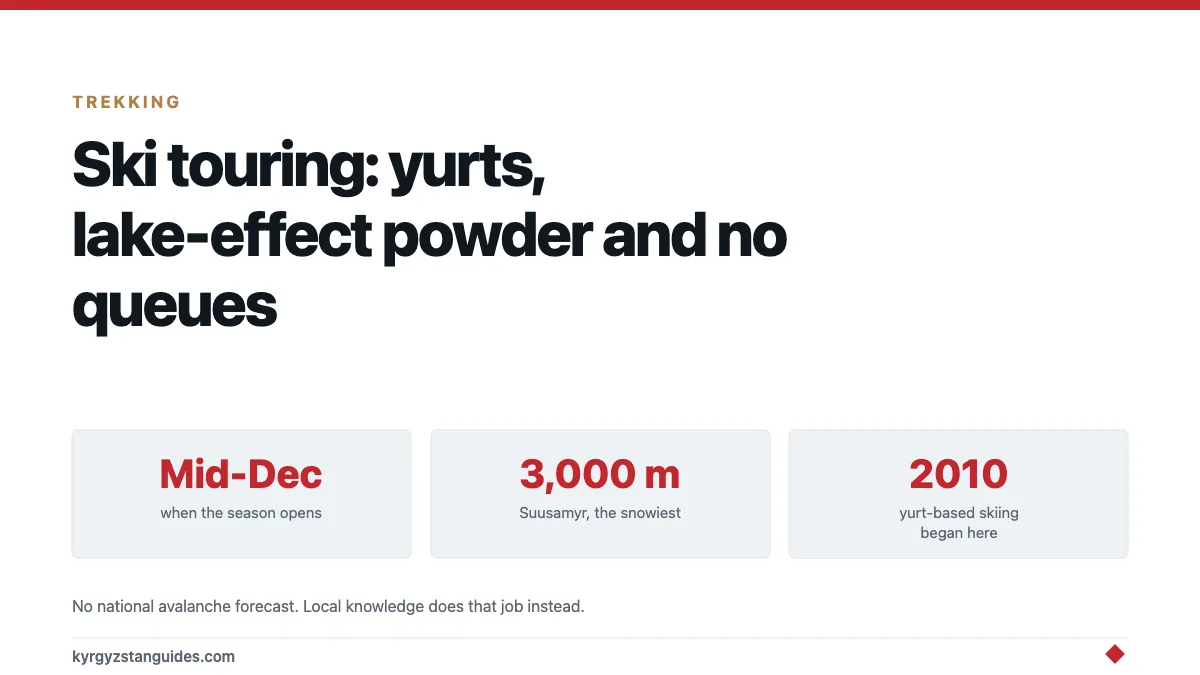
Kyrgyzstan's best skiing isn't at a resort. It's reached on skins from a yurt, in valleys where the only tracks are the ones your group made, and the concept of yurt-based backcountry skiing was more or less invented here — 40 Tribes has been running seven-day trips from a mountain yurt camp outside Karakol since 2010.
Three areas matter: Jyrgalan, Suusamyr and the Karakol side of Issyk-Kul. The season starts around mid-December, and the lake makes the snow.
Why the snow is good
Issyk-Kul is the mechanism, and it's the same one that makes the Great Lakes snowy.
The lake is enormous, deep and does not freeze. Cold air crossing warm water picks up moisture, then dumps it when it hits the mountains on the far side. The result is lake-effect powder on the ranges around the eastern end of the lake in early and mid winter, which is why Karakol's ski base has a reputation out of proportion to its size.
Suusamyr works differently: it is simply high. The valley sits around 3,000 metres, which means cold snow that arrives early and stays dry.
The three areas
Jyrgalan is the one that has changed in the last decade. A former coal-mining village in the far east of the Issyk-Kul region, now the most frequented backcountry zone in the country, with the Jyrgalan Pass at roughly 3,290 metres and slopes generally running 25–35 degrees over descents of around a thousand metres. The village has guesthouses, guides and a genuine local tourism economy built since 2016, our Jyrgalan guide covers its summer face.
Suusamyr is the high, wild one. A huge treeless basin in the Chuy region at 3,000 metres, snowier and colder than anywhere else accessible by road, and the earliest to come into condition. Our Suusamyr guide covers the valley in summer, when it is full of horses instead.
Karakol and the Terskey Ala-Too hold the yurt-camp operations and the resort. This is where the lake effect lands hardest and where multi-day yurt-based touring is most established. See our Karakol guide.
The yurt thing
It deserves its own section because it is what makes skiing here distinctive rather than merely cheap.
The model: a yurt camp is set up in a side valley for the winter, you ski in or are transported in, and you tour from there for several days. Camps sit at around 2,500 metres with surrounding peaks to 3,600 or so. Food is cooked for you, the stove runs, and you're already at altitude when you wake up, no drive, no lift queue, no morning commute to the snow.
Seven days is the standard length. Groups are small because a yurt holds what a yurt holds.
Compared with a European hut tour, the difference is access. There is no lift infrastructure feeding you into the terrain and no other parties to share it with, which cuts both ways: you get untracked snow and you get no rescue standing by.
Getting there, and the other ways up
Skinning isn't the only option, and the alternatives change what a week here looks like.
Cat skiing operates in Jyrgalan and elsewhere: a snowcat takes you up, you ski down, repeat. More vertical per day, less work, and a reasonable middle ground for people who want backcountry snow without earning every metre.
Snowmobile-accessed skiing does the same job faster and reaches further into side valleys.
Heli-skiing exists in the Tien Shan and is the serious-money version. It opens terrain that nothing else reaches and it's priced accordingly, though still well below the equivalent in North America.
Touring from the road is the cheapest version, and in Suusamyr it genuinely works: the pass road gives access to open slopes directly, and a car plus skins plus a guide is a complete plan. Explore-Share's Suusamyr listings give a sense of what's on offer there.
Most weeks mix these. A yurt camp with a cat for two of the days is a common shape.
What you actually need
A guide. Not optional in any serious sense. The terrain is unmapped by European standards, avalanche forecasting is thin to non-existent in most of the country, and local knowledge substitutes for the information infrastructure you are used to.
Full avalanche kit and the ability to use it. Transceiver, probe, shovel, and recent practice. Operators will check.
Touring experience. This isn't a place to learn. Skinning, kick turns, and downhill competence in variable snow are assumed.
Real insurance. Off-piste skiing with helicopter evacuation, named explicitly. Standard travel policies exclude backcountry skiing almost universally, and our insurance guide covers the wider gaps here.
Your own equipment, generally. Rental exists in Karakol and Bishkek but the selection for touring specifically is limited. As our gear guide explains, bring what has to fit you.
The honest risk conversation
Avalanche risk here is real and the safety net is thin.
There is no national avalanche forecast comparable to what Switzerland or Colorado publishes. Rescue isn't a helicopter twenty minutes away; in a side valley in Suusamyr it may be many hours and a road that's itself closed. Mobile coverage is patchy — our wifi and internet guide covers how patchy.
None of that makes it unreasonable. It does mean the decisions are yours and your guide's, made with less information than you would have at home, in terrain with a lower margin for error.
Winter road closures are the other constraint. The passes into Suusamyr close, as our passes guide sets out, and a storm can shut the road out as easily as the road in.
Season and cost
Mid-December to March or early April, with Suusamyr coming into condition earliest because of its altitude and January to February generally the heart of it.
Cost is the other reason people come. Guided yurt-based weeks here run well below the equivalent in the Alps, and the day rates for a guide are a fraction of European rates. That gap is narrowing as the country's reputation spreads, but it has not closed.
For the resort-and-lift version of a Kyrgyz winter, our ski season guide covers Karakol and the smaller bases. This page is about the part where you walk up.
FAQ
Where is the best ski touring in Kyrgyzstan?
Three areas: Jyrgalan in the far east, the most developed backcountry zone; Suusamyr at 3,000 metres, the highest and snowiest; and the Terskey Ala-Too around Karakol, where the yurt-camp operations are concentrated and the lake-effect snow lands.
When is the ski touring season in Kyrgyzstan?
Roughly mid-December to March or early April. Suusamyr comes into condition earliest because of its altitude, and January to February is generally the strongest period.
What is yurt-based skiing?
A yurt camp is set up in a side valley for the winter and you tour from it for several days, typically a week. Camps sit around 2,500 metres with peaks above to 3,600. Food and heating are provided, and you're already at altitude each morning.
Do I need a guide for backcountry skiing in Kyrgyzstan?
Effectively yes. There's no national avalanche forecast, the terrain is unmapped by European standards, and rescue is slow. Local knowledge does the job that published information does elsewhere.
Is ski touring in Kyrgyzstan dangerous?
The avalanche risk is real and the safety infrastructure is thin — no comparable forecasting, slow rescue, patchy phone coverage. It's manageable with a guide, full avalanche kit and touring experience, but the margin is smaller than at home.
Is skiing in Kyrgyzstan cheap?
Considerably cheaper than the Alps, both for guided yurt-based weeks and for guide day rates. The gap is narrowing as the country becomes better known, but it remains substantial.