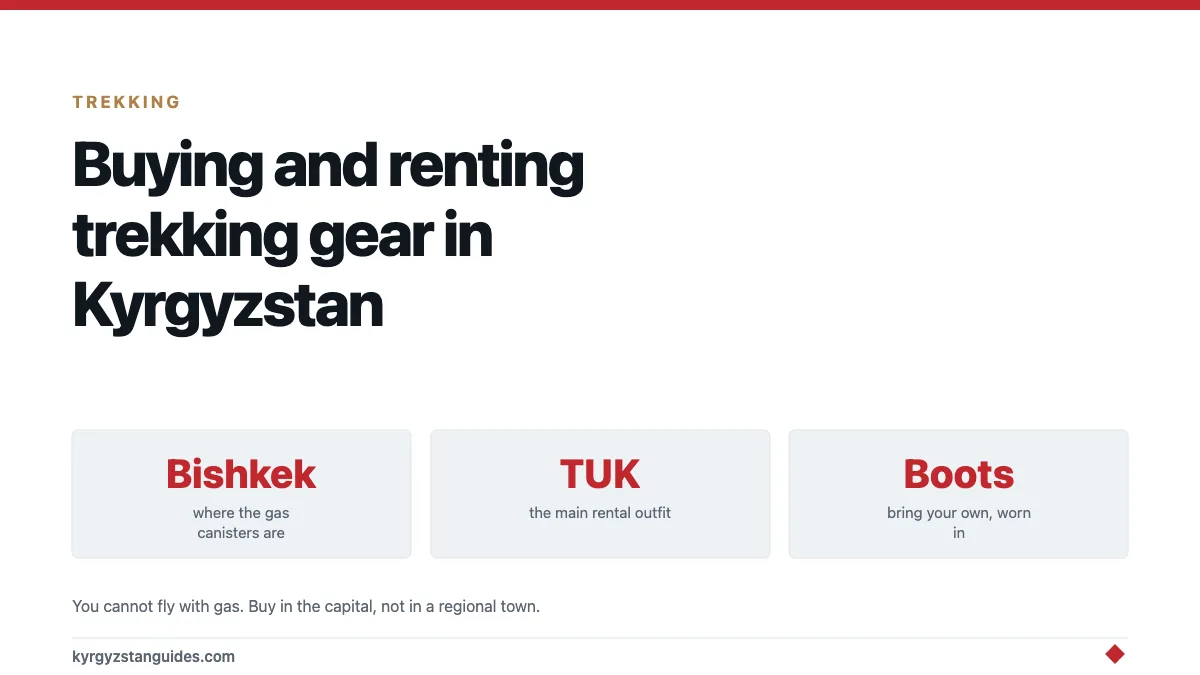
You can't fly with gas canisters, which means every trekker arriving in Kyrgyzstan with a stove has the same first problem, and the answer is that Bishkek sells them along with most of what else you'd want. Renting is easy too, through the Trekking Union of Kyrgyzstan, which is the one outfit in the capital set up to hand a stranger a tent and a sleeping bag.
What follows is where to go, what's worth buying here rather than carrying, and what you should absolutely bring from home.
The gas canister question
Sort this before you do anything else, because it determines whether you eat hot food.
Screw-thread canisters. The standard EN417 type most modern stoves use, are sold in Bishkek. Red Fox stocks them, and the Trekking Union of Kyrgyzstan has them alongside its rental kit. That covers most people.
What isn't reliable is anything unusual. Odd valve types, specific brands, large sizes, or canisters in a small regional town, don't plan around any of those. If you're heading straight from the airport to Karakol or Osh and out into the mountains, buy in Bishkek on the way through rather than assuming you'll find one later.
If your stove burns liquid fuel, petrol is available everywhere and that problem solves itself.
Renting, which most people should do
The Trekking Union of Kyrgyzstan is the main rental operation in Bishkek and it's aimed at exactly your situation: someone who flew in, wants to walk for a week, and doesn't want to buy a tent.
They rent the full set, tents, sleeping bags, mats, stoves, poles, and the rest. Asia Mountains also rents equipment, and there are outfitters in Karakol and Osh for people basing themselves there instead. Our CBT guide covers the community-tourism network, which handles horses, guides and yurt nights rather than hardware.
Renting makes obvious sense for anything bulky that you'd otherwise fly with and use for six days. It makes less sense for anything that has to fit you. Boots above all.
What to buy here rather than carry
Gas, as above.
Food for the trail. Bazaars handle this better than any shop: dried apricots, raisins, walnuts from Arslanbob, kurut, bread, instant noodles, chocolate. It's cheap, it's good, and carrying trail food from home is a waste of baggage allowance.
A cheap sleeping mat or a spare layer, if you're short. Bishkek's malls have generic outdoor clothing, and Osh Bazaar and the second-hand shops carry usable fleeces and jackets at prices that make replacing a lost layer painless.
Water treatment, if you didn't bring it. Though check what's actually on the shelf rather than assuming. Our guide to whether tap water is safe here covers when you need it.
What to bring from home, no arguments
Boots. Worn in, fitted, yours. The selection here is limited and a new pair on day one of Ala-Kul is a genuinely miserable decision.
A proper waterproof. You can buy a jacket in Bishkek. You cannot reliably buy a jacket that keeps you dry through four hours of sleet at 3,800 metres.
Anything medical. Personal prescriptions, blister kit, the painkillers you actually trust. Pharmacies here stock plenty, but not necessarily what you know.
A warm sleeping bag if you're going high. Rental bags exist, but comfort ratings on rental kit are approximate and nights at a yurt camp around 3,000 metres drop near freezing even in July — as our what to wear guide sets out.
Your own headtorch, power bank and charging cables. Obvious, routinely forgotten.
The shops, briefly
Red Fox — the most complete outdoor shop in Bishkek, and the default answer for gear and gas.
Gerger Sport: several branches, backpacks, clothing and bikes as well as camping kit.
Alex.kg — outdoor and camping gear.
Osh Bazaar — not an outdoor shop, but the place for trail food, cheap layers, gloves, hats, and anything you'd rather not pay outdoor-brand prices for. It's also where you'll find yourself if something breaks on a Sunday.
Prices for imported technical gear run higher than in Europe, which is what you'd expect for a small landlocked market. Local and Russian brands are cheaper and perfectly adequate for a week.
Rent or buy? A rough rule
The question people actually ask, so here's the arithmetic rather than a shrug.
Rent anything bulky, expensive and single-trip: tent, stove, mat, poles. A week's rental costs a fraction of buying, and you save the baggage fee twice over on a tent alone.
Buy anything cheap and consumable here: gas, food, a spare fleece, gloves you'll lose.
Bring anything that has to fit you or keep you alive: boots, shell, sleeping bag if you're going high, medication.
The one genuine grey area is the sleeping bag. Rental bags in Kyrgyzstan are widely available and mostly fine for a yurt night at Song-Kul. For a tent at 3,500 metres in late season they're a gamble, because a bag's rating tells you what it was when new and says nothing about the two hundred nights it has had since. Asia Mountains' rental listing is a reasonable place to see what's typically on offer before you decide.
If you only carry one bulky thing from home, make it the bag.
Karakol and Osh
If you're basing yourself outside the capital, the picture thins but doesn't disappear.
Karakol is the trekking hub for the Terskey Ala-Too and has rental outfits geared to Ala-Kul and Altyn-Arashan. It's the one town outside Bishkek where you can reasonably expect to sort kit locally. See our Karakol guide.
Osh serves the Alay and Lenin Peak, and the CBT office in Sary-Mogol handles the practical side for that valley: including the border permit you'll need.
Anywhere smaller than those two, assume nothing.
A note on buying cheap
There's a version of this trip where you outfit yourself entirely at Osh Bazaar for very little money, and for a summer trek at moderate altitude that can work.
Where it stops working is weather. Kyrgyz mountain weather turns fast, and the gap between a functional waterproof and a cheap one is the gap between an uncomfortable afternoon and a serious problem. Save money on the mat, the food and the fleece. Don't save it on the shell, the boots or the sleeping bag if you're going above 3,000 metres.
FAQ
Can you buy gas canisters in Kyrgyzstan?
Yes, in Bishkek. Standard screw-thread canisters are sold at Red Fox and by the Trekking Union of Kyrgyzstan. Buy in the capital rather than counting on finding them in a regional town.
Where can I rent camping gear in Bishkek?
The Trekking Union of Kyrgyzstan is the main rental operation, covering tents, sleeping bags, mats and stoves. Asia Mountains also rents, and there are outfitters in Karakol and Osh.
What outdoor shops are there in Bishkek?
Red Fox is the most complete, and also sells gas. Gerger Sport has several branches covering packs, clothing and bikes. Alex.kg stocks outdoor and camping gear. Osh Bazaar handles trail food and cheap layers.
What should I bring from home for trekking in Kyrgyzstan?
Worn-in boots, a waterproof you trust, your own medication and blister kit, a sleeping bag rated for the altitude you're going to, and your headtorch and charging gear. Everything else can be bought or rented here.
Is trekking gear expensive in Kyrgyzstan?
Imported technical brands cost more than in Europe, which is normal for a small landlocked market. Local and Russian brands are considerably cheaper and fine for a week's walking.
Can I rent gear in Karakol rather than Bishkek?
Yes. Karakol is the trekking hub for the Terskey Ala-Too and has rental outfits set up for Ala-Kul and Altyn-Arashan. Outside Bishkek, Karakol and Osh, don't assume anything is available.