No: or at least, not without treating it first. That is the honest answer for most travelers. Kyrgyzstan’s tap water is mostly mountain-sourced and chlorinated in the big cities, and plenty of locals drink it daily without a second thought. But aging Soviet-era pipes, inconsistent treatment outside Bishkek, and rural systems that pull straight from streams mean the sensible traveler default is simple: treat it, filter it, or buy it.
The good news is that staying safely hydrated here's cheap and easy. Bottled water costs pennies, boiled water (in the form of endless tea) is everywhere, and a decent filter bottle solves the problem entirely — including up in the mountains, where the real risk lives. Here is how we would handle water on a Kyrgyzstan trip, zone by zone.
Cities: Marginal, Not Dangerous
Bishkek’s supply comes largely from underground sources fed by Tien Shan snowmelt and is chlorinated; by regional standards it is decent water, and brushing your teeth with it is a negligible risk. The weak link isn't the source but the delivery — old, corroded distribution pipes and occasional pressure drops that can pull contaminants into the system. Karakol, Osh, and smaller towns are patchier, with older infrastructure and less consistent treatment.
Our take: in cities, tap water is a coin flip your stomach doesn't need to take when a 1.5-liter bottle costs about 30 som. Locals have adapted gut flora; you, arriving from abroad on a diet of unfamiliar dairy and mutton anyway, don't. Save your gut’s goodwill for the food.
Mountains and Homestays: Filter Everything
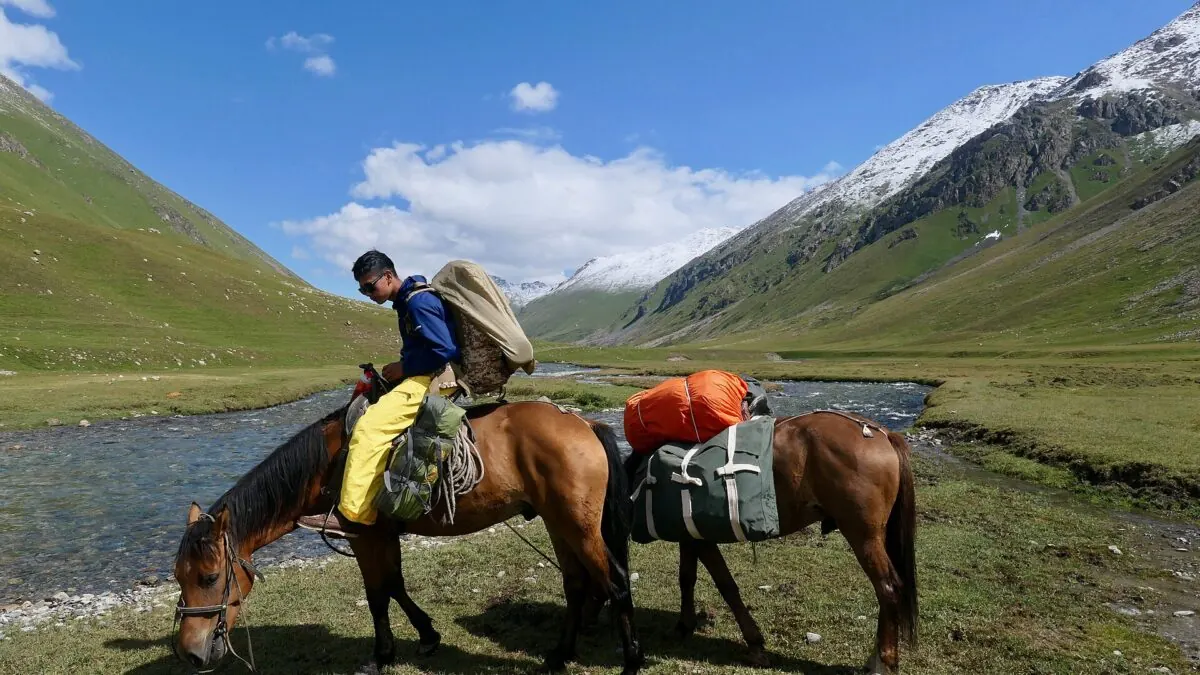
In villages, yurt camps, and on treks, “tap water” often means a pipe or hose from a spring or stream. Crystal-clear mountain water looks pristine, and this is exactly where travelers get burned: upstream of you there are grazing sheep, horses, cattle, and summer herder camps, which means giardia and other nasties are a genuine possibility in even the cleanest-looking stream. Never drink untreated surface water below or near grazing land: which in Kyrgyzstan is nearly all of it below the glaciers.
For anyone heading onto trails covered in our trekking guide, a treatment method is not optional gear. The workable options:
- Squeeze or straw filters (Sawyer-style): light, cheap, handle bacteria and protozoa including giardia. Our default recommendation.
- Filter bottles: the most convenient for mixed city-and-trek trips; fill anywhere, drink immediately.
- Purification tablets or drops: near-weightless backup; add 30 minutes of wait time and a faint taste.
- UV pens: fast and effective in clear water, but battery-dependent, carry tablets as backup.
- Boiling: always works and yurt stoves make it easy; tea offered by hosts is safe for the same reason.
What Water Actually Costs
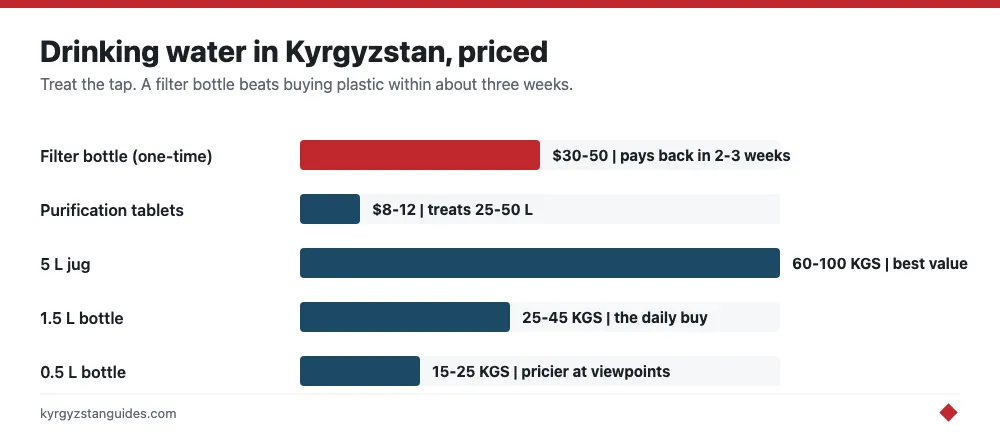
Bottled water is one of the smallest lines in a Kyrgyzstan budget, but it adds up over weeks, and generates a depressing bag of plastic. Rough prices:
| Option | Typical cost | Notes |
|---|---|---|
| 0.5 L bottle, shop | 15-25 KGS | Pricier at kiosks and viewpoints |
| 1.5 L bottle, supermarket | 25-45 KGS | The standard daily buy |
| 5 L jug | 60-100 KGS | Best value for guesthouse stays |
| Filter bottle (one-time) | $30-50 | Pays for itself in 2-3 weeks |
| Purification tablets | $8-12 a pack | Backup; treats ~25-50 liters |
Two weeks of bottled water for one person runs somewhere around 600-900 KGS ($7-10). A filter costs more upfront, wins on any trip over three weeks, and removes the plastic problem — which matters in a country with minimal recycling and a lot of very beautiful ditches.
Ice, Salads, and Other Fine Print
The classic advice. No ice, no salad. Is only half-true here. Ice is rare in Kyrgyz cafes outside upscale Bishkek bars, so the question mostly answers itself; in nicer places it is usually made from purified water, and we wouldn't lose sleep over it. Salads are genuinely everywhere (the tomato-cucumber-dill plate is a national constant) and washed in tap water, which puts them in the same marginal category as the tap itself. Most travelers eat them without drama; if your stomach is famously fragile, skip raw salads for the first few days while your gut acclimatizes, then relax.
Tea, soups, and anything boiled are safe by definition, which conveniently describes half of Kyrgyz cuisine. Fermented drinks like kumis carry their own gastrointestinal adventure entirely unrelated to water safety: approach as a cultural experience, not a thirst quencher.
If Your Stomach Goes Wrong Anyway
Even careful travelers sometimes lose a day or two. Pack oral rehydration salts (cheap at any Kyrgyz apteka, cheaper from home), loperamide for bus-day emergencies only, and a traveler’s antibiotic if your doctor prescribes one for the road, see our packing list for the full first-aid rundown. Ride out a standard bout with fluids, ORS, plain rice or bread, and rest. Seek a clinic in Bishkek or Osh if you see blood, high fever, or symptoms lasting beyond three days; giardia in particular (sulfurous burps, cramps, days of rumbling misery) needs prescription treatment, not patience.
What Bishkek's own water authority says
The city's position is more confident than most travellers expect. Bishkek city hall states that the municipal supply meets GOST 2761-84 and that residents can drink it without concern. The system behind that claim: around 300 artesian wells at 160 to 250 metres, 35 intakes drawing on two underground aquifers, 1,468 km of network, and 360 sampling points tested weekly for bacteriology, chemistry and residual chlorine by the water utility plus the city and republican sanitary services.
One caveat worth stating: that page carries no clear date and appears to date from around 2018-19, and I could find no current statement from Bishkekvodokanal itself. Deep artesian water through a well-monitored network is a genuinely good starting position, but old pipework between the treatment point and your tap is the part nobody tests.
The national picture has improved sharply. The share of the population without access to safe water fell from 5.9% in 2019 to 1.4% in 2025. The regional breakdown is where it matters: Issyk-Kul, Talas, Chuy, Bishkek and Osh city all sit at 0%, Naryn at 0.8%, Osh oblast 0.9%, Jalal-Abad 0.6% — and Batken at 13%, which is not only the outlier but got worse, up from 9.6% in 2024.
The numbers that argue for caution anyway
Eighty per cent of the water pipelines serving the settlements around Bishkek are classed as deteriorated, which our post on the city’s unplanned edge covers. Water quality statistics and gastrointestinal disease statistics tell different stories here, and the second one is the one your trip cares about.
Acute intestinal infections ran to 9,881 cases between January and May 2026, against 8,500 in the same period of 2025, a rise of 13.6%. 78.1% of those cases were children under 14. The disease-prevention department attributes them to poor hygiene, contaminated water and improper food storage, in that order.
Hepatitis A is the more striking figure. Between January and November 2024 Kyrgyzstan recorded 17,902 cases, against 6,637 in the same period of 2023 — acute viral hepatitis up 2.6 times in a year, concentrated in Batken, Jalal-Abad and Osh oblasts. That is a food-and-water-borne disease, and it is the clearest argument in the data for being careful in the south.
The travel-health advice lines up with that rather than with the tap-water question. The CDC recommends hepatitis A vaccination for unvaccinated travellers aged one and over coming to Kyrgyzstan, and says to consider typhoid for areas with poor sanitation and unsafe water including rural areas. What it notably does not do is tell you outright not to drink the tap water. The UK's TravelHealthPro says to take care with personal, food and water hygiene. The FCDO's health page for Kyrgyzstan says nothing about water at all — its warnings are about altitude and about medical facilities being badly equipped.
Treating water at altitude: the rule most people get wrong
If you are trekking, one detail matters more than which filter you bought. The CDC's guidance is to boil for one minute at low elevation but three minutes above roughly 2,000 metres, because water boils cooler as you climb. Most Kyrgyz trekking happens above that line. A one-minute boil at Ala-Kul is not the same disinfection as a one-minute boil in Bishkek.
On chemical treatment, the important limitation: chlorine and iodine are unreliable against Giardia and Cryptosporidium. Chlorine dioxide handles Cryptosporidium, which the others do not. Filters certified to NSF 53 or 58 remove parasites but not all viruses.
And the point people forget: the CDC's own phrasing is that contaminated water can look completely clean and still carry bacteria, viruses and parasites. A clear stream running off a glacier above a jailoo has livestock upstream of it. Clarity tells you nothing.
Frequently Asked Questions
Can I brush my teeth with tap water in Kyrgyzstan?
In cities, yes, the exposure is tiny and we know of no good reason to ration bottled water for toothbrushing in Bishkek. At rural homestays and yurt camps, use filtered or bottled water; the “tap” may be an untreated stream line.
Is bottled water in Kyrgyzstan trustworthy?
Yes. Local brands like Legenda, Jalal-Abad mineral waters, and Bonaqua-type imports are reliable and sold everywhere, sealed. Check the cap seal as you would anywhere. Sparkling (“gazirovannaya”) outnumbers still in small shops, so learn to spot “bez gaza” labels.
Do I really need a filter if I’m not trekking?
No. For a cities-and-Issyk-Kul trip, bottled and boiled water covers you completely for a few dollars a week. Filters earn their place the moment your itinerary includes multi-day treks, yurt stays, or long stretches away from shops.
One final warning, because it is the mistake we see described over and over: the water that gets travelers sick in Kyrgyzstan is almost never city tap water — it's that impossibly clear mountain stream two hours into a hike, drunk straight because it “looks fine.” It has sheep above it. Filter it every single time.
Can you drink tap water in Bishkek?
Bishkek city hall says yes — the supply meets GOST 2761-84, drawn from around 300 artesian wells at 160-250 m and tested weekly at 360 points. The caveat is that the statement is undated and appears to be several years old, and old building pipework is not covered by it.
Is tap water safe everywhere in Kyrgyzstan?
No. The share of the population without safe water is down to 1.4% nationally, but Batken oblast sits at 13% and has got worse. Chuy, Issyk-Kul, Talas, Bishkek and Osh city are at 0%.
Do you need vaccinations for Kyrgyzstan?
The CDC recommends hepatitis A vaccine for unvaccinated travellers aged one and over, and suggests considering typhoid for rural areas with poor sanitation. Hepatitis A cases rose 2.6-fold to 17,902 between January and November 2024.
How long should you boil water when trekking in Kyrgyzstan?
Three minutes above about 2,000 metres, not one. Water boils at a lower temperature as you climb, and most Kyrgyz trekking is above that line.
Do water purification tablets work in Kyrgyzstan?
Partly. Chlorine and iodine are unreliable against Giardia and Cryptosporidium. Chlorine dioxide deals with Cryptosporidium; filters certified to NSF 53 or 58 remove parasites but not all viruses.
Is stream water safe to drink on a trek?
No, however clear it looks. Contaminated water can look clean and still carry bacteria, viruses and parasites, and jailoo streams have livestock upstream. Treat everything.