Stay in a Kyrgyz village long enough with a cough and somebody will suggest something — kymyz for your digestion, a herbal steam for your chest, a visit to a woman two houses down who's good with backs. It's offered kindly and it is meant seriously, and it sits inside a tradition with its own vocabulary, specialists and logic.
This page explains what that tradition is and who its practitioners are. It isn't medical advice, it doesn't assess whether any of it works, and nothing here should replace a doctor.
Two different kinds of practitioner
The distinction matters and gets flattened in English writing about Central Asia.
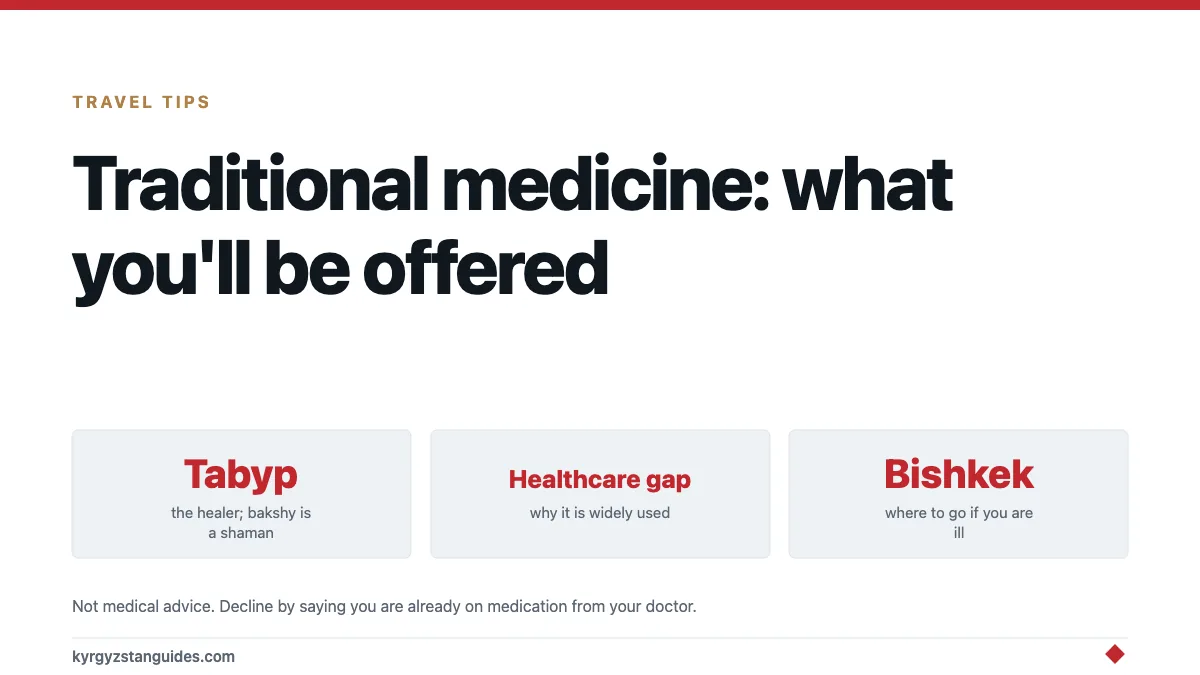
A tabyp is a healer working in a folk-medical tradition. Diagnosis by pulse, illnesses classified as hot or cold, and treatment through plants, compresses, steam, inhalation, powders and manipulation. It's a craft passed on through training and practice, and its logic is closer to historical Greek and Islamic humoral medicine than to anything mystical.
A bakshy is a shaman. The work is with spirits — spells, expulsion, intervention in a world the tabyp doesn't address. Historically distinct from the tabyp, differently regarded, and generally the rarer of the two today.
Somebody in a village recommending a healer to you'll usually mean a tabyp, and often specifically someone with a local reputation for one narrow thing: bonesetting, massage, a herbal preparation for a particular complaint.
Why it's more present than you'd expect
This is the part that turns an exotic detail into a real story.
Kyrgyzstan's state healthcare is thin outside the cities — rural doctor density runs at roughly 13.5% of the national average. Rural clinics are underfunded, specialists are concentrated in Bishkek, and for a family several hours from a hospital on a bad road, a local practitioner is not the second option — it's the available one.
Eurasianet has reported on alternative medicine filling that gap, and the Health Ministry has moved towards studying and regulating traditional practice rather than pretending it isn't happening — phytotherapy, massage, acupuncture and related methods have been proposed for formal training programmes.
So when this gets offered to you, understand what's behind it. It isn't folklore performed for a visitor. It is what a lot of people actually use.
The plants, and why researchers keep coming
There is a serious scientific interest in this that has nothing to do with romanticising it.
Kyrgyzstan's mountain flora is diverse and comparatively unstudied, and the knowledge of which plant does what, held by practitioners and by ordinary rural households, represents centuries of accumulated trial. Ethnobotanists work here for the same reason they work in the Amazon: the knowledge is disappearing faster than it's being recorded, and some of what it encodes turns out to be pharmacologically real.
A 2025 ethnobotanical survey of the Kara-Koy gorge is the kind of work involved — going valley by valley, recording which species are used, for what, prepared how, and by whom.
None of that means a given remedy works. It means the question is worth asking properly, which is different from both dismissing it and believing it.
The distinction matters for a traveller too. Thyme tea is thyme tea. A preparation of unknown composition, taken while you're already on medication, four hours from a hospital, is a different proposition.
What gets offered to travellers
In practice, a short list.
Kymyz. Fermented mare's milk, credited locally with a broad range of benefits, and drunk seasonally from roughly May to August. It will be offered at a yurt camp whether you are ill or not. Our kymyz guide covers what it actually tastes like and how to accept it without committing to a litre.
Herbal teas and infusions. Mountain herbs, thyme, and whatever the household has dried. Generally pleasant and the least fraught thing on this list.
Steam and hot springs. Kyrgyzstan has a serious bathhouse and hot-spring culture, and it's medicalised here in a way it isn't in most Western countries: sanatoria on Issyk-Kul were built around it. Our hot springs guide covers where.
Animal fats and products. Including marmot fat, which we'd decline for reasons that are specific rather than squeamish: Tien Shan marmots are a documented plague reservoir, and handling or consuming them is the route by which human cases in this region generally begin. Our marmots guide sets out the evidence.
A visit to somebody. Massage, bonesetting, a preparation made up for you.
Declining without offending
Straightforward, and worth knowing because the offer is made warmly.
Say you're already taking medication from your doctor and shouldn't mix things. It's true for most travellers, it's a reason anyone accepts immediately, and it doesn't imply any judgement about the offer.
Accepting tea and declining everything else is entirely normal. So is taking a sip of kymyz and leaving the bowl. Nobody is testing you.
What doesn't go down well is treating the whole thing as quaint. You're in someone's house, being offered help.
If you actually get ill
Go to Bishkek.
The capital has the country's real medical infrastructure by a wide margin — hospitals, diagnostics, pharmacies, English-speaking doctors if you look. Regional centres are basic. Remote areas have a nurse, at best.
Carry your own medication, because pharmacies here stock plenty but not necessarily what you know. Have insurance that covers evacuation, particularly if you're trekking above 3,000 metres, as our travel insurance guide explains. Our emergency numbers guide has the contacts — 112 works from any SIM.
Altitude complaints specifically are not something to treat with herbs at 3,500 metres. The treatment for altitude sickness is descent, and our altitude guide says so at more length.
This page is general information about a cultural practice, not medical advice, and we have no medical qualifications. Talk to a doctor about anything that matters.
FAQ
What is a tabyp?
A traditional Kyrgyz healer working in a folk-medical tradition. Diagnosis by pulse, illnesses classified as hot or cold, and treatment through plants, compresses, steam, inhalation and manipulation. Distinct from a bakshy, who's a shaman working with spirits.
Is traditional medicine common in Kyrgyzstan?
More than visitors expect, and largely because state healthcare is thin outside the cities. For rural families hours from a hospital, a local practitioner is often the accessible option rather than an alternative one.
Will I be offered traditional remedies as a tourist?
Likely, if you stay in homestays or yurt camps and mention feeling unwell. Kymyz, herbal teas, steam treatments and a recommendation to visit someone locally are the usual forms.
Should I try kymyz?
That's between you and your stomach. It's fermented mare's milk, drunk seasonally from about May to August, and it's offered as hospitality as much as remedy. Taking a sip and leaving the bowl is completely acceptable.
Is marmot fat safe?
We'd decline it. Tien Shan marmots carry Yersinia pestis, and handling or eating marmot products is the usual route for the region's human plague cases. This is a specific documented risk rather than general caution.
Where should I go if I get sick in Kyrgyzstan?
Bishkek. It has the country's real medical infrastructure by a wide margin, including English-speaking doctors. Regional hospitals are basic and remote areas have very little. Carry your own medication and insurance covering evacuation.