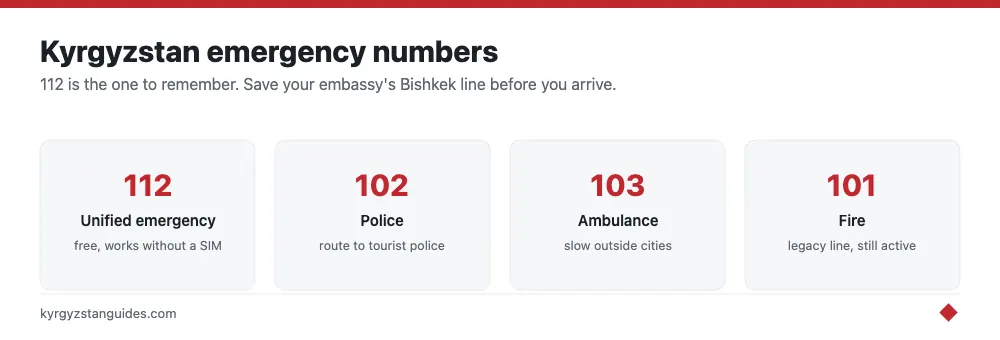
Dial 112. That is the single number to remember in Kyrgyzstan: it is the unified emergency line, it works from any mobile phone, it's free, and it connects even without a local SIM or credit. The older Soviet-era numbers, 101 for fire, 102 for police, 103 for ambulance, still function and are still what many locals dial, but 112 routes to all of them.
The realistic caveat: don't count on the operator speaking English. Responses are usually in Kyrgyz or Russian, so if you're not conversational in either, your fastest path in a crisis is often handing the phone to a local — a hotel receptionist, guesthouse owner, driver, or guide. Save your accommodation’s number on day one for exactly this reason.
The numbers that matter
| Number | Service | Notes |
|---|---|---|
| 112 | Unified emergency line | Free from any phone, works without a SIM; Kyrgyz/Russian, limited English |
| 101 | Fire service | Legacy direct line, still active |
| 102 | Police | Also the route to tourist police units in Bishkek and Issyk-Kul in season |
| 103 | Ambulance | Public ambulance; response can be slow outside cities |
| 104 | Gas emergency | For suspected gas leaks in apartments |
| +996 312 xx-xx-xx | Your embassy in Bishkek | Look up and save your own embassy’s emergency line before arrival |
Kyrgyzstan has experimented with dedicated tourist police, mainly in Bishkek and around Issyk-Kul during the summer season. Coverage and continuity vary year to year, so treat 102 as the reliable route and mention you are a tourist. For theft, insist on a written police report (spravka). Your insurer will demand it, as we cover in our broader look at safety in Kyrgyzstan.
A practical connectivity note: emergency calls work SIM-free, but everything else, calling your guesthouse, an insurer hotline, a taxi out of a bad situation. Does not. A local SIM costs almost nothing and takes ten minutes to set up; our SIM card guide explains the options.
Pharmacies: better than you expect
Pharmacies (apteka / дарыкана) are everywhere in Kyrgyz cities, and many medicines that require prescriptions in the US or EU are sold over the counter: including many antibiotics, strong painkillers’ milder cousins, and most stomach, allergy, and cold remedies. Large chains such as Neman operate around the clock in Bishkek, and prices are low by Western standards.
Two warnings temper the convenience. First, pharmacists speak Russian and Kyrgyz; brand names differ from what you know, so ask using the generic (international) name of a drug, write it down before your trip. Second, over-the-counter availability is not a reason to self-prescribe antibiotics for every stomach wobble; carry a basic kit instead, as laid out in our packing list, and keep any regular prescription medication in original packaging with a doctor’s note.
Hospitals: the city–village gap is real
That gap is structural rather than accidental, and our guide to how the Kyrgyz healthcare system is funded explains why. Bishkek and, to a lesser degree, Osh have hospitals that handle routine emergencies competently — fractures, appendicitis, stitches, IV rehydration. Equipment and comfort levels lag Western standards, public wards can be spartan, and informal payments still grease some wheels, but care happens and it's cheap.
Rural Kyrgyzstan is a different planet. Villages rely on small feldsher points (rural clinics staffed by a paramedic-level worker), district hospitals are basic, and a serious injury in the mountains means a long, rough evacuation by road. There is no comprehensive helicopter rescue service you can summon with an app. Anyone heading into the backcountry should read our trekking guide with this in mind: your first responder is your guide, your driver, and your own first-aid kit.
For anything genuinely major — cardiac events, complex surgery, serious trauma. The standard playbook for foreigners is stabilization in Bishkek followed by medical evacuation to Almaty, Istanbul, or home. That is an insurance conversation, not a cash one: evacuation runs into five figures. For Kyrgyz citizens the equivalent is travelling to India or Turkey and paying out of pocket.
Where expats actually go in Bishkek
Expats and diplomats in Bishkek overwhelmingly use private clinics, where you can usually be seen the same day for $15–40 a consultation. Neomed is the name that comes up most consistently for general and emergency-adjacent care, and several embassies publish lists of vetted doctors, dentists, and clinics on their websites. The US Embassy’s medical providers list is public and worth saving as a PDF before you travel. Private labs handle blood work and imaging quickly and cheaply. For dental emergencies, private dental clinics in Bishkek are plentiful, modern, and a fraction of Western prices.
Insurance: the paperwork that decides everything
- Buy a policy that explicitly covers trekking to your maximum altitude and medical evacuation. Standard policies often cap at 2,500–3,000 m, which many Kyrgyz treks exceed.
- Expect to pay providers upfront in cash (som) and claim reimbursement later. Card acceptance at public facilities is unreliable.
- Collect everything: itemized receipts, doctors’ notes, lab results, and for theft a police report. Documents will be in Russian or Kyrgyz; insurers accept them, but photograph each page immediately.
- Call your insurer’s emergency assistance line before big treatments when possible — many policies require pre-authorization for hospitalization or evacuation.
- Keep a paper copy of your policy number and assistance phone number; mountain valleys are exactly where your phone battery and signal both die.
Quick reference: altitude and stomach
Altitude is the most common health problem travelers actually face here. Much of the country sits above 2,000 m, and popular targets like the Ala-Kul pass approach or exceed 3,900 m. Headache, nausea, and poor sleep above 3,000 m are acute mountain sickness until proven otherwise: stop ascending, hydrate, and descend if symptoms worsen. Ibuprofen helps headaches; nothing substitutes for descent.
Stomach trouble comes second. Tap water is chlorinated in Bishkek but best avoided nationwide — drink bottled, boiled, or filtered. Be gentle with unpasteurized dairy (kymyz, homemade ayran) on your first days, wash fruit from bazaars, and pack oral rehydration salts; they turn a miserable 48 hours into a manageable 24.
What medical evacuation actually costs
This site has said evacuation runs into five figures. For Kyrgyz citizens the equivalent is travelling to India or Turkey and paying out of pocket. The US Embassy in Bishkek puts a number on it, and it is higher than that.
Its guidance states that without adequate evacuation insurance the cost can easily exceed $60,000, and that arranging one may take 24 to 48 hours or longer. That second figure is the one to sit with: this is not a helicopter that arrives within the hour.
The embassy is blunt about the baseline too. Modern American-style health care is not available in Kyrgyzstan; public clinics lack basic resources and supplies; ambulance services are not widely available; and air evacuation is limited and at times non-existent, especially outside major cities.
The UK Foreign Office is consistent with that: medical facilities are often badly equipped and unhygienic with a limited supply of drugs, and there is no reciprocal healthcare agreement.
The practical conclusion is not to avoid the country. It is that evacuation cover is the single line in your policy that matters here, and that trekking above a certain altitude is commonly excluded from standard policies.
Where the embassies actually send people
The US Embassy publishes a facility list, noting that inclusion is not an endorsement. It is still the most useful starting point available, because nothing comparable exists from a Kyrgyz source.
Private, with a 24-hour emergency room: MEDI Private Medical Center, Suerkulova 5/3. Other private options include Neomed Clinic on Orozbekova, BICARD for cardiac surgery on Tynystanov, MercyMed for paediatrics and family medicine, and Eldik Family Medicine Clinic.
State, open around the clock: the National Center of Cardiology and Internal Medicine and the National Republican Hospital, both on Togolok Moldo; the Emergency Medical Care Clinical Hospital on Krivonosov for trauma and burns; and the City Children’s Clinical Emergency Hospital on Baitik Baatyr.
Commercial ambulances, both 24/7: MEDI on 1366 and OVIS-MED on 1399 or 1390. Those short numbers are worth saving before you need them.
On medicines, two things from official guidance. Most UK prescriptions are accepted, but phone a pharmacy ahead to check. And drugs often come under different brand names, so ask for the generic name rather than the one on your box at home. Basic painkillers are sold without prescription, and pharmacies may want cash.
One thing I will not tell you, because the legal text could not be read: whether antibiotics require a prescription here. Plenty of sources assert it either way. Do not plan on self-medicating on the basis of something you read.
FAQ
Does 112 work without a Kyrgyz SIM card?
Yes. Emergency calls to 112 go through from any working mobile phone, with or without a local SIM, and without credit. Voice quality and routing are best with a local SIM, which is cheap and quick to buy.
Do pharmacies in Kyrgyzstan require prescriptions?
For many medicines, no — antibiotics, stomach remedies, and painkillers are commonly sold over the counter. Bring the generic name of anything you need, and carry personal prescription meds in original packaging with a doctor’s letter.
Is there English-speaking medical care?
In Bishkek’s private clinics you can usually find English-speaking doctors, and embassies publish provider lists. Outside the capital, assume Russian and Kyrgyz only and lean on your guide, host, or a translation app.
Do I really need evacuation coverage for a normal trip?
If your plans include any trekking, horse trips, or high passes (which is most people’s reason for coming) yes. There is no on-demand mountain helicopter rescue, and road evacuation plus onward transfer to Almaty or Istanbul is what insurers actually organize and pay for.
What about dog bites and rabies?
Shepherd dogs guard flocks throughout the mountains and aren't pets — give them and their herds a wide berth. Rabies exists in the region; any bite means washing the wound immediately and getting post-exposure shots in Bishkek without delay, so treat a bite as an evacuation-level event, not a wait-and-see one.