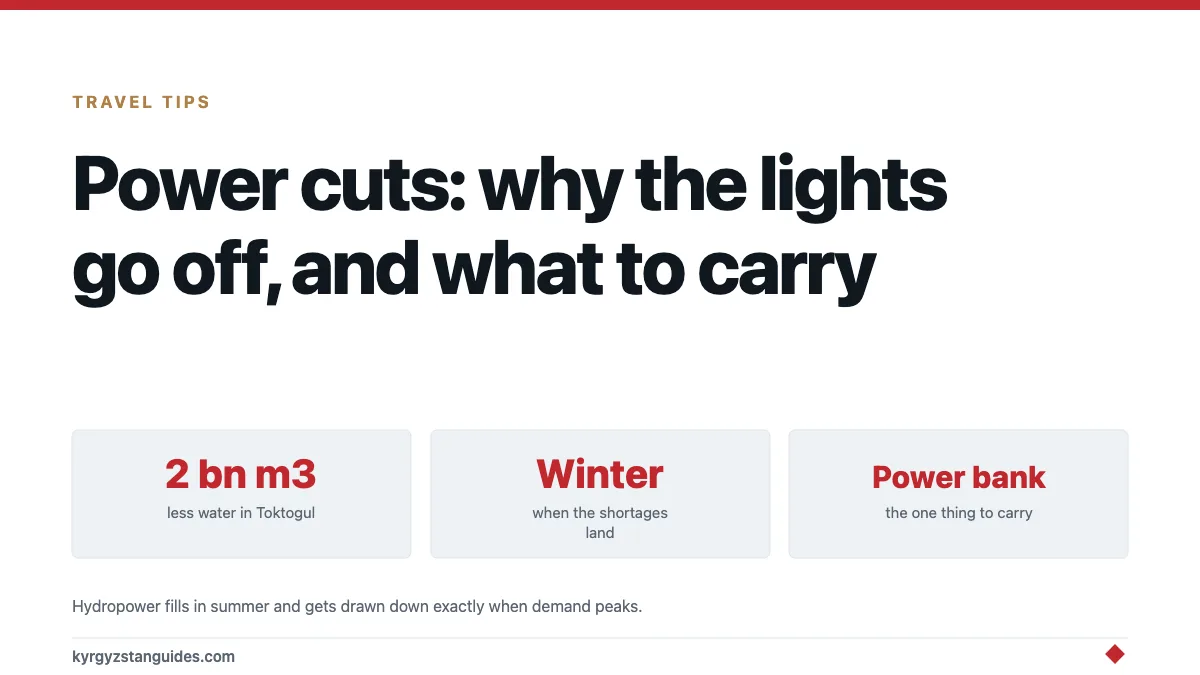
Kyrgyzstan generates most of its electricity from water, water comes from snow and ice, and in a dry year there isn't enough of either. Heading into winter 2026 the Toktogul reservoir — the single most important body of water in the country's energy system — was carrying around two billion cubic metres less than it held at the same point a year earlier.
For a traveller that translates into something simple: carry a power bank, a headtorch, and don't rely on a charging point being live when you need it. In the settlements around Bishkek the problem is more basic: a quarter of them have no gas supply at all and heat with coal.
Why a mountain country runs short of power
The mechanism is worth understanding because it explains the timing.
Hydropower supplies the bulk of Kyrgyzstan's electricity, and the great majority of that comes off the Naryn river cascade, with Toktogul as the regulating reservoir. Water arrives in spring and summer from snowmelt and glacier melt. Demand peaks in winter, when it is dark at five and cold enough to need heating.
So supply and demand are exactly out of phase. The reservoir fills in the months nobody needs it and is drawn down through the months everybody does. A dry summer means a low reservoir in October, and the consequences land in January.
Add the longer trend. Our glaciers piece covers the ice that feeds these rivers, and it's shrinking — around 27% of Tien Shan glacier mass has gone in fifty years. Meanwhile domestic consumption has climbed from 15.5 to 19.3 billion kWh and is projected to pass 21 billion by 2030.
What the country is actually doing about it
The emergency measures are public and specific, which makes them a useful guide to how serious a given winter is.
Recent plans have included conserving water in the reservoirs, importing more electricity, accelerating repairs on ageing generation equipment, and (notably) shutting down cryptocurrency mining farms to take load off the grid.
In Bishkek, measures have included limits during peak hours, incentives for households to cut consumption between 6pm and 10pm, and an instruction for government offices outside national security functions to switch lights off between 6pm and 6am. Eurasianet reported on the capital going dark early as a preventive measure.
When you read that a country is turning off its ministry lights to get through to March, you have the measure of the problem.
What this means on the ground
Highly variable, and that variability is the thing to plan for rather than the severity.
Bishkek mostly keeps the lights on. Cuts happen, they are usually short, and hotels of any size have generators. You will notice it as a flicker, an hour without a lift, or a restaurant lighting candles and carrying on.
Regional towns get it worse and for longer.
Villages and mountain areas are where it matters. Guesthouses in places like Sary-Tash run on intermittent supply as a matter of routine, and a yurt camp at Song-Kul may have a solar panel and a car battery or may have nothing.
Winter is the season. Summer travel is largely unaffected, which is when most visitors come.
What to carry
Short list, all of it cheap.
A power bank, charged. The single most useful object. 10,000mAh or more if you're carrying a phone that does your maps, tickets and translation — which it's.
A headtorch. Better than a phone light, hands-free, and it turns a blackout in a village guesthouse from a problem into a non-event. Our trekking gear guide covers what else to bring.
Offline everything. Download your maps, your translation packs, and your accommodation details. If the power is out the wifi is out, and our wifi and internet guide explains how patchy connectivity is even when the grid is working.
Charge opportunistically. Top up whenever you have power rather than when you need it. This is the habit that actually solves the problem.
Cash. A power cut takes card terminals with it. Our paying in Kyrgyzstan guide explains why you should be carrying som anyway.
Reading the year before you go
You can get a reasonable forecast of how disrupted a winter will be, and it takes about five minutes.
The thing to look for is reporting on Toktogul's water level in September and October. If the reservoir is filling normally, the winter will be unremarkable. If coverage is talking about levels well below the same point last year, expect restrictions.
The other tell is the emergency-measure announcements. Crypto mining shutdowns, import agreements with neighbours and instructions to public buildings all tend to arrive together, and they arrive before the cuts do. The Times of Central Asia and Eurasianet both track this each autumn.
None of which should stop anyone visiting. It's the difference between packing a power bank as a precaution and packing it as a necessity.
Sockets and voltage
Standard European: 220V, 50Hz, type C and F plugs — the round two-pin and the Schuko. UK, US and Australian plugs all need an adapter.
Buy the adapter before you come. They're available in Bishkek but it's an unnecessary errand on your first morning.
Voltage in older buildings and remote areas can be unstable, and sensitive equipment is better off charged from a power bank than plugged straight into a village socket during a brownout.
Heating, which is the related problem
Electricity is only half of it. The same winter that strains the grid strains heating, and a great deal of Kyrgyz heating is coal — which is why the Kara-Keche basin matters nationally and why Bishkek's winter air is what it's.
Guesthouses in winter vary enormously. Some are properly heated; some give you a stove, a pile of blankets and good wishes. Ask specifically before booking a winter stay outside the cities, and pack accordingly — our what to wear guide covers the range.
The structural answer the state has settled on is Kambarata-1, a 1,860 MW dam upstream on the Naryn. It is not built, has no published start date, and the country’s senior seismologist has publicly questioned whether the ground survey is complete.
FAQ
Are there power cuts in Kyrgyzstan?
Yes, mainly in winter. Hydropower supplies most of the country's electricity and reservoirs are drawn down through the cold months, so shortages peak when demand does. Bishkek is least affected; villages and mountain areas most.
Why does Kyrgyzstan have electricity shortages?
Supply and demand are out of phase. Water arrives from snow and glacier melt in spring and summer, while demand peaks in winter. A dry summer leaves reservoirs low going into the cold season, and glacier retreat is tightening the long-term picture.
What is the Toktogul reservoir?
The regulating reservoir on the Naryn river cascade and the most important single body of water in Kyrgyzstan's energy system. Its level going into autumn effectively determines how difficult the winter will be.
Do I need a power bank in Kyrgyzstan?
Yes. It's the most useful thing you can carry, particularly outside Bishkek and particularly in winter. Add a headtorch and download your maps offline, since a power cut takes the wifi with it.
What plugs are used in Kyrgyzstan?
220V, 50Hz, with type C and F sockets — round two-pin and Schuko. UK, US and Australian plugs need an adapter, which is worth buying before you travel.
Do power cuts affect summer travel?
Rarely. The shortage is a winter problem tied to reservoir levels and heating demand. Most visitors travel between May and October and won't notice it beyond the occasional brief outage in a village.